Chaga for Immune Support
1 vs. 0 Human Immune Trials
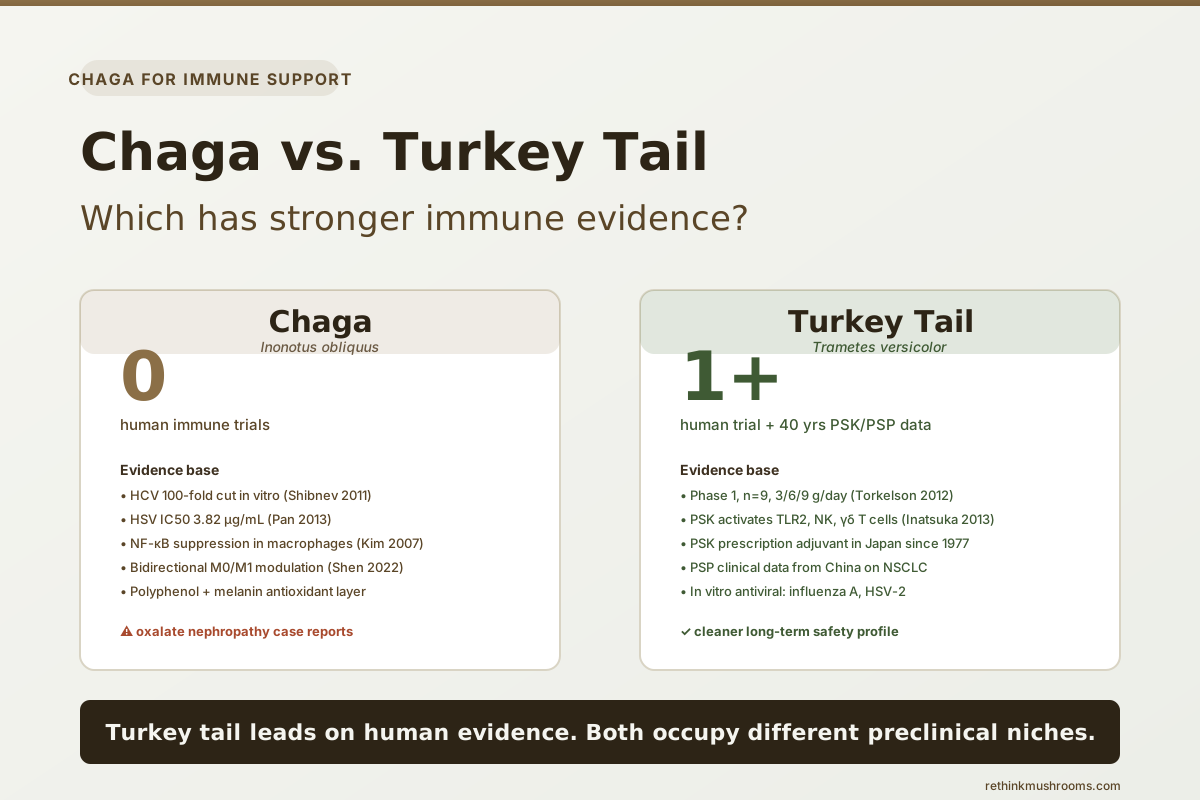
Turkey tail (Trametes versicolor) has a completed Phase 1 dose-escalation trial showing dose-dependent immune recovery in breast cancer patients and four decades of PSK/PSP clinical oncology data. Chaga (Inonotus obliquus) has zero published human immune trials; all chaga immune evidence is preclinical.
Torkelson et al., ISRN Oncology, 2012; Shibnev et al., Bull Exp Biol Med, 2011
9 grams/day safe
Torkelson 2012 established Trametes versicolor maximum tolerated dose with dose-dependent lymphocyte and NK recovery in post-radiation breast cancer patients
TLR2 + Dectin-1
PSK from turkey tail activates TLR2, primes NK and γδ T cells, and drives IFN-γ production (Inatsuka et al., 2013)
Cell culture only
chaga antiviral evidence is limited to HCV, HSV, and feline viruses in vitro (Shibnev 2011; Pan 2013; Tian 2017)
Torkelson et al., ISRN Oncology, 2012; Shibnev et al., Bull Exp Biol Med, 2011
 View as image ↗
The question of whether chaga or turkey tail produces stronger immune effects has two different answers depending on what kind of evidence counts. In preclinical cell culture and macrophage models, both mushrooms engage innate immunity through β-glucan pathways and both show cytokine-modulating activity. In human clinical data, turkey tail has a completed Phase 1 dose-escalation trial in breast cancer patients, decades of Japanese and Chinese oncology trials of its isolated compounds PSK and PSP, and documented effects on lymphocyte and natural killer cell recovery after chemoradiation.[1][2] Chaga has no published human immune trials.[3][4] For the broader evidence framing on each species individually, see chaga for immune support: research on viral and bacterial defense and chaga and the immune system: how it modulates immunity.
Key Takeaways
- Torkelson et al. (2012) conducted the only Phase 1 human trial of Trametes versicolor, testing 3, 6, and 9 grams/day in nine women after breast cancer radiotherapy; the preparation was well tolerated at all doses with trends toward increased lymphocyte counts and improved natural killer cell function
- Inatsuka et al. (2013) demonstrated that PSK, the turkey tail polysaccharide-K fraction, activates γδ T cells through TLR2, upregulates CD25, CD69, and CD107a on T cells, and induces IFN-γ production; this is the only mushroom polysaccharide approved as a prescription cancer adjuvant (Japan, since 1977)
- Shibnev et al. (2011) reported a 100-fold reduction in hepatitis C virus infectivity within 10 minutes in porcine embryo kidney cell culture using chaga water extract, a substantial in vitro effect with no human translation
- Pan et al. (2013) showed chaga aqueous extract inhibits herpes simplex virus entry at IC50 3.82 μg/mL via blocked membrane fusion, with selectivity index >80 in Vero cells
- Shen et al. (2022) found chaga produces bidirectional macrophage modulation, activating resting M0 cells while tempering LPS-activated M1 cells, a pattern not demonstrated for turkey tail in the same comparative framework
- Review-level synthesis (Guggenheim 2014; Lysakowska 2023; Szychowski 2021; Ern 2024) converges on the same framing: turkey tail has the strongest clinical evidence base of any medicinal mushroom for immune-oncology applications; chaga's evidence remains preclinical
Evidence-Tier Standoff
Where Each Mushroom's Immune Evidence Actually Sits
Tiers run from human clinical evidence (top) down to test-tube chemistry (bottom). Turkey tail owns the two clinical tiers outright; chaga owns the two preclinical bottom tiers; the antiviral and receptor tiers are shared or partial. The comparison is not a single axis where one mushroom “wins” — it is two different evidence profiles.
Human clinical trial, immune endpoint
Regulatory-approved isolated compound
Defined immune-receptor mechanism
Direct in-vitro antiviral activity
Macrophage bidirectional M0/M1 modulation
Antioxidant / polyphenol layer
Sources: Torkelson 2012 [1]; Inatsuka 2013 [2]; Shibnev 2011 [3]; Krupodorova 2014 [5]; Pan 2013 [6]; Tian 2017 [7]; Shen 2022 [9]; Lee 2007 [10]. Tiers reflect evidence type present per species, not quantitative effect sizes.
What "Stronger" Actually Has to Mean
The immune system is not a dial that gets turned up or down. It is a coordinated network of pattern recognition, antigen presentation, cytotoxicity, antibody production, and tolerance. A compound that increases one arm can suppress another. Comparing two mushrooms for "immune support" therefore requires specifying which arm, which condition, and what outcome.
Three distinct questions separate the comparison:
- Which has stronger preclinical mechanism data? Both do different things well. Chaga dominates on direct antiviral cell-culture activity and on bidirectional macrophage modulation. Turkey tail dominates on innate cell priming (NK, γδ T cells) through TLR2 engagement and on Dectin-1-driven β-glucan signalling.
- Which has stronger human clinical data? Turkey tail, unambiguously. It has the only completed Phase 1 trial for an immune endpoint in a medicinal mushroom of this class, plus decades of PSK and PSP oncology data across Japan and China. Chaga has zero.
- Which is better suited for a given context? That depends on whether the context is oxidative-stress-driven inflammation, post-chemotherapy immune recovery, viral exposure, or autoimmune-adjacent immune dysregulation. The two mushrooms occupy different niches rather than competing on a single axis.
Turkey Tail's Clinical Evidence Base
Turkey tail occupies a nearly unique position among medicinal mushrooms: two of its isolated polysaccharide fractions, PSK (polysaccharide-K, krestin) and PSP (polysaccharopeptide), have been approved as prescription cancer adjuvants in Japan and China since the late 1970s and 1990s respectively. This gives turkey tail a clinical footprint no other medicinal mushroom matches.
The Torkelson Phase 1 trial. Torkelson et al. (2012) ran the first modern Western human trial of whole Trametes versicolor for an immune endpoint.[1] Nine women who had completed radiotherapy for breast cancer received 3, 6, or 9 grams of Tv daily for six weeks in a three-cohort dose escalation. The preparation was well tolerated at all three doses with no dose-limiting toxicity. Immune assays collected pre-radiation, at three on-treatment time points, and after a three-week washout showed dose-dependent trends: increased lymphocyte counts by week six, improved natural killer cell cytotoxicity, and changes in CD8+ and CD4+ T-cell numbers that tracked with dose. The sample size is too small for statistical inference about efficacy, and the trial was not powered to detect clinical outcomes. What it establishes is that Tv at a practical oral dose can be administered safely in a post-treatment cancer population and produces measurable immune changes.
PSK mechanism data. Inatsuka et al. (2013) characterised PSK's effects on γδ T cells, a bridging arm of innate-adaptive immunity.[2] In mouse splenocyte cultures, PSK induced γδ T cells to produce IFN-γ and upregulated CD25, CD69, and CD107a. Co-culture and trans-well experiments distinguished a direct PSK–T-cell effect from a dendritic-cell-mediated indirect effect, showing both pathways contribute. An earlier study from the same group demonstrated that PSK activates TLR2 and enhances NK cell function, establishing a clear molecular route from extract to effector response. This mechanistic clarity, with defined receptor, defined effector output, and defined cytokine signature, is several evidentiary levels above what exists for chaga.
Broad-spectrum antiviral activity in cell culture. Krupodorova et al. (2014) tested ten basidiomycete species in vitro against influenza A (H1N1) and HSV-2; Trametes versicolor was one of four species effective against both viruses.[5] The effect magnitude sat in the same range as the chaga in vitro antiviral data, making direct species ranking on antiviral activity inappropriate at the preclinical level.
Chaga's Preclinical Evidence Base
Chaga's immune evidence is entirely preclinical but mechanistically substantial.
Direct antiviral activity. Shibnev et al. (2011) reported that water extract fractions of Inonotus obliquus reduced hepatitis C virus infectivity 100-fold within 10 minutes in porcine embryo kidney cell culture, acting in both preventive and therapeutic timing protocols.[3] Pan et al. (2013) established the HSV-1 mechanism: aqueous chaga extract inhibited entry at IC50 3.82 μg/mL via blocked viral-induced membrane fusion, with selectivity index greater than 80 in Vero cells.[6] Tian et al. (2017) extended the pattern to six feline viruses (calicivirus, herpesvirus 1, influenza H3N2 and H5N6, panleukopenia virus, and infectious peritonitis virus) through blocked attachment.[7] The cross-family activity suggests a surface-interaction or receptor-decoy mechanism rather than a targeted enzymatic inhibitor.
Macrophage modulation. Kim et al. (2007) showed that ethanol extract of I. obliquus inhibits LPS-induced NF-κB activation in RAW 264.7 macrophages and reduces iNOS, COX-2, TNF-α, IL-1β, and IL-6 expression.[8] Shen et al. (2022) added an important refinement: chaga extract produced differential effects on resting M0 versus LPS-induced M1 macrophages, activating quiescent cells while tempering inflammatory ones.[9] This bidirectional modulation is characteristic of fungal polysaccharide-rich preparations and has no direct counterpart in the turkey tail literature, where the dominant framing is pro-immunogenic priming rather than bidirectional modulation.
Antioxidant layer. Lee et al. (2007) isolated new polyphenols from chaga (inonoblins A, B, C and phelligridins D, E, G) with scavenging activity against ABTS, DPPH, and superoxide radicals.[10] This redox layer is more pronounced in chaga than in turkey tail, which is one reason chaga appears in inflammation-adjacent contexts while turkey tail appears in immuno-oncology contexts.
For the β-glucan-specific immune mechanism underlying chaga, see chaga beta-glucans and immune cell activation. For the broader view of how chaga interacts with the immune system across both innate and adaptive arms, see chaga and the immune system: how it modulates immunity.
Direct Head-to-Head Comparison
| Domain | Chaga (Inonotus obliquus) | Turkey tail (Trametes versicolor) |
|---|---|---|
| Human clinical trials for immune endpoint | 0 published | Torkelson 2012 (Phase 1, n=9) plus decades of PSK/PSP oncology data |
| Regulatory status of isolated compound | None | PSK approved in Japan as prescription cancer adjuvant since 1977; PSP in China |
| Primary immune receptor engagement | Dectin-1 (β-glucans), TLR engagement suggested but not fully characterised | TLR2 (PSK, directly demonstrated by Inatsuka 2013 and prior work); Dectin-1 (β-glucans) |
| NK cell priming | Preclinical only | Preclinical and Phase 1 human trend data |
| γδ T cell activation | Not demonstrated | Directly demonstrated (Inatsuka 2013) |
| Direct in vitro antiviral activity | HCV (100-fold), HSV-1 (IC50 3.82 μg/mL), six feline viruses | Influenza A H1N1 and HSV-2 (Krupodorova 2014) |
| Macrophage bidirectional M0/M1 modulation | Demonstrated (Shen 2022) | Not directly demonstrated in comparable framework |
| Dominant non-β-glucan bioactive layer | Polyphenols, melanin, triterpenoids | Polysaccharopeptide (PSP) and polysaccharide-K (PSK) |
| Oxalate nephropathy risk | Documented (Kikuchi 2014;[14] Kwon 2022[15]) | Not reported |
| Oncology integration evidence | None | Multiple adjuvant trials for gastric, colorectal, lung cancers |
Why Turkey Tail's Clinical Lead Does Not Translate Mechanically Into "Stronger"
The clinical gap between turkey tail and chaga is large, but a clinical gap is not the same as a mechanism gap. Three points temper a simple ranking.
Different compound landscapes drive different biology. Chaga's polyphenol and melanin content gives it a redox and anti-inflammatory profile that PSK/PSP-dominated turkey tail extracts lack. The reverse also holds: PSK's defined protein-bound polysaccharide structure produces reproducible TLR2 engagement and γδ T cell activation that chaga extracts have not been shown to match. If the clinical question is post-chemotherapy lymphocyte recovery, turkey tail's evidence leads. If the question is oxidative-stress-driven low-grade inflammation with quiescent macrophages, chaga's mechanism data is more directly applicable, though without clinical confirmation.
The PSK/PSP data is not whole-mushroom data. The overwhelming majority of turkey tail's clinical evidence comes from isolated, standardised polysaccharide fractions (PSK: protein-bound β-glucan from the CM-101 strain; PSP: polysaccharopeptide from the Cov-1 strain), not whole fruiting body extract. Supplements sold as "turkey tail" may or may not deliver the same fractions at the same concentrations as clinical PSK. The Torkelson trial used a whole Tv preparation, so the whole-mushroom evidence base is smaller than the PSK/PSP total suggests.
Neither has been compared head-to-head in humans. No published trial has directly compared chaga and turkey tail in the same patient population with the same immune endpoints. All cross-species comparison is indirect inference from non-comparable studies. Even among medicinal-mushroom reviews that rank species by immuno-oncology evidence (Guggenheim 2014; Lysakowska 2023), turkey tail places in the top group and chaga does not typically feature in the same ranking because it has not generated the clinical data required to enter it.[11][12]
Safety Profile Differences Matter for the Comparison
For chronic use, chaga carries specific safety signals that turkey tail does not. Two published case reports document chaga-induced oxalate nephropathy in long-term high-dose users: a 72-year-old woman taking 4–5 teaspoons daily for six months (Kikuchi et al., 2014)[14] and a 69-year-old man taking 10–15 grams daily (Kwon et al., 2022).[15] Chaga also has documented antiplatelet activity, with a platelet-aggregation-inhibitory peptide isolated from Inonotus obliquus mycelia showing up to 81% inhibition in vitro (Hyun et al., 2006),[16] plus theoretical interactions with transplant immunosuppression and biologics. Turkey tail's Phase 1 trial reported nine adverse events across nine patients over six weeks (seven mild, one moderate, one severe), and PSK's decades of adjuvant use in Japan has not generated equivalent organ-specific toxicity signals. Safety does not determine which is "stronger," but it does constrain how either can be used.
For related cluster context on turkey tail's anti-cancer immune mechanisms, see how turkey tail enhances the immune system's anti-cancer response and turkey tail and immune health: how it activates your defenses. For the cross-cluster three-way comparison with reishi, see reishi vs. turkey tail vs. chaga for immunity: which has the best evidence?.
What the Reviews Converge On
Guggenheim et al. (2014) ranked the five mushrooms with the strongest immuno-oncology evidence base: Agaricus blazei, Cordyceps sinensis, Grifola frondosa, Ganoderma lucidum, and Trametes versicolor.[11] Chaga did not make the list, which reflects the clinical trial gap rather than a lack of traditional use or preclinical mechanism data. Lysakowska et al. (2023) in a medicinal-mushroom nutritional and functional review similarly grouped turkey tail with reishi and lion's mane in the evidence-supported tier while noting chaga's bioactive promise without clinical confirmation.[12] Szychowski et al. (2021) and Ern et al. (2024) catalogued chaga's preclinical antiviral and immunomodulatory activity and explicitly noted the absence of clinical trials for any infectious or immune endpoint.[4][13]
The Bottom Line
Turkey tail has the stronger human clinical evidence base for immune support. It has a completed Phase 1 dose-escalation trial in post-radiation breast cancer patients (Torkelson 2012, n=9), four decades of PSK and PSP cancer adjuvant data from Japan and China, and mechanistically defined TLR2 and γδ T cell activation. Chaga has zero human immune trials. Chaga's preclinical evidence is substantial, including in vitro antiviral activity against HCV, HSV, and six feline viruses; NF-κB-mediated macrophage modulation; bidirectional M0/M1 effects; and polyphenol and melanin antioxidant layers. None of it has been translated to clinical testing. Chaga also carries specific safety signals (oxalate nephropathy, antiplatelet activity) that turkey tail does not. On preclinical mechanism, the two mushrooms occupy different niches rather than competing on one axis. On human evidence, turkey tail leads decisively.
Frequently Asked Questions
Sources & References
- 1RTHM-00267·Torkelson, Carolyn J et al. (2012). “Phase 1 Clinical Trial of Trametes versicolor in Women with Breast Cancer..” ISRN oncology.Study breakdown →PubMed →↩
- 2RTHM-00291·Inatsuka, Carol et al. (2013). “Gamma delta T cells are activated by polysaccharide K (PSK) and contribute to the anti-tumor effect of PSK..” Cancer immunology.Study breakdown →PubMed →↩
- 3RTHM-00233·Shibnev, V A et al. (2011). “Antiviral activity of Inonotus obliquus fungus extract towards infection caused by hepatitis C virus in cell cultures..” Bulletin of experimental biology and medicine.Study breakdown →PubMed →↩
- 4RTHM-00722·Szychowski, Konrad A et al. (2021). “Inonotus obliquus - from folk medicine to clinical use..” Journal of traditional and complementary medicine.Study breakdown →PubMed →↩
- 5RTHM-00331·Krupodorova, Tetiana et al. (2014). “Antiviral activity of Basidiomycete mycelia against influenza type A (serotype H1N1) and herpes simplex virus type 2 in cell culture..” Virologica Sinica.Study breakdown →PubMed →↩
- 6RTHM-00300·Pan, Hong-Hui et al. (2013). “Aqueous extract from a Chaga medicinal mushroom, Inonotus obliquus (higher Basidiomycetes), prevents herpes simplex virus entry through inhibition of viral-induced membrane fusion..” International journal of medicinal mushrooms.Study breakdown →PubMed →↩
- 7RTHM-00492·Tian, Jin et al. (2017). “Identification of Inonotus obliquus polysaccharide with broad-spectrum antiviral activity against multi-feline viruses..” International journal of biological macromolecules.Study breakdown →PubMed →↩
- 8RTHM-00117·Kim, Ho-Gyoung et al. (2007). “Ethanol extract of Inonotus obliquus inhibits lipopolysaccharide-induced inflammation in RAW 264.7 macrophage cells..” Journal of medicinal food.Study breakdown →PubMed →↩
- 9RTHM-00796·Shen, Dayue et al. (2022). “In Vitro Immunomodulatory Effects of Inonotus obliquus Extracts on Resting M0 Macrophages and LPS-Induced M1 Macrophages..” Evidence-based complementary and alternative medicine : eCAM.Study breakdown →PubMed →↩
- 10RTHM-00118·Lee, In-Kyoung et al. (2007). “New antioxidant polyphenols from the medicinal mushroom Inonotus obliquus..” Bioorganic & medicinal chemistry letters.Study breakdown →PubMed →↩
- 11RTHM-00323·Guggenheim, Alena G et al. (2014). “Immune Modulation From Five Major Mushrooms: Application to Integrative Oncology..” Integrative medicine (Encinitas.Study breakdown →PubMed →↩
- 12RTHM-00843·Łysakowska, Paulina et al. (2023). “Medicinal Mushrooms: Their Bioactive Components, Nutritional Value and Application in Functional Food Production-A Review..” Molecules (Basel.Study breakdown →PubMed →↩
- 13RTHM-01886·Ern, Phoebe Tee Yon et al. (2024). “Chaga Therapeutic Properties: What This 2024 Review Actually Shows.” Mycology.Study breakdown →PubMed →↩
- 14RTHM-00329·Kikuchi, Yuko et al. (2014). “Chaga mushroom-induced oxalate nephropathy..” Clinical nephrology.Study breakdown →PubMed →↩
- 15RTHM-00775·Kwon, Ohyun et al. (2022). “Chaga mushroom-induced oxalate nephropathy that clinically manifested as nephrotic syndrome: A case report..” Medicine.Study breakdown →PubMed →↩
- 16RTHM-00100·Hyun, Kwang Wook et al. (2006). “Isolation and characterization of a novel platelet aggregation inhibitory peptide from the medicinal mushroom, Inonotus obliquus..” Peptides.Study breakdown →PubMed →↩