Chaga for Immune Support
100-fold HCV Infectivity Cut
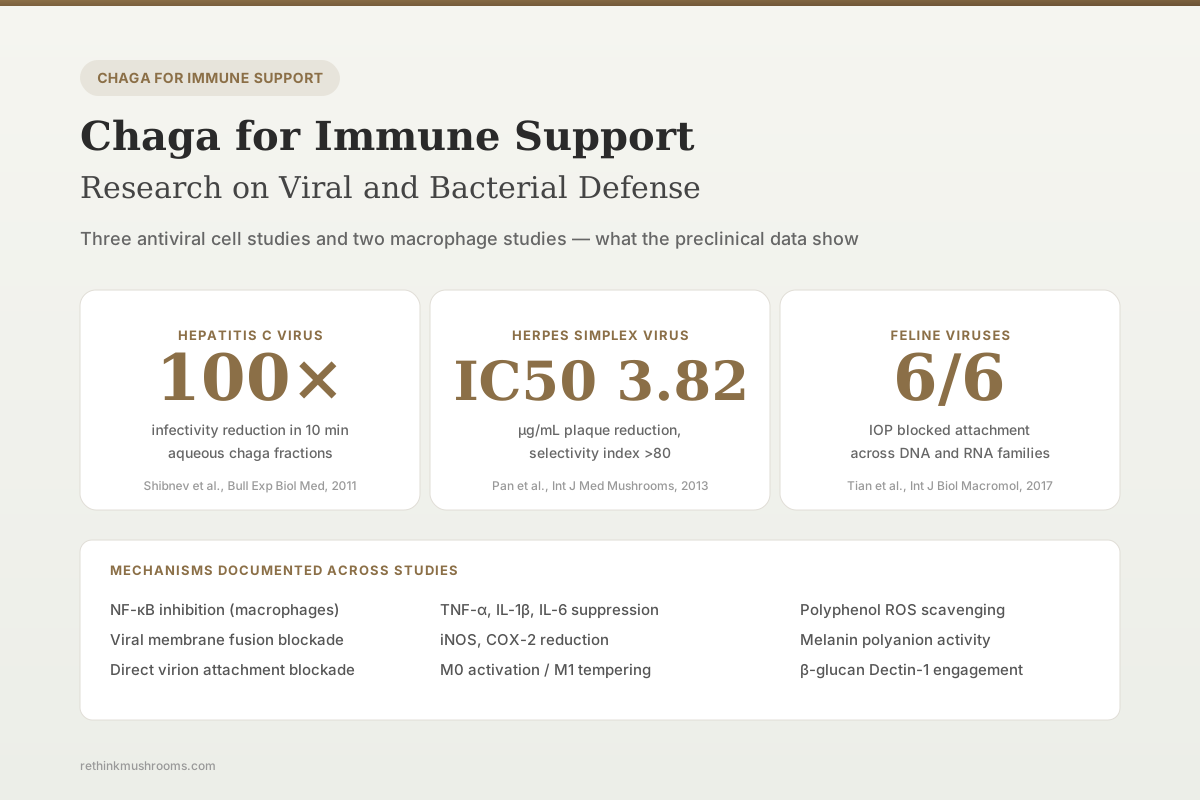
Fractions of Inonotus obliquus aqueous extract reduced hepatitis C virus infectivity 100-fold within 10 minutes in cell culture, acted on herpes simplex virus entry at IC50 3.82 μg/mL, and showed broad-spectrum antiviral activity against multiple feline viruses in vitro. All current evidence for chaga immune support is preclinical.
Shibnev et al., Bull Exp Biol Med, 2011
HSV-1 IC50 3.82 μg/mL
aqueous chaga extract inhibited herpes simplex entry via blocked membrane fusion (Pan et al., 2013)
6 feline viruses
chaga polysaccharide blocked attachment of FCV, FHV-1, FIV H3N2/H5N6, FPV, FIPV (Tian et al., 2017)
0 human RCTs
no randomised clinical trial has tested chaga for cold, flu, or any viral or bacterial infection in humans
Shibnev et al., Bull Exp Biol Med, 2011
 View as image ↗
Immune support is the umbrella marketing claim under which most chaga supplements are sold, and it covers two distinct biological questions. First, does chaga have direct antiviral or antibacterial activity at physiologically achievable exposures? Second, does chaga modulate host immune cell function in ways that plausibly improve infection defence? The available evidence is preclinical on both counts: cell-culture studies demonstrate antiviral effects against hepatitis C virus, herpes simplex virus, and multiple feline viruses; macrophage studies document NF-κB suppression and cytokine modulation; no randomised clinical trial has tested chaga for preventing or treating any human infection.[1][2][3] For the broader immunology sibling, see chaga and the immune system: how it modulates immunity and for the β-glucan-focused mechanism sibling see chaga beta-glucans and immune cell activation.
Key Takeaways
- Shibnev et al. (2011) showed that water extract fractions of Inonotus obliquus produced a 100-fold reduction in hepatitis C virus infectivity within 10 minutes in porcine embryo kidney cell culture, with activity in both preventive and therapeutic timing protocols
- Pan et al. (2013) reported that aqueous I. obliquus extract inhibited herpes simplex virus entry with IC50 3.82 μg/mL in plaque reduction assay and 12.29 μg/mL in HSV-1/blue assay, with CC50 >1 mg/mL in Vero cells (selectivity index >80); mechanism was inhibition of viral-induced membrane fusion during early infection
- Tian et al. (2017) identified chaga polysaccharide as a broad-spectrum antiviral active against feline calicivirus, feline herpesvirus 1, feline influenza H3N2 and H5N6, feline panleukopenia virus, and feline infectious peritonitis virus in cell culture; mechanism involved blocking viral binding and attachment
- Kim et al. (2007) demonstrated that ethanol extract of I. obliquus inhibited LPS-induced NF-κB activation and reduced iNOS, COX-2, TNF-α, IL-1β, and IL-6 expression in RAW 264.7 macrophages, providing the cellular mechanism behind chaga immunomodulation
- Shen et al. (2022) characterised chaga's differential effects on resting M0 versus LPS-induced M1 macrophages in vitro, showing context-dependent immunomodulation that activates quiescent macrophages while tempering inflammatory ones
- Review-level synthesis (Szychowski 2021; Fordjour 2023; Ern 2024) identifies chaga's antiviral and immunomodulatory activity as entirely preclinical, with no published clinical trial for any infectious disease endpoint in humans
What "Immune Support" Means at the Biological Level
Immune defence against infection operates in two overlapping layers. Innate immunity provides first-line response within minutes to hours: pattern recognition receptors (TLRs, NOD-like receptors, Dectin-1) detect pathogen-associated molecular patterns; macrophages, neutrophils, dendritic cells, and natural killer cells respond with phagocytosis, cytokine release, and cytotoxicity. Adaptive immunity takes days: antigen presentation on MHC molecules activates CD4+ helper and CD8+ cytotoxic T cells; B cells produce antibodies specific to the invading pathogen.
For a supplement to meaningfully support immunity against a given infection it would need to act in one of several ways: directly inactivate the pathogen (virucidal or bactericidal activity at achievable tissue concentrations); block pathogen entry or replication steps; enhance innate cell function (macrophage phagocytosis, NK cytotoxicity, neutrophil recruitment); modulate adaptive responses (antigen presentation, T-cell priming, antibody class switching); or reduce collateral inflammatory damage without compromising pathogen clearance.
Chaga's preclinical activity spans several of these: direct in vitro antiviral activity against specific viruses, macrophage-level NF-κB modulation, context-dependent M0/M1 macrophage effects, and antioxidant activity that influences redox-sensitive immune signalling. None of this preclinical activity has been translated into human infection outcomes in a controlled clinical trial.
The Direct Antiviral Evidence: HCV, HSV, and Feline Viruses
Shibnev et al. (2011) reported virucidal activity of Inonotus obliquus water extract fractions against hepatitis C virus in porcine embryo kidney cell cultures.[1] Exposure to the extract reduced HCV infective properties 100-fold within 10 minutes. Activity was demonstrated in two timing protocols: preventive (extract applied 24 hours before viral exposure) and therapeutic (applied during infection). The extract also inhibited production of infective virus by infected cells. The magnitude of effect (100-fold) is substantial at the in vitro level, though the cell system is not a human hepatocyte line and does not model the full hepatitis C replication cycle.
Pan et al. (2013) characterised the anti-herpes simplex virus mechanism of aqueous I. obliquus extract (AEIO) in Vero cells.[2] Plaque reduction assay gave IC50 3.82 μg/mL; HSV-1/blue assay gave IC50 12.29 μg/mL. Cytotoxicity in Vero cells was minimal (CC50 >1 mg/mL), producing a selectivity index >80, which is a meaningful margin between antiviral and cytotoxic concentrations. Time-of-addition experiments localised activity to the early stage of viral infection, specifically inhibition of viral-induced membrane fusion. Blocking entry before cytoplasmic release of viral genome is a mechanistically clean target; the data support that chaga aqueous extract interferes with this step under the assay conditions used.
Tian et al. (2017) extended the antiviral signal to a broader panel using chaga polysaccharide against six feline viruses: feline calicivirus (FCV), feline herpesvirus 1 (FHV-1), feline influenza virus H3N2 and H5N6, feline panleukopenia virus (FPV), and feline infectious peritonitis virus (FIPV).[3] Activity crossed enveloped and non-enveloped, DNA and RNA virus families. Mechanism involved direct blocking of viral binding and attachment. The feline host species limits direct translation to human infections, but the broad-spectrum pattern is informative: a single polysaccharide fraction interferes with entry across unrelated viral families, consistent with a surface-interaction or receptor-decoy mechanism rather than targeted enzymatic inhibition.
Macrophage Immunomodulation: NF-κB and M0/M1 Context-Dependence
Kim et al. (2007) established chaga's macrophage-level mechanism.[4] Ethanol extract of I. obliquus in RAW 264.7 cells suppressed LPS-induced NF-κB activation and reduced iNOS, COX-2, TNF-α, IL-1β, and IL-6 expression. NF-κB sits at the centre of innate immune activation: TLR4 engagement by LPS triggers IKK-mediated IκB phosphorylation, releasing NF-κB for nuclear translocation and transcription of inflammatory effectors. Chaga's inhibition of this axis reduces the effector output of activated macrophages, which is protective in contexts of excessive inflammation but could theoretically reduce antimicrobial effector capacity in active infection.
Shen et al. (2022) directly addressed this context-dependence by comparing chaga's effects on resting M0 macrophages versus LPS-induced M1 macrophages.[5] The study found differential effects: chaga activated resting M0 macrophages toward functional states while tempering the inflammatory output of already-activated M1 cells. This kind of bidirectional modulation is characteristic of many fungal β-glucans and polysaccharide-rich preparations; it complicates simple framing of chaga as either pro-inflammatory or anti-inflammatory.
The practical implication is that chaga's net immune effect depends on the baseline state of the immune system it meets. For chronic low-grade inflammation with quiescent macrophages, activation could be a functional benefit. In acute bacterial sepsis with already-hyperactivated macrophages, NF-κB suppression could plausibly be detrimental or beneficial depending on the specific clinical context. No clinical data characterise how this preclinical bidirectionality plays out in human infection.
The Antioxidant Layer: Polyphenols and Immune Redox Signalling
Reactive oxygen species serve dual roles in immunity: they are effector molecules used by neutrophils and macrophages to kill internalised pathogens, and they are redox-sensitive signals that modulate cytokine transcription. Antioxidant compounds that scavenge ROS can protect host tissues from collateral damage but can also blunt pathogen killing capacity.
Lee et al. (2007) isolated new antioxidant polyphenols from chaga including inonoblins A, B, and C and phelligridins D, E, and G, with scavenging activity against ABTS, DPPH, and superoxide radicals.[6] These compound classes are mechanistically plausible contributors to the anti-inflammatory signals observed in macrophage studies and the host-protective effects documented in colitis and UV damage models. They are also the compounds most likely to contribute to any dampening of oxidative-burst-mediated pathogen killing, though no study has specifically measured this trade-off for chaga.
What About Antibacterial Activity?
The direct antibacterial evidence for chaga is thinner than the antiviral evidence. In vitro studies have tested chaga against Staphylococcus aureus and Salmonella typhimurium, with ethyl acetate fractions showing some inhibitory activity at concentrations higher than typical minimum inhibitory concentrations for conventional antibiotics. Chaga has not been systematically tested against the major bacterial pathogens of clinical importance (multi-drug resistant Enterobacteriaceae, methicillin-resistant Staphylococcus aureus, Pseudomonas aeruginosa, Mycobacterium tuberculosis).
For the specific Helicobacter pylori question, see chaga and helicobacter pylori: antimicrobial effects on stomach bacteria. The current evidence does not support chaga as an antibacterial agent in any clinical sense; in vitro activity against a limited panel of bacteria at non-pharmacological concentrations does not translate to clinical antibacterial use.
What the Reviews Synthesise
Szychowski et al. (2021) reviewed I. obliquus from folk medicine to clinical use and catalogued the antiviral evidence across HCV, HSV, HIV, and influenza cell culture studies, noting the complete absence of clinical antiviral trials.[7] Fordjour et al. (2023) and Ern et al. (2024) converge on the same framing: chaga's antiviral and immunomodulatory activity is mechanistically promising, preclinically documented, and clinically untested.[8][9]
The gap is large. For any of the viruses tested in vitro (HCV, HSV, influenza), a phase 2a clinical trial of standardised chaga extract as an adjunct to standard of care would be scientifically reasonable. Registration of such trials is not evident in public trial registries.
Bioavailability: The Unaddressed Question
All three antiviral studies used direct exposure of cells or virions to aqueous or polysaccharide extracts at defined concentrations. The translation question is whether typical human consumption patterns (oral chaga tea, capsule supplements, alcohol tinctures) produce systemic or tissue concentrations of the relevant antiviral compounds comparable to those used in the cell culture studies.
Pharmacokinetic studies of chaga-specific compounds in humans are limited. Polysaccharides are generally poorly absorbed intact through the gastrointestinal mucosa, though they can engage gut-associated lymphoid tissue (GALT) and modulate innate immunity from the luminal side without requiring systemic absorption. Small-molecule phenolics may be absorbed but are subject to extensive first-pass metabolism. No published study has measured plasma or tissue concentrations of specific chaga bioactives after human oral dosing. The IC50 values observed in vitro (3.82 μg/mL for HSV, for example) may or may not be achievable in vivo; the evidence is silent on this.
What the Evidence Supports and What It Does Not
| Question | Evidence | Confidence |
|---|---|---|
| Does chaga show direct antiviral activity in cell culture? | Yes against HCV (Shibnev 2011), HSV (Pan 2013), and six feline viruses (Tian 2017) | Moderate (in vitro, multiple models) |
| Does chaga inhibit viral entry mechanistically? | Yes for HSV via blocked membrane fusion and for feline viruses via blocked attachment | Moderate (in vitro mechanism) |
| Does chaga modulate macrophage function? | Yes: NF-κB suppression (Kim 2007) and context-dependent M0/M1 effects (Shen 2022) | Moderate (cell culture) |
| Does chaga prevent colds, flu, or other common infections in humans? | Not tested; no published RCT | None |
| Does chaga treat active viral infection in humans? | Not tested; no published RCT for any indication | None |
| Are chaga's in vitro antiviral concentrations achievable with oral dosing? | Unknown; no human pharmacokinetic data | None |
| Is chaga effective against bacterial infections? | Weak in vitro evidence only; no clinical data | Very low |
Safety Considerations for Infection Contexts
Patients with active or recurrent infections considering chaga face several specific considerations:
Immunosuppressive drug interactions: Patients on transplant immunosuppression (tacrolimus, cyclosporine, mycophenolate), anti-cytokine biologics (anti-TNF, anti-IL-17, anti-IL-23), or other immunomodulators have unquantified interaction risk with chaga's immunomodulatory effects. The combination could either supplement or undermine therapeutic intent.
Autoimmune conditions: Chaga's activation of resting M0 macrophages and polysaccharide engagement of innate immunity could theoretically exacerbate autoimmune flares in susceptible individuals. No clinical data address this, and case reports are absent.
Oxalate nephropathy: Three published case reports (Kikuchi 2014; Kwon 2020; Lee 2022) document chaga-induced oxalate nephropathy from long-term high-dose use. Dehydration from acute infection compounds this risk.
Antiplatelet activity: Chaga's antiplatelet activity (Hyun 2006) is a consideration for patients with infection-associated coagulopathy, on anticoagulants for cardiovascular conditions, or with thrombocytopenia.
The Active Compound Landscape for Immune Effects
Polysaccharides (β-glucans, heteroglycans, IOP): The dominant candidate for macrophage activation and innate immune engagement. Dectin-1 receptor engagement by β-glucans has been the central mechanism hypothesised across medicinal mushroom research.
Melanin: Chaga's abundant melanin content has documented free radical scavenging and, in some reports, direct antiviral activity against enveloped viruses. The structural polyanion character of chaga melanin is mechanistically plausible for the antiviral entry-blocking effects observed across studies.
Polyphenols (inonoblins, phelligridins): Direct antioxidant activity; contribute to redox modulation of immune cell function.
Triterpenoids (inotodiol, trametenolic acid, betulin derivatives): Anti-inflammatory through NF-κB and MAPK modulation; relevant to macrophage cytokine output but not directly to antiviral activity.
The Bottom Line
Chaga (Inonotus obliquus) shows preclinical antiviral activity in three independent virus systems: 100-fold HCV infectivity reduction in cell culture within 10 minutes (Shibnev et al., 2011), HSV entry inhibition at IC50 3.82 μg/mL via blocked membrane fusion (Pan et al., 2013), and broad-spectrum activity against six feline viruses via blocked attachment (Tian et al., 2017). Macrophage studies document NF-κB suppression and context-dependent M0/M1 modulation (Kim 2007; Shen 2022). The mechanistic substrate is consistent across polysaccharide, polyphenol, melanin, and triterpenoid fractions. No randomised controlled trial has tested chaga for prevention or treatment of any human infectious disease. Human pharmacokinetic data that would establish whether in vitro active concentrations are achievable with oral dosing do not exist. Immunocompromised, autoimmune, and anticoagulated populations face unquantified safety considerations.
Frequently Asked Questions
Sources & References
- 1RTHM-00233·Shibnev, V A et al. (2011). “Antiviral activity of Inonotus obliquus fungus extract towards infection caused by hepatitis C virus in cell cultures..” Bulletin of experimental biology and medicine.Study breakdown →PubMed →↩
- 2RTHM-00300·Pan, Hong-Hui et al. (2013). “Aqueous extract from a Chaga medicinal mushroom, Inonotus obliquus (higher Basidiomycetes), prevents herpes simplex virus entry through inhibition of viral-induced membrane fusion..” International journal of medicinal mushrooms.Study breakdown →PubMed →↩
- 3RTHM-00492·Tian, Jin et al. (2017). “Identification of Inonotus obliquus polysaccharide with broad-spectrum antiviral activity against multi-feline viruses..” International journal of biological macromolecules.Study breakdown →PubMed →↩
- 4RTHM-00117·Kim, Ho-Gyoung et al. (2007). “Ethanol extract of Inonotus obliquus inhibits lipopolysaccharide-induced inflammation in RAW 264.7 macrophage cells..” Journal of medicinal food.Study breakdown →PubMed →↩
- 5RTHM-00796·Shen, Dayue et al. (2022). “In Vitro Immunomodulatory Effects of Inonotus obliquus Extracts on Resting M0 Macrophages and LPS-Induced M1 Macrophages..” Evidence-based complementary and alternative medicine : eCAM.Study breakdown →PubMed →↩
- 6RTHM-00118·Lee, In-Kyoung et al. (2007). “New antioxidant polyphenols from the medicinal mushroom Inonotus obliquus..” Bioorganic & medicinal chemistry letters.Study breakdown →PubMed →↩
- 7RTHM-00722·Szychowski, Konrad A et al. (2021). “Inonotus obliquus - from folk medicine to clinical use..” Journal of traditional and complementary medicine.Study breakdown →PubMed →↩
- 8RTHM-01694·Fordjour, Eric et al. (2023). “Chaga mushroom: a super-fungus with countless facets and untapped potential..” Frontiers in pharmacology.Study breakdown →PubMed →↩
- 9RTHM-01886·Ern, Phoebe Tee Yon et al. (2024). “Chaga Therapeutic Properties: What This 2024 Review Actually Shows.” Mycology.Study breakdown →PubMed →↩