Chaga and Gut Health
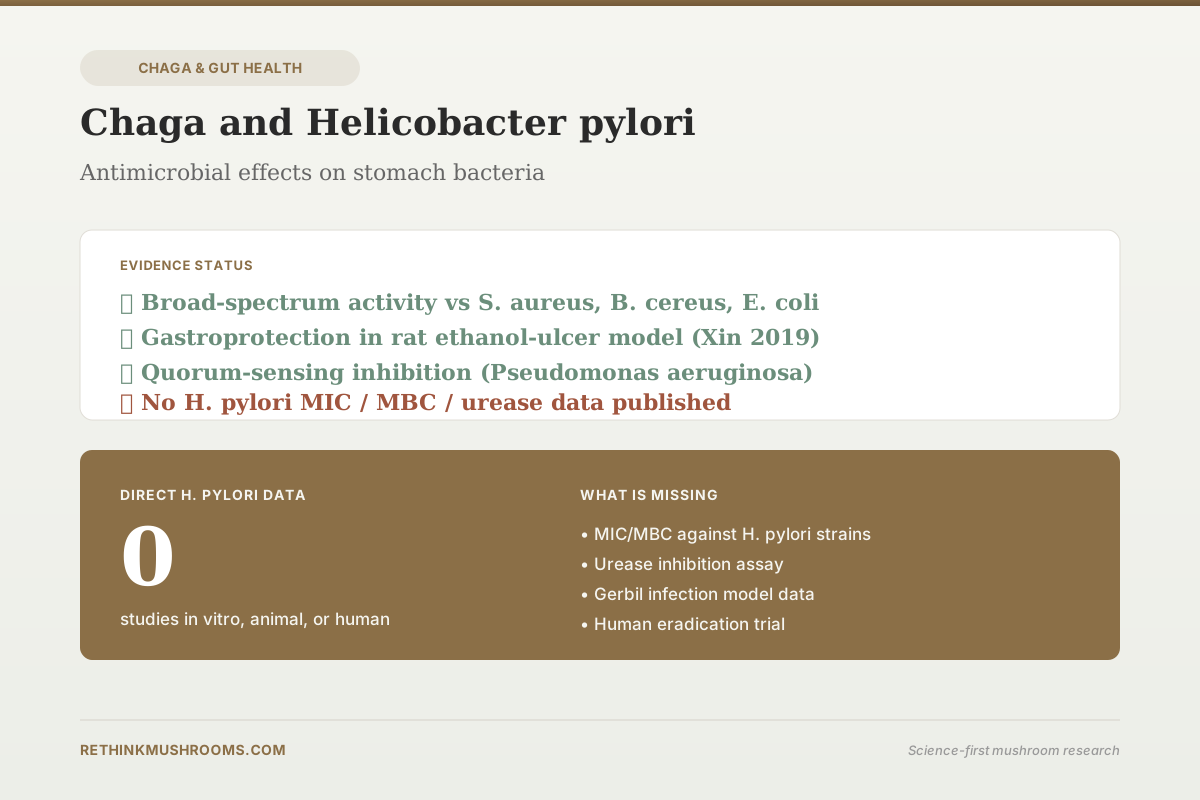
0 published H. pylori trials
Not a single study in the peer-reviewed literature has tested chaga extracts directly against Helicobacter pylori. Chaga's broader antimicrobial and gastroprotective data does not substitute for this specific gap.
PubMed search, April 2026
Broad-spectrum
chaga extracts inhibit gram-positive and gram-negative bacteria in vitro
200 mg/kg
ethanolic chaga extract protected rats against ethanol-induced gastric ulcers
H. pylori untested
the specific bacterium driving most chronic gastritis has not been tested with chaga
PubMed search, April 2026
 View as image ↗
Chaga (Inonotus obliquus) is marketed for stomach health with frequent mention of Helicobacter pylori, the gram-negative bacterium responsible for most peptic ulcers and a substantial fraction of gastric cancers. Traditional Russian and Eastern European medicine used chaga for gastrointestinal ailments for centuries. The problem is that the specific claim "chaga fights H. pylori" does not yet have a published study to support it. Chaga has documented broad-spectrum antibacterial activity, documented gastroprotective effects in ethanol-induced ulcer models, and documented anti-inflammatory effects in the gastric mucosa. None of these is the same as a direct H. pylori trial. This article walks through what the published record does and does not contain, species by species. For the broader stomach picture, see our chaga for gut health article.
The honest summary: no published paper has tested chaga directly against H. pylori in vitro, in animal infection models, or in humans. Chaga's antimicrobial literature covers Staphylococcus aureus, Bacillus cereus, Pseudomonas aeruginosa, Salmonella typhimurium, Escherichia coli, and other common pathogens. The absence of an H. pylori-specific study is a meaningful gap, not an implied extension.
Key Takeaways
- Ethanolic and aqueous chaga extracts showed bacteriostatic and bactericidal activity against all tested gram-positive and gram-negative bacteria, with Staphylococcus aureus and Bacillus cereus most sensitive; H. pylori was not among the tested species (Glamočlija et al., Journal of Ethnopharmacology, 2015)
- Ethanolic chaga extract at 200 mg/kg orally prevented gastric mucosal ulceration in rats with ethanol-induced ulcers, without signs of toxicity or sensitivity (Xin et al., International Journal of Medicinal Mushrooms, 2019)
- Chaga extracts demonstrated anti-quorum-sensing activity against Pseudomonas aeruginosa at sub-MIC concentrations, affecting twitching, swarming, and pyocyanin production (Glamočlija et al., Journal of Ethnopharmacology, 2015)
- Chaga polysaccharides, triterpenoids, melanins, and phenolic compounds each carry documented biological activity relevant to mucosal infection and inflammation (Duru et al., Phytotherapy Research, 2019)
- Chaga aqueous extracts contain oxalic acid as the main organic acid, with the highest concentration in Russian samples; this is the same oxalate that has caused chronic kidney injury in chaga case reports (Glamočlija et al., Journal of Ethnopharmacology, 2015)
- No PubMed-indexed study has reported minimum inhibitory concentration (MIC), minimum bactericidal concentration (MBC), or in vivo eradication data for chaga against Helicobacter pylori
Why H. pylori Is a Specific Case, Not a Generic Stomach Bacterium
Helicobacter pylori is not simply another gut microbe. It colonizes the gastric mucosa using urease to neutralize local acid, adhesion molecules that bind specific gastric epithelial receptors, and VacA and CagA toxins that disrupt host cell function. Roughly half the world's population carries H. pylori at some point, and chronic infection drives most cases of peptic ulcer disease, over 60% of gastric cancer cases worldwide, and a substantial portion of gastric MALT lymphoma.
Standard medical treatment is multi-drug: a proton pump inhibitor plus at least two antibiotics (typically amoxicillin, clarithromycin, metronidazole, or tetracycline variants) over 10-14 days. Rising antibiotic resistance has reduced triple-therapy eradication rates from the 90% range in the 1990s to 70% or lower in many regions today. Natural product research on anti-H. pylori agents is a live and consequential field because of this resistance problem.
Any claim that a supplement "fights H. pylori" belongs in one of four evidence categories: in vitro MIC/MBC data against H. pylori isolates, animal infection model data, human eradication trial data, or adjunctive combination trial data. Chaga has none of these published at the time of writing. For the related ulcer question, see our chaga and ulcers article, which focuses on mucosal protection rather than anti-infective activity.
What Chaga's General Antimicrobial Record Does Show
Glamočlija and colleagues published the most cited chaga antimicrobial study in 2015.[1] They tested aqueous and ethanolic extracts from chaga sourced in Finland, Russia, and Thailand against a panel of bacterial species using the microdilution method.
Results:
- Bacteriostatic and bactericidal activity against all tested gram-positive bacteria (Staphylococcus aureus, Bacillus cereus among others)
- Bacteriostatic and bactericidal activity against all tested gram-negative bacteria
- Staphylococcus aureus and Bacillus cereus were the most sensitive
- Sub-MIC extracts showed anti-quorum-sensing activity in Pseudomonas aeruginosa
- Quorum-sensing effects altered bacterial twitching, swarming, and pyocyanin production
The tested panel did not include H. pylori. This is an important gap. H. pylori requires specialized microaerophilic culture conditions and is not routinely included in broad antimicrobial screening panels. A positive signal against S. aureus or E. coli does not automatically predict activity against H. pylori, which differs in envelope structure, metabolic requirements, and drug target profile.
Glamočlija's study also made an incidental finding worth flagging: oxalic acid was the main organic acid in chaga aqueous extracts, with the highest concentrations in Russian samples. This is the same oxalate that has produced kidney injury in chaga case reports, covered in our article on chaga long-term safety.
Xin 2019: Gastroprotection Without H. pylori
Xin and colleagues in 2019 tested ethanolic chaga extract at 200 mg/kg orally in rats with ethanol-induced gastric mucosal ulceration.[2] The dose was well tolerated, with no toxicity or sensitivity signs. The extract exhibited antiulcer activity across all tested models.
The ethanol ulcer model is a chemical injury model, not an infection model. Ethanol damages the gastric mucosa directly through oxidative stress, reactive oxygen species, and disruption of mucus and bicarbonate barriers. A compound that protects against ethanol ulceration is a candidate gastroprotective agent, meaning it strengthens mucosal defenses. This is a different mechanism than killing bacteria.
The relevance to H. pylori is indirect. H. pylori damages the gastric mucosa partly by inducing oxidative stress, disrupting the mucus barrier, and reducing bicarbonate secretion. A mucosal protective agent could theoretically reduce H. pylori-associated injury without eradicating the organism. But this is a hypothesis, not data. Xin's study did not introduce H. pylori into the model and did not measure any H. pylori-relevant endpoints.
The Review-Level Picture
Duru and colleagues' 2019 review of chaga's pharmacological potential surveyed the full preclinical literature through that date.[3] They identified anticancer, antiviral, hypoglycemic, antioxidant, anti-inflammatory, and immune-modulating activities, supported by chemical characterization of melanins, phenolic compounds, and lanostane-type triterpenoids. The review's infection-related sections focused on antiviral (particularly hepatitis C) and immunomodulatory mechanisms rather than specific bacterial pathogens.
Szychowski and colleagues' 2021 review placed the same pharmacological data within a folk-medicine-to-clinical-use framing.[4] Russian and Eastern European traditional use of chaga for gastritis, ulcers, and gastrointestinal complaints is clearly documented. The review noted that preclinical mechanistic evidence has accumulated but clinical translation remains limited across nearly every indication.
Neither review identified a published chaga-specific H. pylori study. The consistent framing in both was that chaga's anti-infective potential is broad but that species-specific evidence is limited to pathogens that have been explicitly tested.
Why the Gap Exists: Testing H. pylori Is Hard
The absence of chaga-H. pylori data is partly explained by the experimental difficulty of H. pylori testing. H. pylori is microaerophilic (requiring 5% oxygen, 10% CO2, and 85% nitrogen), slow-growing (72-96 hour incubations), and fastidious in its nutritional requirements. Standard antimicrobial susceptibility testing protocols require specialized media (Mueller-Hinton agar with 5-10% sheep blood) and incubation conditions that many general microbiology labs do not routinely run.
The result is that broad antimicrobial screens, which test dozens of candidate compounds against standard pathogen panels, often exclude H. pylori for logistical reasons. The Glamočlija 2015 panel included S. aureus, B. cereus, Listeria monocytogenes, Salmonella Typhimurium, Enterobacter cloacae, E. coli, Micrococcus flavus, and Pseudomonas aeruginosa, reflecting a typical broad-spectrum panel. Testing the same chaga extracts against H. pylori would require a dedicated follow-up study that has not yet been published.
The gap is therefore not evidence against chaga's potential activity against H. pylori. It is evidence that the question has not been asked in a published experiment. This is a meaningful distinction: "not tested" is not the same as "tested and failed."
The Missing Ingredient: Urease Inhibition Data
H. pylori's survival in the acidic stomach depends on its urease enzyme, which hydrolyzes urea to ammonia and creates a neutralized microenvironment around the organism. Urease inhibitors are an established anti-H. pylori drug development target. Studies of other natural products against H. pylori frequently include urease inhibition as a key mechanistic endpoint.
No published study has tested chaga extracts or chaga-derived compounds for urease inhibition. This is the specific experiment that would establish a direct mechanistic link between chaga and H. pylori. Without it, any mechanism-of-action claim for chaga against H. pylori is speculation.
For context, polysaccharides generally do not penetrate bacterial membranes well, making them unlikely candidates for direct intracellular antibacterial action. Triterpenoids and polyphenols are more likely to have antibacterial activity, and both classes are present in chaga. Which specific compound class, if any, has activity against H. pylori is unknown.
The Antibiofilm Angle
Bacterial biofilms are communities of bacteria embedded in an extracellular matrix that protect them from antibiotics and host immune responses. H. pylori forms biofilms on the gastric mucosa, and biofilm presence is associated with treatment failure in eradication therapy.
Glamočlija's quorum-sensing finding in Pseudomonas aeruginosa is mechanistically interesting because quorum sensing controls biofilm formation in many gram-negative bacteria.[1] If chaga compounds disrupt bacterial quorum sensing, they might theoretically disrupt biofilm formation in other organisms. Whether this extends to H. pylori biofilms has not been tested. The quorum-sensing systems of H. pylori and P. aeruginosa use different signaling molecules and regulatory architectures, so cross-species extrapolation is weak without direct testing.
Chaga's Gastric Story Outside of Infection
Chaga's documented gastric-relevant biological activities include antioxidant response (scavenging reactive oxygen species in the gastric mucosa), anti-inflammatory action (suppressing NF-κB-driven cytokine production), AGE inhibition via polysaccharides (slowing glycation-driven tissue damage), immunomodulation (altering gastric mucosal immune responses), and traditional use (historical application for gastric disorders in Russian and Eastern European practice).
For a specific ulcer protection article, see our chaga and ulcers piece. For the gut microbiome angle more broadly, see chaga and gut microbiome modulation. For the inflammatory bowel angle, see chaga for digestive inflammation.
None of these is H. pylori activity. They are gastric-relevant but infection-indirect. The distinction matters when evaluating supplement marketing claims.
What the Evidence Would Need to Look Like
A published chaga anti-H. pylori study would need one or more of:
- In vitro MIC/MBC data against reference H. pylori strains (ATCC 43504 or similar) and clinical isolates, using standard Clinical and Laboratory Standards Institute protocols adapted for H. pylori microaerophilic culture
- Urease inhibition assay to identify whether chaga compounds interact with the enzyme driving H. pylori's acid resistance
- Animal infection model data using H. pylori-infected Mongolian gerbils or humanized mouse models, measuring bacterial load reduction and mucosal inflammation
- Human trial data testing chaga extract as monotherapy or adjunct to standard triple or quadruple therapy, with urea breath test or stool antigen test as eradication endpoints
At the time of writing, the published record contains zero studies in any of these categories for chaga and H. pylori. The supplement industry sells chaga for H. pylori; the research community has not yet tested whether the claim is correct.
Why This Gap Has Not Been Filled
The structural reasons track the pattern for chaga research in general. Chaga cannot be patented as a pharmaceutical, so no drug company has funded an anti-H. pylori development program around it. H. pylori natural product research that has made it to clinical stages (manuka honey, broccoli sprout extract, cranberry, green tea catechins) involved compounds with larger traditional use bases, lower regulatory friction, or pre-existing commercial interest aligned with trial funding. Chaga's commercial market is supplement-focused rather than pharmaceutical, and supplement manufacturers do not generally sponsor the specialized microbiology work that H. pylori testing requires.
Separately, chaga's documented oxalate content creates additional caution around H. pylori trial design. H. pylori infection is chronic, so any anti-H. pylori chaga protocol would likely involve weeks to months of daily dosing. That overlaps with the chaga exposure window implicated in the oxalate nephropathy case reports discussed in the chaga safety of combinations article. A trial designer would need to specify a preparation with characterized low oxalate content before regulatory approval would be straightforward.
For now, the practical implication is that chaga's H. pylori story is one where absence of evidence is genuinely just absence of evidence. Future research may show direct anti-H. pylori activity, no activity, or activity only at doses with safety constraints. All three remain open at the time of writing.
The Bottom Line
Chaga (Inonotus obliquus) has documented broad-spectrum antibacterial activity against gram-positive and gram-negative organisms, gastroprotective activity in ethanol-induced rat ulcer models, and traditional use in Russian and Eastern European medicine for gastrointestinal complaints. No published study has directly tested chaga against Helicobacter pylori in vitro, in animal infection models, or in humans. No urease inhibition data for chaga exists. The antibiofilm and quorum-sensing activity documented in Pseudomonas aeruginosa does not automatically translate to H. pylori. Supplement marketing that implies a specific chaga-H. pylori effect is currently not backed by direct research in the peer-reviewed literature.
Frequently Asked Questions
Sources & References
- 1RTHM-00373·Glamočlija, Jasmina et al. (2015). “Chemical characterization and biological activity of Chaga (Inonotus obliquus), a medicinal "mushroom"..” Journal of ethnopharmacology.Study breakdown →PubMed →↩
- 2RTHM-00600·Xin, Xin et al. (2019). “Assessment of the Gastroprotective Effect of the Chaga Medicinal Mushroom, Inonotus obliquus (Agaricomycetes), Against the Gastric Mucosal Ulceration Induced by Ethanol in Experimental Rats..” International journal of medicinal mushrooms.Study breakdown →PubMed →↩
- 3RTHM-00553·Duru, Kingsley C et al. (2019). “The pharmacological potential and possible molecular mechanisms of action of Inonotus obliquus from preclinical studies..” Phytotherapy research : PTR.Study breakdown →PubMed →↩
- 4RTHM-00722·Szychowski, Konrad A et al. (2021). “Inonotus obliquus - from folk medicine to clinical use..” Journal of traditional and complementary medicine.Study breakdown →PubMed →↩