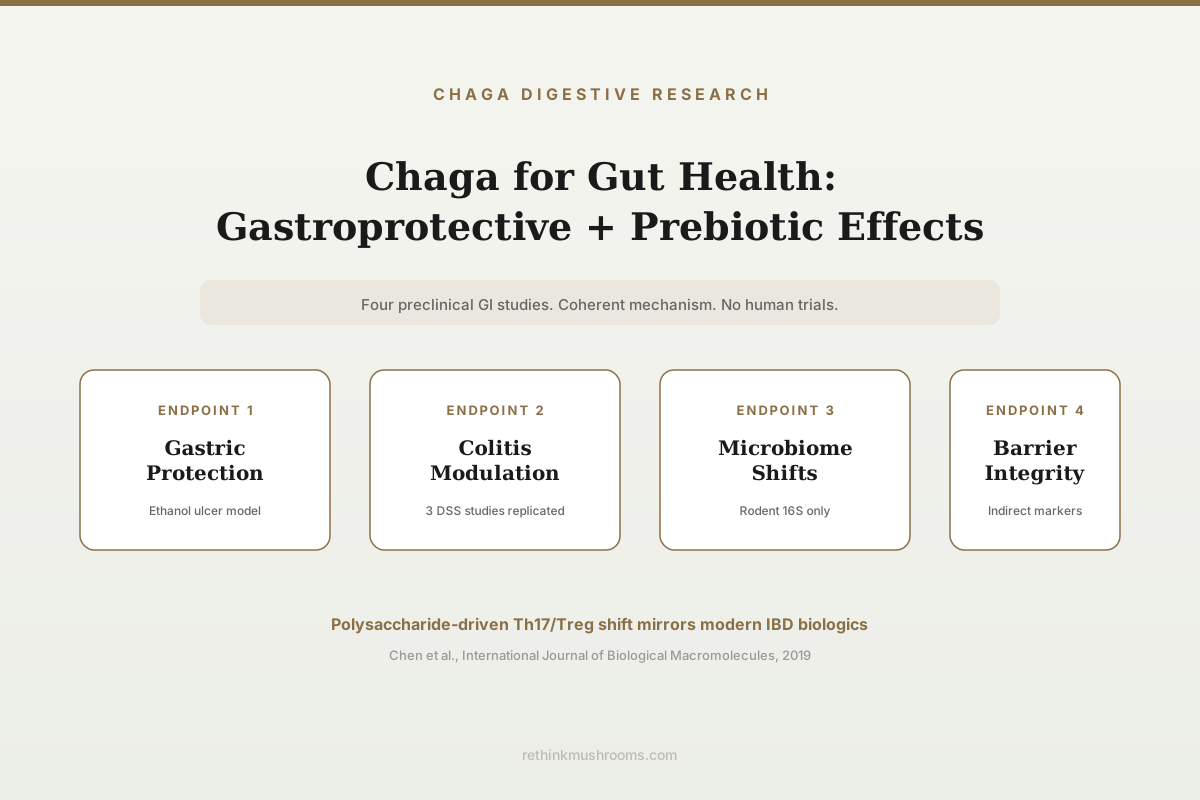
Chaga Digestive Research
4 preclinical GI studies
Chaga reduced gastric ulceration, dampened colitis inflammation, and rebalanced Th17/Treg immune signaling in rodent models of inflammatory bowel disease.
Chen et al., International Journal of Biological Macromolecules, 2019
Ethanol Ulcer Model
gastric mucosal protection in rats
DSS Colitis
three independent rodent studies
Th17/Treg Balance
polysaccharide-mediated shift
Chen et al., International Journal of Biological Macromolecules, 2019
 View as image ↗
Chaga's reputation for gut-calming effects predates the modern research literature by several centuries. Siberian and Baltic folk medicine used chaga decoctions for gastritis, ulcer pain, and general digestive complaints long before anyone had mapped Th17 cells or sequenced a gut microbiome. What has changed since 2010 is that a specific mechanistic story has emerged in rodent models of gastric ulceration and colitis, and that story involves fungal polysaccharides, local anti-inflammatory effects, and modulation of the immune cells that line the intestinal wall. Ern et al. (2024) summarized chaga's gastrointestinal activity across the preclinical literature and noted it as one of the better-supported indications for the mushroom.[1]
For background on what chaga is and how it grows, see what is chaga mushroom. For the compound classes behind the activity described in this article, see chaga bioactive compounds: betulinic acid, melanin, and polysaccharides.
Key Takeaways
- Chaga aqueous extract reduced gastric mucosal ulceration in ethanol-treated rats, with histological protection of the stomach lining (Xin et al., 2019)
- I. obliquus polysaccharide reduced dextran sodium sulfate colitis severity in mice and restored Th1/Th2 and Th17/Treg immune balance (Chen et al., 2019)
- An orally administered aqueous extract of chaga suppressed acute DSS-induced colitis inflammation in mice, with reductions in pro-inflammatory cytokines (Mishra et al., 2012)
- Chaga showed anti-inflammatory activity in a third independent DSS colitis study, supporting replication across laboratories (Choi et al., 2010)
- Glamoclija et al. (2015) documented antimicrobial activity against a panel of gastrointestinal pathogens including strains relevant to gastric inflammation
- No randomized human trial has tested chaga for any gastrointestinal indication as of 2026 (Szychowski et al., 2021)
What "Gut Health" Actually Means in the Chaga Literature
The phrase is used loosely in supplement marketing, so an anchor helps. In the chaga research, "gut health" covers four distinct endpoints, each with its own evidence profile.
Gastric mucosal protection. The stomach lining's capacity to resist acid, alcohol, and NSAID-induced damage. Tested in rodent ulcer models.
Colonic inflammation. The severity of inflammation in the colon in chemically induced colitis, measured by histology, cytokine panels, and clinical scoring. Tested mainly in DSS mouse models.
Microbiome composition. The balance of bacterial species colonizing the gut, measured by 16S rRNA sequencing. Tested almost exclusively in diabetic and obese rodent models, not healthy guts.
Barrier integrity. The tight junction proteins that keep gut contents from leaking into circulation. Measured indirectly through endotoxin levels and tight-junction protein expression.
Chaga has published data on all four endpoints. The strength of evidence varies. Gastric protection and colitis have the most direct experimental support; microbiome modulation and barrier integrity have less. Fordjour et al. (2023) framed this evidence gap in their broader review of chaga's pharmacology.[2]
Gastroprotection: the Xin 2019 Ulcer Model
Xin et al. (2019) ran a standard rat model of gastric ulceration in which ethanol is used to induce mucosal damage, and chaga aqueous extract is pre-administered to test for a protective effect.[3] The ethanol ulcer model is one of the oldest and best-validated screens for gastroprotective compounds because the injury pattern resembles the histological damage seen in human alcohol-associated gastritis and stress-related gastric injury.
The key observations:
- Rats pre-treated with chaga extract had visibly smaller and fewer ulcerations on the stomach wall at necropsy than untreated controls
- Histology showed preservation of the epithelial layer, reduced submucosal edema, and fewer neutrophil infiltrates
- Oxidative stress markers in gastric tissue were lower in chaga-treated animals
- The effect was dose-responsive across the concentrations tested
The proposed mechanism combines three things. Chaga's antioxidant activity reduces ethanol-induced oxidative injury. Its polysaccharide fraction stimulates mucus production and protects the mucosal barrier. And its polyphenolic compounds provide direct anti-inflammatory effects at the tissue level. For the broader mucosal protection story, see chaga and ulcers: can it protect the stomach lining?.
The Translation Gap
Rodent ulcer models predict human gastric protective activity reasonably well for some classes of compounds, and poorly for others. Without a human trial, chaga's activity in this model is a hypothesis-generating finding, not a demonstrated clinical effect. The ethanol ulcer model is an acute injury model. Whether chaga helps with chronic gastritis, H. pylori-associated gastric inflammation, or NSAID-induced ulceration in humans remains to be tested.
Colitis: Three Independent DSS Studies
The strongest gastrointestinal evidence for chaga is actually in colitis, not the stomach. Three separate research groups have tested chaga in the dextran sodium sulfate (DSS) mouse model of colitis, which is the standard preclinical screen for inflammatory bowel disease drug candidates.
Choi et al. (2010) ran the first DSS colitis study on chaga and reported significant reductions in clinical colitis scoring, disease activity index, and pro-inflammatory cytokine expression in colon tissue.[4]
Mishra et al. (2012) replicated the finding two years later using an orally administered aqueous extract of I. obliquus, with endpoints covering colon histology, myeloperoxidase activity, and cytokine panels.[5] The oral route is important for translation because any human therapeutic would almost certainly be oral.
Chen et al. (2019) extended the mechanism by administering purified I. obliquus polysaccharide and characterizing the immune response in detail.[6] Their finding was more specific than the earlier studies: chaga polysaccharide shifted the Th1/Th2 and Th17/Treg balance toward an anti-inflammatory state, which is the same immune axis targeted by modern IBD biologics. For the full mechanism discussion, see chaga for digestive inflammation: IBD and colitis evidence.
Why Three Independent Studies Matter
One animal study is a finding. Three independent studies from different labs using different extract preparations converging on similar endpoints is replication. Replication across laboratories is the single strongest preclinical signal available before human trials start. The chaga-colitis literature has that signal, and it puts chaga in a different category from compounds with only a single unreplicated study.
Microbiome Modulation: What Is Known and What Is Not
Direct evidence that chaga changes the composition of the human gut microbiome does not exist. Evidence that it changes rodent gut microbiomes is emerging, mostly in the context of metabolic disease models rather than healthy animals.
The mechanism is biologically plausible. Chaga polysaccharides are not fully digested by human small-intestinal enzymes. What reaches the colon is available as a substrate for bacterial fermentation, which is the same principle that makes oat beta-glucan and inulin prebiotic. Fermentation of fungal beta-glucans produces short-chain fatty acids including butyrate, which has direct anti-inflammatory effects on the colonic epithelium and is implicated in the health of the gut barrier.
For sibling-cluster coverage of this question, see chaga and gut microbiome modulation: research review.
Why "Prebiotic" Is the Right Framing
Chaga is not a probiotic. It does not contain live bacteria. It may function as a prebiotic, meaning it feeds commensal bacteria that are already resident in the gut. The distinction matters for how the evidence should be interpreted. A prebiotic works by shifting the equilibrium of the existing microbiome toward species that ferment the incoming substrate. Whether chaga produces a meaningful shift in humans, and whether any such shift is clinically beneficial, is an empirical question that has not been answered.
What Rodent Microbiome Studies Suggest
Several rodent studies of I. obliquus in metabolic disease models have included 16S rRNA sequencing of cecal or fecal contents as a secondary endpoint. The common findings are a rise in the relative abundance of Bacteroidetes and Akkermansia muciniphila and a fall in Firmicutes after chaga polysaccharide administration. Akkermansia is associated with a healthier mucus layer and improved barrier function in multiple human cohorts, so the direction of the rodent shift is biologically interesting. The caveat is that these shifts were documented in animals under metabolic stress, not in healthy animals, and the changes may reflect the improvement of the underlying disease rather than a direct chaga effect on bacterial composition. No human 16S study has yet been published.
Antimicrobial Activity and Helicobacter pylori
Helicobacter pylori is the bacterium responsible for the majority of peptic ulcer disease and a major risk factor for gastric cancer. Any compound that shows activity against H. pylori attracts research interest.
Glamoclija et al. (2015) tested chaga extracts against a panel of bacterial and fungal strains, including species relevant to gastrointestinal disease, and documented minimum inhibitory concentrations consistent with moderate antibacterial activity.[7] The chemical characterization in the same paper identified the polyphenolic fraction as a likely contributor.
Other in-vitro work has tested chaga against H. pylori specifically, with mixed results depending on the extract and the strain tested. The cluster article chaga and Helicobacter pylori: antimicrobial effects on stomach bacteria covers this literature directly.
The practical caveat is that in-vitro antimicrobial activity at high concentrations rarely translates to clinical eradication of a pathogen. Standard H. pylori eradication requires combination antibiotic therapy. Chaga's in-vitro activity at achievable human doses is unlikely to substitute for that.
The Polysaccharide Fermentation Hypothesis
Across the four endpoints above, a common mechanistic thread runs through the chaga gut-health story: beta-glucan and related polysaccharides reaching the colon, engaging immune cells through pattern-recognition receptors, and feeding commensal bacteria that produce short-chain fatty acids.
Duru et al. (2019), reviewing the molecular pharmacology of I. obliquus, identified polysaccharides as the primary mediator of both immune modulation and local tissue protection in the gastrointestinal preclinical literature.[8] Chen's 2019 colitis study provides the clearest mechanistic endpoint: polysaccharide administration shifted the Th17/Treg axis, which is the same cellular axis that Dectin-1 engages when it recognizes fungal beta-glucans.
The hypothesis is specific enough to test. If chaga's gut-health effects are primarily polysaccharide-mediated, then:
- Water extracts (which preserve polysaccharides) should be more effective than ethanol extracts (which do not)
- Boiled whole-chaga decoctions should retain most of the activity
- Purified beta-glucan fractions should reproduce the effect of the whole extract
- Extract preparations standardized to beta-glucan content should predict efficacy
The extraction-specific point is supported by the general chaga literature: water-based preparations consistently outperform ethanolic extracts for polysaccharide-associated endpoints.
Honest Evidence Assessment
Szychowski et al. (2021) structured their review of I. obliquus as a progression from folk medicine to clinical use, and their explicit conclusion on the gastrointestinal evidence was that the preclinical data is substantial and coherent while the human clinical evidence is absent.[9]
That conclusion holds in 2026. There is no published randomized controlled trial of chaga for ulcer prevention, colitis, IBD, IBS, or microbiome modulation. The rodent evidence is strong; the translation to humans has not been attempted at rigor.
What this means for interpreting chaga in the gut-health category:
- The mechanism story is mechanistically coherent and supported by replicated rodent data
- The effect sizes in rodent models are large enough that a well-designed human trial could plausibly detect an effect
- In the absence of that trial, claims that chaga "heals the gut" or "fixes the microbiome" overstate what has been demonstrated in humans
- Traditional use is long but does not substitute for controlled trial data
The honest framing is that chaga has one of the better-supported preclinical profiles among medicinal mushrooms for gut applications, and one of the weakest human evidence bases. Both statements are simultaneously true.
The Bottom Line
Four preclinical studies provide a coherent picture of chaga's gastrointestinal activity: gastric mucosal protection in ethanol-induced ulcer models, replicated anti-colitis effects across three independent DSS mouse studies, and a mechanistic basis in fungal polysaccharide-driven Th17/Treg immune modulation. The weak link is the absence of any human randomized trial. The evidence base is preclinical and mechanistic, not clinical.
Frequently Asked Questions
Sources & References
- 1RTHM-01886·Ern, Phoebe Tee Yon et al. (2024). “Chaga Therapeutic Properties: What This 2024 Review Actually Shows.” Mycology.Study breakdown →PubMed →↩
- 2RTHM-01694·Fordjour, Eric et al. (2023). “Chaga mushroom: a super-fungus with countless facets and untapped potential..” Frontiers in pharmacology.Study breakdown →PubMed →↩
- 3RTHM-00600·Xin, Xin et al. (2019). “Assessment of the Gastroprotective Effect of the Chaga Medicinal Mushroom, Inonotus obliquus (Agaricomycetes), Against the Gastric Mucosal Ulceration Induced by Ethanol in Experimental Rats..” International journal of medicinal mushrooms.Study breakdown →PubMed →↩
- 4RTHM-00177·Choi, Se Young et al. (2010). “Anti-inflammatory effects of Inonotus obliquus in colitis induced by dextran sodium sulfate..” Journal of biomedicine & biotechnology.Study breakdown →PubMed →↩
- 5RTHM-00258·Mishra, Siddhartha Kumar et al. (2012). “Orally administered aqueous extract of Inonotus obliquus ameliorates acute inflammation in dextran sulfate sodium (DSS)-induced colitis in mice..” Journal of ethnopharmacology.Study breakdown →PubMed →↩
- 6RTHM-00549·Chen, Yi-Fang et al. (2019). “Inonotus obliquus polysaccharide ameliorates dextran sulphate sodium induced colitis involving modulation of Th1/Th2 and Th17/Treg balance..” Artificial cells.Study breakdown →PubMed →↩
- 7RTHM-00373·Glamočlija, Jasmina et al. (2015). “Chemical characterization and biological activity of Chaga (Inonotus obliquus), a medicinal "mushroom"..” Journal of ethnopharmacology.Study breakdown →PubMed →↩
- 8RTHM-00553·Duru, Kingsley C et al. (2019). “The pharmacological potential and possible molecular mechanisms of action of Inonotus obliquus from preclinical studies..” Phytotherapy research : PTR.Study breakdown →PubMed →↩
- 9RTHM-00722·Szychowski, Konrad A et al. (2021). “Inonotus obliquus - from folk medicine to clinical use..” Journal of traditional and complementary medicine.Study breakdown →PubMed →↩