Mushroom Combinations and Stacking
4 Documented Organ-Injury Case Reports
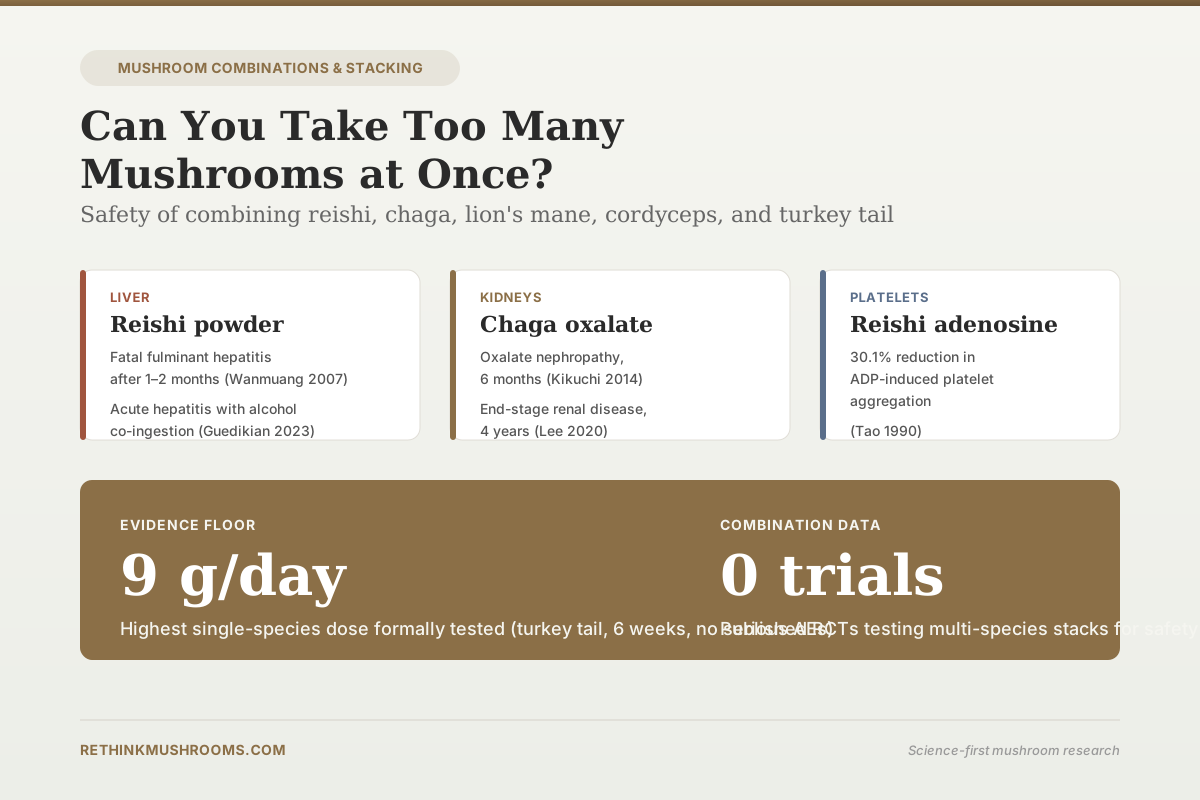
Published case reports have linked single-species mushroom supplements to fatal fulminant hepatitis, acute liver injury, oxalate nephropathy, and end-stage renal disease. None involved combinations, but every added species raises the total bioactive dose.
Wanmuang 2007; Guedikian 2023; Kikuchi 2014; Lee 2020
9 g/day
highest dose formally tested in a clinical safety trial (turkey tail)
0 RCTs
have tested multi-species mushroom stacks for safety in humans
3 Organs
implicated in adverse case reports: liver, kidney, platelets
Wanmuang 2007; Guedikian 2023; Kikuchi 2014; Lee 2020
 View as image ↗
Mushroom supplement shelves now carry products stacking five, eight, or even fourteen species into a single capsule. A reasonable question follows: at what point does combining medicinal mushrooms create real risk? The honest answer is that no randomized controlled trial has tested multi-species mushroom combinations for safety in humans, so the evidence comes from individual-species dose trials and a small number of adverse event case reports. This article works through that evidence one organ system at a time, rather than repeating the generic "well tolerated" claim found on most supplement pages. For the broader context on pairing species, see our guide to 5 evidence-based mushroom stacks for different goals.
The pattern that emerges from the published data: single-species mushroom supplements are broadly well tolerated at studied doses, but every documented injury came at high cumulative exposure, with a pre-existing condition, or alongside another substance (alcohol, anticoagulants, vitamin C). Combining species without reducing individual doses stacks these risk factors rather than diversifying them.
Key Takeaways
- A Phase I dose-escalation trial of turkey tail in breast cancer survivors tested up to 9g/day for 6 weeks with no serious adverse events and no grade 3 or higher toxicities (Torkelson et al., ISRN Oncology, 2012)
- Fatal fulminant hepatitis was reported in two patients after switching from traditionally boiled reishi to reishi powder for 1-2 months, while boiled preparations had produced no toxic effects (Wanmuang et al., Journal of the Medical Association of Thailand, 2007)
- A 47-year-old man developed acute hepatitis with significant transaminitis after co-ingesting reishi powder and alcohol, with complete resolution at 2-week follow-up after N-acetylcysteine treatment (Guedikian et al., Cureus, 2023)
- End-stage renal disease developed in a 49-year-old after four years of chaga powder, with measured chaga oxalate content at 14.2g per 100g and estimated daily oxalate intake 2-5 times normal (Lee et al., Journal of Korean Medical Science, 2020)
- Ganoderma lucidum inhibited ADP-induced platelet aggregation by 30.1% in patients with atherosclerotic disease, mediated by adenosine content (Tao et al., Journal of Tongji Medical University, 1990)
- A randomized cognitive trial of 1.8g/day lion's mane in 41 healthy adults reported no serious adverse events over 28 days (Docherty et al., Nutrients, 2023)
What Clinical Trials Show About Single-Species Safety
Before judging combinations, start with what formal trials have measured when a single species is given at the doses used in research.
The most rigorous safety data comes from Torkelson and colleagues, who ran a Phase I dose-escalation trial of turkey tail (Trametes versicolor) in women who had completed radiation therapy for breast cancer.[1] The trial tested 3g, 6g, and 9g daily for 6 weeks using standard Phase I escalation rules. No dose-limiting toxicities occurred, no grade 3 or 4 adverse events were observed, and natural killer cell activity increased at the 9g dose. This remains the highest oral dose of any medicinal mushroom tested under a formal safety protocol in a clinical trial.
The Docherty 2023 trial of lion's mane (Hericium erinaceus) in 41 healthy adults aged 18-45 used 1.8g/day for 28 days.[2] No serious adverse events were reported. Mori and colleagues earlier gave 30 elderly Japanese adults 3g/day of lion's mane for 16 weeks without reporting adverse events, though their trial was not designed primarily as a safety study.[3]
Hirsch and colleagues tested a cordyceps-containing mushroom blend at 4g/day in 28 healthy young adults for 3 weeks.[4] No adverse events were reported. The trial was small and short, but the dose was above what most commercial capsules deliver.
Cerletti and colleagues' 2021 review of edible mushrooms and beta-glucans noted that tolerability in the published trial record is generally good at doses up to several grams daily, with gastrointestinal symptoms as the most common complaint.[5]
The pattern: single species, at doses from 1.8g to 9g daily, in short-to-medium trials, produced no serious adverse events in the studies that went looking. That is the evidence floor. The adverse events that have been documented all lie outside these conditions.
Case Reports: When Mushroom Supplements Hurt People
Case reports are a different class of evidence than trials. They cannot establish how common an outcome is. What they do is prove a given outcome is biologically possible and identify the conditions under which it occurred. For someone stacking multiple mushroom supplements, these conditions matter more than population averages.
Reishi and the Liver
Two independent case reports have described hepatotoxicity associated with reishi (Ganoderma lucidum or G. lingzhi).
Wanmuang and colleagues published the second known case of reishi-associated liver injury in 2007.[6] The patient developed fatal fulminant hepatitis. The first case, reported from Hong Kong in 2004, also involved reishi powder. In both cases, the patients had previously consumed traditionally boiled reishi without any toxic effect. The hepatotoxic episodes occurred 1-2 months after switching to reishi powder. The authors explicitly flagged concern for powder preparations combined with other drugs, since both patients had been taking additional therapeutic agents.
Guedikian and colleagues reported in 2023 on a 47-year-old man who presented with headache and abdominal pain after consuming reishi powder and alcohol together.[7] Laboratory findings showed acute hepatitis with significant transaminitis. He was treated conservatively with N-acetylcysteine and intravenous fluids. Two-week follow-up labs showed complete resolution.
Both reports share two features relevant to combination users: the preparation form mattered (powder, not traditionally prepared tea), and co-ingestion of other substances appeared to play a role. A mushroom stack that includes reishi powder taken alongside alcohol, acetaminophen, or other hepatically metabolized substances sits in a higher-risk zone than an isolated reishi tea.
Chaga and the Kidneys
Chaga (Inonotus obliquus) carries an organ-specific safety signal unique to this species: oxalate content high enough to cause kidney injury with sustained use.
Kikuchi and colleagues published the first case of chaga-induced oxalate nephropathy in 2014.[8] A 72-year-old Japanese woman with a history of hepatectomy for liver cancer had consumed 4-5 teaspoons of chaga powder daily for 6 months. Renal function declined to the point of requiring hemodialysis. Biopsy showed diffuse tubular atrophy, interstitial fibrosis, and oxalate crystals in the tubular lumina and urinary sediment.
Lee and colleagues' 2020 report added longer-term data.[9] A 49-year-old Korean man reached end-stage renal disease after four years of chaga powder use for atopic dermatitis. Biopsy showed chronic tubulointerstitial nephritis with oxalate crystal deposits. Direct measurement of the same chaga powder the patient had used yielded an oxalate content of 14.2g per 100g. Estimated daily oxalate intake was 2 times higher than normal diet for 4 years and 5 times higher for the final year.
The mechanism is straightforward: chaga concentrates oxalate, oxalate crystallizes with calcium in renal tubules at high sustained intake, and tubular damage progresses to fibrosis. Anyone combining chaga with calcium supplements, vitamin C (which the body can metabolize to oxalate), or other high-oxalate inputs is adding to this load. For a full look at chaga-specific timing and dose considerations, see our article on taking chaga long-term.
Reishi and Platelet Function
Tao and colleagues published clinical data in 1990 showing that Ganoderma lucidum inhibited ADP-induced platelet aggregation by 30.1% in patients with atherosclerotic disease, using aspirin as a comparator.[10] The active compound was identified as adenosine. This is not a case report of bleeding, but it establishes the biological plausibility and quantifies the effect size.
The practical implication: reishi has measurable antiplatelet activity at doses used in traditional preparations. Stacking reishi with other supplements or drugs that also affect platelet function (garlic at high doses, ginkgo, aspirin, clopidogrel, warfarin) creates an additive effect that has not been quantified in any trial. Pre-surgical use is the highest-risk scenario. For readers interested in the broader mushroom overdose question, our companion article on psilocybin toxicity addresses a very different mushroom class with its own risk profile.
The Combination Problem
Every case report above involved a single species. What happens when species are combined has not been formally studied. Three mechanisms of additive risk are biologically plausible from the existing literature.
Additive load on the same organ system. If a stack includes reishi (liver case reports), chaga (kidney case reports), and other species, each species contributes to total daily exposure. The Wanmuang cases occurred at unspecified powder doses over 1-2 months. The Lee case occurred at chronic sub-teaspoon quantities accumulated over years. Stacks do not reset these thresholds; they add to them.
Additive pharmacological effect at one receptor class. Beta-glucans from multiple mushroom species activate innate immune cells through dectin-1 and complement receptor 3 pathways. Cerletti and colleagues noted that turkey tail PSK, reishi beta-glucans, maitake D-fraction, and shiitake lentinan all converge on these receptor systems, though through slightly different polysaccharide structures.[5] Stamets and Yao documented the same for PSP and PSK at the turkey tail side of the pathway.[11] Whether multiple beta-glucan sources produce a ceiling effect at the receptor or sum to something larger has not been tested in humans.
Additive interaction with concurrent medications. The Guedikian case report is the clearest example: reishi alone had no published liver signal in that patient, alcohol alone did not cause the episode, but the combination produced acute hepatitis. Anyone taking a mushroom stack alongside anticoagulants, immunosuppressants, diabetes medications, or drugs metabolized by hepatic CYP450 enzymes is operating in a zone where no study has measured outcomes. For species-specific drug interaction considerations, see our piece on taking maitake with diabetes medication.
How Much Is Too Much in Practical Numbers
The published trial record gives some anchor points, even if no trial has tested stacks directly.
| Species | Highest Dose in Published Trial | Duration | Serious Adverse Events |
|---|---|---|---|
| Turkey tail | 9 g/day | 6 weeks | None reported |
| Cordyceps blend | 4 g/day | 3 weeks | None reported |
| Lion's mane | 3 g/day | 16 weeks | None reported |
| Lion's mane | 1.8 g/day | 28 days | None reported |
A 10-species blend at a typical 2g total daily dose gives each species 200mg, far below any of the trial doses above. That changes the safety equation in two directions: the probability of any species reaching a dose-dependent adverse threshold drops, but so does the probability of any species reaching a dose that produces the benefit documented in its trial. A two-species stack at adequate individual doses matches trial conditions more closely than a dilute many-species blend. For deeper analysis on which species actually pair well based on research, see which mushrooms work best together and the dedicated article on immune support combinations.
Chronic exposure is a separate axis from single-dose intensity. The chaga case reports accumulated injury over months to years. Daily chronic use at even modest doses does not have the same safety profile as a 4-week supplementation window. Our article on taking lion's mane every day digs into one species-specific version of this question.
Who Should Treat Mushroom Stacks With Extra Caution
The published data point to several populations with a higher ratio of documented harm to documented benefit:
People on anticoagulants or antiplatelet drugs. Tao and colleagues' 30.1% reduction in ADP-induced platelet aggregation with Ganoderma lucidum is not a theoretical concern.[10]
People with existing liver disease or heavy alcohol use. The Guedikian case shows that an otherwise quiet reishi preparation can produce acute hepatitis under concurrent alcohol exposure.[7]
People with kidney disease or high baseline oxalate intake. The Kikuchi and Lee cases involved sustained chaga exposure in people whose kidney reserve could not tolerate the additional oxalate load.[8][9]
People on immunosuppressants. The immune-activating mechanism Cerletti and colleagues described runs counter to the intended effect of these medications.[5]
People approaching surgery. Adenosine-mediated platelet inhibition adds to perioperative bleeding risk and is not measured on standard preoperative labs.
What the Absence of Combination Trials Actually Means
The honest summary is that "safe for healthy adults at studied single-species doses" is a supported claim. "Safe when stacked" is not the same claim. The published record contains:
- Multiple short trials of individual species at gram-level doses, all showing acceptable tolerability
- Four case reports involving three organ systems, all at chronic or co-ingestion conditions
- One pharmacological mechanism (adenosine-mediated platelet inhibition) with a measured effect size
- Zero controlled trials of multi-species mushroom combinations
Every marketing claim about mushroom stack safety traces back either to the individual-species trials (which do not test combinations) or to the absence of adverse event reports for specific combinations (which is not the same as evidence of safety). Rare adverse events require large population exposure and surveillance infrastructure to detect. Supplement use does not sit inside that infrastructure. A full picture of the stacking decision also includes the ongoing work catalogued in our ultimate stacking guide, which covers the evidence for specific pairings.
The Bottom Line
No published randomized trial has tested multi-species mushroom supplement combinations for safety in humans. Individual-species trials show good tolerability at gram-level doses over weeks to months. Case reports document three organ-system injuries at high chronic exposure or with co-ingested substances: reishi-associated fatal fulminant hepatitis and alcohol-potentiated acute hepatitis, chaga-induced oxalate nephropathy and end-stage renal disease, and reishi adenosine-mediated platelet inhibition. Combinations can plausibly add to any of these loads. The evidence-aligned reading is that stacks amplify the same risks that exist at the single-species level, not that they introduce entirely new ones.
Frequently Asked Questions
Sources & References
- 1RTHM-00267·Torkelson, Carolyn J et al. (2012). “Phase 1 Clinical Trial of Trametes versicolor in Women with Breast Cancer..” ISRN oncology.Study breakdown →PubMed →↩
- 2RTHM-00821·Docherty, Sarah et al. (2023). “The Acute and Chronic Effects of Lion's Mane Mushroom Supplementation on Cognitive Function, Stress and Mood in Young Adults: A Double-Blind, Parallel Groups, Pilot Study..” Nutrients.Study breakdown →PubMed →↩
- 3RTHM-00165·Mori, Koichiro et al. (2009). “Improving effects of the mushroom Yamabushitake (Hericium erinaceus) on mild cognitive impairment: a double-blind placebo-controlled clinical trial..” Phytotherapy research : PTR.Study breakdown →PubMed →↩
- 4RTHM-00473·Hirsch, Katie R et al. (2017). “Cordyceps militaris Improves Tolerance to High-Intensity Exercise After Acute and Chronic Supplementation..” Journal of dietary supplements.Study breakdown →PubMed →↩
- 5RTHM-00676·Cerletti, Chiara et al. (2021). “Edible Mushrooms and Beta-Glucans: Impact on Human Health..” Nutrients.Study breakdown →PubMed →↩
- 6RTHM-00122·Wanmuang, Harirak et al. (2007). “Fatal fulminant hepatitis associated with Ganoderma lucidum (Lingzhi) mushroom powder..” Journal of the Medical Association of Thailand = Chotmaihet thangphaet.Study breakdown →PubMed →↩
- 7RTHM-00826·Guedikian, Roupen et al. (2023). “Ganoderma lingzhi (Reishi Mushroom)-Induced Acute Liver Injury in the Setting of Alcohol Use: A Case Report and Review of the Literature..” Cureus.Study breakdown →PubMed →↩
- 8RTHM-00329·Kikuchi, Yuko et al. (2014). “Chaga mushroom-induced oxalate nephropathy..” Clinical nephrology.Study breakdown →PubMed →↩
- 9RTHM-00630·Lee, Sua et al. (2020). “Development of End Stage Renal Disease after Long-Term Ingestion of Chaga Mushroom: Case Report and Review of Literature..” Journal of Korean medical science.Study breakdown →PubMed →↩
- 10RTHM-00011·Tao, J et al. (1990). “Experimental and clinical studies on inhibitory effect of ganoderma lucidum on platelet aggregation..” Journal of Tongji Medical University = Tong ji yi ke da xue xue bao.Study breakdown →PubMed →↩
- 11RTHM-00264·Stamets, Paul (2012). “Trametes versicolor (Turkey Tail Mushrooms) and the Treatment of Breast Cancer..” Global advances in health and medicine.Study breakdown →PubMed →↩