Mushroom Stacking
1 + 1 > 2
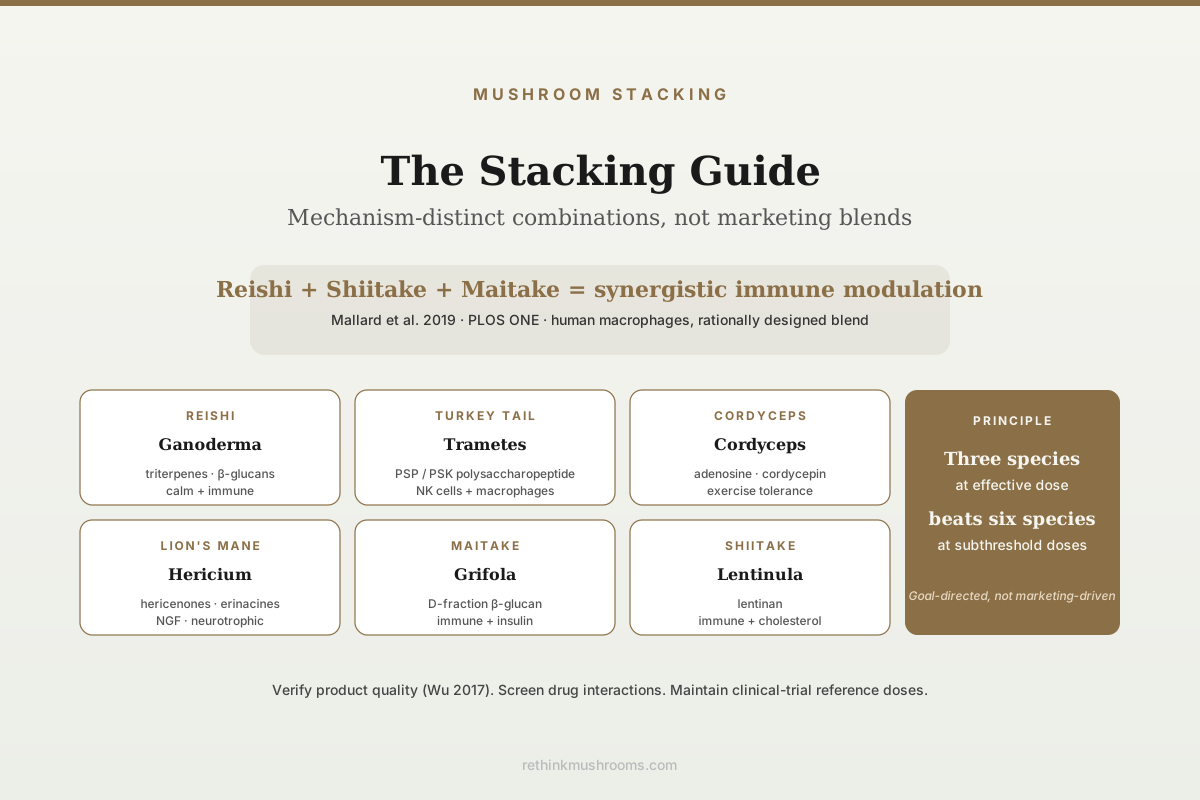
Mallard et al. (2019) provided the first peer-reviewed demonstration that a rationally designed reishi + shiitake + maitake formulation elicited a synergistic immuno-modulatory response in human macrophages beyond what any single extract produced.
Mallard et al., PLOS ONE, 2019
One Synergy RCT-Quality Study
human macrophages, rationally designed blend
Mechanism-Distinct Species
reishi, cordyceps, lion's mane, turkey tail target different pathways
Drug Interaction Caveats
Ganoderma and warfarin the primary concern
Mallard et al., PLOS ONE, 2019
 View as image ↗
"Mushroom stacking" is a consumer-market term. The peer-reviewed literature on combining medicinal mushrooms is narrower than the marketing copy suggests, and the narrow evidence base is more interesting than the broad claims. The most scientifically robust demonstration of mushroom-to-mushroom synergy is Mallard and colleagues (2019), who analysed nine commercial preparations of Ganoderma lucidum (reishi), Lentinula edodes (shiitake) and Grifola frondosa (maitake), selected three extracts based on β- and α-glucan content, and tested the rationally designed combination in human macrophages for immuno-modulatory effects on IL-1α, IL-6, IL-10 and TNF-α.[1] The combination produced a synergistic immuno-modulatory response beyond the sum of the individual extracts. That is one study, in one cell model, with one formulation, and it remains the clearest published evidence that a multi-species mushroom formulation can deliver more than the additive effect of the components.
The more defensible framing of "stacking" starts from mechanism-distinct species. Different medicinal mushrooms target different biological pathways, and a goal-oriented combination can cover complementary endpoints even if no pairwise synergy has been formally demonstrated. For related framing see 5 evidence-based mushroom stacks for different goals, which mushrooms work best together? synergy research, the best mushroom combinations for immune support: synergy research and can you take too many mushrooms at once? safety of combinations.
Key Takeaways
- Mallard et al. (2019) demonstrated synergistic immuno-modulatory activity from a rationally designed reishi + shiitake + maitake formulation in human macrophages, the first peer-reviewed report of true mushroom-formula synergy
- Guggenheim et al. (2014) reviewed the integrative-oncology literature on five major mushrooms (Agaricus blazei, Cordyceps sinensis, Grifola frondosa, Ganoderma lucidum, Trametes versicolor) and mapped their distinct cytokine and pathway effects
- Venturella et al. (2021) reviewed the bioactive compound landscape across medicinal mushrooms, documenting that different species contain quantitatively different β-glucans, triterpenes, ergosterols and mycelial peptides
- Hsu et al. (2007) tested Agaricus blazei in combination with metformin and gliclazide in type 2 diabetes in an RCT and reported additive improvement in insulin resistance
- Tsai et al. (2016) ran a preliminary randomised controlled study of Antrodia cinnamomea combined with chemotherapy in advanced cancer, demonstrating the "stacking with pharmaceuticals" framework
- Klupp et al. (2016) tested Ganoderma lucidum as a standalone intervention for metabolic syndrome in an RCT, providing a reference for what single-mushroom interventions look like in humans
What "Synergy" Actually Means In The Published Evidence
Synergy is a technical claim with a specific definition. Two interventions combine synergistically if the effect of the combination exceeds the sum of the individual effects. The combination outperforming either single agent alone is not the same thing, and the marketing literature often conflates the two. A response of A + B > max(A, B) is simply additive. A response of A + B > A + B expected (where "expected" is calculated from the individual dose-response curves) is synergistic.
Mallard and colleagues (2019) set up their study explicitly to test synergy in the strict sense.[1] They first quantified β-glucan and α-glucan content across nine commercially available reishi, shiitake and maitake preparations. They then selected one extract from each species based on the polysaccharide content, combined the three, and tested both the individual extracts and the combination in human macrophages with and without LPS stimulation, measuring IL-1α, IL-6, IL-10 and TNF-α cytokine output. The combination produced cytokine modulation beyond what was expected from the individual responses, meeting the formal synergy criterion. This is the first published report that crosses the synergy bar for a mushroom formulation using a rigorous study design.
The result matters but has to be bounded. It is one formulation, in one in vitro model, in one cell type. Extrapolation to clinical endpoints in intact humans is a reasonable hypothesis, but it is not yet tested. The specific extract preparations, β-glucan concentrations and α-glucan ratios in the Mallard study are not fully generalisable to every reishi, shiitake and maitake product on the market. The rationale for the design, however, is reproducible: analyse the bioactive content, match extracts with compatible and complementary glucan profiles, and test the specific combination.
The Five-Mushroom Integrative-Oncology Frame
A longer-running scholarly framework for thinking about mushroom combinations comes out of integrative oncology. Guggenheim and colleagues (2014) reviewed immune modulation from five major mushrooms (Agaricus blazei, Cordyceps sinensis, Grifola frondosa, Ganoderma lucidum, Trametes versicolor) and mapped their distinct effects on cytokines, NK cell activity, macrophage function and interaction with chemotherapeutic agents.[2] The review made the case for mechanism-distinct combinations: each species drives a different part of the immune response, and a combination can provide broader immune tone than any single species.
The mechanism-distinct framework extends beyond oncology. Different medicinal mushrooms target reasonably distinct endpoints on first-principles biology:
- Ganoderma lucidum (reishi): triterpene-driven anti-inflammatory and calming effects, β-glucan-mediated immune modulation
- Trametes versicolor (turkey tail): polysaccharopeptide (PSP, PSK) immune activation, particularly NK cell and macrophage
- Cordyceps (sinensis, militaris): exercise tolerance, oxygen utilisation, adenosine receptor modulation
- Hericium erinaceus (lion's mane): nerve growth factor (NGF) induction and neurotrophic activity
- Grifola frondosa (maitake): D-fraction β-glucan immune activation, insulin sensitivity
- Lentinula edodes (shiitake): lentinan β-glucan immune activation, cholesterol modulation
- Inonotus obliquus (chaga): melanin-driven antioxidant and anti-inflammatory activity
Venturella and colleagues (2021) reviewed the bioactive compound landscape across these and other medicinal mushrooms and catalogued the quantitative differences in β-glucan profiles, triterpene content, ergosterol and ergothioneine concentrations, and mycelial peptides.[3] The compound-level differences are the basis for the mechanism-distinct framework.
Jeitler and colleagues (2020) provided a more recent narrative review on medicinal mushrooms in integrative oncology with a clinical-trials focus, identifying which species have supportive RCT data for which endpoints and where the evidence is still preclinical.[4]
Goal-Based Stacking
The defensible way to think about combining mushrooms is goal-oriented: start from the endpoint, select species with distinct mechanistic contributions to that endpoint, and keep the combination small enough that the individual doses remain effective.
Immune support. The Mallard 2019 reishi + shiitake + maitake combination is the direct-evidence stack for immune modulation.[1] The Guggenheim 2014 review extends the logic to additional combinations including turkey tail and Agaricus blazei based on complementary cytokine profiles.[2]
Cognitive function. The main species with clinical data on cognitive endpoints is Hericium erinaceus (lion's mane). Lai and colleagues (2013) characterised the neurotrophic (NGF-inducing) activity of lion's mane extracts in vitro, providing a mechanistic anchor for the cognitive claims.[5] Combinations with other species are driven more by user preference than by direct combination studies.
Exercise tolerance and physical performance. Hirsch and colleagues (2017) tested Cordyceps militaris in humans and reported improved tolerance to high-intensity exercise after both acute and chronic supplementation.[6] This is a single-species endpoint. Combinations with reishi for recovery or lion's mane for training focus are reasonable based on mechanism but not directly tested.
Metabolic health. Klupp and colleagues (2016) ran a double-blind, randomised, placebo-controlled trial of Ganoderma lucidum for cardiovascular risk factors of metabolic syndrome.[7] The RCT illustrates what a standalone single-mushroom intervention looks like in humans at clinical-trial rigour. It is useful as a reference for anyone considering adding a single species to a broader metabolic regimen, before building larger stacks.
Bone and musculoskeletal. Erjavec and colleagues (2016) tested mushroom extracts for effects on bone resorption and formation and demonstrated activity across multiple species, framing the mushroom kingdom as a source of compounds relevant to bone metabolism.[8] This is preclinical but establishes the biological basis.
The principle behind goal-based stacking is that a combination is only as strong as its weakest dose. Three species at one-third doses do not outperform one species at full dose unless those three species contribute through genuinely distinct mechanisms. The Mallard 2019 study is the one clear demonstration of combination-level synergy for a specific three-species immune blend. Outside that single formulation, mechanism-distinct combinations are defensible on biological first principles but not formally demonstrated as synergistic.
Combining Mushrooms With Conventional Drugs
A separate and clinically important category is combining mushroom supplements with conventional pharmaceuticals. Two RCTs illustrate the framework.
Hsu and colleagues (2007) ran a randomised, double-blind, placebo-controlled trial of Agaricus blazei in combination with metformin and gliclazide in patients with type 2 diabetes.[9] The combination improved insulin resistance beyond the drug-alone arm. The mechanism (β-glucan-mediated effects on glucose metabolism) is distinct from the mechanisms of metformin or gliclazide, and the combination was well-tolerated in the 72 subjects.
Tsai and colleagues (2016) ran a preliminary randomised controlled study of Antrodia cinnamomea combined with chemotherapy in patients with advanced cancer.[10] The study was small and exploratory but demonstrated the feasibility of mushroom-supplement co-administration with active chemotherapy under clinical monitoring.
These two studies define the clinical-trial approach: a specific mushroom, a specific drug, a specific endpoint and a specific monitoring framework. Generalising to "stacking mushrooms with pharmaceuticals" without that specificity is not supported by the evidence. The relevant caveats are discussed in can you take too many mushrooms at once? safety of combinations.
Drug-Interaction Considerations
The specific drug-interaction concerns documented in the literature are narrower than consumer marketing suggests, but they are real.
- Anticoagulants and antiplatelets. Ganoderma lucidum and other mushrooms with documented platelet-inhibiting activity can potentiate anticoagulants. The clinical evidence is limited to case reports and preclinical data, but the biological plausibility is sufficient that concurrent use with warfarin warrants clinical monitoring rather than casual stacking.
- Immunosuppressants. Mushrooms with active immuno-modulation (reishi, turkey tail, maitake) are biologically antagonistic to immunosuppressive therapy. Patients on tacrolimus, cyclosporine or biologic immunosuppressants should not add immune-activating mushroom supplements without clinical oversight.
- Chemotherapy. The integrative-oncology literature, reviewed in Guggenheim 2014 and Jeitler 2020, covers both supportive uses (Tsai 2016 for Antrodia, multiple studies for turkey tail PSK) and areas of concern. This is a high-supervision context, not a consumer-stacking one.
- CYP450 substrates. Several mushroom extracts have been shown in vitro to modulate cytochrome P450 enzymes that metabolise many pharmaceuticals. The clinical significance varies by extract and by drug, and is not systematically characterised.
The single most robust practical rule from the drug-interaction literature is that high-dose single-species mushroom supplements interacting with an active pharmaceutical regimen are a clinical decision, not a stacking decision.
How To Approach Stacking Responsibly
Translating the evidence into a responsible approach:
- Identify the goal before the stack. Build from endpoint to species, not from species to rationale.
- Select mechanism-distinct species. The only published synergy evidence is for the Mallard 2019 reishi + shiitake + maitake formulation. Outside that, mechanism-distinct combinations are supported by first-principles biology but not by direct synergy demonstrations.
- Keep the stack small. Three species at effective doses outperforms six species at subthreshold doses.
- Verify product quality. Wu 2017 documented that only 26.3% of tested reishi supplements matched their labels. Any stacking strategy depends on the individual components actually containing what the label claims.
- Check pharmaceutical interactions. The categorical rules above (anticoagulants, immunosuppressants, chemotherapy) are clinically material.
- Maintain dose fidelity. Clinical-trial doses of the individual species are the reference point. Reducing individual doses to accommodate more species without rationale dilutes the evidence base of each component.
Limits Of The Evidence
The published evidence on mushroom combinations has several boundaries that should be stated plainly.
Synergy in the strict sense has been demonstrated once (Mallard 2019) in one in vitro model with one rationally designed formulation. Claims that "mushroom blends are synergistic" more broadly do not have the literature support implied. They are extrapolations from single-species data and first-principles mechanism thinking, not direct combination studies.
The "45% NK cell activity boost" often cited in industry marketing does not trace cleanly to a peer-reviewed primary source. Readers should be cautious about quantitative synergy claims that do not cite a specific published study with specific cell types, extract preparations and measurement methods.
Most consumer-market mushroom blends are formulated on marketing grounds, not on Mallard-style β-glucan content rationale. A generic "7 mushroom blend" may or may not have the extract concentrations that would produce synergy in the Mallard study design.
The drug-interaction evidence is mostly preclinical and case-report level. The absence of large clinical interaction studies is not the same as evidence of safety; it is evidence of limited evaluation.
Clinical trials on multi-species mushroom formulations in intact humans are very limited. Most of the integrative-oncology evidence is either on a single species (PSK from turkey tail, Agaricus blazei alone) or on mushroom extracts combined with chemotherapy where the mushroom formulation itself is a single species. Multi-mushroom formulations in human RCTs for any endpoint remain rare.
The Bottom Line
The scientifically robust case for combining medicinal mushrooms rests on one demonstrated synergy study (Mallard et al., 2019, reishi + shiitake + maitake in human macrophages) plus a larger body of mechanism-distinct single-species data (Guggenheim 2014, Venturella 2021, Jeitler 2020). Goal-based stacking with a small number of mechanism-distinct species at clinical-trial doses is a defensible approach; generic high-count "mushroom blends" with unverified extract content are not well-supported by the published evidence. Drug-interaction concerns (anticoagulants, immunosuppressants, chemotherapy) are real and require clinical oversight.
Frequently Asked Questions
Sources & References
- 1RTHM-00580·Mallard, Brody et al. (2019). “Synergistic immuno-modulatory activity in human macrophages of a medicinal mushroom formulation consisting of Reishi, Shiitake and Maitake..” PloS one.Study breakdown →PubMed →↩
- 2RTHM-00323·Guggenheim, Alena G et al. (2014). “Immune Modulation From Five Major Mushrooms: Application to Integrative Oncology..” Integrative medicine (Encinitas.Study breakdown →PubMed →↩
- 3RTHM-00726·Venturella, Giuseppe et al. (2021). “Medicinal Mushrooms: Bioactive Compounds, Use, and Clinical Trials..” International journal of molecular sciences.Study breakdown →PubMed →↩
- 4RTHM-00622·Jeitler, Michael et al. (2020). “Significance of Medicinal Mushrooms in Integrative Oncology: A Narrative Review..” Frontiers in pharmacology.Study breakdown →PubMed →↩
- 5RTHM-00295·Lai, Puei-Lene et al. (2013). “Neurotrophic properties of the Lion's mane medicinal mushroom, Hericium erinaceus (Higher Basidiomycetes) from Malaysia..” International journal of medicinal mushrooms.Study breakdown →PubMed →↩
- 6RTHM-00473·Hirsch, Katie R et al. (2017). “Cordyceps militaris Improves Tolerance to High-Intensity Exercise After Acute and Chronic Supplementation..” Journal of dietary supplements.Study breakdown →PubMed →↩
- 7RTHM-00429·Klupp, Nerida L et al. (2016). “A double-blind, randomised, placebo-controlled trial of Ganoderma lucidum for the treatment of cardiovascular risk factors of metabolic syndrome..” Scientific reports.Study breakdown →PubMed →↩
- 8RTHM-00424·Erjavec, Igor et al. (2016). “Mushroom Extracts Decrease Bone Resorption and Improve Bone Formation..” International journal of medicinal mushrooms.Study breakdown →PubMed →↩
- 9RTHM-00114·Hsu, Chung-Hua et al. (2007). “The mushroom Agaricus Blazei Murill in combination with metformin and gliclazide improves insulin resistance in type 2 diabetes: a randomized, double-blinded, and placebo-controlled clinical trial..” Journal of alternative and complementary medicine (New York.Study breakdown →PubMed →↩
- 10RTHM-00453·Tsai, Ming-Yen et al. (2016). “A preliminary randomised controlled study of short-term Antrodia cinnamomea treatment combined with chemotherapy for patients with advanced cancer..” BMC complementary and alternative medicine.Study breakdown →PubMed →↩