Combining Medicinal Mushrooms
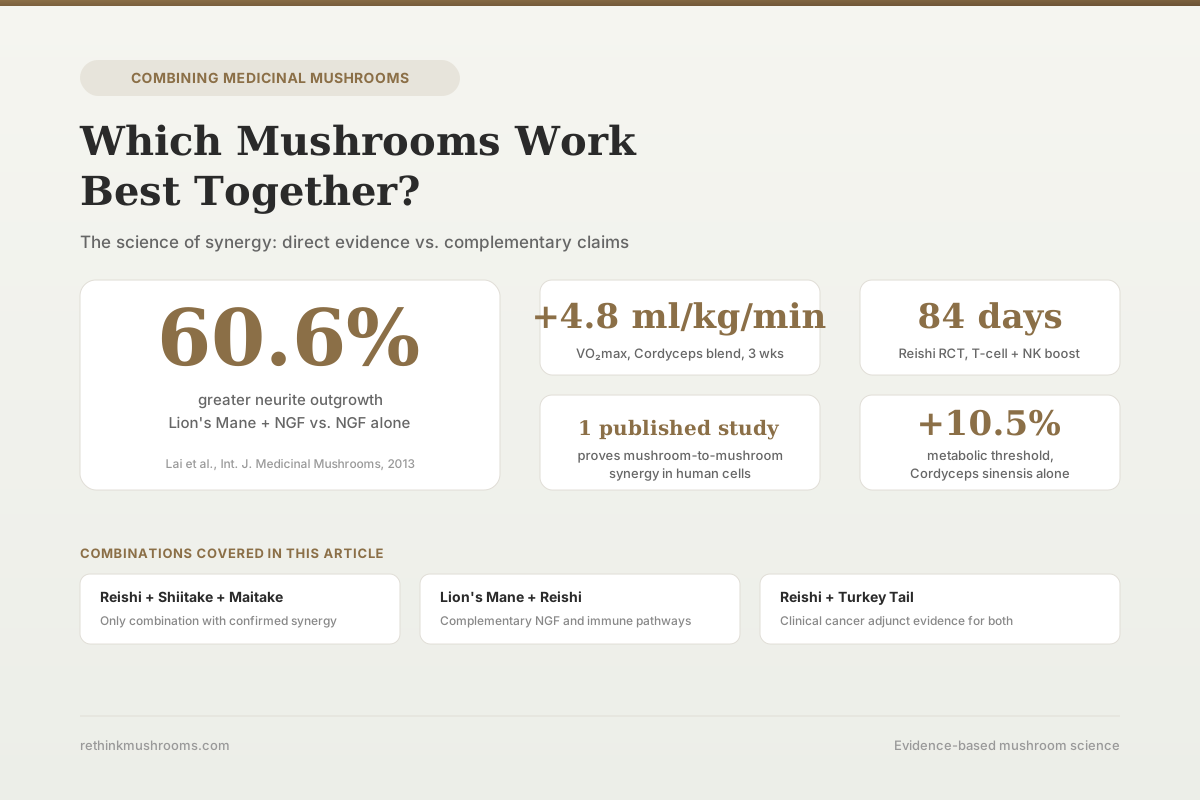
60.6% more neurite growth
Lion's mane extract combined with nerve growth factor produced 60.6% greater neurite outgrowth than NGF alone, the first direct synergy signal between a mushroom extract and a neurotrophin.
Lai et al., International Journal of Medicinal Mushrooms, 2013
1 study
directly proves mushroom-to-mushroom synergy in human cells
+4.8 ml/kg/min
VO₂max from a 3-week mushroom blend trial
84 days
reishi beta-glucan RCT showing T-cell and NK cell enhancement
Lai et al., International Journal of Medicinal Mushrooms, 2013
 View as image ↗
The word "synergy" appears on nearly every mushroom supplement label. Most of the time it means little more than "these two mushrooms both do something beneficial." That framing is not wrong, but it obscures a more precise scientific question: do any mushroom species produce effects that exceed the sum of their individual actions when tested together?
As of this writing, only one published study has directly tested and confirmed true pharmacological synergy between distinct medicinal mushroom species in a human cell model. The combination research base is thin but growing, and the gap between "complementary mechanisms" and "demonstrated synergy" matters far more than most product labels acknowledge.
This article examines what direct combination research actually shows, the molecular mechanisms that might explain why certain pairs outperform predictions, and where the current evidence genuinely ends. For a broader look at how to build mushroom stacks around specific health goals, see the complete guide to combining medicinal mushrooms.
Key Takeaways
- Only one published study has directly demonstrated pharmacological synergy between mushroom species: Mallard et al. (2019) showed a reishi, shiitake, and maitake formula produces greater-than-additive immune activation in human macrophages using curve-shift analysis.
- Lion's mane extract combined with exogenous nerve growth factor at 1 μg/mL produced 60.6% greater neurite outgrowth than NGF alone, a direct synergistic interaction at the molecular level per Lai et al. (2013).
- A Cordyceps militaris-containing mushroom blend improved VO₂max by 4.8 ml·kg⁻¹·min⁻¹ after 3 weeks in a double-blind trial (Hirsch et al., 2017), though individual mushroom contributions in the blend cannot be separated from these results.
- Reishi and Turkey Tail share overlapping but distinct mechanisms; both extend disease-free interval and overall survival as adjuncts to cancer therapies per Neuwirthova et al. (2020), but their direct combination has not been tested against either species alone.
- Different mushroom species produce structurally distinct beta-glucans that activate different immune receptors (Dectin-1, Dectin-2, TLR-2), which is the theoretical basis for why blends may exceed what any single species can achieve.
- Most marketed "mushroom stack synergy" claims are based on complementary pathways, not verified interaction testing. Distinguishing these two categories is essential for interpreting supplement labeling.
What It Means for Mushrooms to Work Best Together
In pharmacology, synergy has a precise definition. Two compounds are synergistic when their combined effect exceeds what would be predicted by adding their individual effects at the same doses. Researchers confirm synergy using curve-shift analysis and combination indices. When the combination index falls below 1.0, the interaction is synergistic. When it equals 1.0, effects are simply additive.
This is fundamentally different from complementary use, where two substances each provide useful activity through independent pathways without meaningful biochemical interaction between them. Lion's mane supports nerve growth factor production; reishi modulates inflammation through triterpenes. These are complementary mechanisms. Whether they interact synergistically at the doses typically consumed requires direct testing to establish.
The distinction carries practical implications. True synergy means that lower doses of each component can achieve effects equivalent to larger doses of either alone, which has real consequences for formulation design and dosing strategy. Products marketed as synergistic blends generally have not been put through the factorial experimental designs needed to distinguish genuine synergy from the appearance of it.
The Only Directly Demonstrated Mushroom Synergy
In 2019, Mallard and colleagues published what they described as "the first report of a synergistic immuno-modulatory response in human macrophages elicited from a mushroom formula."[1]
The study examined nine commercially available preparations from three species: reishi (Ganoderma lucidum), shiitake (Lentinula edodes), and maitake (Grifola frondosa). Rather than combining the most popular products by default, the researchers first analyzed beta-glucan and alpha-glucan content across all nine preparations. Beta-glucans are the primary immunomodulatory polysaccharides, while high alpha-glucan content is associated with starchy filler that dilutes potency. Three preparations with high beta-glucan and low alpha-glucan content were selected and combined into a formula.
The combination was tested against individual extracts for their ability to activate cytokine expression in human macrophages, measuring IL-1α, IL-6, IL-10, and TNF-α under both resting and LPS-stimulated conditions. The formula produced lower EC50 values for TNF-α expression from LPS-stimulated macrophages compared to the individual extracts, the first signal that the combination was outperforming prediction. Curve-shift analysis then confirmed that the formula produced synergistic immuno-stimulatory effects on most cytokines evaluated.
One finding is worth highlighting for its honesty: IL-10, a regulatory cytokine that helps prevent excessive immune activation, showed an antagonistic response to the combination. The formula suppressed IL-10 less than would be expected, meaning the combination was not uniformly "better" across all immune parameters. This complexity does not undermine the synergy finding but it does illustrate that combination effects are not simply about amplifying everything.
The study was conducted in cell culture, not in human subjects. EC50 values from macrophage cultures do not translate directly to supplementation doses in whole organisms. Whether the same synergistic immune activation occurs at the concentrations achievable through commercial supplements in living tissue has not been tested in a clinical trial.
Mallard et al. (2019) · PLoS ONE
- Population
- Human macrophages in cell culture (nine commercial preparations screened for β- and α-glucan content)
- Intervention
- A rationally selected reishi + shiitake + maitake formula, tested against each extract alone
- Comparator
- The individual mushroom extracts
- Finding
- The formula produced lower EC50 values for TNF-α in LPS-stimulated macrophages than any single extract, and curve-shift analysis confirmed synergistic activation of most cytokines evaluated. IL-10 was the exception, showing an antagonistic response.
preliminary Genuine curve-shift synergy — but in cell culture. EC50 values do not translate directly to supplement doses in the body, and no clinical trial has confirmed the effect in people.
Mallard et al., PLoS ONE, 2019
Lion's Mane and Reishi: Complementary Mechanisms With One Cellular Synergy Signal
The combination of lion's mane (Hericium erinaceus) and reishi is among the most frequently recommended mushroom pairings, and the mechanistic rationale is plausible. Lion's mane contains hericenones and erinacines that stimulate nerve growth factor (NGF) synthesis in nerve cells,[2] while reishi's beta-glucans and triterpenes provide immunomodulatory and anti-inflammatory activity that has been confirmed in human trials.[4]
Clinical evidence for lion's mane alone is more developed than for any combination. Mori et al. (2009) conducted a double-blind, placebo-controlled trial in 30 adults aged 50 to 80 with mild cognitive impairment. Participants taking lion's mane three times daily for 16 weeks showed significantly higher cognitive scores at weeks 8, 12, and 16 compared to the placebo group. Scores declined at week 4 after supplementation stopped, suggesting the benefit required ongoing intake.[3]
On the synergy question specifically, Lai et al. (2013) tested whether lion's mane aqueous extract interacts with exogenous NGF in NG108-15 neuroblastoma-glioma cells.[2] The combination of 10 ng/mL NGF with 1 μg/mL mushroom extract yielded a 60.6% percentage increase in neurite outgrowth. The extract contained neuroactive compounds that induced secretion of extracellular NGF, which in turn promoted further neurite outgrowth. The paper explicitly describes this as a synergistic interaction rather than an additive one, and the mesh terms include "Drug Synergism."
This finding has not been replicated in a combination trial with reishi. The lion's mane and reishi pairing remains mechanistically plausible and the lion's mane synergy signal with NGF is real, but no published study has directly tested the two mushrooms together in a synergy framework. For a focused look at mushroom combinations targeting immune modulation specifically, see the best mushroom combinations for immune support.
Cordyceps Combinations: Performance Data Without Isolation
Cordyceps is among the most common additions to performance-focused mushroom stacks. The mechanistic rationale involves ATP synthesis, mitochondrial efficiency, and oxygen utilization pathways distinct from the immune-focused mechanisms of reishi or turkey tail.
Chen et al. (2010) examined Cordyceps sinensis supplementation at 1 g daily in 20 healthy adults aged 50 to 75 in a 12-week double-blind trial.[6] The metabolic threshold increased by 10.5% and the ventilatory threshold by 8.5% compared to placebo, though VO₂max showed no significant change in either group. The metabolic threshold is the exercise intensity above which lactate begins accumulating, making this an indicator of aerobic efficiency rather than maximal capacity.
The evidence that specific multi-mushroom blends affect performance comes from Hirsch et al. (2017), who tested a mushroom blend containing Cordyceps militaris in 28 subjects using a randomized, double-blind, placebo-controlled design.[5] After three weeks, the mushroom blend group improved VO₂max by 4.8 ml·kg⁻¹·min⁻¹ and time to exhaustion by 69.8 seconds compared to negligible changes in the placebo group. After one week, significant improvements in time to exhaustion were already detectable.
The methodological limitation deserves emphasis: the Hirsch blend was a six-species formula built around Cordyceps militaris, adding reishi, lion's mane, shiitake, turkey tail, and king trumpet. The study design cannot isolate which species contributed to the outcome or whether any interaction between them exceeded what any single component would have produced alone. For a deeper analysis of the cordyceps performance evidence, the article on cordyceps for runners and endurance athletes covers the individual species data in greater detail.
Reishi and Turkey Tail: Distinct Pathways, Overlapping Cancer Adjunct Evidence
Reishi and Turkey Tail (Trametes versicolor, also known as Coriolus) represent a pairing with the most clinical context, concentrated in the cancer immunotherapy literature.
Neuwirthova et al. (2020) reviewed clinical studies on both species in cancer patients and their meta-analyses.[7] Both extracts, when used as adjuncts to standard therapy, showed benefits for immune function measures, tumor-related symptoms, performance status, disease-free interval, and overall survival. Turkey tail's primary active compounds are the polysaccharopeptides PSK (Krestin) and PSP, which have been approved as adjuvant cancer therapy in Japan for more than 30 years. Reishi operates through a different primary profile: its triterpenes and structurally distinct polysaccharides produce immune modulation through pathways that overlap partially but not completely with turkey tail's mechanisms.
The clinical significance of reishi beta-glucan alone is demonstrated by Chen et al. (2023), who conducted a randomized, double-blind, placebo-controlled trial in 126 healthy adults aged 18 to 55.[4] After 84 days, the reishi group showed significant increases in CD3+, CD4+, and CD8+ T-lymphocytes, an improved CD4/CD8 ratio, higher natural killer cell counts, and elevated serum immunoglobulin A, with no adverse effects on kidney or liver markers.
This establishes a clear baseline for reishi alone. What has not been tested is whether adding turkey tail to a reishi regimen produces outcomes greater than either species alone, or whether the two are simply additive or even redundant in some pathways. The Neuwirthova review covers parallel evidence for each, not a comparison of combinations.
Combination · Directly Tested? · Evidence · Tier
What Has Actually Been Tested for Each Mushroom Combination
Of the four most-discussed pairings, only one has been put through the factorial testing that distinguishes genuine synergy from complementary mechanisms — and that result lives in a cell culture, not a human trial.
Reishi + Shiitake + Maitake
Yes — tested head-to-head against the individual extracts
Curve-shift analysis in human macrophages confirmed greater-than-additive activation of most cytokines evaluated (IL-10 was antagonistic). The only published combination with direct pharmacological synergy evidence — but in cell culture, not people.
Ref 1 · Mallard 2019
Lion's Mane + Reishi
No — never tested together in a synergy framework
Complementary mechanisms only. Lion's mane extract did synergize with exogenous NGF (60.6% more neurite outgrowth) at the cell level, and single-species lion's mane improved cognition in a 16-week trial — but neither result involves reishi.
Refs 2, 3 · Lai 2013, Mori 2009
Cordyceps blends (performance)
Partly — only as a fixed multi-species blend
A six-species blend raised VO₂max by 4.8 ml/kg/min in 3 weeks, but the design cannot isolate which species drove it. Single-species Cordyceps sinensis shifted metabolic and ventilatory thresholds without changing VO₂max.
Refs 5, 6 · Hirsch 2017, Chen 2010
Reishi + Turkey Tail
No — studied in parallel, never as one formula
Both extend disease-free interval and survival as cancer-therapy adjuncts, through overlapping-but-distinct pathways, and reishi β-glucan alone enhanced T-cell and NK-cell counts over 84 days. Their direct combination has not been tested against either alone.
Refs 4, 7 · Neuwirthova 2020, Chen 2023
Only the reishi–shiitake–maitake formula has been directly tested for synergy. Every other pairing rests on complementary mechanisms, un-isolable blends, or parallel single-species data — which is why most “synergy” label claims outrun what the research shows.
Source: Mallard et al. (2019); Lai et al. (2013); Mori et al. (2009); Chen et al. (2023); Hirsch et al. (2017); Chen et al. (2010); Neuwirthova et al. (2020)
How Different Beta-Glucan Structures May Enable Synergy
The mechanistic case for mushroom synergy beyond the immune context rests on receptor biology. Mushroom beta-glucans are not structurally identical across species. They differ in polymer chain length, branching frequency, and the ratio of beta-1,3 to beta-1,6 glucosidic linkages. These structural differences determine which pattern recognition receptors on immune cells they engage.
The primary receptors involved in fungal beta-glucan recognition include Dectin-1, which is the main receptor for particulate beta-1,3-glucans with beta-1,6 branches, and TLR-2 and TLR-4, which respond to different molecular motifs. Co-stimulation of macrophages through Dectin-1 and TLR-4 simultaneously has been shown to produce synergistic cytokine production that exceeds what either receptor's activation alone predicts. Both receptors converge on NF-kB activation but through distinct intracellular signaling cascades, and simultaneous engagement of multiple pattern recognition receptors appears to produce non-additive immune responses.
This is the theoretical framework that may explain the Mallard 2019 result. By rationally selecting reishi, shiitake, and maitake extracts based on beta-glucan content and composition, the researchers may have created a formula whose components engaged a more diverse receptor profile than any single species extract could achieve. Different mushroom species produce beta-glucans that vary in solubility, molecular weight, and fine structure, all of which affect receptor binding and downstream signaling.
This framework also implies that not all mushroom combinations would be synergistic. Two species with highly similar beta-glucan structures might activate the same receptors and produce only additive effects. Structural characterization of the specific polysaccharides being combined is a prerequisite for predicting whether synergy is achievable, and most commercial products do not provide this data. For a focused analysis of how beta-glucan structure affects immune activation across species, see chaga beta-glucans and immune cell activation.
Questions about whether combining multiple mushroom species outperforms a single species for immune purposes are explored in detail at combining immune mushrooms: is a blend better than one species?.
Fact check
Are marketed mushroom blends 'synergistic'?
The claim
“Our synergistic blend combines mushrooms that work together for effects greater than any single species.”
Supplement marketing that borrows the pharmacology term 'synergy' to describe what is usually just two mushrooms with complementary benefits.
What research shows
OverstatedExactly one published study has directly demonstrated pharmacological synergy between mushroom species — a reishi, shiitake, and maitake formula that produced greater-than-additive immune activation in human macrophages using curve-shift analysis.
That result was in cell culture, depended on a specific glucan-content-matched ratio, and has not been reproduced in people. Most blends are never tested as combinations at all, so their 'synergy' claim describes complementary mechanisms, not verified interaction.
Mallard et al., PLoS ONE, 2019
What Direct Combination Research Cannot Yet Establish
Several questions that matter for practical use remain unresolved by the current literature:
Clinical translation from cell studies: The Mallard 2019 synergy finding was demonstrated in human macrophage cell culture. Whether the same interaction occurs in intact organisms at supplementation doses achievable through commercial products has not been tested in clinical trials. EC50 values measured in cells do not translate linearly to human intake amounts.
Dose ratios: The synergy in Mallard 2019 depended on a specific ratio of the three extracts, which was itself derived from systematic beta-glucan content analysis across nine commercially available preparations. The optimal combination ratio for any given health objective has not been established in human trials, and the "right" ratio almost certainly varies with extraction method and batch variation in raw material.
Gut microbiome interactions: Polysaccharides from mushrooms act as prebiotics and are metabolized in the colon by microbiota before significant systemic absorption occurs. Individual gut microbiome composition likely affects how different beta-glucans are processed and what downstream signaling occurs. How different mushroom polysaccharides interact in the gut environment, and whether combinations produce different fermentation profiles than single species, has not been studied systematically.
Polysaccharide and triterpene interactions: Reishi contains a substantial triterpene fraction alongside its polysaccharides. Whether combinations between reishi's triterpenes and the polysaccharide-rich fractions of other mushrooms produce meaningful pharmacological interactions has not been directly addressed. Most synergy research has focused on polysaccharide fractions.
Duration effects: Whether synergy observed acutely in cell culture translates to sustained effects with chronic supplementation, and whether any combination effects diminish with continued use due to receptor downregulation, remains untested at the combination level.
Species specificity of the evidence base: Published combination research focuses almost exclusively on the most commercially prominent species: reishi, shiitake, maitake, lion's mane, cordyceps, and turkey tail. The functional mushroom space includes thousands of species with documented bioactive compounds, and the combination landscape among less-studied species is nearly unexplored.
For guidance on how many mushrooms can be taken simultaneously and what safety data shows, see can you take too many mushrooms at once?. For the full strategic approach to building a mushroom stack matched to specific goals, 5 evidence-based mushroom stacks applies the combination literature to practical use cases.
- Cell & Lab Studiescurrent
The ceiling for any direct synergy claim: Mallard 2019 confirmed curve-shift synergy in human macrophages, and Lai 2013 documented a synergistic lion's-mane-plus-NGF signal in neuroblastoma cells. Both are cell culture.
- Animal Studiesmissing
No study has tested a defined mushroom combination for greater-than-additive effects in an animal model.
- Small Human Trialsmissing
Human blend trials exist (Hirsch 2017), but by design they cannot separate synergy from the effects of the individual species, so they do not test the synergy question at all.
- Large Randomized Trialsmissing
No large trial has compared a mushroom combination against its individual components in people.
- Meta-Analyses & Systematic Reviewsmissing
There is no body of combination-synergy trials to synthesize.
For the synergy question specifically, the evidence tops out at the very first rung. Every direct demonstration lives in a cell culture; no animal or human study has confirmed that any mushroom combination beats its individual parts.
Mallard et al. (2019); Lai et al. (2013); Hirsch et al. (2017)
Safety
Moderate'Natural blend' does not mean 'proven' or 'interaction-free'
Concern
Because mushroom blends are marketed as synergistic and natural, people may combine several species — or add them to cancer therapy or prescription medications — assuming proven benefit and zero risk. The combination-superiority evidence is thin, and reishi and turkey tail are discussed here specifically in the context of cancer treatment, where interactions with therapy matter.
What the research says
At standard supplement doses, common medicinal mushrooms have not shown serious safety signals, and reishi and turkey tail have been used alongside cancer therapies for extended periods. But no combination has been established as superior to a single species, and safety in the context of active medical treatment depends on the individual case.
Particularly relevant for: People undergoing cancer treatment, taking prescription medications, pregnant or breastfeeding, or managing a chronic condition
What to do
Review any mushroom regimen — especially alongside cancer therapy or other medications — with your physician or oncology team. This article is educational and not medical advice.
Neuwirthova et al. (2020); Chen et al. (2023); Hirsch et al. (2017)
The Bottom Line
One published study has directly demonstrated pharmacological synergy between medicinal mushroom species, confirming that a reishi, shiitake, and maitake formula produces greater-than-additive immune activation in human macrophages. Beyond this, the evidence for combination benefit comes from complementary mechanisms in individual species and from multi-species blend trials that cannot isolate synergistic contributions. Most marketed combination synergy claims exceed what the current research base directly demonstrates.
Frequently Asked Questions
Sources & References
- 1RTHM-00580·Mallard, Brody et al. (2019). “Synergistic immuno-modulatory activity in human macrophages of a medicinal mushroom formulation consisting of Reishi, Shiitake and Maitake..” PloS one.Study breakdown →PubMed →↩
- 2RTHM-00295·Lai, Puei-Lene et al. (2013). “Neurotrophic properties of the Lion's mane medicinal mushroom, Hericium erinaceus (Higher Basidiomycetes) from Malaysia..” International journal of medicinal mushrooms.Study breakdown →PubMed →↩
- 3RTHM-00165·Mori, Koichiro et al. (2009). “Improving effects of the mushroom Yamabushitake (Hericium erinaceus) on mild cognitive impairment: a double-blind placebo-controlled clinical trial..” Phytotherapy research : PTR.Study breakdown →PubMed →↩
- 4RTHM-01673·Chen, Shiu-Nan et al. (2023). “Evaluation of Immune Modulation by β-1,3; 1,6 D-Glucan Derived from Ganoderma lucidum in Healthy Adult Volunteers, A Randomized Controlled Trial..” Foods (Basel.Study breakdown →PubMed →↩
- 5RTHM-00473·Hirsch, Katie R et al. (2017). “Cordyceps militaris Improves Tolerance to High-Intensity Exercise After Acute and Chronic Supplementation..” Journal of dietary supplements.Study breakdown →PubMed →↩
- 6RTHM-00176·Chen, Steve et al. (2010). “Effect of Cs-4 (Cordyceps sinensis) on exercise performance in healthy older subjects: a double-blind, placebo-controlled trial..” Journal of alternative and complementary medicine (New York.Study breakdown →PubMed →↩
- 7RTHM-01264·Neuwirthová, Jana et al. (2020). “Immunostimulatory and anticancer effect of Reishi and Coriol extracts at the level of clinical studies and their implementation in practice..” Klinicka onkologie : casopis Ceske a Slovenske onkologicke spolecnosti.Study breakdown →PubMed →↩