Mushroom Combinations & Stacking
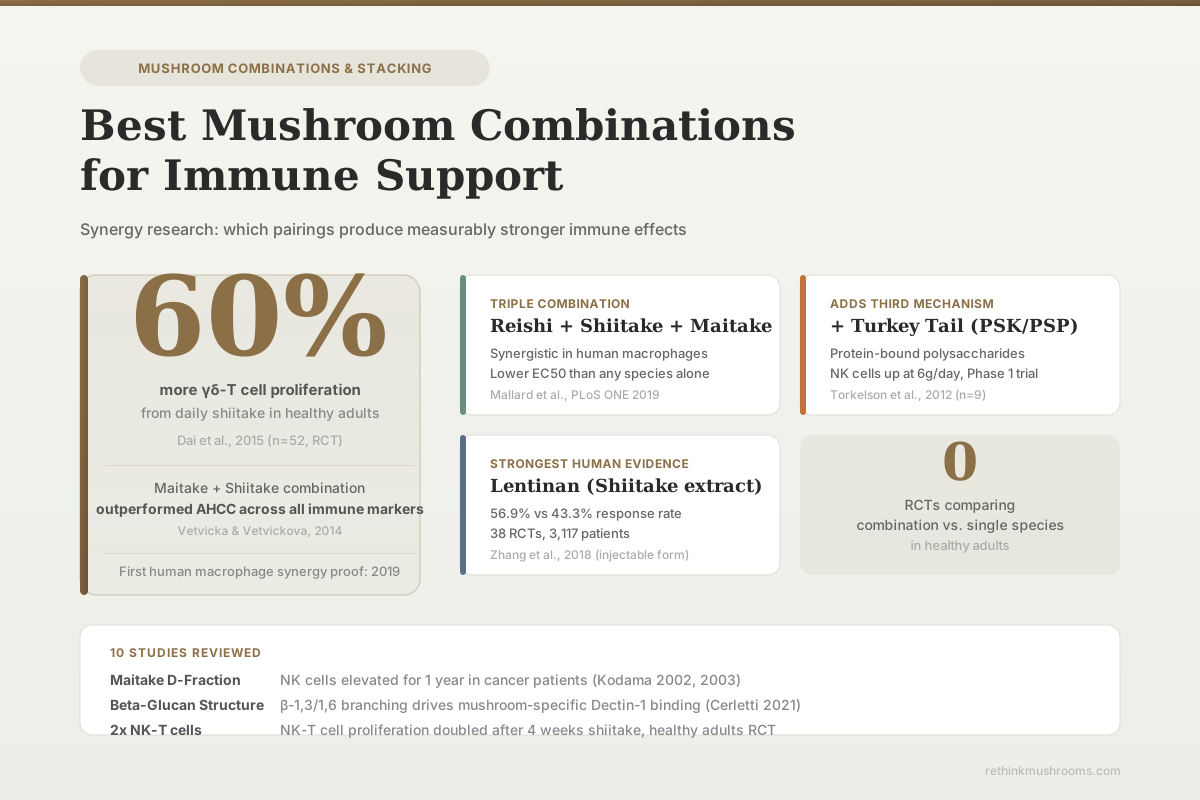
60% more immune cell activity
Daily shiitake consumption for 4 weeks increased γδ-T cell proliferation by 60% in healthy adults. Pairing it with maitake outperforms both species individually and AHCC across every immune marker measured.
Dai et al., J Am Coll Nutr, 2015; Vetvicka & Vetvickova, Ann Transl Med, 2014
2019
year synergy was first proved in human macrophages for a mushroom formula
38 RCTs
included in lentinan (shiitake) combination meta-analysis, 3,117 patients
3 species
with strongest direct combination evidence: Reishi, Shiitake, Maitake
Dai et al., J Am Coll Nutr, 2015; Vetvicka & Vetvickova, Ann Transl Med, 2014
 View as image ↗
Among the hundreds of mushroom combinations sold for immune support, very few have been tested directly for synergy. Most commercial blends are assembled on instinct, not evidence. A 2019 study by Mallard and colleagues changed that picture. For the first time, researchers tested a formula of Reishi, Shiitake, and Maitake in human macrophages and found that the combination produced greater immune activation than any of the three extracts alone, a result they described as synergistic rather than merely additive.[1] That distinction matters: additive means the whole equals the sum of its parts; synergistic means the whole exceeds them.
This article examines the direct evidence for immune-supporting mushroom combinations, including which species have been tested together, what immune mechanisms each one engages, and where the research has genuine limits. For the complete framework on combining mushrooms across all goals, see Combining Medicinal Mushrooms: The Ultimate Stacking Guide.
Key Takeaways
- A 2019 lab study found Reishi + Shiitake + Maitake together produced synergistic immune activation in human macrophages, with lower EC50 values for TNF-α than any single extract alone (Mallard et al., PLoS ONE)
- In a direct head-to-head comparison, the Maitake-Shiitake combination ranked as the most active across NK cell activity, phagocytosis, and cytokine secretion, outperforming both individual species and AHCC (Vetvicka & Vetvickova, 2014)
- Daily shiitake consumption (5-10g) for 4 weeks increased γδ-T cell proliferation 60% and NK-T cell activity 2-fold in 52 healthy adults in a randomized trial (Dai et al., 2015)
- A meta-analysis of 38 randomized controlled trials found lentinan (a shiitake beta-glucan) added to chemotherapy raised overall response rates from 43.3% to 56.9% in lung cancer patients across 3,117 patients
- Turkey Tail at 6g/day in a Phase 1 clinical trial showed trends toward increased NK cell functional activity and lymphocyte counts after radiotherapy (Torkelson et al., 2012)
- No randomized controlled trial has yet directly compared a multi-species mushroom combination against single-species arms in healthy humans; the synergy evidence remains in vitro and ex vivo
Why Different Mushrooms Engage Different Immune Pathways
Mushroom beta-glucans are not interchangeable. Their immunomodulatory effects depend on chain length, branching frequency, and the ratio of β-1,3 to β-1,6 linkages. Cerletti and colleagues (2021) reviewed this structural diversity and noted that mushroom beta-glucans, characterized by β-1,3 backbone chains with β-1,6 side branches, bind to immune receptors differently than the linear β-1,3 glucans found in cereals.[10] This structural specificity is not trivial; it determines which receptors on macrophages and NK cells recognize the compound.
Maitake's D-Fraction is a branched beta-1,6-glucan with beta-1,3 branches. Shiitake's lentinan is a triple-helical beta-1,3-glucan with beta-1,6 side chains. Reishi contains both polysaccharides and triterpenoids, the latter being anti-inflammatory compounds absent from Shiitake and Maitake. Turkey Tail adds yet another structural class: protein-bound polysaccharides (PSK and PSP) that engage different molecular targets than free beta-glucans.
When structurally distinct compounds from multiple species reach macrophages and NK cells simultaneously, they can engage multiple pattern recognition receptors through complementary binding. This is the mechanistic argument for combinations. The Mallard 2019 study tested whether this argument holds in actual human macrophages. It does. For a deeper look at how beta-glucan structure drives immune recognition, see Beta-Glucans and Anti-Tumor Immunity: Mechanisms Explained.
The Reishi + Shiitake + Maitake Formula: First Direct Synergy Evidence
The most rigorous combination-specific study published to date is Mallard et al. (2019), published in PLoS ONE. The researchers first screened nine commercially available preparations from Reishi (Ganoderma lucidum), Shiitake (Lentinula edodes), and Maitake (Grifola frondosa), selecting three based on beta-glucan content and alpha-glucan concentration. Alpha-glucans, which predominate in mycelium-on-grain products, do not activate immune pathways the way beta-glucans do.[1]
The three selected extracts were tested both individually and as a combined formula in human macrophages, measuring IL-1α, IL-6, IL-10, and TNF-α expression with and without LPS stimulation. The formula showed lower EC50 values for TNF-α from LPS-stimulated macrophages compared to each individual extract. A lower EC50 means greater potency at smaller concentrations. Response additivity analysis and curve-shift analysis both confirmed that the combined effect was synergistic for most cytokines, not merely additive. The one exception was IL-10, an anti-inflammatory cytokine that showed an antagonistic response from the formula. The combination amplified pro-inflammatory immune signaling while dampening a counterregulatory signal.
The study authors described this as the first report of a synergistic immuno-modulatory response in human macrophages from a mushroom formula rationally derived from beta-glucan content. This matters because it provides a selection principle: the ratio and type of beta-glucans in the extracts used, not just the species, drives the synergistic outcome.
For practical guidance on how to use this combination, see 5 Evidence-Based Mushroom Stacks for Different Goals.
Maitake + Shiitake: The Most Active Pairing in Comparative Testing
Vetvicka and Vetvickova (2014) took a direct comparative approach that is unusual in the mushroom literature. They administered beta-glucan preparations from Maitake alone, Shiitake alone, the Maitake-Shiitake combination, and AHCC (a standardized Shiitake mycelium extract widely marketed for immunity) at equivalent doses, then measured phagocytosis, NK cell activity, IL-6, IL-12, IFN-γ secretion, and CRP after 14 days of oral administration.[3]
The Maitake-Shiitake combination ranked most active across all immune endpoints measured. Maitake alone was second. Shiitake alone was third. AHCC ranked last. Short-term oral administration of the combination produced the strongest stimulation of both the cellular and humoral branches of immune response among all preparations tested.
AHCC's ranking below whole mushroom preparations in this direct comparison deserves attention. The structural differences between cultured mycelium extracts and whole fruiting body beta-glucans likely explain the discrepancy. The integrity of the triple-helical lentinan structure, which can be degraded by processing, affects receptor binding and downstream immune activation.
Turkey Tail Adds a Third Structural Class
Turkey Tail (Trametes versicolor) contributes something structurally distinct from Reishi, Shiitake, and Maitake. Its primary immunomodulatory compounds are polysaccharopeptide (PSP) and polysaccharide-K (PSK), both protein-bound polysaccharides rather than free beta-glucans. This structural difference means Turkey Tail likely engages immune pathways the other three species do not reach through their beta-glucans alone.
Torkelson and colleagues (2012) conducted a Phase 1 dose-escalation clinical trial of Trametes versicolor in nine women with breast cancer following standard radiotherapy, with participants receiving 3, 6, or 9 grams per day for six weeks.[5] At 6g/day, the trial observed trends toward increased NK cell functional activity. At 6 and 9g/day, CD8+ T cells and CD19+ B cells showed dose-related increases. The findings were trends rather than statistically confirmed outcomes, reflecting the study's Phase 1 safety focus and small enrollment (nine completers). Adverse events were mostly mild, and the preparation was tolerated at all doses up to 9g/day.
The broader five-mushroom review by Guggenheim, Wright, and Zwickey (2014) mapped the immune mechanisms of Agaricus blazei, Cordyceps sinensis, Maitake, Reishi, and Turkey Tail separately and found that each modifies cytokines through distinct cellular pathways, supporting the rationale for combinations that span more than one structural class.[7]
For a focused look at whether blending immune mushrooms consistently outperforms single species, see Combining Immune Mushrooms: Is a Blend Better Than One Species?.
Shiitake as the Combination Anchor: What Daily Consumption Does
Shiitake appears in every major immune-focused mushroom combination studied, and a well-designed randomized trial establishes why. Dai and colleagues (2015) enrolled 52 healthy adults aged 21-41 and randomly assigned them to consume 5g or 10g of whole dried Lentinula edodes daily for four weeks.[8]
After four weeks, both groups showed 60% greater ex vivo proliferation of γδ-T cells (p < 0.0001) and a 2-fold increase in NK-T cell activity (p < 0.0001) compared to pre-intervention baselines. Both cell types also demonstrated enhanced activation receptor expression, meaning they were not simply more numerous but better primed to respond to immune challenges. Salivary IgA increased, suggesting improved mucosal immunity. Serum CRP decreased, indicating reduced systemic inflammation. The 5g and 10g groups showed comparable results within this dose range.
This is one of the few randomized trials on mushroom immune effects conducted in healthy people rather than cancer patients or immunocompromised populations.
Extending to a pharmaceutical form, Zhang and colleagues (2018) reviewed 38 randomized controlled trials of lentinan, an injectable purified beta-glucan from Shiitake approved as a clinical drug in Japan and South Korea, in 3,117 lung cancer patients.[9] Adding lentinan to standard chemotherapy increased the overall response rate from 43.3% to 56.9%. Quality of life improved alongside chemotherapy efficacy. The data is specific to the injectable form in cancer treatment, which differs substantially from oral whole-mushroom or extract supplementation, but it establishes the immune-relevant biological activity of Shiitake beta-glucans at a scale of evidence no other mushroom species currently matches.
Maitake D-Fraction: How NK Cell Activation Works
Maitake's immune mechanism centers on its D-Fraction beta-glucan, which activates NK cells through a macrophage-IL-12 cascade. Kodama and colleagues (2002) traced this pathway in tumor-bearing mice and cancer patients: D-Fraction administration elevated macrophage-derived IL-12 secretion, which then activated NK cells, corresponding with increased TNF-α and IFN-γ from spleen cells and suppressed tumor growth over 19 days.[4]
In cancer patients receiving D-Fraction without conventional drugs, elevated NK cell cytotoxic activity was maintained for one year across the monitoring period (Kodama et al., 2003).[2] NK cell activity increased in all patients examined, tumor markers lessened, and metastatic progression was hindered. The study was small and lacked a control group, which limits clinical interpretation, but the NK cell activation data is mechanistically consistent with the in vitro and animal findings.
This IL-12-driven NK cell pathway is distinct from Shiitake's lentinan mechanism and from Reishi's triterpenoid pathways. It is also distinct from Turkey Tail's PSK-mediated T cell pathways. This mechanistic separation across species is what provides the rationale for multi-species immune formulas.
Reishi's Role: Modulation as Much as Stimulation
Reishi (Ganoderma lucidum) plays a more complex immune role than Shiitake or Maitake. Its polysaccharides stimulate macrophages, T cells, NK cells, and dendritic cells, but its triterpenoids exert anti-inflammatory effects that modulate rather than simply amplify immune responses.
Gao and colleagues (2005) tested water-soluble Ganoderma lucidum polysaccharides at 5.4g/day in 30 advanced lung cancer patients for 12 weeks in an open-label study.[6] Mean immune cell counts and cytokine concentrations did not significantly shift across the full group, but individual patients showed marked immune modulation. Changes in IL-1 correlated significantly with IL-6, IFN-γ, CD3, CD8, and NK activity (p < 0.05), suggesting that Reishi polysaccharides may engage immune-responsive subgroups rather than producing uniform activation.
This variability in Reishi's immune effects across individuals has important implications for combination formulas. In the Mallard 2019 synergy study, Reishi contributed to synergistic macrophage activation in a controlled ex vivo environment. In the Gao 2005 clinical study, oral Reishi polysaccharides produced heterogeneous responses in cancer patients. Both observations can be true simultaneously: Reishi contributes meaningfully to a combination at the cellular level while its clinical immune effects in diverse populations remain difficult to predict. For Reishi's respiratory immune evidence specifically, see Can Reishi Help Prevent Colds and Flu? Clinical Evidence.
What the Evidence Does Not Show
Human RCTs comparing combinations against single species do not exist. Every study that has directly compared a mushroom combination against individual species has been conducted in vitro, ex vivo, or in animals. The Vetvicka 2014 study compared combinations but was not a randomized clinical trial in humans. No published study has enrolled healthy adults, randomized them to Reishi alone, Shiitake alone, Maitake alone, or a three-species combination, and measured clinical immune outcomes.
Combination dosing is not studied. The Mallard 2019 formula used specific extracts selected on beta-glucan content, but no dose-response relationship for the combined formula was characterized. Whether the synergistic effect holds at lower doses, and how individual extract amounts within a blend should be weighted, is unknown. Most commercial formulas contain small amounts of many species; whether any of those doses reach biologically relevant concentrations is typically untested.
Most beta-glucan research uses injectable or purified forms. The lentinan data comes from an injectable drug. The D-Fraction research uses a purified oral extract, not whole mushroom powder. Commercial oral supplements with uncharacterized beta-glucan content and integrity may produce substantially different immune effects than the preparations used in any of these studies.
Population-specific response data is sparse. The Dai 2015 shiitake RCT used healthy adults aged 21-41. The Kodama studies used cancer patients. The Torkelson trial used cancer patients after radiotherapy. Whether multi-species combinations produce comparable immune activation in healthy older adults, people with autoimmune conditions, or people under chronic stress has not been tested.
For safety considerations specific to multi-species immune regimens, see Can You Take Too Many Mushrooms at Once? Safety of Combinations. For the broader question of which individual species pair best for general goals, see Which Mushrooms Work Best Together? Synergy Research.
The Bottom Line
Combinations of Reishi, Shiitake, and Maitake have produced synergistic immune activation in human macrophages, with a 2019 PLoS ONE study demonstrating greater cytokine potency from the three-species formula than from any individual extract. Direct comparative experiments confirm the Maitake-Shiitake pairing outperforms both species alone and AHCC across NK cell activity, phagocytosis, and cytokine markers. Turkey Tail adds structurally distinct immune mechanisms through protein-bound polysaccharides. The largest gap in this evidence base is the absence of randomized clinical trials comparing multi-species combinations against single-species controls in healthy humans; the synergy data is mechanistically strong but has not been tested at the clinical outcomes level.
Frequently Asked Questions
Sources & References
- 1RTHM-00580·Mallard, Brody et al. (2019). “Synergistic immuno-modulatory activity in human macrophages of a medicinal mushroom formulation consisting of Reishi, Shiitake and Maitake..” PloS one.Study breakdown →PubMed →↩
- 2RTHM-00112·Kodama, Noriko et al. (2003). “Effect of Maitake (Grifola frondosa) D-Fraction on the activation of NK cells in cancer patients..” Journal of medicinal food.Study breakdown →PubMed →↩
- 3RTHM-00654·Vetvicka, Vaclav et al. (2014). “Immune-enhancing effects of Maitake (Grifola frondosa) and Shiitake (Lentinula edodes) extracts..” Annals of translational medicine.Study breakdown →PubMed →↩
- 4RTHM-00096·Kodama, Noriko et al. (2002). “Effects of D-Fraction, a polysaccharide from Grifola frondosa on tumor growth involve activation of NK cells..” Biological & pharmaceutical bulletin.Study breakdown →PubMed →↩
- 5RTHM-00267·Torkelson, Carolyn J et al. (2012). “Phase 1 Clinical Trial of Trametes versicolor in Women with Breast Cancer..” ISRN oncology.Study breakdown →PubMed →↩
- 6RTHM-00152·Gao, Yihuai et al. (2005). “Effects of water-soluble Ganoderma lucidum polysaccharides on the immune functions of patients with advanced lung cancer..” Journal of medicinal food.Study breakdown →PubMed →↩
- 7RTHM-00323·Guggenheim, Alena G et al. (2014). “Immune Modulation From Five Major Mushrooms: Application to Integrative Oncology..” Integrative medicine (Encinitas.Study breakdown →PubMed →↩
- 8RTHM-00368·Dai, Xiaoshuang et al. (2015). “Consuming Lentinula edodes (Shiitake) Mushrooms Daily Improves Human Immunity: A Randomized Dietary Intervention in Healthy Young Adults..” Journal of the American College of Nutrition.Study breakdown →PubMed →↩
- 9RTHM-00538·Zhang, Yiran et al. (2018). “Lentinan as an immunotherapeutic for treating lung cancer: a review of 12 years clinical studies in China..” Journal of cancer research and clinical oncology.Study breakdown →PubMed →↩
- 10RTHM-00676·Cerletti, Chiara et al. (2021). “Edible Mushrooms and Beta-Glucans: Impact on Human Health..” Nutrients.Study breakdown →PubMed →↩