Mushroom Combinations and Stacking
5 Research-Backed Stacks
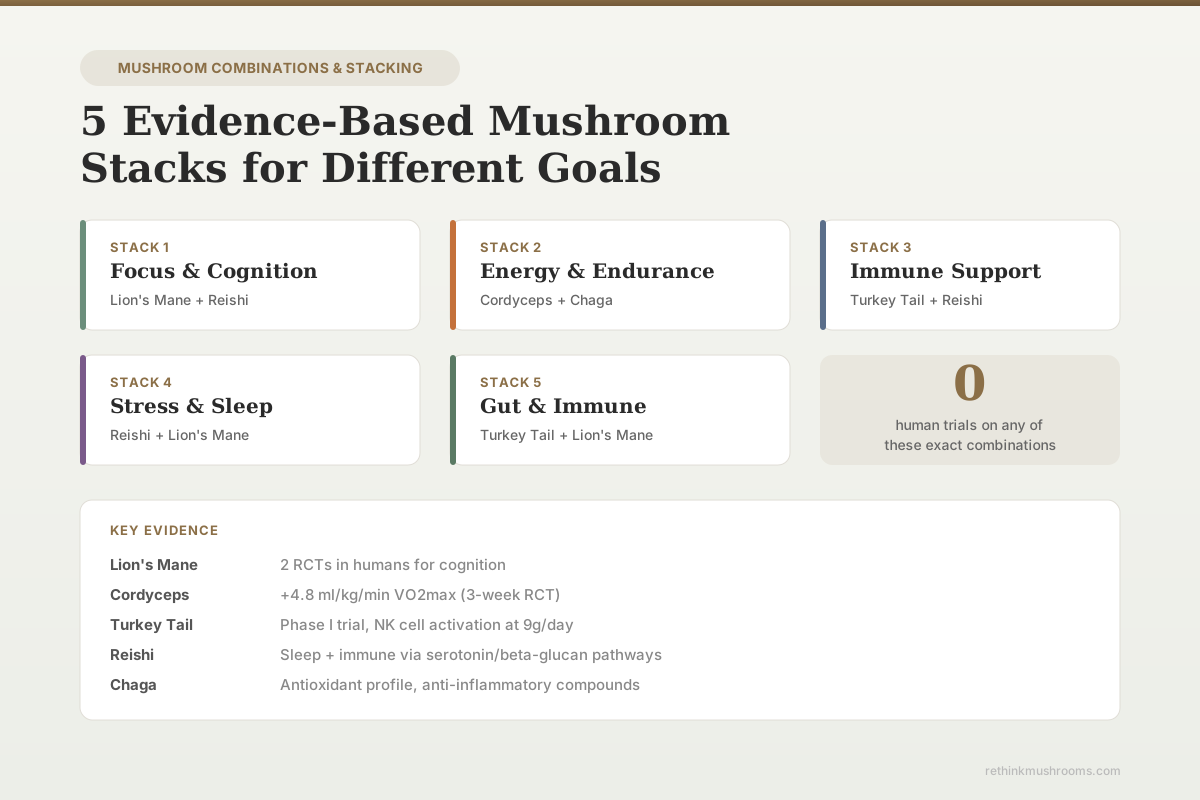
Each mushroom stack below pairs species that have been studied for a specific outcome. The evidence ranges from randomized controlled trials to preclinical animal data. No stack has been studied as a combination in humans.
Multiple sources; see individual citations
10 Species Covered
across 5 goal-specific stacks
0 Combo Trials
no human trial has tested these exact pairings
RCT to Preclinical
evidence strength varies by species and goal
Multiple sources; see individual citations
 View as image ↗
Mushroom supplement brands sell multi-species blends with names like "10 Mushroom Complex" or "Ultimate Shroom Stack." These products bundle anywhere from 3 to 14 species into a single capsule and promise benefits across cognition, immunity, energy, and stress. The problem: no published study has tested any of these specific combinations in humans. The species are studied individually. The stacks are assembled by marketers.
That does not mean combining mushroom species is pointless. It means the evidence for each species exists on its own, and combining them is a logical hypothesis, not a proven formula. Below are five stacks built from species that have individual research support for a specific goal. Each entry includes the evidence level, what the research found, and what it did not test. For a deeper look at which mushrooms work best together based on synergy research, that gets its own article. The ultimate stacking guide covers dosing and timing considerations.
Key Takeaways
- A 2023 double-blind pilot study found lion's mane improved reaction time on a cognitive task at 60 minutes post-dose in 41 healthy adults (Docherty et al., Nutrients, 2023)
- Cordyceps militaris supplementation for 3 weeks improved VO2max by 4.8 ml/kg/min in a randomized controlled trial of 28 young adults (Hirsch et al., Journal of Dietary Supplements, 2017)
- A Phase I dose-escalation trial of turkey tail (Trametes versicolor) at 3, 6, or 9 g daily reported increased NK cell functional activity at the 6 g/day dose and increased lymphocyte counts at 6 and 9 g/day, with up to 9 g/day judged safe and tolerable in 9 women completing the study after breast-cancer radiotherapy (Torkelson et al., ISRN Oncology, 2012)
- Reishi promoted sleep through a serotonin-involved pathway in a mouse model, shortening sleep latency and extending sleep duration (Yao et al., Scientific Reports, 2021)
- A 2009 RCT in 30 elderly Japanese adults with mild cognitive impairment found lion's mane significantly improved cognitive function scores at weeks 8, 12, and 16 (Mori et al., Phytotherapy Research, 2009)
- No published human trial has tested any multi-species mushroom combination for synergistic effects
Goal · Pairing · Anchor Evidence · Tier
Five Stacks, Ranked by the Evidence Behind Their Anchor Species
Each stack’s tier reflects the strongest data for its lead species alone. Two stacks are anchored by human RCTs, one by a small human Phase I trial, and two rest mainly on preclinical or non-significant results.
Focus & Cognition
Lion's Mane + Reishi
Anchor: Lion's mane (Hericium erinaceus)
A 2009 double-blind RCT in 30 adults with mild cognitive impairment improved cognitive scores at weeks 8, 12 and 16; a 2023 pilot in 41 healthy adults sped Stroop-task reaction time 60 minutes after a single dose. Reishi’s contribution is preclinical.
Refs 1, 2
Energy & Endurance
Cordyceps + Chaga
Anchor: Cordyceps militaris
A 2017 double-blind RCT in 28 adults raised VO₂max by 4.8 ml/kg/min after 3 weeks (vs 0.9 in placebo, p = 0.042) using a cordyceps-containing blend. Chaga adds only review-level antioxidant rationale, with no human exercise-recovery data.
Ref 4
Immune Support
Turkey Tail + Reishi
Anchor: Turkey tail (Trametes versicolor)
A 2012 Phase I dose-escalation trial in 9 women after breast-cancer radiotherapy reported increased NK-cell functional activity at 6 g/day and higher lymphocyte counts at 6 and 9 g/day. Small, uncontrolled, safety-focused. Reishi adds a separate macrophage pathway.
Ref 7
Stress & Sleep
Reishi + Lion's Mane
Anchor: Reishi (Ganoderma lucidum)
Reishi shortened sleep latency and extended sleep duration via a serotonin-involved pathway — in mice, not humans. The lion’s-mane stress signal was a non-significant trend after 28 days (p = 0.051). This is the weakest-anchored stack.
Refs 2, 3
Gut & Immune Foundations
Turkey Tail + Lion's Mane
Anchor: Turkey tail (Trametes versicolor)
Turkey tail was well tolerated up to 9 g/day with no gastrointestinal adverse events, and its polysaccharides are prebiotic in nature. Gut-specific benefit rests on mechanism and traditional use, not on human digestive-endpoint trials.
Refs 1, 3, 7
Every tier above measures one species on its own. No published human trial has tested any of these two-species pairings as a combination, so “stack” evidence remains a hypothesis assembled from single-species studies.
Source: Mori et al. (2009); Docherty et al. (2023); Yao et al. (2021); Hirsch et al. (2017); Torkelson et al. (2012)
Stack 1: Focus and Cognition (Lion's Mane + Reishi)
Goal: Mental clarity, reaction time, stress reduction during cognitive work
The individual evidence:
Lion's mane (Hericium erinaceus) has the strongest human evidence for cognitive effects among medicinal mushrooms. A 2009 randomized, double-blind, placebo-controlled trial by Mori and colleagues tested lion's mane in 30 Japanese men and women aged 50-80 with mild cognitive impairment.[1] The lion's mane group showed significantly higher scores on the cognitive function scale at weeks 8, 12, and 16 compared to placebo. When supplementation stopped, scores declined.
A 2023 double-blind pilot study by Docherty and colleagues tested 1.8g of lion's mane daily in 41 healthy adults aged 18-45.[2] After a single dose, participants performed faster on the Stroop task (a measure of processing speed and selective attention) at 60 minutes post-dose. After 28 days of daily use, there was a trend toward reduced subjective stress (p = 0.051), though this did not reach statistical significance.
Reishi (Ganoderma lucidum) contributes to this stack through its calming properties. Yao and colleagues showed in 2021 that reishi extract promoted sleep in mice through a gut microbiota-dependent, serotonin-involved pathway.[3] While this is an animal study, the proposed mechanism (increased serotonin signaling) is consistent with reduced stress during waking hours. The logic: lion's mane supports processing speed while reishi reduces the stress that impairs concentration.
What is not proven: No study has tested lion's mane and reishi together. The interaction between them is theoretical. The Mori 2009 trial used 3g/day of lion's mane. The Docherty 2023 trial used 1.8g/day. Doses in commercial stacks are typically much lower.
Stack 2: Physical Energy and Endurance (Cordyceps + Chaga)
Goal: Exercise tolerance, VO2max, recovery
The individual evidence:
Cordyceps militaris has the most direct exercise performance data. Hirsch and colleagues published a randomized, double-blind, placebo-controlled trial in 2017 testing a cordyceps-containing mushroom blend in 28 healthy adults (mean age 22.7).[4] After 3 weeks of supplementation, VO2max improved by 4.8 ml/kg/min in the mushroom group compared to 0.9 ml/kg/min in the placebo group (p = 0.042). Time to exhaustion also improved: +28.1 seconds after 1 week and +69.8 seconds after 3 weeks. One week of supplementation alone did not produce significant changes in VO2max, suggesting the effect requires consistent use.
Choi and colleagues confirmed in a 2020 study that cordyceps militaris extract promoted cellular energy production via ATP synthesis pathways.[5] This preclinical work provides a mechanistic explanation for the exercise performance findings.
Chaga (Inonotus obliquus) brings antioxidant capacity to this stack. A 2024 review by Ern and colleagues in Mycology cataloged chaga's bioactive compounds — polysaccharides, triterpenoids, polyphenols, and lignin metabolites — and the antioxidant, anti-inflammatory, and anti-fatigue activities reported in the underlying literature.[6] The recovery rationale: exercise generates oxidative stress, and chaga's antioxidant profile could theoretically support faster recovery between training sessions, although direct human exercise-recovery data with chaga is not yet available.
What is not proven: The Hirsch trial used a blend, not pure cordyceps, making it difficult to isolate cordyceps' specific contribution. Chaga's antioxidant effects have not been tested in an exercise recovery context in humans. The pairing is built on complementary mechanisms, not direct combination evidence.
Stack 3: Immune Support (Turkey Tail + Reishi)
Goal: NK cell activation, immune defense, adjunct support during illness
The individual evidence:
Turkey tail (Trametes versicolor) has the most extensive clinical immune data of any medicinal mushroom. Torkelson and colleagues published a Phase I dose-escalation clinical trial in 2012 testing a Trametes versicolor preparation in women who had recently completed radiotherapy for breast cancer.[7] Eleven participants were enrolled and nine completed the study, with cohorts of three each receiving 3, 6, or 9 grams daily for 6 weeks. The authors reported increased lymphocyte counts at the 6 g and 9 g doses, increased natural killer (NK) cell functional activity at 6 g/day, and dose-related increases in CD8+ T cells and CD19+ B cells. Up to 9 g/day was judged safe and tolerable. This is one of the few dose-escalation safety trials for any medicinal mushroom in cancer patients, but the study was small (n=9 completers), uncontrolled, and aimed at safety and immunological signal rather than efficacy.
Stamets and colleagues expanded on this in a 2012 review, documenting how turkey tail polysaccharides (PSK and PSP) stimulate innate immune cells including monocytes, NK cells, and dendritic cells.[8] PSK is an approved pharmaceutical adjunct in Japan for cancer treatment and has been used in clinical practice since the 1970s.
Reishi adds a second mechanism. A 2021 review by Cerletti and colleagues in Nutrients described how beta-glucans from mushrooms, including reishi, activate macrophages and modulate cytokine production through dectin-1 and complement receptor 3 pathways.[9] The two species activate different branches of innate immunity: turkey tail primarily stimulates NK cells, while reishi beta-glucans target macrophage activation.
What is not proven: No trial has tested turkey tail and reishi together. PSK, the most-studied turkey tail compound, is a pharmaceutical-grade extract, not equivalent to over-the-counter turkey tail supplements. The strongest NK functional-activity signal in the Torkelson trial was at 6 g/day, which is still well above the per-species dose in most commercial multi-mushroom blends.
Stack 4: Stress and Sleep (Reishi + Lion's Mane)
Goal: Cortisol reduction, sleep onset, anxiolytic support without sedation
The individual evidence:
Reishi appears twice in these stacks because its evidence spans multiple outcomes. For sleep specifically, Yao and colleagues demonstrated in 2021 that a reishi extract shortened sleep latency and extended sleep duration in mice.[3] The mechanism involved increased 5-hydroxytryptamine (serotonin) signaling through changes in gut microbiota composition. This is an animal study with a plausible mechanism, not direct human proof.
For stress, the Docherty 2023 lion's mane trial found a near-significant trend toward reduced subjective stress after 28 days of supplementation (p = 0.051).[2] The earlier 2009 Mori trial in elderly adults with mild cognitive impairment also reported improvements in mood-related subscales, though the primary outcome was cognitive function.[1]
The pairing logic: reishi addresses sleep onset and duration through serotonergic pathways (so far in mice), while lion's mane addresses daytime stress and cognitive fatigue through nerve growth factor (NGF) stimulation. A 2019 study by Saitsu and colleagues found that 12 weeks of oral lion's mane supplementation significantly improved Mini Mental State Examination (MMSE) scores in a randomized, double-blind, placebo-controlled study; the trial also ran the Benton visual retention test and the Standard verbal paired-associate learning test, but it did not include validated depression or anxiety subscales as primary endpoints.[10]
What is not proven: Reishi's sleep effects have not been confirmed in a human randomized trial. The stress reduction from lion's mane did not reach statistical significance in the Docherty trial. Whether these two species interact synergistically, antagonistically, or not at all when taken together is unknown.
Stack 5: Gut and Immune Foundations (Turkey Tail + Lion's Mane)
Goal: Gut microbiome support, mucosal immunity, digestive health
The individual evidence:
Turkey tail's impact on gut health is supported by its Phase I trial data. Torkelson and colleagues noted in 2012 that turkey tail was well tolerated orally at doses up to 9g/day with no gastrointestinal adverse events.[7] The polysaccharides in turkey tail (PSP and PSK) are prebiotic in nature, meaning they serve as substrates for beneficial gut bacteria. Yao and colleagues' 2021 reishi study demonstrated that mushroom polysaccharides can modify gut microbiota composition.[3] While this was a reishi study, the mechanism (polysaccharide-driven microbiome modulation) applies broadly to beta-glucan-rich mushroom species.
Lion's mane has been studied for its effects on gastric tissue. The Mori 2009 study focused on cognition, but lion's mane is traditionally used in East Asian medicine for digestive complaints.[1] Its polysaccharides support mucosal integrity, and its NGF-stimulating compounds (hericenones and erinacines) act on the enteric nervous system, the "second brain" that governs gut motility and secretion.
What is not proven: No study has tested turkey tail and lion's mane together for gut health outcomes. Lion's mane's gut-specific effects are primarily supported by animal and in vitro data, not human clinical trials targeting digestive endpoints. The prebiotic effects of turkey tail polysaccharides have not been characterized in a dedicated microbiome study.
The Combination Evidence Gap
Every stack above is assembled from individual species data. This is an honest limitation, not a minor footnote.
Pharmaceutical research requires combination studies because two drugs that work individually can interact in unpredictable ways. They can compete for the same receptors, alter each other's absorption, or cancel out effects. Mushroom species contain hundreds of bioactive compounds each. Combining two species doubles the complexity.
The closest thing to combination evidence comes from studies using multi-species beta-glucan blends for immune activation. Volman and colleagues tested beta-glucan-rich polysaccharide extracts from multiple mushroom species in 2010 and found that different extracts activated different immune pathways.[11] This supports the idea that combining species could broaden the immune response, but it does not prove that combining them in a capsule produces better outcomes than taking one species at an effective dose. For a thorough look at safety when combining multiple mushroom species, that is covered separately. And the research on which specific mushroom combinations show immune synergy has its own article.
Dose Matters More Than Combination
The doses used in published research are typically much higher than what commercial multi-mushroom products deliver per species. The Mori 2009 lion's mane trial used 3g/day.[1] The Hirsch 2017 cordyceps trial used 4g/day of a mushroom blend.[4] The Torkelson turkey tail trial used up to 9g/day.[7]
A product containing 10 species at 1,000mg total gives each species 100mg. At that dose, none of the species reaches the amount used in any published trial. A two-species stack at adequate individual doses is more likely to match study conditions than a 10-species blend at diluted doses.
Dose Comparison
Whole-mushroom powders (per species): Research vs. commercial doses
What research used
3–9 g/day
Oral
Daily · 3 weeks to 16 weeks, depending on trial
Lion's mane RCT used 3 g/day (Mori 2009); the cordyceps blend RCT used 4 g/day (Hirsch 2017); the turkey tail Phase I trial went up to 9 g/day (Torkelson 2012).
What supplements sell
~100 mg per species
Oral
Daily
A 10-species '1,000 mg complex' capsule splits that gram across every species, so each one lands far below any studied amount.
Multi-species blends typically deliver each species at roughly 1/30th to 1/90th of the dose used in the trials that generated the evidence. Dose, not the number of species, is the variable most likely to decide whether a product does anything.
- *Extract potency varies: a concentrated beta-glucan extract at 500 mg is not equivalent to 500 mg of raw fruiting-body powder.
- *The Hirsch trial dosed a blend, so its 4 g/day is not a pure-cordyceps figure.
- *No trial has established an effective dose for any two-species combination.
Mori et al. (2009); Hirsch et al. (2017); Torkelson et al. (2012)
Before You Stack
ModerateThese stacks are educational, not medical advice
Concern
Much of the strongest data here comes from clinical populations — the turkey tail evidence is from breast-cancer patients after radiotherapy. Medicinal mushrooms can affect immune signaling and, for some species, blood clotting (cordyceps has antiplatelet activity in preclinical work), which matters if you take immunosuppressants, anticoagulants, or are preparing for surgery.
What the research says
Nothing in this article is a recommendation to treat, prevent, or cure any condition. Use it to understand what the research does and does not show, not as a dosing protocol.
Particularly relevant for: People who are pregnant or breastfeeding, immunocompromised, on prescription medication, or undergoing cancer treatment
What to do
Talk to a qualified healthcare provider before starting any mushroom supplement or combining species, especially alongside prescription medication or active treatment.
Torkelson et al. (2012); general pharmacovigilance guidance
The Bottom Line
The five stacks above are built from species with published individual evidence, not from proven combinations. Lion's mane has the best human cognitive data. Cordyceps militaris has the most direct exercise performance evidence. Turkey tail has the most clinical immune data. Reishi has the broadest preclinical support across sleep, stress, and immune function. No published study has tested any multi-species mushroom stack for synergistic effects in humans. Until combination trials exist, the most evidence-aligned approach is choosing one or two species with research support for your specific goal, at doses that match published studies.
Frequently Asked Questions
Sources & References
- 1RTHM-00165·Mori, Koichiro et al. (2009). “Improving effects of the mushroom Yamabushitake (Hericium erinaceus) on mild cognitive impairment: a double-blind placebo-controlled clinical trial..” Phytotherapy research : PTR.Study breakdown →PubMed →↩
- 2RTHM-00821·Docherty, Sarah et al. (2023). “The Acute and Chronic Effects of Lion's Mane Mushroom Supplementation on Cognitive Function, Stress and Mood in Young Adults: A Double-Blind, Parallel Groups, Pilot Study..” Nutrients.Study breakdown →PubMed →↩
- 3RTHM-00731·Yao, Chunyan et al. (2021). “Ganoderma lucidum promotes sleep through a gut microbiota-dependent and serotonin-involved pathway in mice..” Scientific reports.Study breakdown →PubMed →↩
- 4RTHM-00473·Hirsch, Katie R et al. (2017). “Cordyceps militaris Improves Tolerance to High-Intensity Exercise After Acute and Chronic Supplementation..” Journal of dietary supplements.Study breakdown →PubMed →↩
- 5RTHM-00613·Choi, Eunhyun et al. (2020). “Beneficial Effect of Cordyceps militaris on Exercise Performance via Promoting Cellular Energy Production..” Mycobiology.Study breakdown →PubMed →↩
- 6RTHM-01886·Ern, Phoebe Tee Yon et al. (2024). “Chaga Therapeutic Properties: What This 2024 Review Actually Shows.” Mycology.Study breakdown →PubMed →↩
- 7RTHM-00267·Torkelson, Carolyn J et al. (2012). “Phase 1 Clinical Trial of Trametes versicolor in Women with Breast Cancer..” ISRN oncology.Study breakdown →PubMed →↩
- 8RTHM-00264·Stamets, Paul (2012). “Trametes versicolor (Turkey Tail Mushrooms) and the Treatment of Breast Cancer..” Global advances in health and medicine.Study breakdown →PubMed →↩
- 9RTHM-00676·Cerletti, Chiara et al. (2021). “Edible Mushrooms and Beta-Glucans: Impact on Human Health..” Nutrients.Study breakdown →PubMed →↩
- 10RTHM-00585·Saitsu, Yuusuke et al. (2019). “Improvement of cognitive functions by oral intake of Hericium erinaceus..” Biomedical research (Tokyo.Study breakdown →PubMed →↩
- 11RTHM-00200·Volman, Julia J et al. (2010). “Effects of mushroom-derived beta-glucan-rich polysaccharide extracts on nitric oxide production by bone marrow-derived macrophages and nuclear factor-kappaB transactivation in Caco-2 reporter cells: can effects be explained by structure?.” Molecular nutrition & food research.Study breakdown →PubMed →↩