Psilocybin Safety & Toxicology
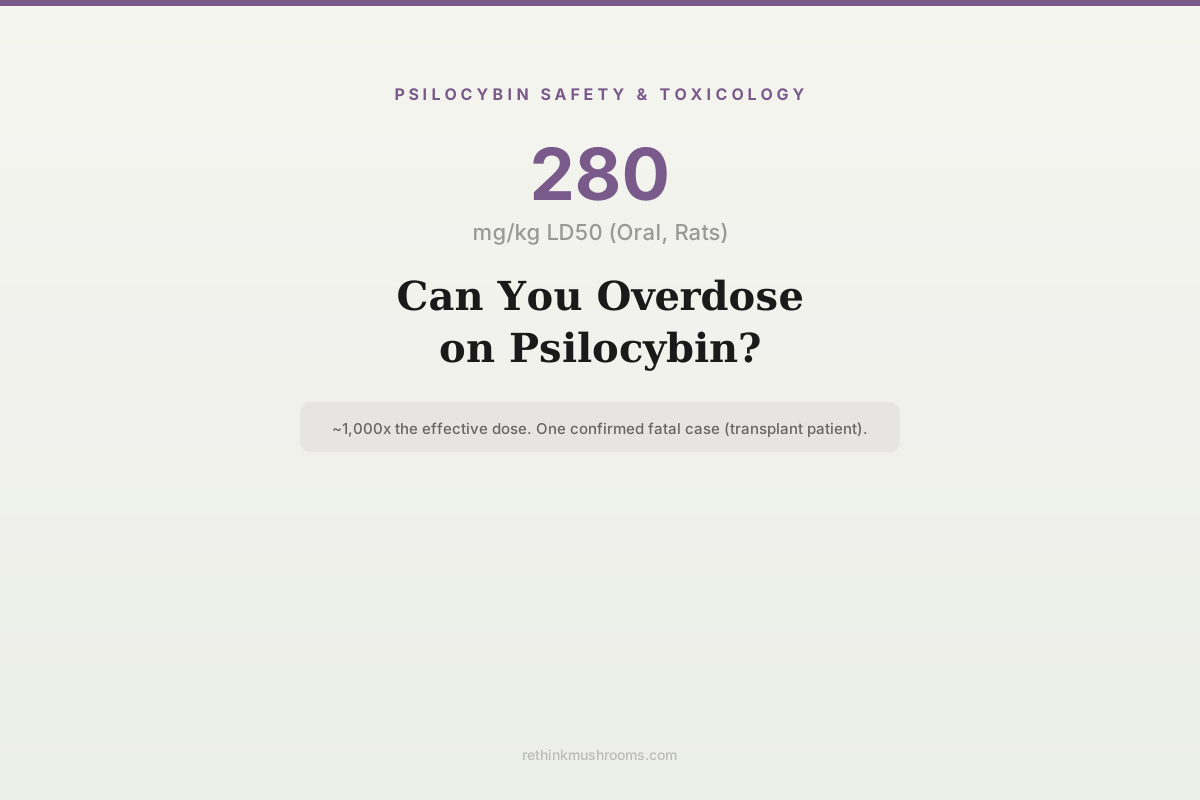
293 mg/kg
The LD50 of psilocin in mice is 293 mg/kg, extrapolating to an estimated human lethal dose roughly 1,000 times the typical effective dose. One confirmed fatal case exists in the literature.
Zhuk et al., Toxins, 2015
1 Death
confirmed psilocybin-attributed fatality (immunocompromised patient)
No Organ Damage
21-day repeated dosing showed no liver, kidney, or blood toxicity
Schedule IV
researchers recommend reclassification based on safety profile
Zhuk et al., Toxins, 2015
 View as image ↗
The short answer: a lethal overdose from psilocybin alone is extraordinarily unlikely in a healthy person. The longer answer involves animal toxicology data, clinical trial safety records, emergency department case series, and exactly one confirmed fatal case that illustrates the specific circumstances under which psilocybin can be dangerous. The evidence consistently places psilocybin among the safest pharmacologically active substances in terms of physiological toxicity, while acknowledging that psychological risks (panic, psychosis-like episodes, dangerous behavior during intoxication) represent the more realistic source of harm. For the complete safety evidence, see how safe is psilocybin? The complete safety research.
Key Takeaways
- The LD50 of pure psilocin in mice is 293 mg/kg, with whole-mushroom extracts even less toxic (317-324 mg/kg); the estimated human lethal dose of 2,000-6,000 mg is roughly 1,000 times the typical effective dose of 6 mg and 200 times the recreational dose of 10-30 mg (Zhuk et al., 2015)
- One confirmed fatal case exists: a 24-year-old heart transplant recipient who experienced cardiac arrest 2-3 hours after psilocybin mushroom consumption (Johnson et al., 2018)
- In clinical trials testing doses up to 40 mg/70 kg, no deaths, organ damage, or lasting physiological harm have been reported across hundreds of participants (Goodwin et al., 2022; Griffiths et al., 2016)
- Gradually increasing psilocybin doses administered daily for 21 days produced no measurable effects on electrolytes, blood sugar, or liver toxicity markers (Johnson et al., 2018)
- Psilocybin does not cause serotonin syndrome even at high doses, unlike MDMA or combinations of serotonergic drugs (Johnson et al., 2018)
- An 8-factor analysis of abuse potential concluded psilocybin should be scheduled no more restrictively than Schedule IV, with low reinforcing effects and no physical dependence (Johnson et al., 2018)
Animal Toxicology: The LD50 Data
Zhuk et al. (2015) measured the acute toxicity and behavioral effects of methanolic extracts from psilocybin-containing mushrooms and pure psilocin in mice.[1] The LD50 of pure psilocin was 293 mg/kg administered intraperitoneally, and whole-mushroom extracts were even less toxic (LD50 values of 317-324 mg/kg). To put this in human terms: a 70 kg person would need on the order of 20,000 mg (20 grams) of pure psilocin to reach the rodent LD50 equivalent. Since dried Psilocybe cubensis mushrooms typically contain 0.5-1% psilocybin by weight, this would require eating roughly 2-4 kilograms of dried mushrooms in a single sitting, a quantity that is practically impossible.
The estimated human lethal dose has been extrapolated to 2,000-6,000 mg based on animal data and limited human case reports. A typical therapeutic dose in clinical trials is 25-30 mg. A typical recreational dose is 10-30 mg. The ratio between the effective dose and the lethal dose (the therapeutic index) is therefore approximately 100-1,000:1. For comparison, acetaminophen (Tylenol) has a therapeutic index of roughly 10:1, and many opioids have therapeutic indices under 10:1.
Dose-to-Danger Ladder
How Far Apart Are an Effective Dose and a Dangerous One?
The gap between the dose that produces psilocybin’s effects and the dose that could threaten the body spans more than three orders of magnitude. Reaching the rodent lethal threshold would mean eating on the order of 2–4 kilograms of dried mushrooms in a single sitting — a physically impossible quantity.
Effective therapeutic dose
6 mgThe amount used to produce a measurable clinical effect
Typical recreational dose
10–30 mgA common self-administered range
Estimated human lethal dose
2,000–6,000 mgConservative estimate from animal data and case reports
Rodent LD50, human-equivalent
~20,000 mgZhuk psilocin LD50 (293 mg/kg) scaled to a 70 kg adult — roughly 2–4 kg of dried mushrooms
How to read it: a wide margin describes the toxicological gap only. It does not make psilocybin risk-free — the psychological risks (panic, psychosis-like episodes) and cardiovascular cautions covered elsewhere in this article are independent of this margin.
Sources: Zhuk et al. 2015, Toxins [1] (rodent LD50); Goodwin et al. 2022 [4] (effective dose). Bar widths are log-scaled (log₁₀ of the midpoint milligram value, normalized to the largest tier = 100%) so the 6 mg dose stays legible across a more-than-3,000-fold range; the printed milligram values are the actual figures.
Glatfelter et al. (2022) examined structure-activity relationships for psilocybin, baeocystin, aeruginascin, and related analogues, noting that psilocybin's primary pharmacological actions are mediated through serotonin receptor agonism without the respiratory depression, cardiovascular collapse, or organ toxicity mechanisms that make other drug overdoses fatal.[2]
The One Confirmed Death
Johnson et al. (2018) conducted the most comprehensive review of psilocybin's abuse potential and safety profile, analyzing all available evidence through the 8-factor framework of the U.S. Controlled Substances Act.[3]
The review identified one documented case of acute overdose death likely attributable to psilocybin: a 24-year-old woman who had received a heart transplant 10 years prior for end-stage rheumatic heart disease. She experienced cardiac arrest 2-3 hours after consuming psilocybin-containing mushrooms and subsequently died. The critical context: she was immunocompromised, on transplant medications, and had a pre-existing cardiac condition. Psilocybin produces transient increases in heart rate and blood pressure (typically 10-20 mmHg systolic), which are clinically insignificant in healthy individuals but could be dangerous in someone with compromised cardiac function.
This single case does not establish a general risk. It illustrates a specific vulnerability: people with pre-existing cardiovascular disease or cardiac transplants may be at elevated risk from psilocybin's sympathomimetic effects. Clinical trials routinely exclude participants with cardiovascular conditions for this reason.
Cardiovascular & Interactions
ModerateWho should be cautious despite the wide safety margin
Concern
Psilocybin produces transient increases in heart rate and blood pressure (typically 10-20 mmHg systolic). These are clinically insignificant in healthy people but can be dangerous for anyone with cardiovascular disease, a prior cardiac transplant, or otherwise compromised heart function — the profile of the single confirmed fatal case.
What the research says
There is no evidence of organ toxicity, respiratory depression, or serotonin syndrome at therapeutic doses. The transient sympathomimetic cardiovascular effect is the one physiological mechanism with a documented fatal outcome, which is why trials screen out cardiac conditions.
Particularly relevant for: People with cardiovascular disease, a prior cardiac transplant, or uncontrolled hypertension; those taking SSRIs (which tend to blunt psilocybin's effects rather than cause toxicity).
What to do
This article is educational and is not medical advice. Anyone with a heart condition or taking prescription medication should consult a physician before considering psilocybin.
Johnson et al., 2018
Clinical Trial Safety: Hundreds of Doses, No Deaths
The clinical trial record provides the most controlled safety data. Goodwin et al. (2022) administered single doses of 25 mg, 10 mg, or 1 mg of synthetic psilocybin to 233 patients with treatment-resistant depression.[4] No deaths occurred. No organ damage was detected. Adverse events in the 25 mg group included headache (most common), nausea, dizziness, and fatigue. Transient anxiety during the dosing session was reported but resolved without intervention.
Griffiths et al. (2016) administered up to 30 mg/70 kg of psilocybin to cancer patients with depression and anxiety.[5] No serious adverse events were attributed to psilocybin. The psychological effects were the primary safety concern: some participants experienced transient fear, anxiety, or confusion during peak drug effects, but these resolved within hours under supervised conditions.
McGowan et al. (2025) investigated the safety and tolerability of single-dose psilocybin for post-traumatic stress disorder, adding to the growing body of controlled safety data across different psychiatric populations.[6]
Across all published clinical trials, the pattern is consistent: psilocybin at therapeutic doses (10-40 mg) produces transient cardiovascular changes (mild increases in heart rate and blood pressure), transient psychological distress in some participants, headache, and nausea. It does not produce organ damage, respiratory depression, seizures, or any of the physiological mechanisms that cause death from overdose of other drugs. For a detailed comparison, see psilocybin cardiovascular safety: why it's considered low-risk compared to MDMA.
No Serotonin Syndrome
Despite acting as a serotonin receptor agonist, psilocybin does not cause serotonin syndrome even at extremely high doses. Johnson et al. (2018) addressed this directly: "despite acting as non-selective serotonin receptor agonists, psilocybin and other major serotonergic psychedelics like LSD do not cause serotonin syndrome even in the context of extreme overdose."[3]
The reason is pharmacological. Serotonin syndrome requires excessive serotonin activity at postsynaptic receptors, typically caused by drugs that increase synaptic serotonin levels (SSRIs, MAOIs, tramadol) or that directly activate multiple serotonin receptor subtypes at high concentrations (MDMA). Psilocybin acts primarily through 5-HT2A receptor agonism and does not increase synaptic serotonin concentration. Its receptor binding profile and pharmacokinetics do not produce the constellation of symptoms (hyperthermia, clonus, rigidity, autonomic instability) that define serotonin syndrome.
This does not mean that combining psilocybin with SSRIs is without risk. The SSRI-psilocybin interaction concern is primarily about efficacy attenuation (SSRIs may blunt psilocybin's effects) rather than toxicity, though isolated case reports of serotonin toxicity-like symptoms have been described in online self-reports.
Repeated Dosing Safety
Johnson et al. (2018) cited evidence that administration of gradually increasing doses of psilocybin daily for 21 days had no measurable effect on electrolyte levels, blood sugar levels, or liver toxicity tests.[3] This is unusual for a Schedule I substance and contrasts with alcohol (hepatotoxicity), MDMA (hepatotoxicity, neurotoxicity), cocaine (cardiotoxicity, hepatotoxicity), and methamphetamine (neurotoxicity, cardiotoxicity), all of which produce measurable organ damage with repeated administration.
Hasler et al. (1997) established the pharmacokinetic profile of psilocin (the active metabolite) in human plasma, showing rapid absorption and elimination with a half-life of approximately 2-3 hours.[7] The short half-life means psilocybin does not accumulate with repeated dosing at typical intervals, further reducing the risk of cumulative toxicity.
The Cytotoxicity Data: Cellular-Level Toxicity
Laabi et al. (2024) measured the cytotoxicity of psilocybin and psilocin on murine macrophages, finding that psilocybin was approximately twice as cytotoxic as psilocin, with LC50 values of 12 ng/mL and 28 ng/mL respectively.[8] These are in vitro findings at cellular-level concentrations and do not translate directly to whole-organism toxicity. Plasma psilocin concentrations after typical therapeutic doses are well within the non-toxic range identified in these cell studies.
Rakoczy et al. (2024) reviewed the pharmacological and behavioral effects of tryptamines present in psilocybin-containing mushrooms, confirming that the safety profile of psilocybin as the primary compound extends to the tryptamine context in which it naturally occurs.[9]
The Real Risks: Psychology, Not Pharmacology
McClure-Begley and Bhatt (2022) reviewed the "promises and perils" of psychedelic pharmacology for psychiatry and emphasized that psilocybin's primary risks are psychological, not pharmacological.[10] The realistic dangers include:
- Panic and dangerous behavior: people may harm themselves during acute intoxication by acting on distorted perceptions (running into traffic, falling from heights)
- Psychotic episodes: in vulnerable individuals (those with personal or family history of psychotic disorders), psilocybin can trigger prolonged psychotic episodes
- HPPD: hallucinogen persisting perception disorder, in which visual disturbances persist after the drug has worn off, affects a small percentage of users
- Misidentification: foraging wild mushrooms risks confusing psilocybin-containing species with toxic look-alikes, particularly Amanita species that cause liver failure
None of these risks are dose-dependent in the way that pharmacological toxicity is. A person can experience a psychotic episode at a standard therapeutic dose. These risks are managed in clinical settings through screening (excluding people with psychotic disorders), supervised environments (preventing dangerous behavior during intoxication), and pharmaceutical-grade preparations (eliminating misidentification risk). For the broader safety framework, see psilocybin is one of the safest recreational substances: the evidence.
The Bottom Line
Psilocybin has an exceptionally wide therapeutic index, with an estimated lethal dose roughly 1,000 times the effective dose. One confirmed fatal case exists, in a heart transplant recipient. Clinical trials testing doses up to 40 mg/70 kg across hundreds of participants have recorded no deaths, no organ damage, and no serotonin syndrome. Repeated daily dosing for 21 days showed no laboratory abnormalities. The primary risks are psychological (panic, psychotic episodes in vulnerable individuals), not pharmacological. The physiological safety margin places psilocybin among the least toxic pharmacologically active substances studied.
Frequently Asked Questions
Sources & References
- 1RTHM-00415·Zhuk, Olga et al. (2015). “Research on acute toxicity and the behavioral effects of methanolic extract from psilocybin mushrooms and psilocin in mice..” Toxins.Study breakdown →PubMed →↩
- 2RTHM-00759·Glatfelter, Grant C et al. (2022). “Structure-Activity Relationships for Psilocybin, Baeocystin, Aeruginascin, and Related Analogues to Produce Pharmacological Effects in Mice..” ACS pharmacology & translational science.Study breakdown →PubMed →↩
- 3RTHM-00514·Johnson, Matthew W et al. (2018). “The abuse potential of medical psilocybin according to the 8 factors of the Controlled Substances Act..” Neuropharmacology.Study breakdown →PubMed →↩
- 4RTHM-00761·Goodwin, Guy M et al. (2022). “Single-Dose Psilocybin for a Treatment-Resistant Episode of Major Depression..” The New England journal of medicine.Study breakdown →PubMed →↩
- 5RTHM-00426·Griffiths, Roland R et al. (2016). “Psilocybin produces substantial and sustained decreases in depression and anxiety in patients with life-threatening cancer: A randomized double-blind trial..” Journal of psychopharmacology (Oxford.Study breakdown →PubMed →↩
- 6RTHM-00941·McGowan, Niall M et al. (2025). “Investigating the safety and tolerability of single-dose psilocybin for post-traumatic stress disorder: A nonrandomized open-label clinical trial..” Journal of psychopharmacology (Oxford.Study breakdown →PubMed →↩
- 7RTHM-00021·Hasler, F et al. (1997). “Determination of psilocin and 4-hydroxyindole-3-acetic acid in plasma by HPLC-ECD and pharmacokinetic profiles of oral and intravenous psilocybin in man..” Pharmaceutica acta Helvetiae.Study breakdown →PubMed →↩
- 8RTHM-00887·Laabi, Salma et al. (2024). “Deciphering psilocybin: Cytotoxicity, anti-inflammatory effects, and mechanistic insights..” International immunopharmacology.Study breakdown →PubMed →↩
- 9RTHM-00901·Rakoczy, Ryan J et al. (2024). “Pharmacological and behavioural effects of tryptamines present in psilocybin-containing mushrooms..” British journal of pharmacology.Study breakdown →PubMed →↩
- 10RTHM-00787·McClure-Begley, Tristan D et al. (2022). “The promises and perils of psychedelic pharmacology for psychiatry..” Nature reviews. Drug discovery.Study breakdown →PubMed →↩