Psychedelic Safety & Integration
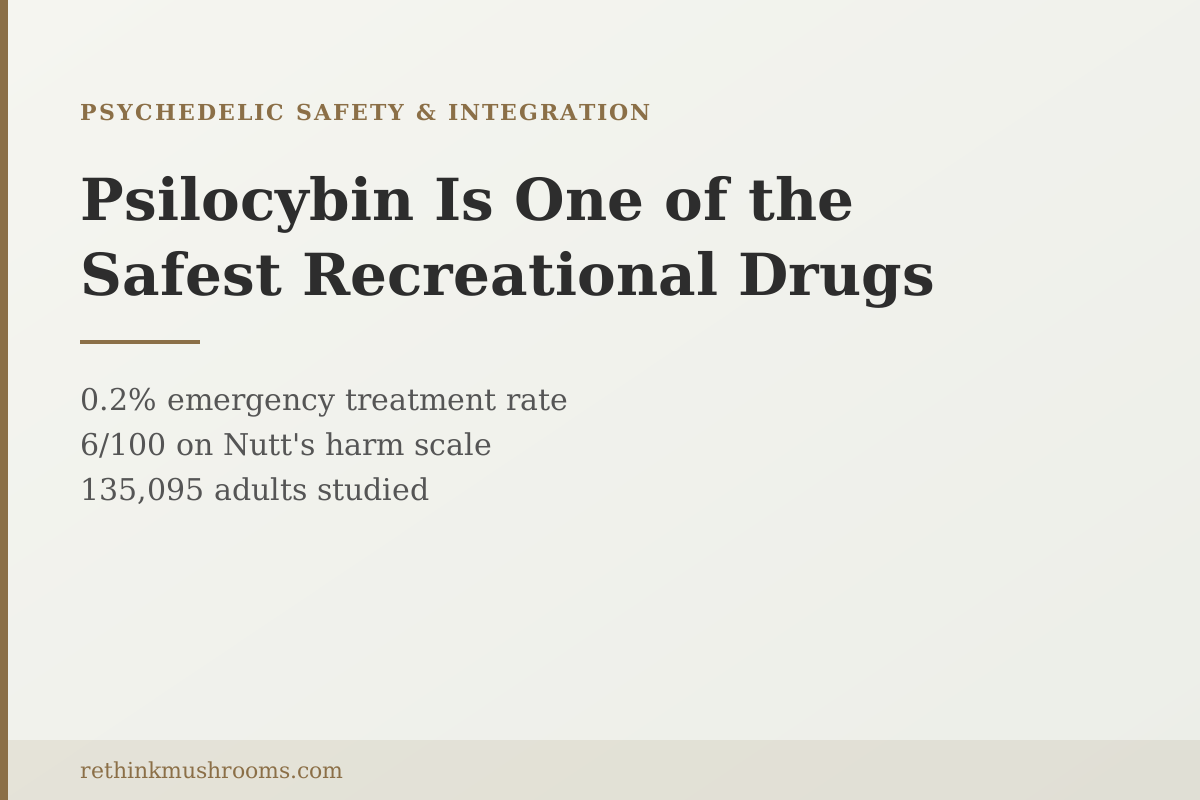
0.2% emergency treatment rate
Magic mushrooms had the lowest emergency medical treatment rate of any drug tracked in the 2017 Global Drug Survey, based on 9,233 past-year users — lower than alcohol, cocaine, MDMA, and LSD.
Kopra et al., J Psychopharmacol, 2022
6/100
harm score in Nutt's 2010 Lancet analysis vs alcohol's 72/100
135,095
adults studied with no link found to mental health problems
600:1
psilocybin physiological safety ratio vs ethanol's 10:1
Kopra et al., J Psychopharmacol, 2022
 View as image ↗
Two independent datasets, using completely different methods, reach the same conclusion about psilocybin. One tracked 9,233 people on what sent them to the emergency room after using various recreational drugs. The other asked fifteen independent drug experts to score twenty substances across sixteen harm criteria. Both ranked psilocybin mushrooms at or near the bottom of the list, the lowest emergency treatment rate of any drug in the first dataset, and a harm score of 6 out of 100 in the second, compared to alcohol's 72.[5][2]
The convergence of two independent methodologies pointing in the same direction is the core of the evidence here. This article walks through both datasets, adds a third from a 135,000-person population study on mental health outcomes, and explains clearly what "one of the safest recreational drugs" means in the data, and what it doesn't mean.
For the full overview of psilocybin's safety across all risk dimensions, see How Safe Is Psilocybin? The Complete Safety Research.
Key Takeaways
- Magic mushrooms had the lowest emergency medical treatment rate (0.2%) of any drug in the 2017 Global Drug Survey, based on 9,233 past-year users — compared to 4.8% for methamphetamine, 1.0% for cocaine, 1.0% for LSD (Kopra et al., 2022)
- In Nutt's 2010 Lancet analysis of 20 drugs scored by 15 independent experts across 16 harm criteria, psilocybin mushrooms scored 6/100 — among the lowest of any drug assessed; alcohol scored 72/100 (Nutt et al., 2010)
- In a population study of 135,095 US adults including 19,299 lifetime psychedelic users, no significant association was found between psychedelic use and serious psychological distress, suicidal ideation, suicide plans, or suicide attempts (Johansen and Krebs, 2015)
- Across all 8 scheduling criteria used by the US Controlled Substances Act, psilocybin scored low on abuse potential, physical dependence, and addiction liability — leading researchers to conclude Schedule I classification is scientifically unsupported (Johnson et al., 2018)
- Psilocybin's physiological safety ratio is approximately 600:1 (lethal dose to effective dose), compared to caffeine at 35–50:1 and ethanol at 10:1 (Nahlawi et al., Nat Cardiovasc Res, 2025)
- The "safest recreational drug" framing has important limits: psilocybin's low harm scores reflect pharmacological risk, not psychological distress risk, and people with personal or family histories of psychosis face genuine contraindications (Johnson et al., 2008)
The 0.2% Emergency Rate: Lower Than Any Other Drug in the Survey
Kopra and colleagues analyzed data from the 2017 Global Drug Survey, specifically focusing on what sent people to seek emergency medical treatment after recreational drug use.[5]
The survey covered 9,233 people who had used magic mushrooms in the past year. Nineteen of them, 0.2%, sought emergency medical care. That was the lowest rate of any drug in the survey.
For context, Kopra reported the rates for other substances in the same dataset: methamphetamine users sought emergency care at a rate of 4.8%, making it 24 times more likely to result in an ER visit than mushrooms. Cocaine and LSD both came in at 1.0%, five times the mushroom rate. MDMA came in at 0.6%, three times the mushroom rate.
What this number captures is acute harm: the kind of drug reaction severe enough to require emergency medical attention. The adverse reactions among the 0.2% who did seek help were predominantly psychological and short-lasting, not physical organ damage or overdose.
The study does not capture all dimensions of drug risk. It reflects how often recreational use under real-world, uncontrolled conditions results in an emergency. This is a meaningful measure of harm, but it is not the only one.
Two Independent Rankings, Same Result: The Comparison Data
The Global Drug Survey ER rate (population-level acute harm) and the Nutt 2010 harm scoring (expert multicriteria analysis) are methodologically independent. One is observational population data; the other is a structured expert assessment. Their agreement strengthens the conclusion.
Nutt and colleagues published their analysis in The Lancet in 2010, scoring 20 drugs across 16 harm criteria that spanned both harm to the user and harm to others.[2] A panel of 15 independent drug experts completed the scoring.
How psilocybin compares to other recreational substances in two key safety metrics:
| Drug | Global Drug Survey ER Rate | Nutt 2010 Harm Score |
|---|---|---|
| Alcohol | ~1% | 72/100 |
| Cocaine | 1.0% | 27/100 |
| MDMA | 0.6% | 9/100 |
| LSD | 1.0% | 7/100 |
| Magic mushrooms | 0.2% | 6/100 |
Psilocybin mushrooms scored 6 out of 100 in Nutt's analysis, among the lowest of any substance assessed. Alcohol scored 72. Cannabis, which wasn't in the Kopra dataset, scored 20 in Nutt's analysis.
The Nutt analysis also found that mushrooms had the lowest harm-to-others score of any drug evaluated. This is worth noting separately: harm-to-others covers violence, accidents affecting third parties, family burden, and community impact. By this measure, mushrooms didn't just rank low on self-harm; they ranked lowest on social harm as well.
For context on what the physical safety data specifically shows, see Psilocybin's Physiological Safety: What the Data Shows.
What 135,000 People Show About Mental Health Outcomes
The two harm-ranking datasets above deal with acute and chronic physical risk. The natural follow-up question is psychological risk, specifically: does psychedelic use increase rates of mental health problems over time at the population level?
Johansen and Krebs answered this with a large-scale study published in the Journal of Psychopharmacology in 2015.[3]
They analyzed data from 135,095 US adults drawn from the National Survey on Drug Use and Health. Within that group, 19,299 people reported lifetime use of a classic psychedelic (psilocybin, LSD, peyote, or mescaline). After controlling for demographics, other drug use, and childhood depression, they found no statistically significant association between psychedelic use and serious psychological distress, mental health treatment use, suicidal ideation, suicide plans, or suicide attempts.
The sample size is the key strength here. Small studies can miss real effects or detect spurious ones. A study of 135,095 people with nearly 20,000 psychedelic users has sufficient statistical power to detect even modest associations if they exist. The null result is not simply an absence of evidence; at this scale, it is evidence of absence.
It is worth noting what this study does and doesn't show. It covers lifetime use, not acute effects. It cannot distinguish between single use and heavy use, or between experiences that were difficult and those that weren't. And it studies association, not causation. What it shows is that, at the population level, people who have used classic psychedelics do not show elevated rates of the most serious negative mental health outcomes compared to those who haven't.
Why Psilocybin Scores Low on Every Addiction Criterion
One of the most commonly cited reasons psilocybin is considered lower-risk than most recreational substances is its absence of addiction liability.
Johnson, Griffiths, Hendricks, and Henningfield conducted a systematic analysis in 2018, evaluating psilocybin against all eight criteria the US Controlled Substances Act uses to determine scheduling and abuse potential.[4]
Their findings across the criteria were consistent. Psilocybin does not produce physical dependence. Animals do not self-administer it (a standard preclinical test for addiction potential). Users do not escalate doses to maintain effects. There is no recognized withdrawal syndrome when use stops. Cross-tolerance with opioids, stimulants, or alcohol does not occur.
The researchers concluded that psilocybin's Schedule I classification, which places it in the same category as heroin and above cocaine (which is Schedule II), is scientifically unsupported by the evidence. They proposed Schedule IV, alongside benzodiazepines, as more appropriate given the actual risk profile.
The abuse potential finding matters for the harm comparison: many drugs that rank high on harm scores do so partly because they carry significant dependence liability, which multiplies harm through compulsive continued use. Psilocybin's low addiction ceiling means the harms associated with it don't compound the way they do with opioids, stimulants, or alcohol.
For context on how this connects to psilocybin's legal status, see Psilocybin and Schedule I: The Legal History and Path to Rescheduling.
The 600:1 Safety Ratio: Safer Than Caffeine by This Measure
Beyond population surveys and expert rankings, there is a pharmacological measure of drug safety: the safety ratio, also called the therapeutic index in clinical medicine. This is the ratio between the dose that produces a toxic or lethal effect and the dose that produces the intended effect.
Nahlawi and colleagues, in their 2025 review in Nature Cardiovascular Research, cited psilocybin's safety ratio as approximately 600:1.[6] For comparison: caffeine has a safety ratio of roughly 35 to 50:1. Ethanol sits around 10:1.
A safety ratio of 600 means the dose that would be lethal is roughly 600 times the dose that produces psychological effects. No human deaths have been attributed to psilocybin toxicity alone in the clinical or population literature, which is consistent with this pharmacological profile.
The safety ratio is a measure of direct physiological toxicity. It does not capture accident risk, psychological distress, or the harm that can occur if someone takes psilocybin in an unsafe environment. But it does explain why, even when people consume more than they intended, direct physical toxicity has not been a clinically significant problem.
For what the data shows specifically about toxicity at high doses, see Can You Overdose on Psilocybin? Toxicity Research. For the cardiovascular safety data specifically, see Psilocybin Cardiovascular Safety: Low Risk vs. MDMA.
The Limits of "Safest": What the Data Doesn't Cover
The evidence above consistently points in one direction. Psilocybin scores low on acute harm, population-level mental health outcomes, addiction potential, and physiological toxicity. But "safest recreational drug" requires more qualification than most coverage gives it.
Johnson and colleagues published the first comprehensive safety framework for psilocybin research in 2008, and it identified the primary risk clearly: overwhelming psychological distress during a session, what is colloquially called a "bad trip."[1] Prolonged psychosis was described as rare in the context of research settings with screening, but the framework was built around managing the real possibility of acute psychological distress.
There are several dimensions of risk that the population-level harm rankings and ER rates do not fully capture.
Psychiatric contraindications are real. People with personal or family histories of psychosis, schizophrenia, or bipolar disorder with psychotic features face genuine elevated risk. The harm rankings reflect average outcomes across large populations; they do not reflect outcomes in people with these specific vulnerabilities.
Set and setting matter enormously. The Global Drug Survey's 0.2% ER rate reflects recreational use across all contexts, including problematic ones. Controlled research settings with preparation, screened participants, and therapeutic support produce better outcomes than uncontrolled recreational use. But the population average is still low because even in varied recreational contexts, severe outcomes remain rare.
The data is mostly from uncontrolled recreational use. The Johansen/Krebs study, the Global Drug Survey, and Nutt's harm ranking all draw on populations using psilocybin without clinical oversight. The "safest" framing cannot be used to suggest that uncontrolled use is risk-free or that the low harm scores mean anyone can use psilocybin without consequence.
Chronic microdosing safety is not established. The evidence on daily low-dose use is far less developed than evidence on occasional sessions. Most of the data supporting psilocybin's safety profile comes from episodic use patterns.
The honest reading of "one of the safest recreational drugs" is this: by multiple independent measures of pharmacological and population-level harm, psilocybin consistently ranks at or near the bottom of recreational substances. That is a meaningful conclusion. It is also a conclusion about average outcomes across large populations, not a guarantee for any individual.
For a closer look at the psychiatric risk specifically, see Psilocybin and Psychosis Risk: The Schizophrenia Concern. For drug interactions that can affect safety, see Psilocybin Drug Interactions: A Complete Guide.
The Bottom Line
Two independent datasets reach the same conclusion: psilocybin mushrooms score at or near the bottom of recreational drug harm rankings. In the 2017 Global Drug Survey, 0.2% of 9,233 past-year users sought emergency medical care, the lowest rate of any drug tracked. In Nutt's 2010 Lancet multicriteria analysis, psilocybin scored 6/100 on harm, compared to alcohol's 72. A 135,000-person population study found no link between psychedelic use and serious mental health outcomes. Psilocybin shows low scores on all eight addiction criteria and carries a physiological safety ratio of approximately 600:1. The caveat that honest coverage requires: these population averages do not apply to people with personal or family histories of psychosis, for whom the risk profile is meaningfully different.
Frequently Asked Questions
Sources & References
- 1. Source details for this reference are not yet available.
- 2. Source details for this reference are not yet available.
- 3. Source details for this reference are not yet available.
- 4. Source details for this reference are not yet available.
- 5. Source details for this reference are not yet available.
- 6. Source details for this reference are not yet available.