Psilocybin Safety
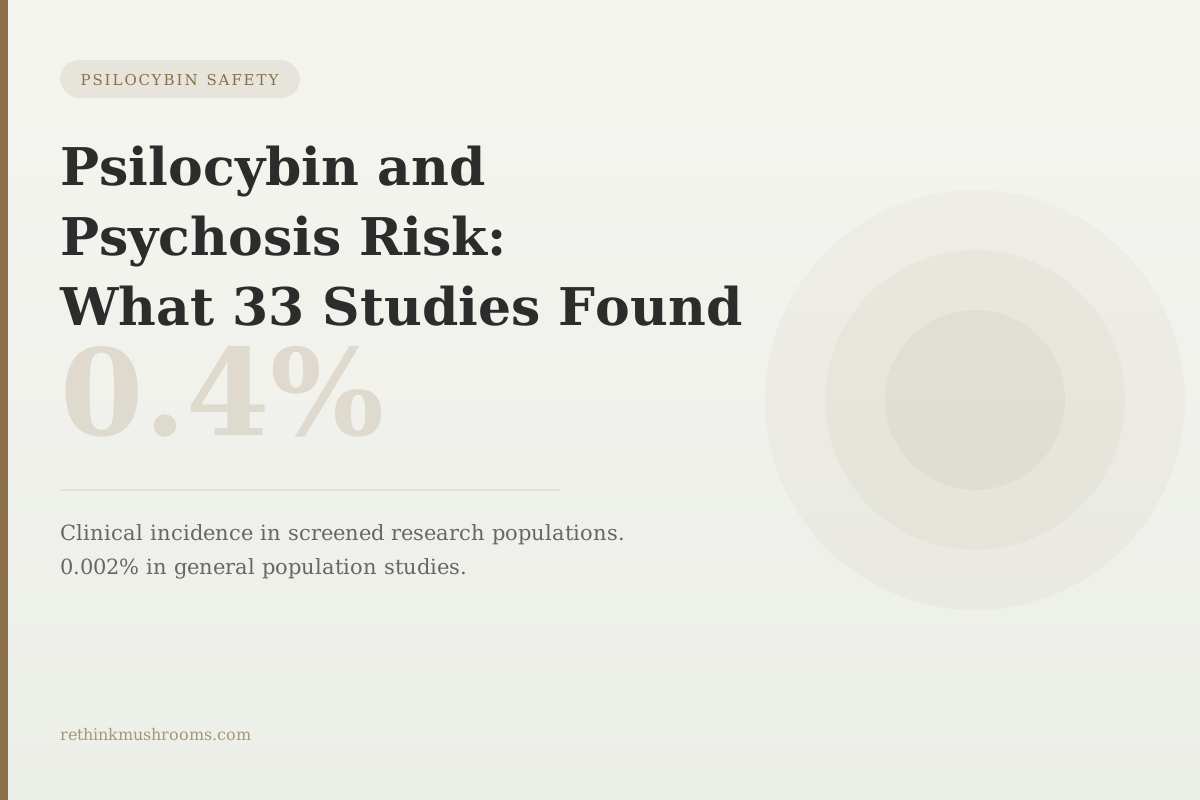
0.4%
A 2025 meta-analysis of 33 studies found psilocybin-induced psychosis occurred in just 0.4% of participants in clinical research settings — and in only 0.002% of people in general population studies.
Sabé et al., Molecular Psychiatry, 2025
130,152
US adults in Johansen 2015: no association between lifetime psychedelic use and mental health problems
0.002%
psychosis incidence in population studies — 200x lower than in clinical settings (Sabé 2025)
4%
of participants with pre-existing neuropsychiatric conditions had serious adverse events (Gasser 2024)
Sabé et al., Molecular Psychiatry, 2025
 View as image ↗
The fear that psilocybin causes psychosis is one of the most common concerns people bring to the research. It comes from a real phenomenon: psilocybin can, in some people under some conditions, trigger a psychotic episode. The question is how often, in whom, and under what conditions — and here the actual research has a more specific answer than most people expect.
In 2025, Sabé and colleagues published the most comprehensive analysis to date on psychedelic-induced psychosis: a meta-analysis of 33 studies covering both clinical research populations and general population data.[1] Their finding gave the question a number: in clinical settings, where participants are screened, monitored, and supported, the incidence of psychosis was 0.4%. In general population studies — people who had used psychedelics outside of supervised settings — it was 0.002%.
Neither of these is zero. But they are also not the same number, and understanding what they mean for different people is the whole story.
This article covers who faces real psychosis risk, what the research shows about the schizophrenia contraindication specifically, how bipolar disorder fits in, and what the population-level data tells us about risk in people without psychiatric history. For a broader overview of psilocybin safety, including cardiovascular and physiological risk, see how safe is psilocybin: the complete safety research.
Key Takeaways
- A 2025 meta-analysis of 33 studies (Sabé et al., Molecular Psychiatry) found psychosis incidence of 0.4% in clinical settings and 0.002% in general population studies; pre-existing psychotic vulnerability and higher doses were the primary risk amplifiers.
- A study of 130,152 US adults found no association between lifetime psychedelic use and mental health problems or suicidal behavior in the general population (Johansen & Krebs, 2015).
- People with schizophrenia, schizoaffective disorder, or a personal history of psychotic episodes are considered contraindicated for psilocybin therapy based on consistent clinical consensus.
- Bipolar I disorder carries substantially higher psychosis risk than Bipolar II; a 2026 comprehensive review recommends against psilocybin in Bipolar I while acknowledging more nuanced evidence for Bipolar II.
- An international survey of bipolar individuals with psilocybin experience found mixed outcomes — some reported mood stabilization, but a subset experienced mania or hypomania triggering — with Bipolar I carrying higher risk than Bipolar II (Polito et al., 2023).
- Most psychedelic-related psychosis is transient, occurring during or shortly after the session; the "permanent psychotic break" scenario is much rarer and almost exclusively associated with pre-existing vulnerability.
The 0.4% Number: What a 33-Study Meta-Analysis Actually Found
The Sabé et al. 2025 meta-analysis, published in Molecular Psychiatry, is currently the highest-quality aggregated evidence on psychedelic-induced psychosis.[1] The researchers analyzed 33 studies — a combination of clinical trial data and population survey data — and found two distinct incidence rates depending on the population.
In clinical and research settings: 0.4%. These are participants in supervised psilocybin research, screened before entry, monitored during sessions, and supported afterward. The 0.4% figure includes all reported psychotic episodes — brief, transient episodes as well as more prolonged cases.
In general population studies: 0.002%. These are broader surveys of people who have used psychedelics outside supervised settings — without screening, without monitoring, in contexts that could include set, setting, and dose conditions quite different from clinical research.
The 200-fold difference between these two numbers tells you something important. It is not that supervised settings are 200 times more likely to cause psychosis. The more likely explanation is that clinical research screens out the people most at risk — those with personal or family psychiatric history who are excluded from enrollment. The population that gets into clinical trials is not representative of all psychedelic users, and particularly not of those with elevated risk.
This means the 0.4% and 0.002% figures are not comparable estimates of the same underlying risk. They reflect different populations with different risk profiles. Neither should be used in isolation. Together, they say: for screened healthy adults in clinical settings, the psychosis rate is low; for the broader population (which includes some higher-risk individuals without knowing it), the rate is lower still in aggregate but that may reflect dose, setting, and population differences in complex ways.
The Sabé analysis also identified the two primary risk amplifiers: pre-existing psychotic vulnerability and higher doses. This gives the psychosis risk a profile rather than a uniform rate — it is concentrated in specific people at specific doses.
The Population Counterpoint: 130,000 Adults, No Increased Risk
While the Sabé 2025 meta-analysis provides the most current quantification, the Johansen & Krebs 2015 study provides the largest single dataset on psychedelic use and mental health outcomes in a population context.[2]
Analyzing data from 130,152 US adults in the National Survey on Drug Use and Health, Johansen and Krebs found no association between lifetime psychedelic use and increased rates of mental health problems or suicidal behavior. This held after controlling for other drug use and demographic variables.
This does not prove that psychedelics cannot cause mental health problems in anyone. A nationally representative survey cannot rule out rare individual events. What it shows is that at the population level, among the mix of people who have used psychedelics at least once in their lives — a heterogeneous group that includes both careful and reckless users, both healthy and vulnerable individuals — there is no detectable signal of elevated mental health harm.
This population-level finding is consistent with the Sabé 2025 numbers. A 0.002% incidence in general population studies is, by definition, not detectable as a population-level signal in survey data. The risk exists, but it is concentrated enough in specific individuals that it does not show up in aggregate statistics.
Who Actually Faces Elevated Risk: The Hard Contraindications
The population-level data is reassuring for the general population. It is not reassuring for everyone, because the Sabé meta-analysis was explicit: pre-existing psychotic vulnerability is the primary risk amplifier.
Clinical consensus has settled on two categories as absolute contraindications for psilocybin therapy:
Schizophrenia and schizoaffective disorder. These are psychotic spectrum disorders characterized by impaired reality testing. Psilocybin's mechanism — acute 5-HT2A receptor activation producing altered perception and cognition — overlaps directly with the symptom profile of psychosis. Introducing a powerful serotonergic hallucinogen to a brain already dysregulating perception is, mechanistically, adding fuel to a fire. All major clinical trials exclude participants with a personal or family history of primary psychotic disorders.
Personal history of a psychotic episode. Even if someone does not have a standing psychotic disorder diagnosis, a prior psychotic episode indicates individual vulnerability. The research on psychedelic psychosis consistently identifies prior psychotic history as a strong risk predictor. This is treated as a hard stop in clinical trial screening.
A 2024 meta-analysis of acute adverse effects of therapeutic psilocybin doses found that serious adverse events occurred in approximately 4% of participants with pre-existing neuropsychiatric conditions — significantly higher than in participants without such history.[3] This finding reinforces that psychiatric history is the dominant risk variable, not psilocybin exposure itself.
The Bipolar Question: Why Bipolar I and Bipolar II Are Not the Same Risk
Bipolar disorder occupies a complex position in the psilocybin risk picture. It is a mood disorder, not a psychotic disorder, but Bipolar I includes psychotic features in some patients and carries meaningful risk of mania that can involve psychosis.
An international survey of individuals with bipolar disorder who had used psilocybin found mixed outcomes.[4] Some reported mood stabilization and therapeutic benefit. A subset experienced triggering of mania or hypomania — episodes of pathologically elevated mood that can become dangerous. Critically, Bipolar I carried higher risk of adverse outcomes than Bipolar II.
A 2026 comprehensive review of psilocybin use in bipolar disorder reached a structured conclusion.[5] For Bipolar I, the review recommends against psilocybin use: the risk of precipitating a manic or psychotic episode is substantial enough that no clinical benefit currently justifies the risk. For Bipolar II — a form of bipolar disorder characterized by hypomanic episodes (less severe than full mania) and depression — the picture is more ambiguous. Some patients with Bipolar II may have clinical profiles where psilocybin therapy is being considered under careful supervision, and the review called for controlled research rather than blanket prohibition.
This Bipolar I / Bipolar II distinction matters because "bipolar" is often treated as a single category in psilocybin risk discussions. It is not. Someone with Bipolar II and a strong history of depressive episodes that haven't responded to standard treatment is in a different risk category than someone with Bipolar I who has had psychotic manic episodes.
For a full discussion of how family psychiatric history — including a parent or sibling with bipolar disorder or schizophrenia — should be factored into psilocybin risk assessment, see family history of psychosis and psilocybin: risk assessment.
The Family History Gray Zone: Risk Stratification vs. Binary Exclusion
Family psychiatric history sits in a grayer area than personal history. All clinical trials exclude participants with personal psychotic history; many also exclude first-degree relatives of people with schizophrenia or schizoaffective disorder. Whether this should be a blanket exclusion is the question that 2024 research addressed directly.
Schindler and colleagues published what they called a "Plea for Nuance" in 2024, arguing against categorical exclusion of everyone with any family psychiatric history from psilocybin research.[6] Their argument was quantitative: the genetic risk conferred by family history varies substantially by the closeness of the relationship and the specific disorder involved.
A first-degree relative (parent or sibling) with schizophrenia increases lifetime risk from the population baseline of approximately 1% to around 10% — a tenfold elevation. A monozygotic (identical) twin with schizophrenia corresponds to approximately 44% concordance. These are meaningfully different risk levels. Treating "my aunt had schizophrenia" the same as "my identical twin has schizophrenia" misses that distinction.
Schindler's paper proposes individualized risk stratification: weighting the genetic proximity, the specific disorder in the family member, the individual's own symptom history and baseline, and the therapeutic context. This approach treats family history as a risk variable to quantify rather than a binary exclusion criterion.
For clinical trial purposes, conservative exclusion of all first-degree relatives of primary psychotic disorder patients is defensible on precautionary grounds. For individual-level risk assessment — the decision someone makes with a clinician about whether psilocybin therapy is appropriate for them — the Schindler nuance framework is more informative than a checklist.
Transient vs. Persistent Psychosis: What "Permanent Psychotic Break" Actually Means
One of the common fears about psilocybin is the "permanent psychotic break" — the idea that a single psilocybin session could trigger lasting psychosis in an otherwise healthy person. The data on this is worth addressing directly.
Psychedelic experiences involve perceptual distortions, altered sense of reality, and sometimes frightening content. These are not psychosis — they are expected pharmacological effects of a hallucinogen. The fact that psilocybin produces unusual mental states during a session is not evidence of psychosis any more than anesthesia-induced unconsciousness is evidence of brain damage.
Clinical psychosis, by contrast, involves a persistent inability to distinguish internal mental content from external reality, lasting after the drug has been eliminated. The Sabé 2025 meta-analysis was tracking this endpoint — genuine psychotic episodes, not just difficult drug experiences.
Within the 0.4% clinical incidence figure, most episodes were transient — occurring during or shortly after the session and resolving without lasting psychiatric symptoms. Prolonged psychotic episodes lasting weeks or months, or new-onset schizophrenia triggered by psilocybin in a person with no prior vulnerability, are at the far edge of the reported incidence. The data does not suggest this happens to healthy, screened individuals at any meaningfully detectable rate.
The "permanent psychotic break" scenario is real but extremely rare, and the evidence consistently points to pre-existing vulnerability as the necessary condition. For most people without personal or family psychiatric history who use psilocybin in appropriate conditions, the risk of persistent psychosis is not supported by the current evidence base.
What "Safe for Most People" Actually Means Here
The Johansen 2015 population data showing no broad mental health association, the Sabé 2025 0.4% clinical incidence, and the at-risk population data from the bipolar research all fit together into a coherent picture.
Psilocybin carries a meaningful and specific psychosis risk for people with certain psychiatric profiles: schizophrenia, schizoaffective disorder, personal history of psychotic episodes, and Bipolar I. For these groups, the contraindication is not precautionary hand-waving — it is based on a mechanistic explanation (5-HT2A activation in a brain already struggling with reality processing) and consistent clinical evidence of adverse outcomes.
For healthy adults without personal or family psychiatric history, screened appropriately and supported in a clinical setting, the psychosis rate is approximately 0.4% in research contexts and far lower in population data. The risk is not zero, but it is low enough that it does not show up as a detectable mental health signal in a sample of 130,000 adults.
For a broader picture of how this psychosis risk compares to psilocybin's overall safety profile, see psilocybin is one of the safest recreational substances: the evidence and psilocybin's physiological safety: what the data shows.
For information on other specific contraindications — including the lithium interaction, pregnancy, and who is excluded from clinical trials — see who should not take psilocybin: contraindications explained and psilocybin and lithium: the dangerous interaction.
The Bottom Line
The best current evidence on psilocybin-induced psychosis comes from a 2025 meta-analysis of 33 studies (Sabé et al.): 0.4% incidence in clinical settings, 0.002% in population studies. Pre-existing psychotic vulnerability and higher doses are the primary risk amplifiers. Schizophrenia, schizoaffective disorder, and personal psychotic history are hard contraindications. Bipolar I carries substantially higher risk than Bipolar II. For screened adults without psychiatric history, the population-level data (130,000 adults, Johansen 2015) shows no detectable broad mental health signal from psychedelic use.
Frequently Asked Questions
Sources & References
- 1. Source details for this reference are not yet available.
- 2. Source details for this reference are not yet available.
- 3. Source details for this reference are not yet available.
- 4. Source details for this reference are not yet available.
- 5. Source details for this reference are not yet available.
- 6. Source details for this reference are not yet available.