Psilocybin Contraindications & Safety
47% seizure rate in documented cases
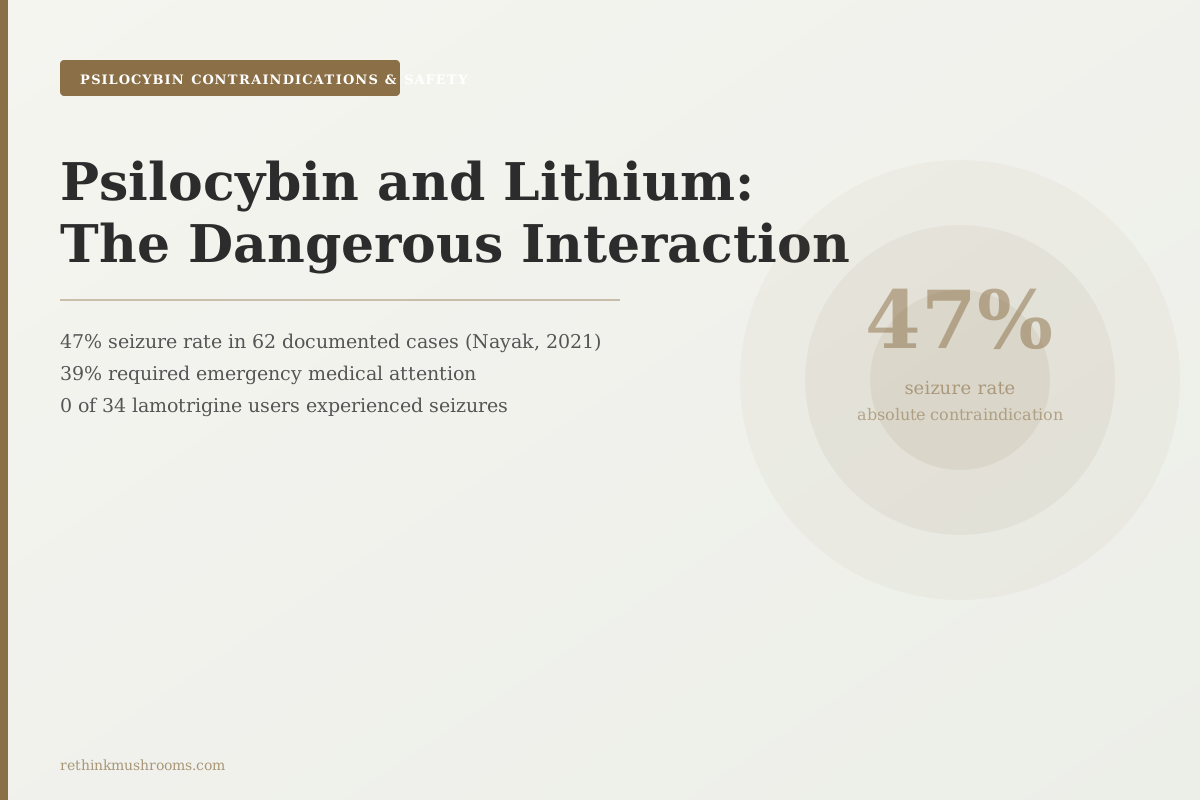
A 2021 analysis of 62 reports of psilocybin combined with lithium found seizures in 47% of cases. None of 34 lamotrigine users experienced seizures. The same risk does not apply to other mood stabilizers.
Nayak et al., Pharmacopsychiatry, 2021
62 reports
of combined psilocybin + lithium use analyzed by Nayak et al., 2021
39%
of psilocybin + lithium cases required emergency medical attention
0 / 34
lamotrigine users experienced seizures in the same dataset
Nayak et al., Pharmacopsychiatry, 2021
 View as image ↗
The answer to "can I take psilocybin while on lithium?" is straightforward: no. A 2021 analysis of 62 documented cases of the psilocybin-lithium combination found that 47% involved seizures.[1] Nearly 4 in 10 of those cases required emergency medical attention. That is not a theoretical risk. It is a rate that makes the psilocybin-lithium combination one of the clearest absolute contraindications in psychedelic medicine.
This matters beyond a warning label. Lithium is the most widely used mood stabilizer for bipolar disorder. As clinical psilocybin therapy expands, growing numbers of people with treatment-resistant depression (including those who have bipolar disorder) are asking about their options. Understanding what the lithium interaction is and why it happens is important clinical context, whether someone is navigating this question themselves or alongside a prescriber. This article is part of the broader safety framework covered in the complete guide to psilocybin safety.
Key Takeaways
- A 2021 analysis of 62 reports of psilocybin combined with lithium found seizures in 47% of cases; 39% required medical attention
- The same analysis found zero seizures in 34 reports of psilocybin combined with lamotrigine, another mood stabilizer, confirming the risk is lithium-specific
- A 2024 scoping review of 27 studies confirmed that psilocybin alone does not increase seizure risk in healthy individuals, making the lithium interaction specific rather than a general psilocybin-seizure concern
- The mechanism behind the lithium-psilocybin seizure interaction is not fully understood, which makes this interaction unpredictable at any dose
- Lithium is a primary treatment for bipolar disorder; clinical psilocybin trials routinely exclude patients currently taking lithium
- No human clinical data exists on the safety of switching from lithium to an alternative before psilocybin therapy; this is an active area of clinical discussion
The 47% Seizure Rate: What a 2021 Study Actually Found
Combining psilocybin with lithium is an absolute contraindication: not a risk to be weighed against benefits, but a combination to avoid entirely. The 2021 analysis by Nayak and colleagues in Pharmacopsychiatry established the empirical basis for this classification.[1]
The researchers analyzed 62 published online experience reports describing psilocybin use alongside lithium. In 47% of those cases, the report included a seizure. In 39% of cases, the person required emergency medical attention. Among the seizure cases where duration was noted, most resolved without permanent harm, but hospitalizations were documented.
The evidence base is worth understanding clearly. These were self-reported accounts from online experience-sharing platforms, not clinical trial data. Self-reports carry inherent limitations: doses are uncertain, lithium blood levels at the time of the experience are unknown, and confounding factors (other substances, underlying health conditions) are difficult to rule out. People who have frightening experiences may also be more likely to file a report, which could inflate the apparent rate.
Those caveats noted, the 47% rate is still striking. Rare drug interactions typically appear at single-digit percentages even in formal adverse event reporting systems designed to detect unusual outcomes. A 47% seizure rate in 62 reports, regardless of the source, signals a strong and specific interaction that is not explained by chance or reporting bias alone. The researchers concluded this was a clinically significant interaction pattern.
To put the number in context: most drug interactions classified as absolute contraindications do so on the basis of case reports numbering in the single digits. Nayak 2021 identified 62 reports with a near-majority seizure rate. By the standards of adverse interaction evidence, this is substantial.
The Lamotrigine Contrast: Why This Is About Lithium Specifically
The most important finding in the Nayak 2021 study may not be the 47% seizure rate. It may be the contrast case.
The same researchers identified 34 reports of psilocybin used alongside lamotrigine, another mood stabilizer commonly prescribed for bipolar disorder. In those 34 reports, zero seizures occurred. The researchers also noted an absence of reports describing particularly difficult or adverse experiences.
This contrast matters because it rules out the simpler explanation: that combining any mood stabilizer with a serotonergic drug causes elevated seizure risk. It does not. The risk is specific to lithium.
Lamotrigine and lithium are both used for bipolar disorder but work through entirely different pharmacological mechanisms. Lithium's mechanism involves sodium, calcium, and second-messenger systems; it also has well-documented effects on serotonin release and reuptake. Lamotrigine works primarily by blocking voltage-gated sodium channels, which actually reduces neuronal excitability rather than adding to it. The different mechanisms likely explain why the seizure interaction appears with lithium but not lamotrigine.
This contrast also has clinical implications that some practitioners are beginning to discuss. Some clinicians have used lamotrigine as an alternative mood stabilizer for patients with bipolar disorder who want to explore psilocybin therapy in clinical settings. The zero-seizure record in 34 reports is not controlled clinical evidence. But the contrast with lithium is large enough that lamotrigine has become the comparison of interest when clinicians discuss this population.
The current evidence does not establish any specific protocol recommendation for switching. That is a clinical discussion, not a self-managed one. But the data from Nayak 2021 is what makes the comparison clinically meaningful.
Psilocybin Alone and Seizure Risk: What a 2024 Review Found
A natural follow-up question is whether psilocybin itself increases seizure risk. The answer from a 2024 scoping review is clear: not in healthy individuals.[2]
Soto-Angona and colleagues analyzed 27 studies examining classic psychedelics and seizure risk: 16 in humans and 11 in animals. Their conclusion was that classic psychedelics (including psilocybin, LSD, and DMT) do not increase seizure risk in people without predisposing factors. In properly screened populations, psychedelic-associated seizure risk appears to be near baseline.
The review did identify two specific co-administration contexts associated with elevated seizure risk: lithium, and kambo (a South American frog secretion). Both are combination risks. Neither is an intrinsic psilocybin risk.
This distinction changes how the lithium interaction should be understood. The problem is not that psilocybin is epileptogenic (capable of triggering seizures) at clinical doses. The problem is that something about the lithium-psilocybin combination produces an outcome that neither compound produces alone. Understanding why requires looking at the pharmacology, which is where things become less certain.
What We Know (and Don't Know) About the Mechanism
The mechanism behind the lithium-psilocybin seizure interaction is not fully established. This is not a case where researchers have identified the pathway and are warning against it. It is a case where the observed outcome is empirically documented but the biological explanation is incomplete.
When psilocybin is swallowed, the body rapidly converts it into psilocin, the compound that produces the psychoactive effects.[3] Psilocin is a potent agonist at the 5-HT2A receptor: it works primarily by activating a specific serotonin receptor subtype in the brain's cortex, which drives changes in neural signaling, perception, and emotional processing. This is a powerful serotonergic event.
Lithium has a complex pharmacological profile. It affects multiple cellular systems simultaneously: it modulates how neurons handle sodium and calcium ions, it influences the second-messenger systems that regulate cellular responses to neurotransmitters, and it affects serotonin release and reuptake in ways that remain incompletely characterized. At therapeutic blood levels, lithium is documented to lower the seizure threshold in some individuals.
The prevailing hypothesis is that lithium's serotonergic effects, combined with the intense cortical activation that psilocin produces through 5-HT2A agonism, create a compounded disruption that tips certain individuals into seizure. When these two systems interact, the combined load on the serotonergic and excitatory circuits may exceed what the brain can safely regulate.
That hypothesis is not confirmed. Researchers have not identified the specific pathway. And because the mechanism is not understood, the interaction is also unpredictable: no one has established a dose threshold at which the combination becomes safer. The uncertainty is itself a clinically important fact.
Who Uses Lithium and Why This Matters for Psilocybin Therapy
Lithium is prescribed primarily for bipolar disorder, particularly bipolar I. It is one of the oldest and most studied mood stabilizers in psychiatry, with a proven track record for preventing both manic and depressive episodes. For bipolar I, it remains a first-line treatment.
Bipolar disorder and treatment-resistant depression overlap significantly. A substantial proportion of people who might otherwise benefit from clinical psilocybin therapy are taking lithium. As psilocybin research expands into more patient populations, this creates a practical collision: the people most likely to be seeking alternative treatments for depression are also among the most likely to be on the very medication that makes psilocybin dangerous.
All major clinical psilocybin trials have excluded participants currently taking lithium. This is a universal exclusion across the research literature. It is not a precautionary measure based on theoretical concern. It is a direct response to documented seizure cases.
Some clinicians and researchers have discussed whether a supervised period of lithium discontinuation followed by a transition to an alternative mood stabilizer could open a pathway to psilocybin therapy for this population. This is not standard practice. It is not supported by controlled clinical data on safety. And lithium discontinuation carries its own significant risks: abrupt withdrawal can trigger rebound mania, and tapering requires careful medical management. Any discussion of medication switching belongs in a full psychiatric care relationship, not in a harm-reduction or self-guided framework.
For broader context on why psilocybin carries specific risks for people with bipolar disorder beyond the lithium interaction itself, see Psilocybin and Psychosis Risk: The Schizophrenia Concern and Family History of Psychosis and Psilocybin: Risk Assessment.
What the Research Picture Shows
The psilocybin-lithium interaction is among the clearest-cut contraindications in the psychedelic medicine literature. The evidence is not a case of incomplete data requiring more study. It is 47% seizures and 39% emergency medical attention in 62 documented cases, alongside zero seizures in the comparison mood stabilizer group. Psilocybin alone does not increase seizure risk. The interaction is lithium-specific. The mechanism is unknown, which makes it unpredictable at any dose.
For people on lithium who are researching psilocybin therapy, the clinically relevant questions are about whether alternatives to lithium exist for their situation, and what the transition risks would be. These are prescribing questions. The existing evidence on lamotrigine as an alternative is suggestive but not controlled, and does not support self-managed switching.
For a full overview of all psilocybin contraindication categories, see Who Should NOT Take Psilocybin? Contraindications Explained. For context on other dangerous psilocybin drug interactions, see Psilocybin Drug Interactions: A Complete Guide and Psilocybin and MAOIs: The Dangerous Combination. For readers who want to understand why psilocybin is considered low-risk in most other contexts, see Psilocybin Is One of the Safest Recreational Substances: The Evidence.
The Bottom Line
Combining psilocybin with lithium caused seizures in 47% of 62 documented cases, with 39% requiring emergency medical attention. The same risk does not apply to lamotrigine, confirming this is a lithium-specific interaction. Psilocybin alone does not increase seizure risk in healthy individuals according to a 2024 scoping review. The mechanism is not fully understood, making the combination unpredictable at any dose and supporting its classification as an absolute contraindication.
Frequently Asked Questions
Sources & References
- 1. Source details for this reference are not yet available.
- 2. Source details for this reference are not yet available.
- 3. Source details for this reference are not yet available.