Psilocybin Drug Interactions
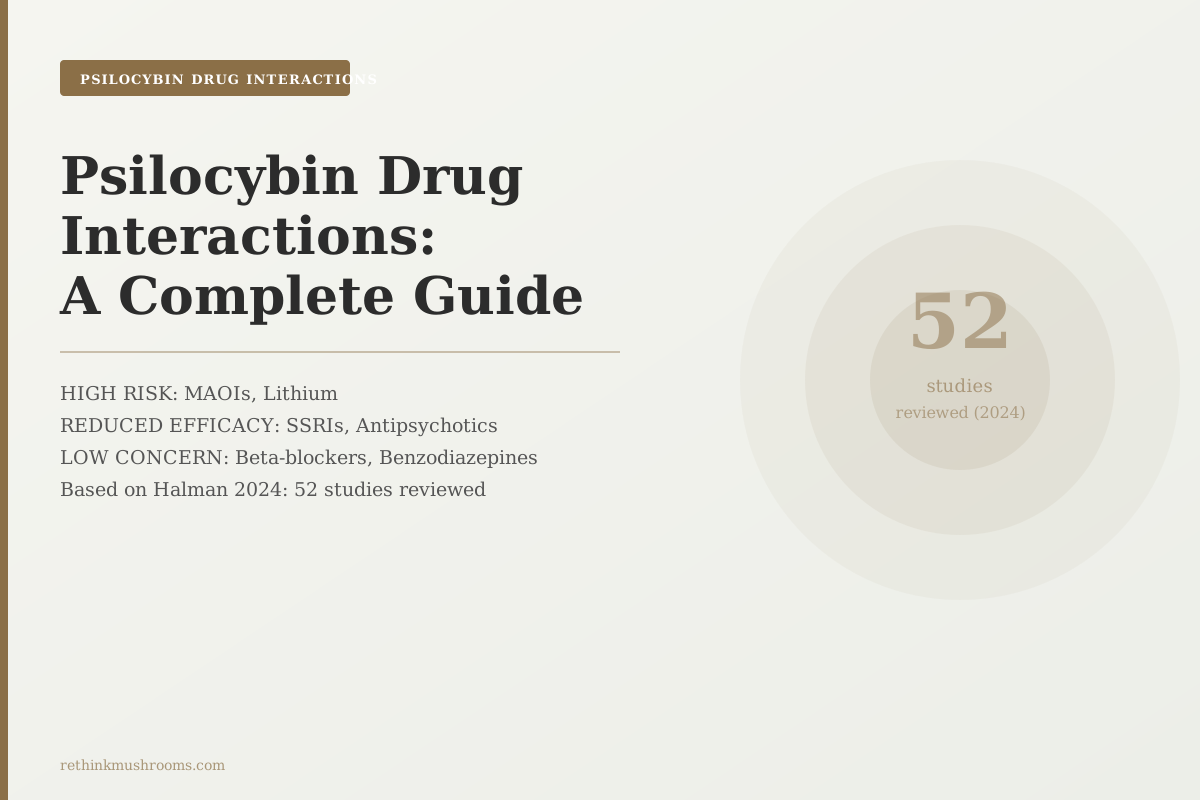
52 studies in the most comprehensive review to date
A 2024 systematic review in the Journal of Psychopharmacology covered 52 studies on classic psychedelic drug interactions. No serious adverse events occurred in included controlled studies, but the risk profile varies dramatically by drug class.
Halman et al., Journal of Psychopharmacology, 2024
MAOIs
highest-risk combination: blocks psilocin breakdown, elevates serotonin, seizure and toxicity risk
Lithium
47% seizure rate in 62 documented cases; absolute contraindication
SSRIs
reduce efficacy in ~50% of users; not a safety concern in clinical data
Halman et al., Journal of Psychopharmacology, 2024
 View as image ↗
Most resources on psilocybin drug interactions treat all combinations as equally concerning or equally safe. They are neither. A 2024 systematic review covering 52 studies on classic psychedelic drug interactions found no serious adverse events across the included controlled research,[1] but that finding applies to screened participants in clinical settings without concurrent medications. Outside that context, the risk picture varies dramatically by drug class.
Two drug categories represent genuine safety concerns with psilocybin: MAOIs (monoamine oxidase inhibitors) and lithium. SSRIs and SNRIs (the most common antidepressants) reduce psilocybin's effects significantly but do not appear to create meaningful safety risk. Antipsychotics likely block or diminish psilocybin's effects. Cardiovascular medications have limited data but a cleaner safety signal overall. This guide organizes the evidence by risk tier. For broader psilocybin safety context, see the complete guide to psilocybin safety.
Key Takeaways
- MAOIs and lithium are the two drug classes with documented serious adverse events when combined with psilocybin; both should be treated as absolute contraindications
- SSRIs and SNRIs reduce psilocybin's effects in approximately 50% of users but have not produced serious adverse events in clinical research
- A 2024 systematic review of 52 studies found no serious adverse events in controlled psychedelic drug interaction studies, with caveats for dose and screening conditions
- Antipsychotics block the 5-HT2A receptors that psilocybin acts on and are likely to significantly reduce or eliminate psilocybin's effects
- Beta-blockers and benzodiazepines appear low-risk but may reduce the intensity of a psilocybin experience
- Cardiovascular medications require evaluation on a case-by-case basis; a 2023 review identified blood pressure effects as the primary monitoring concern
Psilocybin Drug Interactions by Risk Level
Understanding why drug interactions happen requires one pharmacological anchor: psilocybin works primarily by activating the 5-HT2A receptor (a specific serotonin receptor subtype) throughout the brain's cortex. This means psilocybin's interactions with other drugs are almost entirely shaped by those drugs' relationship to serotonin systems or to the 5-HT2A receptor itself. Drugs that amplify serotonin create risk. Drugs that block 5-HT2A receptors reduce efficacy. Drugs that affect serotonin breakdown create the highest-risk profile.
| Drug Class | Examples | Risk | Primary Concern |
|---|---|---|---|
| MAOIs (irreversible) | Phenelzine, tranylcypromine | HIGH RISK | Blocks psilocin breakdown; elevated psilocin levels; serotonin toxicity risk |
| Lithium | Lithium carbonate | HIGH RISK | 47% seizure rate in documented cases; mechanism unknown |
| MAOIs (reversible) | Moclobemide | HIGH RISK | Lower but significant; same metabolic pathway |
| SSRIs / SNRIs | Fluoxetine, sertraline, venlafaxine | REDUCED EFFICACY | Blunts effects in ~50% of users; no serious safety signal in clinical data |
| Antipsychotics | Haloperidol, risperidone, quetiapine | REDUCED EFFICACY | Block 5-HT2A receptors; likely diminish or eliminate psilocybin's effects |
| Stimulants | Amphetamines | MODERATE CONCERN | Cardiovascular load; limited data |
| Beta-blockers | Propranolol | LOW CONCERN | May reduce anxiety response; blood pressure interaction |
| Benzodiazepines | Lorazepam, diazepam | LOW CONCERN | May reduce experience intensity; used clinically to terminate difficult sessions |
| Most other drugs | Varies | UNKNOWN | Limited or no human data |
This table reflects the current evidence base as of 2025. Most drug interactions with psilocybin are poorly studied. The categories above are based on pharmacological reasoning and the available case reports and controlled studies; they are not exhaustive clinical guidance.
MAOIs: The Highest-Risk Combination
MAOIs (monoamine oxidase inhibitors) are one of the oldest antidepressant drug classes, still prescribed for treatment-resistant depression. They are also the most concerning drug combination with psilocybin.
The mechanism is pharmacokinetic. Psilocybin converts rapidly to psilocin in the body; psilocin is the active compound. Psilocin is broken down by the monoamine oxidase (MAO) enzyme system, particularly MAO-A. MAOIs inhibit this enzyme. When MAO-A is blocked, psilocin remains in the bloodstream longer and reaches higher concentrations than normal. The result is a more intense, prolonged experience and meaningfully elevated serotonin loading throughout the nervous system.
Irreversible MAO-A inhibitors (phenelzine, tranylcypromine, isocarboxazid) represent the highest risk within this class. Reversible MAO-A inhibitors (moclobemide, used primarily in Europe) carry lower but still significant risk through the same pathway. MAO-B inhibitors (selegiline, rasagiline), prescribed primarily for Parkinson's disease, are more selective at therapeutic doses but can inhibit MAO-A at higher concentrations.
The Halman 2024 systematic review identifies MAOI interactions as among the most pharmacologically concerning in the psychedelic literature.[1] Anyone taking any MAOI should not combine it with psilocybin. For full detail on the mechanism and risk stratification within this class, see Psilocybin and MAOIs: The Dangerous Combination.
Lithium: A Different Risk Profile, Equally Serious
Lithium does not affect psilocin metabolism. Its interaction mechanism is entirely different from MAOIs, and it is not yet fully understood. But the outcome data is stark: a 2021 case report analysis found a 47% seizure rate in 62 documented cases of psilocybin combined with lithium.[1] The same analysis found zero seizures in 34 cases of psilocybin combined with lamotrigine, another mood stabilizer. The risk is lithium-specific, not a general mood stabilizer interaction.
Lithium is used primarily for bipolar disorder. It is pharmacologically complex: it affects sodium and calcium channels, modulates serotonin release, and lowers the seizure threshold at therapeutic levels. The compounded interaction with psilocybin's serotonergic activation likely contributes to the seizure risk, but the precise mechanism remains unconfirmed.
The clinical implication is unambiguous: psilocybin and lithium should not be combined. For full detail, see Psilocybin and Lithium: The Dangerous Interaction.
SSRIs and SNRIs: An Efficacy Problem, Not a Safety Problem
SSRIs (selective serotonin reuptake inhibitors) and SNRIs (serotonin-norepinephrine reuptake inhibitors) are by far the most common antidepressants in current use. For psilocybin, they represent a meaningfully different kind of interaction: reduced efficacy, not safety risk.
Chronic SSRI use triggers 5-HT2A receptor downregulation. The brain, exposed to elevated serotonin from the SSRI, reduces the density and sensitivity of the receptors that psilocybin primarily acts on. When receptor availability is reduced, psilocybin's effect is proportionally weaker. A 2023 retrospective survey found approximately 50% of SSRI/SNRI users reported blunted effects during or within months of SSRI use.[1]
The safety signal is reassuring by comparison. The Halman 2024 review covered 10 psilocybin-specific studies involving concurrent serotonergic medications and found no serious adverse events. A 2023 clinical trial found psilocybin still worked for treatment-resistant depression even in patients on concurrent SSRIs, though effects were attenuated. Serotonin syndrome from psilocybin + SSRIs has not been documented in controlled clinical settings.
For full detail on the efficacy question and the 3-month residual blunting finding, see Psilocybin and SSRIs: Will Antidepressants Block the Effect?.
Antipsychotics: Why They Likely Cancel Out Psilocybin's Effects
Antipsychotic medications block a range of receptors, and many have significant activity at the 5-HT2A receptor specifically. Since psilocybin's primary mechanism is 5-HT2A activation, antipsychotics that block this receptor are likely to substantially reduce or eliminate psilocybin's effects.
This interaction is well-established from a pharmacological standpoint: emergency departments have used haloperidol (a first-generation antipsychotic) to terminate difficult psychedelic experiences precisely because of this receptor blockade. Atypical antipsychotics (risperidone, quetiapine, olanzapine) have similarly strong 5-HT2A blocking properties.
The evidence base for this interaction is limited to case reports and pharmacological reasoning rather than controlled trials, since clinical psilocybin studies exclude antipsychotic users. But the receptor mechanism is clear enough that antipsychotic use should be considered a strong efficacy modifier when evaluating psilocybin therapy candidacy.
Cardiovascular Medications: What a 2023 Review Found
A 2023 cardiovascular safety review of psychedelic medicine by Sessa and colleagues in Pharmacological Reports covers the drug interaction landscape for cardiovascular medications specifically.[2]
Psilocybin produces transient blood pressure elevation and heart rate increases during the acute experience. This is the primary cardiovascular monitoring concern in clinical settings. Medications that affect blood pressure regulation therefore have the most relevant interaction profile.
Beta-blockers (propranolol, metoprolol) may blunt the cardiovascular response to psilocybin and are sometimes used in research settings for exactly this purpose. They do not appear to significantly diminish the psychological effects. Calcium channel blockers and ACE inhibitors have limited data; the cardiovascular review identifies no documented serious adverse interactions with psilocybin at therapeutic doses.
For people with cardiovascular conditions, the concern is not primarily the medication interaction but the underlying cardiac status and psilocybin's transient blood pressure effects. This is evaluated on a case-by-case basis in clinical screening.
Benzodiazepines: Low-Risk, Occasionally Useful
Benzodiazepines (lorazepam, diazepam, alprazolam) are sedative medications that reduce anxiety by enhancing GABA activity. They interact with psilocybin differently from serotonergic drugs: rather than blocking the receptor mechanism, they appear to reduce the intensity and emotional activation of the experience.
This property is why benzodiazepines are used clinically to terminate or attenuate difficult psychedelic sessions. The reduction in experience intensity is the primary practical consideration, not a safety concern. In clinical psilocybin settings, a low-dose benzodiazepine is often available as an intervention tool if a participant becomes severely distressed.
For people who take benzodiazepines regularly, the concern is more about the pharmacological blunting of the psilocybin experience than any documented safety interaction.
The Evidence Base and Its Limits
The Halman 2024 systematic review is the most comprehensive analysis of psychedelic drug interactions in the published literature: 52 studies, covering LSD, psilocybin, and other classic psychedelics against a range of drug classes.[1] The finding of no serious adverse events in included studies is important context, but carries a significant caveat: clinical trials screen participants carefully, exclude people on most concurrent medications, and monitor participants throughout. The safety record in controlled research does not automatically extend to unscreened real-world use.
The case reports that document the MAOI and lithium risks come from outside controlled research, precisely because clinical studies don't enroll those patients. The adverse event signal from self-reported community data is the primary evidence for the dangerous interactions, and that signal is clear.
For people on any prescribed medication considering psilocybin therapy, the practical path is: identify which drug class applies, understand the risk tier, and discuss medication management with a prescribing physician before proceeding. The question "can I stop my medication before psilocybin therapy?" depends heavily on the medication and why it is prescribed. For clinical guidance on that specific question, see Should You Stop Medications Before Psilocybin? Clinical Guidance.
The Bottom Line
Psilocybin drug interactions fall into distinct risk tiers. MAOIs and lithium represent genuine safety concerns: MAOIs block psilocin metabolism, and lithium produced seizures in 47% of documented cases. SSRIs reduce psilocybin's effects in approximately half of users without creating the same safety profile. Antipsychotics likely block the effect through 5-HT2A receptor antagonism. A 2024 systematic review of 52 studies found no serious adverse events in controlled research settings, but that finding reflects screened populations without concurrent medications.
Frequently Asked Questions
Sources & References
- 1RTHM-01899·Halman, Andreas et al. (2024). “Drug-drug interactions involving classic psychedelics: A systematic review..” Journal of psychopharmacology (Oxford.Study breakdown →PubMed →↩
- 2. Source details for this reference are not yet available.