Psychedelic Safety & Integration
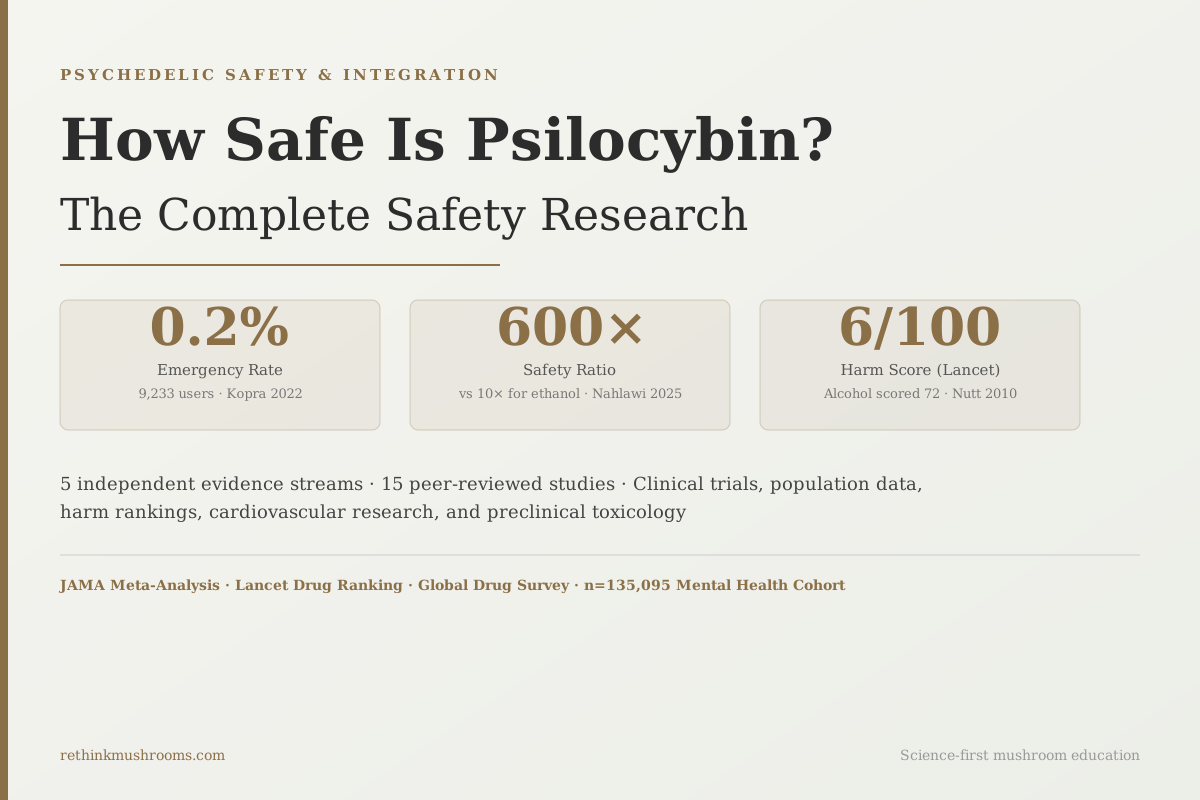
0.2% Emergency Rate
Of 9,233 past-year magic mushroom users surveyed in the Global Drug Survey, 19 sought emergency medical treatment — about 1 in 1,800 individual uses, and the lowest rate of any drug in the survey.
Kopra et al., J Psychopharmacol, 2022
5/100
composite harm score in the Lancet drug ranking — the lowest of all 20 drugs assessed; alcohol scored 72
~1,000×
estimated ratio of lethal dose to effective dose, against roughly 10× for alcohol
48 hours
outer limit of any adverse effect in a meta-analysis of 528 clinical trial participants
Kopra et al., J Psychopharmacol, 2022
 View as image ↗
In 2022, researchers analyzed Global Drug Survey data from 9,233 people who had used magic mushrooms in the past year. Of that group, 19 sought emergency medical treatment. That is 0.2%, or roughly one emergency per 1,800 individual uses — the lowest emergency rate of any drug in the survey.[1]
That single statistic is striking, but the question of how safe is psilocybin requires looking across five independent lines of evidence: acute adverse events in clinical trials, population-level harm rankings, long-term mental health outcomes in large cohorts, cardiovascular physiology during sessions, and preclinical toxicology. Each research stream uses different populations, different methods, and different outcome measures. They largely converge. This article synthesizes all five, along with the genuine caveats the evidence supports — including the ones that get dropped when these studies are summarized elsewhere.
Key Takeaways
- In the Global Drug Survey (n=9,233), 0.2% of magic mushroom users sought emergency treatment — the lowest rate of any drug tracked, and about 1 in 1,800 individual uses
- A 2024 JAMA meta-analysis of 528 clinical trial participants found that psilocybin's adverse effects (headache, nausea, anxiety, dizziness, raised blood pressure) all resolved within 48 hours
- Nutt et al. (Lancet, 2010) scored psilocybin mushrooms 5 out of 100 on a composite harm scale across 16 criteria — the lowest of all 20 drugs assessed, against 72 for alcohol
- In a population study of 135,095 US adults, lifetime psychedelic use showed no significant association with serious psychological distress, suicidal ideation, or suicide attempts
- Psilocybin's estimated lethal dose is on the order of 1,000 times an effective dose, compared with roughly 10 for ethanol — but animal studies do establish a lethal dose, so "no known lethal dose" applies to humans, not to pharmacology in general
- QTc prolongation, psychiatric contraindications, and 5-HT2B receptor binding during chronic microdosing are real, documented safety concerns — the favorable profile comes with specific limits
Is Psilocybin Safe? The Evidence in Plain Terms
In supervised clinical settings with appropriate screening, psilocybin has a well-documented safety profile. Common adverse effects — headache, nausea, anxiety, dizziness, transient blood pressure elevation — resolve within 48 hours. It does not produce physical dependence or a withdrawal syndrome, no human death from psilocybin toxicity alone has been documented, and it produces the lowest emergency treatment rate of any drug tracked by the Global Drug Survey.
That is the accurate, evidence-based short answer. The rest of this article shows where that answer comes from, what it covers, and where it stops.
The evidence comes from three methodologically distinct domains. Clinical trials test psilocybin under controlled conditions with screened participants, providing clean adverse event data but limited generalizability. Population surveys track outcomes in people who use psilocybin outside any clinical context, capturing real-world harm at scale. Comparative analyses rank psilocybin against other substances using standardized criteria, placing it in context. Each approach catches different risks. Together they build a picture no single study could.
How the Question Gets Answered
Five Literatures, Five Different Questions
“Is psilocybin safe” is not one question, and no single study answers it. Five independent research streams each measure something different, on different people, with different methods. Each one is blind to what the others catch — which is why the convergence between them carries more weight than any one result.
Real-world emergencies
9,233 usersQuestion it can answer
How often does uncontrolled, unscreened use send someone to an emergency room?
What it found
0.2% sought emergency treatment — roughly 1 in 1,800 individual uses[1]
What it cannot see
Self-reported recreational use; no screening, no dose verification, frequent co-use of other substances
Clinical-trial adverse events
528 participantsQuestion it can answer
Which side effects reliably appear when psilocybin is given under medical supervision?
What it found
Headache, nausea, anxiety, dizziness and raised blood pressure — all resolved within 48 hours[2]
What it cannot see
Participants were screened, prepared and supervised, and were being treated for depression or anxiety
Comparative harm ranking
20 drugs, 16 criteriaQuestion it can answer
Where does psilocybin sit against other drugs when every category of harm is weighed at once?
What it found
Mushrooms scored 5 out of 100 — the lowest overall harm score of all 20 drugs assessed[4]
What it cannot see
Expert consensus rather than direct measurement; reflects UK use patterns as of 2010
Population mental health
135,095 adultsQuestion it can answer
Does psychedelic use track with psychiatric illness at the scale of a whole country?
What it found
No significant association with psychological distress, suicidal ideation, plans or attempts[5]
What it cannot see
Groups LSD, mescaline and psilocybin together; measures lifetime use, not dose or frequency
Cardiac electrophysiology
25 mg clinical doseQuestion it can answer
Does psilocybin lengthen the heart’s electrical recovery interval enough to matter?
What it found
Mean QTcF change of 2.1 ms (upper 90% CI 6.6 ms) at the standard clinical dose[16]
What it cannot see
Healthy volunteers only; says nothing about people already on QTc-prolonging medication
How to read it: the five streams point the same direction, but none of them covers people with a personal or family history of psychotic illness, people with existing cardiovascular disease, or long-term repeated dosing. Convergence across the five describes what has been measured — not a verdict on the populations nobody has studied.
Sources: Kopra et al. 2022, J Psychopharmacol [1]; Yerubandi et al. 2024, JAMA Netw Open [2]; Nutt et al. 2010, The Lancet [4]; Johansen & Krebs 2015, J Psychopharmacol [5]; Dahmane et al. 2021, Clin Pharmacol Drug Dev [16].
What that picture shows: psilocybin's primary risks are psychological — overwhelming distress, paranoia, confusion — rather than physiological. The psychological risks are real and deeply context-dependent. The physiological risks are real but mostly mild and time-limited. Certain populations face elevated risk and are systematically excluded from clinical research. Understanding who those populations are is part of understanding psilocybin safety.
0.2% Emergency Rate: What 9,233 Real-World Users Tell Us
The most striking real-world safety benchmark for psilocybin comes from the Global Drug Survey 2017, analyzed by Kopra and colleagues in the Journal of Psychopharmacology in 2022.[1]
Of 9,233 respondents who had used magic mushrooms in the past year, 19 sought emergency medical treatment. That is 0.2% of users, and the authors calculate a per-event risk of about 0.06% — roughly one emergency per 1,800 individual uses. Magic mushrooms produced the lowest rate in the survey. The Global Drug Survey's cross-drug reporting for the same wave put methamphetamine at 4.8%, alcohol at 1.3%, cocaine and LSD at 1.0% each, and cannabis at 0.6%. Kopra's own paper notes that mushroom-related emergency presentations ran roughly five times lower than LSD's.
Young age was the only significant predictor of an emergency presentation: those who sought treatment had a median age of 19, against 23 for those who did not.
What the 19 Emergencies Consisted Of
Mostly Psychological — But Not Only Psychological
Nineteen people out of 9,233 sought emergency treatment. Their reported symptoms skewed heavily psychological, which is the finding usually quoted. The same paper also records seizures, loss of consciousness and breathing difficulty in a meaningful minority of those nineteen — the part that is usually left out.
Anxiety or panic
68%Paranoia or suspiciousness
68%Hallucinations
42%Loss of consciousness
37%Difficulty breathing
32%Seizures
26%How to read it: these percentages describe the nineteen people who sought help, not the 9,233 surveyed. Roughly one in four of the nineteen — about five people in the whole sample — reported a seizure. The authors note some of these may have been psychologically triggered rather than true epileptic events, and that the mechanism is uncertain. All but one respondent was back to normal within 24 hours.
Source: Kopra et al. 2022, Journal of Psychopharmacology 36(8):965–973 [1]. Denominator is the 19 emergency-treatment seekers, not the 9,233 past-year users; symptoms overlap, so the column does not total 100%.
The symptom profile deserves more attention than it usually gets. Among those 19 people, the most common reports were psychological — anxiety or panic and paranoia or suspiciousness, each in 68% — followed by hallucinations in 42%. But the same paper documents loss of consciousness in 37%, difficulty breathing in 32%, and seizures in 26%. Popular summaries of this study frequently describe the adverse reactions as purely psychological. They were predominantly psychological, which is not the same claim. The authors themselves flag uncertainty about the seizure reports, noting that some may have been psychologically triggered rather than true epileptic events, and that the mechanism is unresolved.
The recovery data is genuinely reassuring: all but one respondent returned to normal within 24 hours.
This is why the 0.2% figure reframes the safety conversation. It does not come from a carefully selected research population. It comes from a large, naturalistic sample of recreational users, and even in that context serious harm was rare and short-lived.
For a deeper look at how psilocybin compares to alcohol, MDMA, cocaine, and cannabis across two independent harm metrics, see Psilocybin Is One of the Safest Recreational Substances: The Evidence.
What Adverse Effects Actually Look Like: The JAMA Meta-Analysis
The most rigorous clinical-trial data on psilocybin adverse events comes from a 2024 meta-analysis published in JAMA Network Open by Yerubandi and colleagues.[2]
Yerubandi et al. (2024) · JAMA Network Open
- Population
- 528 participants (approximately 51% female, median age 39.8 years) enrolled in randomized, double-blind trials treating depression or anxiety
- Intervention
- Single moderate-to-high therapeutic doses of psilocybin
- Comparator
- Placebo, low-dose psilocybin, or active comparator
- Finding
- Five adverse effects reached statistical significance: headache (RR 1.99), nausea (RR 8.85), anxiety (RR 2.27), dizziness (RR 5.81), and elevated blood pressure (RR 2.29). Paranoia and transient thought disorder were not significantly more common than in control conditions. The acute adverse effect profile was described as tolerable and resolved within 48 hours.
positive Clean acute safety signal — but generated in screened, supervised patients being treated for depression or anxiety, not in the general population.
Yerubandi et al., JAMA Network Open, 2024;7(4):e245960 [2]
Two details are worth drawing out. First, nausea carried by far the largest relative risk of the five — a nearly nine-fold increase over control. It is mild and self-limiting, but it is the effect a participant is most likely to actually experience. Second, paranoia and transient thought disorder are the outcomes most people worry about, and across 528 participants their rates did not differ significantly from control conditions. That is a meaningful null result, though it describes screened and supported participants rather than anyone taking psilocybin alone.
A 2025 systematic review in the Australian and New Zealand Journal of Psychiatry by Freitas and colleagues collated adverse event data across 24 published trials.[3] The most common events during and after sessions were elevated blood pressure, headache, nausea, vomiting, fatigue, and anxiety. Suicidal ideation and behavior were observed infrequently, and mainly in participants who already had a history of suicidal ideation or attempts. No deaths were attributed to psilocybin.
The authors' framing is more cautious than the individual findings suggest, and the caution is the point. They concluded that the safety of psilocybin-assisted psychotherapy is generally supported by available data, but called for "cautious optimism" given the preliminary nature and heterogeneity of that data — and specifically criticized the field for lacking a standard definition of what counts as an adverse event, how it should be measured, and how it should be reported. Different trials have been counting different things.
For a detailed breakdown of what psilocybin does to blood pressure, heart rate, the gastrointestinal system, and how long each effect lasts, see Psilocybin's Physiological Safety: What the Data Shows.
The Lancet Ranked 20 Drugs for Harm. Psilocybin Came Last.
In 2010, pharmacologist David Nutt and colleagues published one of the most-cited drug policy papers in history. In The Lancet, they ranked 20 drugs on 16 harm criteria using a multi-criteria decision analysis with panels of independent drug experts.[4]
Each drug received a composite score out of 100, weighting nine harms to the individual user and seven harms to other people.
Composite Harm Score, Out of 100
Twenty Drugs, Ranked on Sixteen Kinds of Harm
A panel of independent drug experts scored 20 substances across nine harms to the user and seven harms to other people, then weighted the criteria by importance. Psilocybin mushrooms finished last of twenty — the lowest overall harm score in the study, and roughly one fourteenth of alcohol’s.
Alcohol
Heroin
Crack cocaine
Metamfetamine
Cocaine
Tobacco
Amphetamine
Cannabis
GHB
Benzodiazepines
Ketamine
Methadone
Mephedrone
Butane
Khat
Ecstasy (MDMA)
Anabolic steroids
LSD
Buprenorphine
Mushrooms (psilocybin)
How to read it: this is expert consensus scoring, not direct measurement, and it reflects UK drug use patterns in 2010. What makes it useful anyway is its breadth — it weighs acute toxicity, dependence, chronic damage, crime, family harm and economic cost together, and mushrooms rank at or near the bottom of the individual criteria too, not just in the total.
Source: Nutt DJ, King LA, Phillips LD. “Drug harms in the UK: a multicriteria decision analysis.” The Lancet 2010;376(9752):1558–65 [4]. All twenty published overall-harm scores shown; bar widths are linear against alcohol at 72.
Alcohol scored 72 out of 100, the highest of any drug assessed. Heroin scored 55 and crack cocaine 54. Cocaine scored 27, cannabis 20, ecstasy 9, LSD 7. Psilocybin mushrooms scored 5 — the lowest score in the study, ranked twentieth of twenty.
On harm to others specifically, psilocybin mushrooms scored near zero. The drug's risks are almost entirely concentrated in the individual user rather than imposed on people around them. That contrasts sharply with alcohol, which scored highest of all drugs on harm-to-others because of violence, accidents, and economic costs.
The Nutt analysis has critics, and their objections are legitimate. It relies on expert consensus rather than direct measurement. The weighting of harm criteria involves judgment calls about what matters most. And it reflects UK drug use patterns as of 2010.
What makes the study valuable despite those limits is exactly its breadth: it examines acute toxicity, chronic health damage, dependence potential, economic cost, crime, and family and community impact simultaneously. Psilocybin sits at or near the bottom across those dimensions individually, not just in the weighted total — so the result does not depend on one category that happens to favor it.
135,000 People, No Mental Health Signal: What the Population Data Found
One of the most persistent concerns about psilocybin is whether it triggers or worsens mental illness. Researchers put this to a large-scale test in 2015.
Johansen and Krebs analyzed data from 135,095 US adults in a national health survey, including 19,299 who reported lifetime psychedelic use.[5] After adjusting for sociodemographics, other drug use, and childhood depression, they found no significant association between lifetime psychedelic use and past-year serious psychological distress, mental health treatment, suicidal thoughts, suicide plans, suicide attempts, depression, or anxiety.
This was not a case of real effects narrowly missing a significance threshold. The associations were close to null across every outcome tested. The authors concluded they had failed to find evidence that psychedelic use is an independent risk factor for mental health problems.
Important limits: the study grouped LSD, mescaline, and psilocybin together under "psychedelics" rather than isolating psilocybin. It measured lifetime use rather than frequency, dose, or context. And self-reported survey data from a general population may miss extreme experiences or underrepresent the highest-risk users.
What the data does establish is that at a population scale of 135,000 people, lifetime psychedelic use is not associated with increased rates of mental health problems. That directly addresses the fear that psilocybin destabilizes mental health in general users.
But a population-level null does not mean psilocybin is safe for everyone. Population averages can conceal elevated risk in small subgroups. Clinical trials systematically exclude people with personal or family histories of psychosis, schizophrenia, and bipolar disorder with psychotic features, because those individuals are considered to face elevated risk from serotonergic compounds. Johansen and Krebs sampled a general population, not those high-risk groups.
For a dedicated examination of that concern, see Family History of Psychosis and Psilocybin: Risk Assessment.
Is Psilocybin Addictive? What the Scheduling Science Actually Says
In 2018, Johnson and colleagues published a systematic evaluation of psilocybin against all eight factors used to classify substances under the Controlled Substances Act — the legal framework that placed psilocybin in Schedule I in 1970.[6]
Their findings are more nuanced than the popular summary. Psilocybin has limited reinforcing effects, supporting only marginal and transient self-administration in animals. Physical dependence and withdrawal have not been documented. Human use patterns reflect this: most people who use psilocybin report only a few lifetime occasions rather than escalating or compulsive use.
But the authors did not conclude that psilocybin has no abuse potential. They concluded the opposite in a narrow sense: psilocybin has an abuse potential appropriate for scheduling under the CSA if it is approved as a medicine, and they identified real potential harms — dangerous behavior in unprepared or unsupervised users, and exacerbation of mental illness in people with or predisposed to psychotic disorders. Their recommendation was that the scientific evidence supports Schedule IV, the same tier as benzodiazepines like diazepam, rather than Schedule I. The gap they identify is between Schedule I and Schedule IV, not between Schedule I and no control at all.
Mechanistically, psilocybin does not drive the dopamine reward circuitry that underlies physically addictive substances. The Kopra 2022 real-world data supports the same conclusion from the other direction: across 9,233 past-year users, there is no cluster of withdrawal-related emergencies or harm patterns consistent with physical dependence.
For the full context on psilocybin's legal classification and the gap between its scheduling status and the science, see Psilocybin and Schedule I: The Legal History and Path to Rescheduling.
What Actually Happens to the Heart During a Psilocybin Session
Psilocybin produces real cardiovascular effects during a session. The question is whether those effects cause lasting harm.
Wsół, writing in Pharmacological Reports in 2023, reviewed the cardiovascular safety of psychedelics across experimental and clinical evidence.[7] The core finding is that psilocybin produces significant sympathomimetic effects during the active period: heart rate and blood pressure both rise. Pooled analyses of clinical trial sessions put tachycardia — a heart rate above 100 beats per minute — at roughly 7% of psilocybin administrations, and systolic blood pressure above 140 mmHg at about half, with effects peaking around 60 to 90 minutes after dosing and largely resolving within four to six hours.
Taken in isolation, "half of participants had systolic pressure above 140" sounds alarming. In context, it describes a cardiovascular response in the range of moderate exercise, in participants selected for cardiovascular health. Wsół's own conclusion is deliberately narrow, and worth quoting closely: experimental studies provide inconsistent information on psychedelics' cardiovascular toxicity; clinical trial data points to relative cardiovascular safety in "healthy" volunteers; there is insufficient evidence on microdosing; and there is still a lack of data on psychedelics in people with existing cardiovascular disease.
The critical question is whether this transient activation causes lasting cardiac damage. The answer from the accumulated record is that no lasting cardiac damage has been reported from psilocybin at therapeutic doses. Nahlawi and colleagues, publishing in Nature Cardiovascular Research in 2025, reviewed the cardiovascular effects of classic psychedelics across three risk categories — electrophysiological and arrhythmia risk, structural and valvular risk, and vascular effects including hypertension and ischemia — and emphasized the same gaps Wsół did: no studies in people with underlying cardiovascular disease, poorly characterized drug-drug interactions, and unknown effects of repeated long-term exposure.[8]
The 5-HT2B question, stated accurately
The comparison to MDMA is where popular explanations most often go wrong.
Chronic MDMA use is associated with valvular heart disease. Droogmans and colleagues, in the American Journal of Cardiology in 2007, echocardiographically compared 29 MDMA users against 29 age- and gender-matched controls: 8 of the MDMA users (28%) had abnormal results by the FDA's criteria for appetite-suppressant-induced valvular heart disease, against none of the controls. The mechanism is repeated activation of the 5-HT2B receptor in cardiac valve tissue, which drives fibrosis and valve thickening over months and years — the same pathway implicated in withdrawn drugs like fenfluramine and pergolide.
It is frequently claimed that psilocybin avoids this because it acts on 5-HT2A receptors and not 5-HT2B. That is not what the receptor pharmacology shows. Tagen and colleagues, in a 2023 assessment in the Journal of Psychopharmacology, searched the in vitro, animal, and clinical literature on valvular risk for LSD, psilocybin, mescaline, DMT, and MDMA.[17] They found that all five compounds, and some of their metabolites, bind the 5-HT2B receptor with potency equal to or greater than their potency at 5-HT2A. Psilocin is a partial agonist there, not a non-binder.
Rouaud and colleagues reached a compatible conclusion in a 2024 review, noting that LSD and psilocybin share structural features with medications known to cause cardiac fibrosis when taken regularly, and calling for safety evaluation of chronic microdosing specifically.[9] The distinction that matters is not receptor selectivity. It is dosing frequency.
QTc prolongation: the one number worth knowing
There is one cardiovascular concern that is specific, measurable, and worth taking seriously. The QTc interval is the heart's electrical recovery period between beats. When it lengthens abnormally, the risk of dangerous arrhythmia rises.
Dahmane and colleagues ran a concentration-QTc analysis on psilocybin data from an open-label ascending-dose study, published in Clinical Pharmacology in Drug Development in 2021.[16] They found a statistically significant but shallow relationship between psilocin concentration and QTc change.
QTc Prolongation by Exposure
How Much Does Psilocybin Actually Lengthen the QT Interval?
The QTc interval is the heart’s electrical recovery time between beats. Drug regulators treat an increase of 10 milliseconds as the point where a compound warrants closer scrutiny. Psilocybin does lengthen it — the relationship is statistically real — but at the dose used in clinical trials the effect sits well under that line.
25 mg clinical dose
18.7 ng/mLMean 2.1 ms, upper 90% confidence bound 6.6 ms. The standard dose used in depression trials
Threshold crossing
31.1 ng/mLUpper 90% confidence bound reaches 10 ms. Concentration at which the upper confidence bound first reaches 10 ms
Supraclinical exposure
~60 ng/mLMean 9.1 ms, upper 90% confidence bound 17.9 ms. Roughly three times the clinical dose concentration
How to read it: this analysis was run in healthy volunteers taking psilocybin alone. Its reassurance does not transfer to someone already taking a medication that lengthens the QTc independently — many antidepressants, antipsychotics and antibiotics do. Effects on that combination stack, and no equivalent analysis exists for it.
Source: Dahmane et al. 2021, Clinical Pharmacology in Drug Development 10(1):78–85 [16]. Bars are linear in milliseconds against a 20 ms axis; the 10 ms line is the ICH E14 threshold of regulatory concern.
At the 25 mg clinical dose, mean peak psilocin concentration was 18.7 ng/mL and the corresponding mean QTcF change was 2.1 milliseconds, with an upper 90% confidence bound of 6.6 milliseconds. Regulators treat 10 milliseconds as the threshold at which a compound warrants closer scrutiny; the upper confidence bound does not reach it until 31.1 ng/mL. Even at a supraclinical concentration around 60 ng/mL, the mean change was 9.1 milliseconds. Because psilocin's half-life is short, no accumulation is expected across the monthly dosing intervals used in trials.
That analysis was performed in healthy volunteers taking psilocybin alone, which is exactly the caveat both Wsół and Nahlawi emphasize. Many commonly prescribed antidepressants, antipsychotics, and antibiotics prolong the QTc independently, and their effects stack. ECG screening before sessions is standard in clinical protocols for that reason.
For the pharmacological explanation of why 5-HT2A activity shapes psilocybin's subjective effects, see Psilocybin and the 5-HT2A Receptor: The Key to Psychedelic Effects.
For the complete cardiovascular analysis, see Psilocybin Cardiovascular Safety: Why It's Considered Low-Risk Compared to MDMA.
How Far Is Psilocybin from a Toxic Dose?
Pharmacological safety is often expressed as a safety ratio: the lethal dose divided by the typical effective dose. A ratio of 10 means the lethal dose is 10 times the effective dose. Higher numbers mean a wider margin.
Reviewing psilocybin's acute toxicity as part of their Controlled Substances Act analysis, Johnson and colleagues put psilocybin's lethal dose in humans at a theoretical estimate of approximately 1,000 times an effective dose.[6] That estimate traces back to Robert Gable's comparative toxicology work in Addiction in 2004, which computed safety ratios for 20 widely used psychoactive substances by comparing reported lethal doses against customary recreational doses. In that analysis, the hallucinogens showed the least direct physiological toxicity of any class examined, while ethanol fell in the band of roughly 10 to 20 and intravenous heroin was the most toxic. Different sources round psilocybin's ratio differently — figures from roughly 600 to about 1,000 appear in the literature depending on which lethal-dose estimate is used — but the comparison that matters is stable: the margin is two orders of magnitude wider than alcohol's.
- Cell studiescompleted
Laabi 2024 measured cytotoxicity in murine macrophages: LC50 of 12 ng/mL for psilocybin and 28 ng/mL for psilocin. Cell-level cytotoxicity at these concentrations does not translate to organism-level harm.
- Animal lethality studiescompleted
Zhuk 2015 established LD50 values in mice: 293 mg/kg for psilocin and 317-324 mg/kg for whole mushroom extracts. A lethal dose exists and has been measured.
- Human case reportscompleted
No death from psilocybin toxicity alone has been documented in the published record. Fatalities involving mushrooms typically involve misidentification, co-intoxicants, or behavioral accidents.
- Controlled-dose human trialscurrent
Brown 2017 escalated 12 healthy adults to 0.6 mg/kg — above likely therapeutic doses — with no serious physical or psychological events during or within 30 days of any dose.
- Large safety-powered RCTsmissing
No trial has been powered primarily to detect rare serious adverse events, and none has enrolled people with cardiovascular disease or psychotic-spectrum illness.
- Chronic-exposure evidencemissing
No study has evaluated the toxicology of repeated long-term dosing or microdosing over months to years.
Psilocybin's acute toxicity is unusually well characterized at the low end of the evidence ladder and unusually thin at the high end. A lethal dose has been measured in animals; no human toxicity death has been recorded; but nothing has tested repeated long-term exposure or medically vulnerable populations.
Laabi et al. 2024 [11]; Zhuk et al. 2015 [10]; Brown et al. 2017 [13]; Johnson et al. 2018 [6]
The animal data deserves a correction that is frequently mishandled in popular coverage. Zhuk and colleagues, in a 2015 study in Toxins, isolated psilocin and methanolic extracts from Psilocybe semilanceata and Pholiotina cyanopus and determined lethal doses in mice.[10] They found an LD50 of 293 mg/kg for pure psilocin, 317 mg/kg for the Pholiotina cyanopus extract, and 324 mg/kg for the Psilocybe semilanceata extract. Psilocybin is not a substance without a lethal dose in the pharmacological sense — a lethal dose exists and has been measured. What is true is that these doses are roughly a thousand-fold above a human therapeutic dose on a milligram-per-kilogram basis, and that no human death from psilocybin toxicity alone has been documented.
Cell-level data illustrates why toxicology has to be read at the right scale. Laabi and colleagues, in a 2024 study in International Immunopharmacology, measured cytotoxicity of psilocybin and psilocin against murine macrophages and reported LC50 values of 12 ng/mL and 28 ng/mL respectively — psilocybin being roughly twice as cytotoxic as psilocin in that assay.[11] Their primary finding was immunological: psilocin, but not psilocybin, reduced TNF-alpha and raised IL-10 in activated macrophages, indicating an anti-inflammatory effect on that cell type. Isolated cells sitting in a fixed concentration of a compound are not a body that absorbs, distributes, metabolizes, and clears it, which is why in vitro cytotoxicity numbers cannot be read as human risk.
How quickly the body clears it
Meshkat and colleagues, in a 2025 systematic review in Pharmaceutics, pooled 14 pharmacokinetic studies including six clinical studies covering 112 healthy human participants.[12] Psilocybin is rapidly dephosphorylated to psilocin, the active compound. Psilocin reaches peak plasma concentration between roughly 1.8 and 4 hours after oral dosing, and its elimination half-life ranges from about 1.5 to 4 hours across studies. Metabolism runs primarily through the CYP2D6 and CYP3A4 enzymes, which is the reason drug-drug interactions are a live consideration.
Brown and colleagues documented the same pattern directly in a 2017 phase-1 study, escalating 12 healthy adults through oral doses of 0.3, 0.45, and 0.6 mg/kg.[13] Psilocin pharmacokinetics were linear across that range, the elimination half-life was 3 hours, no intact psilocybin appeared in plasma or urine, and renal clearance accounted for under 2% of total clearance. Their simulations established the equivalence that anchors modern trial design: a 25 mg fixed oral dose approximates the exposure of 0.3 mg/kg. Despite the top dose exceeding likely therapeutic levels, no serious physical or psychological events occurred during or within 30 days of any dose.
A half-life of a few hours means psilocybin does not accumulate the way daily medications do. The body processes it and clears it, and the exposure ends. This is mechanistically why chronic organ toxicity from occasional standard doses is unlikely — and equally why chronic frequent dosing is a genuinely different exposure question that this data does not answer.
For the toxicology-specific analysis, including what "no known human lethal dose" actually means in practice, see Can You Overdose on Psilocybin? Toxicity Research.
Why Clinical Trial Safety Data Is So Clean: The 2008 Protocol
The favorable adverse event profiles in Yerubandi's meta-analysis and Freitas's systematic review did not happen by accident. They reflect a deliberate safety framework codified in a 2008 paper by Johnson, Richards, and Griffiths in the Journal of Psychopharmacology.[14]
Johnson's team identified the primary risk in hallucinogen research plainly: overwhelming distress during drug action — the "bad trip" — which can lead to dangerous behavior such as leaving the study site. Prolonged psychoses triggered by hallucinogens are less common but documented. Their safeguards, which have become the standard for virtually all subsequent clinical research, are four:
Screening excludes volunteers with personal or family histories of psychotic disorders or other severe psychiatric disorders.
Rapport and preparation means establishing trust between session monitors and the volunteer before dosing day, and preparing the participant carefully for what the experience involves.
A safe physical environment — the session setting itself is treated as a safety control, not decoration.
Interpersonal support from at least two study monitors present throughout the session. Two, not one, is the specified standard.
The paper adds a follow-up requirement that rarely survives into summaries: investigators should probe for hallucinogen persisting perception disorder (HPPD), a rare condition involving continuing visual disturbances after the drug has cleared. It is uncommon, and it is a real documented outcome that belongs in any honest safety accounting.
Johnson's team concluded that persisting adverse reactions are rare when research is conducted along these guidelines, and warned that incautious research jeopardizes both participants and the future of the field. That conditional is the whole point. The clean adverse event profiles in the literature describe psilocybin administered inside this framework. The same drug used without screening, preparation, support, or a safe setting carries meaningfully different risk.
Where the Safety Evidence Gets Complicated
The evidence for psilocybin safety is substantial. It is also specific to certain populations, doses, settings, and time horizons. Understanding the caveats is part of understanding the safety picture.
Psychological distress during sessions. Barrett and colleagues validated the Challenging Experience Questionnaire in 2016, identifying seven factors that characterize difficult psilocybin experiences: grief, fear, death, insanity, isolation, physical distress, and paranoia.[15] These experiences are common, particularly at higher doses, even among screened and supported participants. Factor scores correlated not only with difficulty but also with meaningfulness, spiritual significance, and change in well-being — which is why challenging experiences in clinical research are often reframed as therapeutically meaningful rather than purely harmful. That reframing should not obscure the immediate reality: a difficult experience under psilocybin is genuinely difficult, and without preparation and support it can be overwhelming.
Populations the evidence does not cover
CriticalThe safety data describes screened participants — screening is part of what produces it
Concern
Every clinical trial in this article excluded people with personal or family histories of schizophrenia, bipolar disorder with psychotic features, and other psychotic disorders, on the basis of biological plausibility and clinical judgment. Because those populations are excluded from research, the magnitude of their elevated risk has never been characterized. The 135,095-person population study found no signal, but population averages can conceal elevated risk in small subgroups, and it sampled the general population rather than high-risk groups. Cardiovascular trials have the same gap: Nahlawi 2025 notes explicitly that no large-scale trial has studied psilocybin in patients with pre-existing cardiovascular disease.
What the research says
The favorable safety record describes psilocybin given to screened, prepared, supervised people without these histories. It is evidence about that population. It is not evidence that the drug is safe for the populations deliberately kept out of the studies — and an absence of data is not a finding of safety.
Particularly relevant for: People with a personal or family history of psychosis, schizophrenia, or bipolar disorder with psychotic features; people with arrhythmia, recent cardiac events, or significant hypertension; people taking QTc-prolonging medications
What to do
This article is general research information, not medical advice. Anyone with a psychiatric or cardiac history, or taking prescription medication, should discuss psilocybin with a qualified clinician who knows their history rather than reasoning from population-level statistics.
Johnson et al. 2008 [14]; Johansen & Krebs 2015 [5]; Nahlawi et al. 2025 [8]; Wsół 2023 [7]
QTc prolongation and drug interactions. The Dahmane 2021 exposure-response analysis shows the effect is small at clinical doses in healthy volunteers.[16] It says nothing about someone already taking a QTc-prolonging medication, and many commonly prescribed antidepressants, antipsychotics, and antibiotics do exactly that.[7][8] Because psilocin is metabolized largely by CYP2D6 and CYP3A4, drugs that inhibit those enzymes can also raise exposure.[12] This is not a contraindication for the healthy general population; it is a specific medical consideration for a substantial subset of potential users.
Chronic microdosing
ModerateThe safety evidence covers occasional standard doses, not months of repeated exposure
Concern
Essentially all of the safety data in this article covers single or few therapeutic doses — typically 25 mg, in one to three sessions. Chronic microdosing is a fundamentally different exposure pattern: sub-perceptual doses taken every few days for weeks or months. Tagen 2023 found that psilocin binds the 5-HT2B receptor — the receptor implicated in drug-induced valvular heart disease — with potency equal to or greater than its potency at 5-HT2A, and that safety margins from typical microdoses, while wider than those of known valvulopathogenic drugs, are 'not without potential risk.' No animal or clinical study appropriately designed to evaluate this risk exists for psilocybin.
What the research says
No empirical evidence of cardiac harm from psilocybin microdosing has been reported to date. That is genuinely different from evidence of safety: the studies that would detect such harm have not been done, and the exposure pattern most likely to produce it is the one least studied.
Particularly relevant for: Anyone microdosing psilocybin on a repeating schedule over weeks or months, particularly alongside other serotonergic drugs
What to do
Treat chronic microdosing cardiac safety as an open question rather than a settled one. This is not medical advice; anyone on a long-term microdosing schedule should raise it with a clinician, especially if they have any cardiac history.
Tagen et al. 2023 [17]; Rouaud et al. 2024 [9]; Nahlawi et al. 2025 [8]
Uncontrolled settings and unverified material. The Kopra data is a reminder that outside a clinic, dose and species are guesses. Mushroom potency varies widely between species and even between flushes, misidentification of look-alike species is a documented cause of poisoning unrelated to psilocybin itself, and mixing substances was among the most commonly cited reasons for the emergencies in that survey.[1]
The Bottom Line
Across five independent lines of evidence, psilocybin shows a consistently low physiological risk profile: a 0.2% emergency treatment rate among 9,233 real-world users (about 1 in 1,800 uses), adverse effects that resolve within 48 hours in a meta-analysis of 528 trial participants, the lowest composite harm score of all 20 drugs in the Lancet ranking at 5 out of 100, no detectable mental health signal across 135,095 adults, and an estimated lethal-to-effective dose ratio on the order of 1,000 against roughly 10 for ethanol. The caveats are equally real and more specific than usually reported: among the 19 people who did seek emergency care, seizures and loss of consciousness appear alongside the psychological symptoms; psilocin binds the 5-HT2B receptor implicated in valvular disease, making chronic microdosing an open question; QTc prolongation is small at clinical doses but unstudied in people on interacting medications; and every trial excluded people with psychotic-spectrum or cardiovascular illness. "Safe" here describes psilocybin's pharmacological risk profile in screened, supervised contexts — not a blanket reassurance across all doses, settings, and populations.
Frequently Asked Questions
Sources & References
- 1RTHM-01554·Kopra, Emma I et al. (2022). “Adverse experiences resulting in emergency medical treatment seeking following the use of magic mushrooms..” Journal of psychopharmacology (Oxford.Study breakdown →PubMed →↩
- 2RTHM-02030·Yerubandi, Akhila et al. (2024). “Acute Adverse Effects of Therapeutic Doses of Psilocybin: A Systematic Review and Meta-Analysis..” JAMA network open.Study breakdown →PubMed →↩
- 3RTHM-02083·Freitas, Rosana R et al. (2025). “The safety of psilocybin-assisted psychotherapy: A systematic review..” The Australian and New Zealand journal of psychiatry.Study breakdown →PubMed →↩
- 4RTHM-00356·Nutt, David J et al. (2010). “Drug harms in the UK: a multicriteria decision analysis..” Lancet (London.Study breakdown →PubMed →↩
- 5RTHM-00696·Johansen, Pål-Ørjan et al. (2015). “Psychedelics not linked to mental health problems or suicidal behavior: a population study..” Journal of psychopharmacology (Oxford.Study breakdown →PubMed →↩
- 6RTHM-00514·Johnson, Matthew W et al. (2018). “The abuse potential of medical psilocybin according to the 8 factors of the Controlled Substances Act..” Neuropharmacology.Study breakdown →PubMed →↩
- 7RTHM-01822·Wsół, Agnieszka (2023). “Cardiovascular safety of psychedelic medicine: current status and future directions..” Pharmacological reports : PR.Study breakdown →PubMed →↩
- 8RTHM-02156·Nahlawi, Acile et al. (2025). “Cardiovascular effects and safety of classic psychedelics..” Nature cardiovascular research.Study breakdown →PubMed →↩
- 9RTHM-00903·Rouaud, Antonin et al. (2024). “Microdosing psychedelics and the risk of cardiac fibrosis and valvulopathy: Comparison to known cardiotoxins..” Journal of psychopharmacology (Oxford.Study breakdown →PubMed →↩
- 10RTHM-00415·Zhuk, Olga et al. (2015). “Research on acute toxicity and the behavioral effects of methanolic extract from psilocybin mushrooms and psilocin in mice..” Toxins.Study breakdown →PubMed →↩
- 11RTHM-00887·Laabi, Salma et al. (2024). “Deciphering psilocybin: Cytotoxicity, anti-inflammatory effects, and mechanistic insights..” International immunopharmacology.Study breakdown →PubMed →↩
- 12RTHM-00945·Meshkat, Shakila et al. (2025). “Pharmacokinetics of Psilocybin: A Systematic Review..” Pharmaceutics.Study breakdown →PubMed →↩
- 13RTHM-00461·Brown, Randall T et al. (2017). “Pharmacokinetics of Escalating Doses of Oral Psilocybin in Healthy Adults..” Clinical pharmacokinetics.Study breakdown →PubMed →↩
- 14RTHM-00259·Johnson, Mw et al. (2008). “Human hallucinogen research: guidelines for safety..” Journal of psychopharmacology (Oxford.Study breakdown →PubMed →↩
- 15RTHM-00417·Barrett, Frederick S et al. (2016). “The Challenging Experience Questionnaire: Characterization of challenging experiences with psilocybin mushrooms..” Journal of psychopharmacology (Oxford.Study breakdown →PubMed →↩
- 16RTHM-01341·Dahmane, Elyes et al. (2021). “Exposure-Response Analysis to Assess the Concentration-QTc Relationship of Psilocybin/Psilocin..” Clinical pharmacology in drug development.Study breakdown →PubMed →↩
- 17RTHM-01799·Tagen, Michael et al. (2023). “The risk of chronic psychedelic and MDMA microdosing for valvular heart disease..” Journal of psychopharmacology (Oxford.Study breakdown →PubMed →↩