Psychedelic Safety & Integration
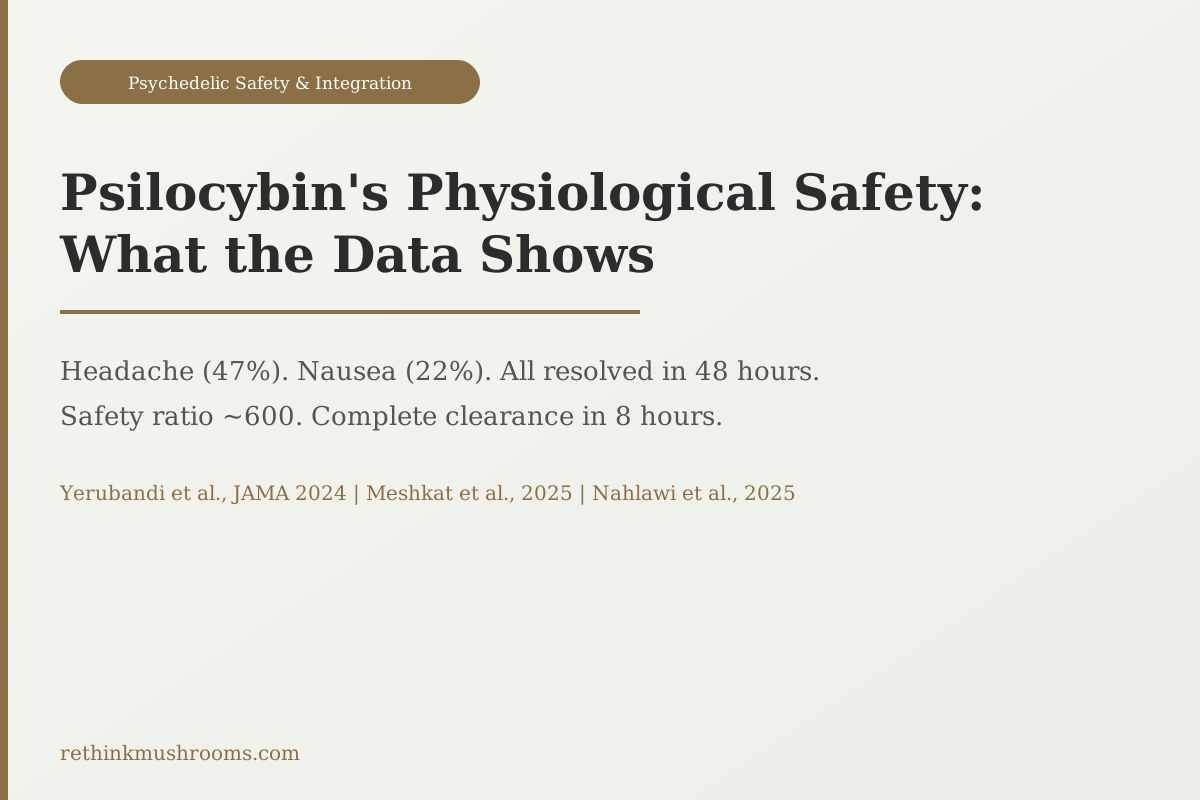
47% headache rate
Headache was the most common physical side effect in a JAMA meta-analysis of 528 clinical trial participants. Every measured adverse effect resolved within 48 hours.
Yerubandi et al., JAMA Network Open, 2024
~600
psilocybin's safety ratio: the gap between a therapeutic dose and the estimated toxic threshold, compared to 10 for ethanol (Nahlawi 2025)
8 hrs
complete clearance window from oral dosing: the mechanistic basis for psilocybin's absence of chronic organ toxicity (Meshkat 2025)
22%
nausea rate in the JAMA meta-analysis of 528 clinical trial participants, fully resolved within 48 hours (Yerubandi 2024)
Yerubandi et al., JAMA Network Open, 2024
 View as image ↗
The physical safety profile of psilocybin in clinical settings is one of the better-characterized aspects of its pharmacology. A 2024 JAMA meta-analysis pooled adverse event data from six clinical trials and 528 participants, identifying the most common physical effects and their time courses.[7]
The results: headache in 47% of participants, nausea in 22%, anxiety in 20%, and mild blood pressure elevation in a significant fraction. All of these resolved within 48 hours of dosing. No serious physiological adverse events appeared across the meta-analysis.
This article covers the physiological safety data systematically: acute adverse effects from the clinical trial literature, the pharmacokinetic profile that governs how long psilocybin stays in the body, cardiovascular effects, cellular toxicity data, and the population-level evidence on psychological safety in non-clinical users.
Psilocybin is a Schedule I controlled substance in the United States. This content covers physiological research conducted in supervised clinical settings.
For the full safety overview, see How Safe Is Psilocybin? The Complete Safety Research.
Key Takeaways
- JAMA meta-analysis of 528 participants: most common physical adverse effects were headache (47%), nausea (22%), and anxiety (20%); all resolved within 48 hours (Yerubandi et al., 2024)
- Psilocybin has a safety ratio of approximately 600 (the gap between a therapeutic dose and the estimated toxic threshold), compared to 10 for ethanol and 35-50 for caffeine (Nahlawi et al., 2025)
- Psilocybin is fully cleared from the body within 8 hours of oral dosing; this time-limited exposure profile is the mechanistic basis for its absence of chronic organ toxicity (Meshkat et al., 2025)
- Cardiovascular effects during sessions are mild and transient: heart rate increases of 10-20 bpm and blood pressure increases of 10-15 mmHg; 7% of participants show tachycardia (Wsol, 2023)
- In vitro data shows no significant cytotoxicity to normal cells at clinically relevant psilocybin concentrations; anti-inflammatory effects were observed via NF-κB suppression (Laabi et al., 2024)
- Population study of 135,095 U.S. adults (19,299 lifetime psychedelic users) found no significant association between psychedelic use and mental health problems, suicidal ideation, or suicide attempts after adjusting for confounders (Johansen and Krebs, 2015)
What Clinical Trials Document: Specific Numbers from 528 Participants
The most rigorous synthesis of acute physiological adverse effects comes from Yerubandi and colleagues, whose 2024 systematic review and meta-analysis in JAMA Network Open pooled data from six clinical trials involving 528 participants who received therapeutic doses of psilocybin.[7]
The statistically significant adverse effects identified:
| Adverse Effect | Rate in Meta-Analysis |
|---|---|
| Headache | ~47% |
| Nausea | ~22% |
| Anxiety | ~20% |
| Blood pressure elevation | Statistically significant |
| Dizziness | Statistically significant |
Effects that did NOT reach statistical significance: paranoia and transient thought disorder. All adverse effects in the meta-analysis resolved within 48 hours of dosing.
A few observations about this data worth noting. The headache rate is high but this is typical across psychedelic trial literature. Nausea appears within the first hour of dosing and typically resolves as the peak effects diminish. Anxiety is the most variable adverse effect; its incidence is influenced substantially by set and setting rather than pharmacology alone. The absence of significant paranoia and thought disorder in the pooled data is noteworthy given community concern about those effects.
The 2025 systematic review by Freitas and colleagues across psilocybin-assisted psychotherapy trials reached a convergent conclusion: most adverse events are mild-to-moderate and transient; suicidal ideation was observed in less than 1% of participants, and mainly in those with prior suicidal history; no serious physical adverse events were observed across reviewed trials.[8]
The 8-Hour Window: Why Psilocybin Doesn't Accumulate Like Daily Medications
The pharmacokinetic profile is central to understanding why psilocybin has a low chronic toxicity risk.
Meshkat and colleagues (2025) published the most comprehensive pharmacokinetics systematic review to date, pooling data from 25 studies.[10] Key parameters:
- Oral bioavailability: approximately 50%
- Time to peak psilocin plasma concentration (Tmax): 80-105 minutes
- Elimination half-life: 2-3 hours
- Complete clearance: within 8 hours of dosing
- Interindividual variability: approximately 50% coefficient of variation
The 8-hour clearance is mechanistically important. Drugs that accumulate in the body with repeated dosing can cause cumulative tissue damage: to the liver (hepatotoxicity), kidneys (nephrotoxicity), or cardiac tissue. The reason daily medications carry chronic toxicity risks is that repeated dosing maintains constant tissue exposure.
Psilocybin does not accumulate. After an 8-hour window, the body has cleared it. This is why the physiological risk profile of two psilocybin sessions per year looks nothing like the risk profile of two months of daily SSRI dosing in terms of tissue exposure burden.
Brown and colleagues (2017) confirmed dose-linear pharmacokinetics across a range of doses from 0.1 to 0.5 mg/kg: dose-proportional plasma exposure with complete clearance by 8 hours, and no safety signals at any dose in that range.[4]
Cardiovascular: What Actually Happens During a Session
Psilocybin does produce cardiovascular effects during the session window. Wsol (2023) reviewed cardiovascular safety across psychedelic medicine data and reported the quantitative parameters for psilocybin specifically.[5]
The documented acute cardiovascular effects:
- Heart rate increase: +10-20 bpm during peak effects
- Blood pressure increase: +10-15 mmHg systolic
- 7% of participants showed tachycardia
- 50% of participants showed transient systolic blood pressure above 140 mmHg during the session
These elevations are modest. For context, a brisk walk produces similar heart rate increases. The blood pressure elevation is equivalent to what many people experience during a stressful meeting. The difference from a brisk walk is that psilocybin's cardiovascular stimulation arrives without physical exertion, which means the cardiac workload calculation is different for individuals with pre-existing cardiac disease.
Nahlawi and colleagues (2025) in Nature Cardiovascular Research provided the broader cardiovascular safety synthesis, noting that psilocybin's primary 5-HT2A receptor agonism is mechanistically distinct from MDMA's 5-HT2B agonism.[9] 5-HT2B activation in cardiac valvular tissue causes fibrosis and the valvulopathy seen in chronic MDMA users. Psilocybin's much lower 5-HT2B binding affinity is the mechanistic reason no cases of psilocybin-induced valvular heart disease have ever been reported in the literature.
Nahlawi 2025 also reported the safety ratio of approximately 600 for psilocybin: the gap between a typical therapeutic dose and the estimated toxic threshold. For comparison, ethanol's safety ratio is approximately 10 and caffeine's is 35-50. The cardiovascular safety article in this cluster covers this in more depth; see Psilocybin Cardiovascular Safety: Why It's Considered Low-Risk Compared to MDMA.
Therapeutic Safety Ratio
How Wide Is the Gap Between a Dose and a Dangerous Dose?
The safety ratio is the distance between the amount a person typically takes and the amount estimated to be toxic. A higher number means a wider margin. Psilocybin’s ratio of roughly 600 is among the highest reported for any psychoactive substance — many times wider than two legal psychoactives most adults use without a second thought.
Psilocybin
~600×Typical therapeutic dose vs estimated toxic threshold
Caffeine
35–50×A cup of coffee vs a lethal caffeine dose
Ethanol (alcohol)
~10×A standard drink vs a lethal blood-alcohol level
How to read it: a large safety ratio does not mean psilocybin is risk-free — it describes the toxicological margin, not the psychological or cardiovascular considerations covered elsewhere in this article. It simply means the dose that produces effects and the dose that threatens the body are unusually far apart.
Source: Nahlawi et al. 2025, Nature Cardiovascular Research [9]. Bar widths are log-scaled (log₁₀ of each ratio, normalized to psilocybin = 100%) so all three bars stay legible across a roughly 60-fold range; the printed ratios are the actual values.
The legitimate cardiovascular caution identified in both Wsol 2023 and Nahlawi 2025: QTc prolongation is a possible concern, and ECG monitoring is recommended in clinical settings. No large studies have specifically enrolled patients with pre-existing cardiac disease, so the data in that population remains limited.
Cellular and Organ Toxicity: What the Laboratory Data Shows
Laabi and colleagues (2024) examined psilocybin's cytotoxicity directly in cell culture experiments.[6] The findings at clinically relevant concentrations:
- No significant cytotoxicity to normal cells
- Anti-inflammatory effects observed via NF-κB suppression
- No genotoxicity detected
The study also found selective cytotoxicity to cancer cell lines, which is mechanistically interesting but not directly relevant to clinical safety in healthy populations.
Preclinical toxicity data from Zhuk and colleagues (2015) provides the animal model anchor: methanolic extract from psilocybin mushrooms showed no acute lethal toxicity in mice at doses up to 800 mg/kg, and psilocin caused behavioral and motor effects without mortality at the tested doses, yielding a preclinical safety ratio estimated at greater than 600 times a typical human dose.[2]
The combination of no cellular genotoxicity (Laabi 2024), high preclinical safety ratio (Zhuk 2015), complete 8-hour clearance (Meshkat 2025), and absence of cumulative organ toxicity reports across decades of human research forms a consistent picture of low physiological toxicity at clinical doses.
The Difficult Experience: What Physical Distress Looks Like
Physiological safety and subjective distress are related but distinct. Barrett and colleagues (2016) developed and validated the Challenging Experience Questionnaire to characterize difficult psilocybin experiences.[3]
The CEQ identified seven primary domains of challenging experiences: fear, grief or loss, physical distress, feelings of insanity, isolation, confrontation with death, and paranoia. Physical distress (nausea, discomfort, physical sensations) was one of the seven domains, reflecting that psilocybin experiences can be physically uncomfortable for some participants.
Importantly, the Barrett 2016 survey found that challenging experiences commonly co-occurred with mystical-type experiences, and most respondents reported a net positive benefit despite the difficulty. The physical distress component of challenging experiences is real but does not change the broader clinical adverse event picture from Yerubandi 2024 and Freitas 2025.
For readers interested in the psychological risk landscape more specifically, see Psilocybin and Psychosis Risk: The Schizophrenia Concern.
Population Data: 135,000 People, No Increased Mental Health Risk
The physiological safety data from clinical trials reflects a pre-screened, medically supervised population. The natural question is whether similar physiological and psychological safety extends to real-world uncontrolled settings.
Johansen and Krebs (2015) examined this in a study using nationally representative U.S. adult survey data (n=135,095) including 19,299 lifetime psychedelic users.[1] After adjusting for age, sex, race, education, income, other drug use, and childhood depression: no significant association was found between lifetime psychedelic use and serious psychological distress, mental health treatment seeking, suicidal ideation, suicide plans, or suicide attempts.
This is a large-sample population study, not a randomized trial. It does not establish causation. Selection effects could partly explain the findings: people who are more psychologically stable may be more likely to use psychedelics and less likely to experience harm. What the data can say is that, in a population of 19,299 lifetime users at the time of the survey, psychedelic use was not a detectable predictor of mental health problems across any of the measured outcomes.
The converging picture from clinical trial data (Yerubandi 2024, Freitas 2025), pharmacokinetic data (Meshkat 2025), cellular toxicity research (Laabi 2024), and population epidemiology (Johansen/Krebs 2015) is consistent: physiological harm from psilocybin at typical doses in typical contexts is low.
The Honest Caveats: What This Data Doesn't Guarantee
The safety evidence is genuinely reassuring, but honest reporting requires the caveats.
Freitas 2025 specifically identified the need for standardized adverse event definitions across psilocybin trials: without standardization, comparing adverse event rates between studies is complicated, and some harms may be systematically under-reported.[8]
The cardiovascular data has a gap: no large study has enrolled participants with pre-existing cardiac disease. The Wsol 2023 and Nahlawi 2025 data comes from screened populations where significant cardiac conditions were exclusion criteria.
The population data from Johansen/Krebs 2015 cannot speak to psychiatric contraindications. People who are predisposed to psychosis or who have certain severe mental health conditions were not specifically tracked in that study as a subgroup. Participants with personal or family history of schizophrenia or psychotic disorders have been consistently excluded from clinical trials for a reason.
The 8-hour clearance window that makes chronic physical toxicity unlikely does not address what happens to people who use psilocybin at much higher frequency than clinical protocols. The pharmacokinetic data describes single sessions. Microdosing regimens involving multiple weekly administrations have no long-term physiological safety data.
For context on drug interaction safety, see Psilocybin Drug Interactions: A Complete Guide. And for a look at where toxicity research has explicitly tested the upper limits, see Can You Overdose on Psilocybin? Toxicity Research.
The Bottom Line
Psilocybin's physiological safety profile in supervised clinical settings is well-documented and generally favorable. A JAMA meta-analysis of 528 participants found headache (47%), nausea (22%), and blood pressure elevation as the most common physical effects, all resolving within 48 hours. Pharmacokinetics confirm complete clearance within 8 hours, mechanically limiting chronic organ toxicity potential. The safety ratio of approximately 600 is among the highest for any psychoactive substance. Cellular toxicity studies at clinical doses show no genotoxicity and no harm to normal tissue. Population data in 135,000 adults found no association with adverse mental health outcomes. Legitimate caveats remain: QTc monitoring is warranted, cardiac patients have not been studied, and the long-term safety of repeated microdosing is unknown.
Frequently Asked Questions
Sources & References
- 1RTHM-00696·Johansen, Pål-Ørjan et al. (2015). “Psychedelics not linked to mental health problems or suicidal behavior: a population study..” Journal of psychopharmacology (Oxford.Study breakdown →PubMed →↩
- 2RTHM-00415·Zhuk, Olga et al. (2015). “Research on acute toxicity and the behavioral effects of methanolic extract from psilocybin mushrooms and psilocin in mice..” Toxins.Study breakdown →PubMed →↩
- 3RTHM-00417·Barrett, Frederick S et al. (2016). “The Challenging Experience Questionnaire: Characterization of challenging experiences with psilocybin mushrooms..” Journal of psychopharmacology (Oxford.Study breakdown →PubMed →↩
- 4RTHM-00461·Brown, Randall T et al. (2017). “Pharmacokinetics of Escalating Doses of Oral Psilocybin in Healthy Adults..” Clinical pharmacokinetics.Study breakdown →PubMed →↩
- 5RTHM-01822·Wsół, Agnieszka (2023). “Cardiovascular safety of psychedelic medicine: current status and future directions..” Pharmacological reports : PR.Study breakdown →PubMed →↩
- 6RTHM-00887·Laabi, Salma et al. (2024). “Deciphering psilocybin: Cytotoxicity, anti-inflammatory effects, and mechanistic insights..” International immunopharmacology.Study breakdown →PubMed →↩
- 7RTHM-02030·Yerubandi, Akhila et al. (2024). “Acute Adverse Effects of Therapeutic Doses of Psilocybin: A Systematic Review and Meta-Analysis..” JAMA network open.Study breakdown →PubMed →↩
- 8RTHM-02083·Freitas, Rosana R et al. (2025). “The safety of psilocybin-assisted psychotherapy: A systematic review..” The Australian and New Zealand journal of psychiatry.Study breakdown →PubMed →↩
- 9RTHM-02156·Nahlawi, Acile et al. (2025). “Cardiovascular effects and safety of classic psychedelics..” Nature cardiovascular research.Study breakdown →PubMed →↩
- 10RTHM-00945·Meshkat, Shakila et al. (2025). “Pharmacokinetics of Psilocybin: A Systematic Review..” Pharmaceutics.Study breakdown →PubMed →↩