Psychedelic Safety & Integration
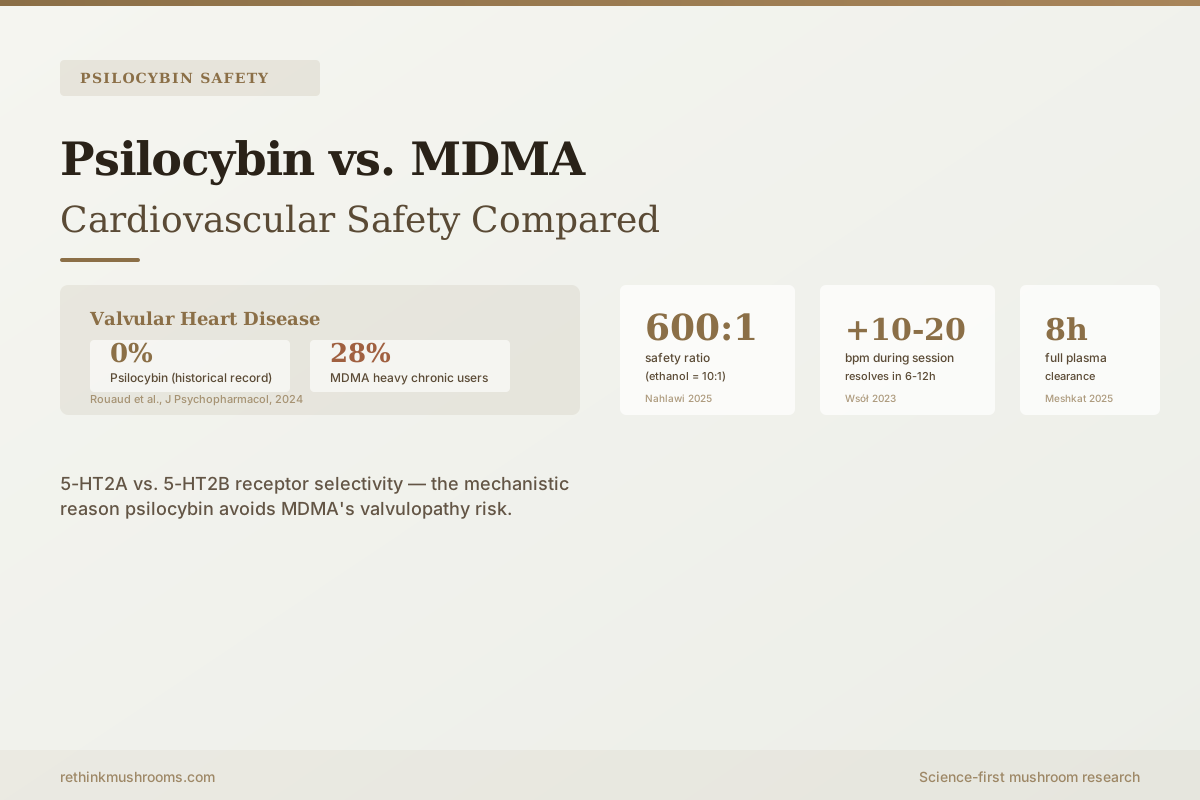
0 cases of psilocybin valvulopathy ever reported
MDMA causes echocardiographic valvular disease in 28% of heavy chronic users. Psilocybin, which binds primarily to brain 5-HT2A receptors rather than the cardiac 5-HT2B receptor, has never caused valvular damage in decades of clinical and recreational use.
Rouaud et al., J Psychopharmacol, 2024; Nahlawi et al., Nat Cardiovasc Res, 2025
+10–20 bpm
typical heart rate increase during a session
600:1
psilocybin safety ratio vs ethanol's 10:1
8 hours
complete plasma clearance after dosing
Rouaud et al., J Psychopharmacol, 2024; Nahlawi et al., Nat Cardiovasc Res, 2025
 View as image ↗
Psilocybin causes mild, transient cardiovascular effects during a session: heart rate increases of 10–20 beats per minute and systolic blood pressure increases of 10–15 mmHg. These effects peak around two hours after dosing and normalize within 6–12 hours. No cases of psilocybin-induced valvular heart disease have ever been reported in either clinical trials or population-level data.[5]
The contrast with MDMA is stark. Heavy chronic MDMA users show echocardiographic evidence of valvular heart disease in 28% of cases — a rate comparable to drugs like methysergide and ergotamine that were withdrawn from markets precisely because of this complication.[3] The reason psilocybin avoids this risk comes down to which receptor it binds to. Understanding that distinction explains most of what makes psilocybin's cardiovascular safety profile distinct from other serotonergic psychoactives.
For the full safety overview across all physiological systems, see How Safe Is Psilocybin? The Complete Safety Research.
Key Takeaways
- Psilocybin produces transient heart rate increases of 10–20 bpm and systolic blood pressure increases of 10–15 mmHg that normalize within 6–12 hours; clinical monitoring data shows 7% tachycardia rate and 50% transient systolic elevation above 140 mmHg (Wsół et al., Pharmacol Rep, 2023)
- No cases of psilocybin-induced valvular heart disease have ever been reported; MDMA causes valvulopathy in 28% of heavy chronic users. The difference is receptor selectivity: psilocybin targets 5-HT2A (brain), MDMA targets 5-HT2B (cardiac tissue) (Rouaud et al., J Psychopharmacol, 2024)
- Psilocybin's physiological safety ratio is approximately 600:1 (lethal dose to effective dose), compared to caffeine at 35–50:1 and ethanol at 10:1 (Nahlawi et al., Nat Cardiovasc Res, 2025)
- A JAMA Network Open meta-analysis of 528 clinical trial participants found elevated blood pressure was a statistically significant adverse effect, but all cardiovascular effects resolved within 48 hours (Yerubandi et al., JAMA Netw Open, 2024)
- Complete plasma clearance occurs within 8 hours of dosing; this time-limited exposure is a key reason chronic cardiac effects seen with daily medications do not apply to psilocybin (Meshkat et al., Pharmaceutics, 2025)
- QTc prolongation is a legitimate concern: cardiac screening and ECG monitoring before sessions are recommended, particularly for people with pre-existing cardiac disease or taking QTc-prolonging medications (Nahlawi et al., Nat Cardiovasc Res, 2025)
During a Session: Heart Rate Up, Blood Pressure Up, Normal Again by Bedtime
During a psilocybin session, the cardiovascular system experiences mild but measurable changes. Wsół (2023) reviewed the clinical monitoring data and reported consistent findings across studies: heart rate increases of 10–20 beats per minute, systolic blood pressure increases of 10–15 mmHg, and 50% of participants showing a transient systolic reading above 140 mmHg at some point during the session.[2] About 7% of monitored participants developed frank tachycardia (heart rate above 100 bpm).
These numbers need context. A brisk 15-minute walk produces a similar magnitude of cardiovascular response in a healthy adult. The increases are real and detectable on monitoring equipment, but they fall in the range of what the cardiovascular system handles routinely during ordinary physical and emotional arousal.
What matters more is the time course. The changes peak at approximately 2 hours post-dosing and return to baseline within 6–12 hours, well within the session window and without any lingering effects detected on follow-up monitoring.[2]
The JAMA Network Open meta-analysis by Yerubandi et al. (2024), which pooled data from 528 clinical trial participants, confirmed that elevated blood pressure was a statistically significant adverse effect of therapeutic psilocybin doses.[4] So was headache (occurring in about 47% of participants) and nausea (about 22%). All adverse effects, including the cardiovascular ones, resolved within 48 hours across all studies in the analysis. The review described the overall acute safety profile as "tolerable."
Paranoia and transient disordered thinking, often cited as major concerns in popular coverage, did not reach statistical significance across the pooled studies.
For broader coverage of psilocybin's acute physiological effects beyond the cardiovascular system, see Psilocybin's Physiological Safety: What the Data Shows.
Why MDMA Causes Heart Valve Damage, and Why Psilocybin Doesn't
The key to understanding psilocybin's cardiac profile is a single distinction: which serotonin receptor it primarily targets.
Serotonin, the neurotransmitter both MDMA and psilocybin affect, has multiple receptor subtypes scattered across different tissues and organs. The receptor labeled 5-HT2A is concentrated in the brain. When psilocybin's active metabolite (psilocin) binds to this receptor, it produces the psychedelic effects. The receptor labeled 5-HT2B is found in heart valve tissue. When this receptor is repeatedly activated, it causes the valve tissue to thicken and scar in a process called fibrosis, gradually preventing the valve leaflets from opening and closing correctly.
Psilocybin's binding at 5-HT2B is weak. MDMA's is not.
Rouaud et al. (2024) reviewed the comparative evidence directly.[3] In heavy chronic MDMA users, defined as averaging about 3.6 tablets per week over 6.1 years, echocardiography detected valvular heart disease in 28% of cases. This rate matches what was seen with older pharmaceutical drugs (methysergide, ergotamine) that were withdrawn specifically because of this complication. Those drugs also worked via 5-HT2B activation.
Psilocybin and LSD, by contrast, have zero cases of valvular disease in the historical record, across decades of clinical research and extensive recreational use data. The mechanistic explanation is consistent: they are much weaker 5-HT2B agonists than MDMA.
Rouaud's review did raise one theoretical concern for chronic microdosing: because small repeated doses could still produce some 5-HT2B stimulation over time, the cardiac fibrosis risk from daily microdosing cannot be entirely dismissed without long-term data. This is different from the standard high-dose session model, and Rouaud describes it as an open question rather than a demonstrated risk. No empirical evidence of harm from microdosing exists as of 2024.
Nahlawi et al. (2025), publishing in Nature Cardiovascular Research, reviewed the cardiovascular effects of classic psychedelics with the same conclusion: psilocybin's primary 5-HT2A agonism explains the absence of valvulopathy, while the weak 5-HT2B binding profile keeps chronic cardiac risk low at standard doses.[5]
For a deeper explanation of how psilocybin's receptor binding profile determines its effects, see Psilocybin and the 5-HT2A Receptor: The Key to Psychedelic Effects.
The 600:1 Safety Ratio: Why This Number Matters for the Heart
One of the most useful ways to compare drug safety across substances is the physiological safety ratio: the ratio between the dose that produces lethal toxicity and the dose that produces the intended effect.
Nahlawi et al. (2025) cite psilocybin's safety ratio as approximately 600:1.[5] This means the dose that kills would need to be roughly 600 times the effective therapeutic or psychedelic dose. For context: caffeine's safety ratio is approximately 35–50:1, and ethanol's is approximately 10:1. By this metric, psilocybin is physiologically safer than the two most commonly consumed legal psychoactive substances.
This does not mean psilocybin has no risks. Safety ratio measures acute toxicity, not psychological distress, context-dependent risks, or contraindicated populations. But it does explain why, despite decades of both clinical research and widespread recreational use, there are no documented deaths attributable to psilocybin toxicity alone.
The cardiovascular component of this picture is that psilocybin's effects on the heart fall in the "mild, transient, and self-resolving" category rather than in the "accumulates over time and causes structural damage" category.
For the full picture of psilocybin's toxicity limits, see Can You Overdose on Psilocybin? Toxicity Research.
The Real Cardiac Concern: QTc Prolongation and Who It Affects
The most legitimate cardiovascular concern identified in the current literature is not heart rate or blood pressure. It is QTc prolongation.
QTc refers to a measurement of the heart's electrical recovery time between beats, corrected for heart rate. When QTc becomes too long, the heart is vulnerable to a dangerous arrhythmia called torsades de pointes. Many common drugs, including antihistamines, antibiotics, and antidepressants, carry QTc prolongation as a side effect, which is why it appears prominently on medication warning labels.
Wsół (2023) identified QTc prolongation as a legitimate concern with psilocybin and recommended ECG monitoring before and during sessions for clinical use.[2] Nahlawi et al. (2025) echoed this, explicitly recommending cardiac screening protocols for psilocybin-assisted therapy that include baseline ECG.[5]
The data on the magnitude of this risk is incomplete. QTc prolongation has been observed in psilocybin sessions, but neither Wsół nor Nahlawi identified any cases of actual arrhythmia in the clinical literature. The concern is theoretical but not negligible: people taking other QTc-prolonging medications (certain antidepressants, antibiotics, or cardiac drugs) face higher combined risk.
The honest picture: the acute cardiovascular effects are mild and transient, valvulopathy risk is essentially absent based on the receptor mechanism and historical record, but QTc monitoring is warranted, particularly for people with cardiac disease or taking other medications.
For a detailed examination of the QTc evidence, see Psilocybin and QTc Prolongation: What Cardiac Monitoring Data Shows.
Why 8-Hour Clearance Changes the Chronic Cardiac Risk Equation
One underappreciated aspect of psilocybin's safety profile is how quickly the body processes and eliminates it.
Meshkat et al. (2025) published the most current systematic review of psilocybin pharmacokinetics, synthesizing data across multiple studies.[6] Oral bioavailability is approximately 50%. Psilocybin is rapidly converted in the body to psilocin, the active form. Psilocin peaks in plasma at 80–105 minutes after dosing and has a half-life of 2–3 hours. Complete clearance from the body occurs within approximately 8 hours.
Brown et al. (2017) confirmed dose-proportional linear pharmacokinetics across doses from 0.1 to 0.5 mg/kg, with no safety signals detected at any dose level tested.[1]
The 8-hour clearance figure matters for chronic cardiac risk specifically. The mechanism by which MDMA causes valvular disease requires sustained 5-HT2B receptor stimulation over months to years. A drug that is completely cleared within 8 hours, taken at intervals of weeks or months, cannot accumulate the chronic 5-HT2B exposure that produces fibrosis. The pharmacokinetic profile structurally prevents the kind of chronic exposure that drives MDMA-related cardiac damage.
This is also different from a drug taken daily. Most medications that carry cardiac risks do so because the body encounters them every day, often for years. Psilocybin's use in therapeutic contexts, typically one to three sessions in a treatment course, produces cumulative exposure that is a fraction of what occurs with daily medications.
Inter-individual variability in clearance rate is real: Meshkat et al. identified CYP2C9 enzyme activity and monoamine oxidase activity as key sources of variation in how quickly different people metabolize psilocin. But even in slower metabolizers, clearance occurs well within the same day.
Who Needs Extra Caution: The Three Cardiac Risk Categories
Nahlawi et al. (2025) identified three categories of people for whom cardiac precautions are particularly relevant.[5]
First, people with pre-existing cardiac disease, particularly those with a history of arrhythmias, structural heart disease, or severe hypertension. The mild blood pressure elevation during a session is generally benign in healthy cardiovascular systems but could be meaningful in compromised ones. There are no large-scale clinical trials of psilocybin specifically in cardiac patient populations, so the evidence base for risk management in these groups is thin.
Second, people taking other QTc-prolonging medications. The combined effect of psilocybin and a medication that already extends QTc is unknown and potentially additive. This is the most specific cardiac contraindication in current safety frameworks.
Third, people with uncontrolled hypertension. The transient blood pressure increase during a session adds to whatever baseline elevation already exists.
For controlled clinical research settings, the safety monitoring approach that has emerged includes baseline ECG before any session, blood pressure and heart rate monitoring throughout the session, and exclusion criteria for people with significant cardiac disease. This is the approach embedded in current research protocols and consistent with Nahlawi's 2025 recommendations.
For a full breakdown of these risk categories, see Heart Conditions and Psilocybin: Who Should Be Cautious?.
What Three Independent Evidence Sources Show in Agreement
The evidence for psilocybin's cardiovascular safety profile converges from three independent sources, each using different methodologies.
Acute effects, confirmed by meta-analysis: heart rate and blood pressure rise modestly during sessions, resolve within hours, and are statistically confirmed across 528 clinical trial participants. The magnitude is mild by clinical standards.
Chronic structural damage, absent across historical records: no valvulopathy, no cardiac fibrosis, zero cases across both clinical and population data. The receptor mechanism (weak 5-HT2B binding relative to MDMA) provides a biological reason for why this absence is expected to continue for standard-dose sessions. Chronic microdosing remains a theoretical exception where the data is not yet sufficient for confident conclusions.
QTc prolongation, a legitimate safety consideration: supports screening before clinical use, particularly in populations with pre-existing cardiac risk factors or drug interactions.
The 600:1 safety ratio, the 8-hour clearance window, and the zero historical valvulopathy cases are the three foundations of why psilocybin is described as cardiovascularly low-risk. The QTc monitoring recommendation is the counterweight, the real caveat that responsible coverage should include alongside the reassuring data.
The Bottom Line
Psilocybin causes mild, transient cardiovascular changes during sessions, modest heart rate and blood pressure increases that resolve within hours, and has never been associated with valvular heart disease in either clinical or population data. The mechanistic explanation is receptor selectivity: psilocybin's weak binding at the cardiac 5-HT2B receptor, compared to MDMA's strong binding, explains the absent valvulopathy risk. QTc prolongation is a genuine concern that warrants ECG monitoring before sessions, particularly for people with existing cardiac conditions or QTc-prolonging medications. Complete 8-hour plasma clearance limits the cumulative 5-HT2B exposure that underlies medication-related cardiac fibrosis.
Frequently Asked Questions
Sources & References
- 1. Source details for this reference are not yet available.
- 2. Source details for this reference are not yet available.
- 3. Source details for this reference are not yet available.
- 4. Source details for this reference are not yet available.
- 5. Source details for this reference are not yet available.
- 6. Source details for this reference are not yet available.