Psilocybin and Cardiovascular Safety
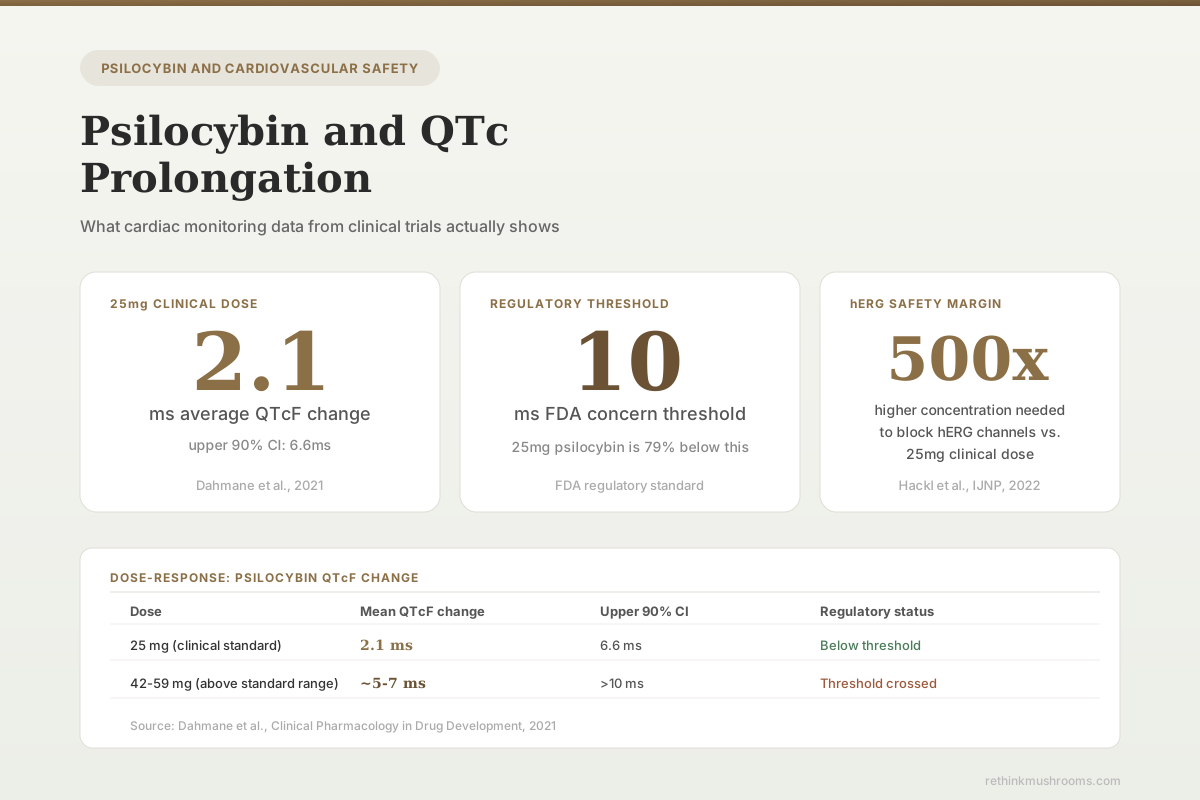
2.1 ms average QTcF change at 25mg
Dahmane and colleagues measured the QTc interval response across a range of psilocybin doses. At the standard 25mg clinical dose, the mean QTcF change was just 2.1ms, well below the 10ms threshold that triggers regulatory concern.
Dahmane et al., Clinical Pharmacology in Drug Development, 2021
10ms
FDA regulatory threshold for QTc concern
500x
higher psilocin concentration needed to block hERG channels vs. clinical dose
42-59mg
dose range where upper 90% CI for QTcF crosses the 10ms threshold
Dahmane et al., Clinical Pharmacology in Drug Development, 2021
 View as image ↗
The QT interval is the piece of cardiac data that has quietly shaped which patients can enter psilocybin clinical trials. It appears in pre-treatment ECG screening, in exclusion criteria for multiple Phase 2 and Phase 3 trials, and in the discussion sections of every comprehensive cardiovascular safety review. Most people who encounter it in a psilocybin context have no idea what it means, what the actual numbers look like across doses, or why psilocybin QTc prolongation risk is considered low at standard clinical doses but not at higher ones.
The data on this question is more precise than almost any other area of psilocybin safety research. A 2021 pharmacokinetic analysis published the first detailed concentration-QTc curve for psilocybin, giving researchers and clinicians a dose-by-dose map of the risk. That data is what this article is about. This article is part of the broader guide to psilocybin safety research.
Key Takeaways
- Dahmane et al. (2021) measured a mean QTcF change of 2.1ms at the standard 25mg clinical dose, with an upper 90% confidence interval of 6.6ms, both well below the 10ms regulatory threshold[1]
- QTc concern at the threshold level only begins at doses of 42-59mg, well above the 25mg dose used in most psilocybin therapy protocols[1]
- Hackl et al. (2022) found that hERG channel inhibition, the main mechanism of drug-induced QTc prolongation, requires psilocin concentrations 500 times higher than those achieved at 25mg, meaning the main QTc mechanism is not active at clinical doses[2]
- A 2024 meta-analysis (Yao et al.) found treatment-emergent cardiovascular events were not significantly elevated versus placebo across pooled psychedelic trial data at standard doses[4]
- The 2025 Nature Cardiovascular Research review (Nahlawi et al.) identifies pre-treatment ECG screening as appropriate for three groups: patients on QTc-prolonging medications, those with known long QT syndrome, and those with significant electrolyte disorders[3]
- The honest knowledge gap: no randomized trial has enrolled patients with known baseline QTc prolongation; current screening protocols reflect expert consensus, not direct trial evidence
What QTc Prolongation Is and Why Drug Regulators Care About It
The QT interval is the time it takes for the heart's lower chambers (ventricles) to electrically recover after each beat. Measured on an ECG, it appears as the gap between two specific points on the tracing. A normal QT interval is roughly 350 to 450 milliseconds in adults.
QTc is the corrected version. Heart rate affects the raw QT interval in a predictable way: faster heart rates shorten it, slower rates lengthen it. Correcting for heart rate allows comparison across people and across conditions. QTcF (the Fridericia correction) is the formula most clinical trials use.
The problem with a prolonged QTc is that it represents a window of electrical vulnerability in the heart. During this recovery phase, an additional electrical signal arriving at the wrong moment can trigger an abnormal rhythm. The most dangerous of these is torsades de pointes, a potentially fatal arrhythmia that, at its worst, can progress to ventricular fibrillation.
Most drugs that cause torsades de pointes first cause QTc prolongation. This is why the FDA uses QTc prolongation as a regulatory safety signal even for drugs that haven't been directly linked to arrhythmia. The specific threshold most agencies use: a mean QTc change greater than 5ms warrants close attention; a change greater than 10ms warrants a regulatory flag regardless of whether arrhythmias have been observed.
This is the framework within which psilocybin's cardiac profile has to be understood.
What the Dose-Response Data Actually Shows
In 2021, Dahmane and colleagues published the first detailed analysis of the concentration-QTc relationship for psilocybin in Clinical Pharmacology in Drug Development.[1] The study used pharmacokinetic modeling to map how blood psilocin concentration (the active metabolite of psilocybin) related to QTcF change across a range of doses.
At the 25mg dose, the mean peak psilocin blood level was 18.7 ng/mL. At that concentration, the mean QTcF change was 2.1ms. The upper bound of the 90% confidence interval was 6.6ms. Both numbers fall clearly below the 10ms threshold that triggers regulatory concern.
Dahmane's analysis also tested what happens at higher concentrations. The results give a picture of where the risk landscape changes:
| Psilocin Cmax (ng/mL) | Approximate dose | Mean QTcF change | Upper 90% CI | Regulatory status |
|---|---|---|---|---|
| 18.7 | 25 mg | 2.1 ms | 6.6 ms | Below threshold |
| 31.1 | 42-59 mg | ~5-7 ms | >10 ms | Threshold crossed |
The distinction matters. At 25mg, the dose used in the majority of published clinical trials including the Johns Hopkins depression studies and the COMPASS Pathways Phase IIb trial, QTc prolongation is minimal. Regulatory concern at the threshold level only begins at doses in the 42-59mg range, which most clinical protocols do not reach.
For context on who should be particularly screened before psilocybin therapy, see psilocybin and cardiovascular risk assessment.
Why the QTc Risk Is Low at Standard Doses: The Channel Science
Understanding why psilocybin has low QTc liability at clinical doses requires knowing how drug-induced QTc prolongation typically works at a cellular level.
Most drugs that prolong the QT interval do so by blocking a specific potassium channel called hERG (human ether-a-go-go related gene). The hERG channel controls the speed at which potassium flows out of cardiac cells during recovery. Block that channel, and recovery slows. Slow recovery means a longer QT interval.
Hackl and colleagues (2022) specifically tested whether psilocin could inhibit hERG channels in laboratory conditions, publishing the results in the International Journal of Neuropsychopharmacology.[2] The finding: psilocin did reduce hERG channel activity, but only at high concentrations. To achieve the level of hERG inhibition that produces meaningful QTc changes, psilocin concentrations needed to be approximately 500 times higher than what is found in human plasma at the 25mg clinical dose.
This is a large safety margin. The concentration at which hERG inhibition begins to matter is so far beyond the clinical dose range that the mechanism essentially does not operate at standard therapeutic doses. Hackl concluded that hERG channel-mediated cardiotoxicity is not a meaningful concern for therapeutic psilocybin use.
What does cause the 2.1ms change seen in Dahmane's data? Psilocybin has some direct effect on cardiac serotonin receptors, and serotonergic activity can affect heart rhythm. But this effect, at clinical doses, is small, and it resolves as psilocybin metabolizes. It does not produce the sustained QTc prolongation that hERG blockade causes.
What the 2025 Harvard Cardiologist Review Found
The most comprehensive recent synthesis comes from Nahlawi and colleagues at Massachusetts General Hospital, published in Nature Cardiovascular Research in 2025.[3] The authors are cardiologists reviewing the psychedelic cardiovascular literature, which gives the paper an authority that internal medicine or psychiatry reviews lack.
Nahlawi organized psychedelic cardiovascular risk into three domains. The first is electrophysiological: arrhythmia risk and QTc prolongation. The second is structural: the risk of heart valve disease through chronic stimulation of the 5-HT2B receptor (a separate mechanism from QTc, covered in detail in 5-HT2B and cardiac valvulopathy: is long-term psilocybin use safe?). The third is vascular: acute blood pressure elevation and its implications for people with existing cardiovascular disease.
On the electrophysiological domain, which includes QTc, Nahlawi's conclusion is consistent with the Dahmane data: clinical doses carry low acute QTc risk. The review does not dismiss the concern entirely but places it in appropriate context. The groups that warrant pre-treatment ECG screening are: patients taking other medications known to prolong QTc (there are hundreds of such drugs, including some antidepressants and antipsychotics), patients with known long QT syndrome, and patients with significant electrolyte abnormalities (particularly low potassium or magnesium, which reduce cardiac resilience).
For people outside those three categories, routine ECG screening before a single psilocybin session is not supported by the data as a blanket requirement.
How Pooled Trial Data Looks on Cardiac Outcomes
Beyond the pharmacokinetic analysis and the mechanism study, the clinical trial record is the most direct evidence for what actually happens during psilocybin administration.
Yao and colleagues (2024) published a systematic review and meta-analysis in Psychiatry Research pooling efficacy and safety data from multiple psychedelic trials.[4] Their finding on cardiac outcomes: cardiotoxicity was low across trials, and treatment-emergent cardiovascular events were not significantly elevated versus placebo at standard therapeutic doses. This is the population-level evidence that complements the pharmacokinetic data.
Wsół (2023) reviewed cardiovascular safety across all classic psychedelics in Pharmacological Reports, including psilocybin, LSD, DMT, ayahuasca, and mescaline.[5] The review found that trial data consistently pointed to relative cardiovascular safety in healthy volunteers. It identified two significant knowledge gaps that the Yao meta-analysis also noted: data for patients with pre-existing cardiovascular disease is sparse, and data for the long-term cardiac effects of microdosing is essentially absent.
These gaps matter. Saying that psilocybin at 25mg has low QTc liability in healthy participants is not the same as saying it is safe for someone with an existing QTc of 480ms, or for someone who has been microdosing weekly for two years. Those questions remain unanswered.
How Psilocybin Compares to Common Medications
Context helps calibrate the clinical risk. Psilocybin is not the only drug that affects the QT interval. Many widely prescribed medications carry QTc liability that exceeds what clinical doses of psilocybin produce.
Several common antidepressants, including certain SSRIs and SNRIs, are associated with QTc prolongation. Citalopram has one of the larger effects among antidepressants, with mean QTc changes at therapeutic doses that can reach 10ms or more. Some atypical antipsychotics have even higher QTc liability. Certain antibiotics, antihistamines, and antifungals also carry significant QTc effects.
The Nahlawi 2025 review notes this explicitly: by comparison to many drugs in common clinical use, the QTc profile of psilocybin at standard doses is favorable.[3] This is not a reason to dismiss cardiac screening before psilocybin use. It is a reason to understand the risk in the same proportional way that clinicians manage QTc risk for any medication.
For readers who want a broader comparison of psilocybin's cardiac safety profile relative to other psychoactive substances, see psilocybin cardiovascular safety: why it's considered low-risk compared to MDMA.
What ECG Screening Before Psilocybin Therapy Actually Looks For
Understanding the clinical monitoring question requires separating what ECG screening is designed to detect from what it isn't.
An ECG before psilocybin administration is not screening for the possibility that psilocybin will extend QTc in a normal heart. At 25mg, that extension is 2.1ms on average, and it poses no meaningful risk. The ECG is screening for pre-existing conditions that change the risk calculation.
Specifically, an ECG prior to psilocybin therapy looks for three things, consistent with the Nahlawi 2025 framework.[3] First, a baseline QTc that is already prolonged: if someone arrives with a QTc of 490ms, even a small additional change creates greater risk than the same change in someone starting at 430ms. Second, cardiac rhythm abnormalities that might indicate underlying conduction disease. Third, signs of prior cardiac events that weren't previously identified.
The medication review that typically accompanies the ECG is equally important. Patients taking QTc-prolonging drugs in combination with psilocybin may face additive effects that the pharmacokinetic data does not capture, because that data was generated in drug-naive participants. The magnitude of any additive effect is not known.
The practical guidance that emerges from the evidence: most healthy adults with no cardiac history and no QTc-prolonging medications have a favorable QTc profile for standard-dose psilocybin. The populations that need careful evaluation are those with a personal history of cardiac arrhythmia, known long QT syndrome, regular use of QTc-prolonging medications, or significant electrolyte disorders. For a more complete picture of who should exercise caution, see heart conditions and psilocybin: who should be cautious?.
And for readers concerned about general physiological safety beyond cardiac effects, psilocybin's physiological safety: what the data shows provides the broader context.
The Bottom Line
At the 25mg clinical dose used in most psilocybin therapy trials, the mean QTcF interval change is 2.1ms, well below the 10ms regulatory concern threshold. QTc concern at the threshold level is only reached at 42-59mg doses. The hERG channel mechanism underlying most drug-induced QTc prolongation does not operate at clinical doses because the required psilocin concentrations are approximately 500 times higher than those achieved at 25mg. Pooled trial data confirms low cardiotoxicity at standard doses. The key knowledge gaps are patients with pre-existing QTc prolongation and long-term microdosing regimens, where direct data is absent.
Frequently Asked Questions
Sources & References
- 1. Source details for this reference are not yet available.
- 2. Source details for this reference are not yet available.
- 3. Source details for this reference are not yet available.
- 4. Source details for this reference are not yet available.
- 5. Source details for this reference are not yet available.