Psychedelic Safety & Integration
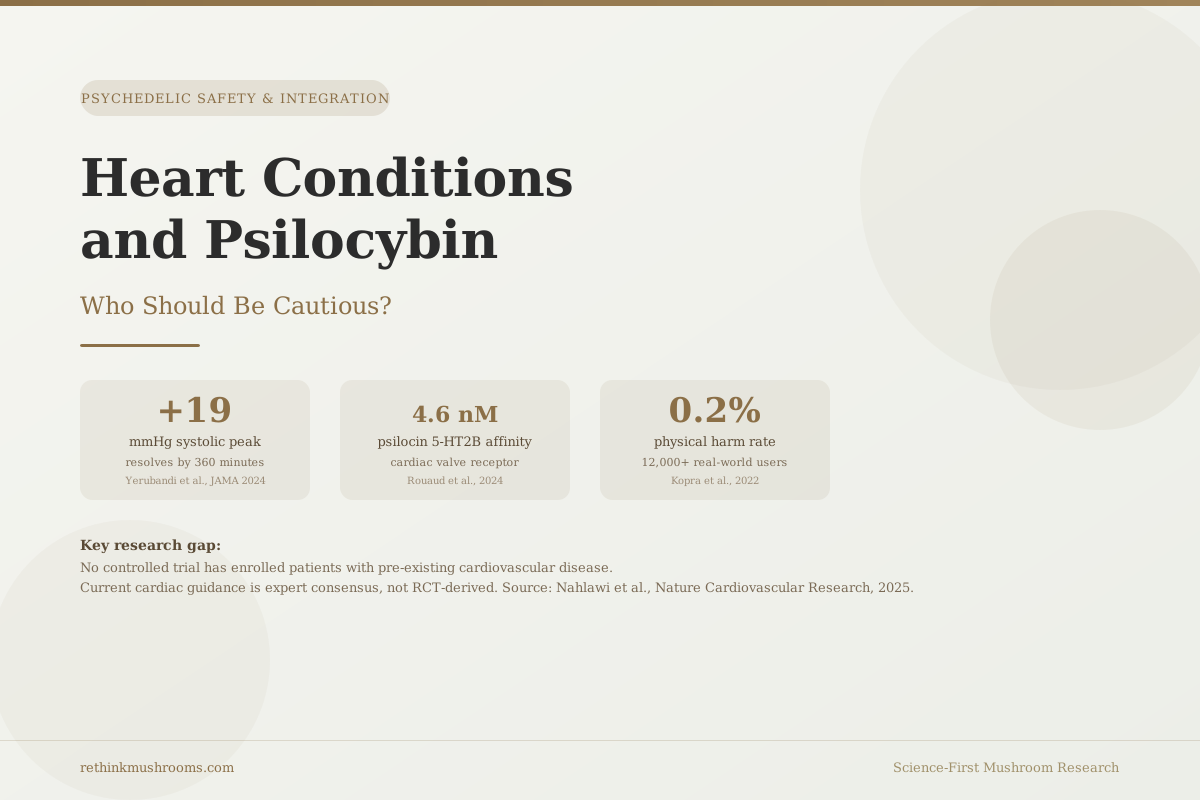
+19 mmHg systolic
Average peak increase in systolic blood pressure during psilocybin sessions in a 2024 JAMA Network Open meta-analysis; transient, resolving within 6 hours, but significant for people with existing cardiovascular disease.
Yerubandi et al., JAMA Network Open, 2024
+8.66 mmHg
average diastolic increase; resolves by 360 minutes (Yerubandi 2024)
4.6 nM
psilocin's affinity for the cardiac 5-HT2B receptor (Rouaud 2024)
0.2%
physical harm rate in 12,000+ real-world users (Kopra 2022)
Yerubandi et al., JAMA Network Open, 2024
 View as image ↗
Psilocybin's cardiovascular profile is regularly described in vague terms: "it can raise blood pressure and heart rate." That's accurate but incomplete. The more useful question (especially for people with existing heart conditions) is which specific cardiac situations are most relevant, what the actual magnitude of effects is, and how the research distinguishes serious risk from manageable caution. This article builds that picture using the available clinical and pharmacological evidence. For the broader safety profile beyond cardiovascular effects, see our complete guide to psilocybin safety research.
The research on heart conditions and psilocybin has two distinct threads that are frequently conflated: the acute sympathomimetic effects on blood pressure and heart rate during a session, and the theoretical long-term risk of cardiac valve changes from chronic serotonin receptor stimulation. These involve different mechanisms, different timeframes, and different populations.
Key Takeaways
- A 2024 JAMA Network Open meta-analysis found psilocybin raises systolic blood pressure by an average of 19 mmHg and diastolic by 8.66 mmHg; heart rate normalizes by 240 minutes, BP by 360 minutes (Yerubandi et al.)
- Nahlawi et al.'s 2025 Nature Cardiovascular Research review from MGH/Harvard cardiologists identifies three cardiac risk domains: electrophysiological (arrhythmia/QTc), structural (valvulopathy via 5-HT2B), and vascular (hypertension/ischemia)
- Current expert consensus identifies severe heart failure, recent myocardial infarction, uncontrolled hypertension, and pre-existing QTc prolongation as conditions warranting exclusion from psilocybin protocols
- Psilocin binds the cardiac 5-HT2B receptor with a Ki of 4.6 nM, high enough to raise concern for existing valve disease, though intermittent therapeutic dosing is considered far lower risk than daily drug exposure (Rouaud et al., 2024)
- No controlled trial has systematically enrolled patients with pre-existing cardiovascular disease; current guidance for cardiac patients is expert consensus, not RCT-derived
- In real-world data from over 12,000 magic mushroom users, cardiac events requiring emergency care were rare; the majority of emergency presentations were for psychological distress (Kopra et al., 2022)
Two Separate Cardiac Risks That Are Frequently Conflated
Psilocybin interacts with the cardiovascular system through two distinct mechanisms that operate on different timescales and carry different clinical implications.
The first is acute: psilocybin is a serotonin agonist that transiently activates the sympathetic nervous system, producing a temporary rise in blood pressure and heart rate during the experience. This effect is predictable, dose-related, and self-limiting.
The second is theoretical and long-term: psilocin, the active metabolite of psilocybin, has meaningful affinity for the 5-HT2B serotonin receptor subtype. Chronic overstimulation of 5-HT2B receptors is the mechanism that caused cardiac valve disease in patients taking the weight-loss drug fenfluramine (fen-phen) in the 1990s. The question for psilocybin is whether the intermittent dosing paradigm of therapeutic use is enough to trigger similar changes.
Nahlawi et al.'s 2025 review in Nature Cardiovascular Research, authored by cardiologists at Massachusetts General Hospital and Harvard, organizes these risks into three domains: electrophysiological (arrhythmia and QT interval changes), structural (valvulopathy through 5-HT2B), and vascular (blood pressure elevation and ischemia risk).[1]
This three-domain framework is the most rigorous public-facing categorization available and structures the rest of this article. For a detailed look at the 5-HT2B valvulopathy mechanism, see our dedicated article on psilocybin 5-HT2B receptor and cardiac valvulopathy.
The Acute Effects on Blood Pressure and Heart Rate: What the Numbers Show
The most precise data on psilocybin's acute cardiovascular effects comes from Yerubandi et al.'s 2024 meta-analysis in JAMA Network Open, which pooled results from controlled psilocybin trials.[2]
The average findings: systolic blood pressure rises by approximately 19 mmHg and diastolic by 8.66 mmHg. Heart rate is significantly elevated at the 90-minute mark, returning to baseline by 240 minutes. Blood pressure returns to baseline by 360 minutes (6 hours after dosing).
A 19 mmHg systolic increase is not trivial. For a person with normal resting blood pressure of around 120/80, this represents a peak of approximately 139/89, within a range most cardiologists would consider moderate. For a person with pre-existing systolic hypertension at 160/95, the same relative increase produces a peak of around 179/104, which is in the stage 2 hypertension range and potentially sufficient to trigger a cardiovascular event in someone with severely compromised arterial integrity or recent cardiac damage.
This is the core reasoning behind cautionary guidance for cardiac patients: the absolute blood pressure values matter, not just the relative increase.
For a deeper look at the BP and HR data including the full timeline and dose-dependence, see our article on psilocybin blood pressure and heart rate effects.
Conditions That Clinical Protocols Typically Exclude
Clinical trials and therapeutic programs that use psilocybin routinely screen out participants with certain cardiac conditions. This is based on expert consensus informed by mechanism and the acute effect data above, not on RCT evidence from cardiac patients (which doesn't exist).
The conditions most consistently cited across expert guidelines and the Nahlawi 2025 and Wsół 2023 reviews as warranting exclusion:[1][3]
Uncontrolled hypertension: When resting blood pressure is already elevated and unmanaged, a 19 mmHg additional rise represents meaningful additional risk for hypertensive emergency, stroke, or aortic dissection.
Recent myocardial infarction: The post-MI period involves vulnerable myocardium, altered arterial compliance, and typically involves polypharmacy (anticoagulants, beta-blockers, antiplatelets) with complex interaction potential. No trials have examined psilocybin in the post-MI period.
Severe heart failure: Compensated cardiac function in heart failure depends on tight control of preload, afterload, and heart rate. Sympathomimetic stimulation disrupts this balance. Severe heart failure (NYHA class III-IV) is consistently excluded from psilocybin protocols.
Pre-existing QTc prolongation: People with baseline QTc values above the normal range, including those on QTc-prolonging medications (certain antidepressants, antipsychotics, and antibiotics), face a theoretically elevated risk of additive QTc prolongation during psilocybin sessions. For the specific data on psilocybin and QTc, see our article on psilocybin QTc prolongation and cardiac monitoring.
Severe valvular disease: Given psilocin's 5-HT2B affinity, existing valvular disease (particularly mitral regurgitation or aortic stenosis) represents a relative or absolute contraindication depending on severity.
For a comprehensive look at all contraindication categories, see our article on who should not take psilocybin.
Conditions That Require Extra Monitoring Rather Than Automatic Exclusion
Not every cardiac history disqualifies someone from psilocybin therapy in research or clinical settings. The Wsół 2023 systematic review in Pharmacological Reports and the Nahlawi 2025 review both note that the overall data supports relative cardiovascular safety in healthy volunteers, with the main knowledge gap being patients with existing disease.[3]
Conditions more commonly treated as relative concerns requiring enhanced screening rather than automatic exclusion include:
Controlled hypertension: Blood pressure managed to the normal range with medication may be compatible with psilocybin therapy under careful monitoring. The key variable is whether the controlled baseline leaves sufficient margin before the acute rise reaches dangerous territory.
Stable coronary artery disease without recent events: The acute BP increase represents increased myocardial oxygen demand. In stable, well-treated CAD without recent ischemic events, this may be manageable with careful pre-session assessment. No trials have formally studied this population.
Mild valvular abnormalities: Subclinical or mild mitral valve prolapse, mild regurgitation, or bicuspid aortic valve without significant hemodynamic compromise may fall into a monitored rather than excluded category.
Atrial fibrillation with controlled rate: AF with good rate control on anticoagulation is not automatically excluded in all protocols, but the rhythm disorder and anticoagulation polypharmacy warrant careful evaluation.
The fundamental problem for all these relative-caution categories is the same: clinical trial populations have been healthy volunteers. There is no controlled data on what happens to psilocybin's cardiovascular profile in people with any of these conditions.
Why Existing Valve Disease Gets Special Attention: The 5-HT2B Receptor
The 5-HT2B serotonin receptor is expressed on cardiac valve leaflets. Chronic stimulation causes fibroproliferative changes in the valve tissue, which is the mechanism behind the valvular disease epidemic caused by fenfluramine in the 1990s.
Rouaud et al.'s 2024 review in the Journal of Psychopharmacology quantified psilocin's affinity for this receptor: a Ki of 4.6 nM, high enough to be pharmacologically relevant.[4]
The critical distinction the Rouaud review makes is about exposure duration and frequency. Fenfluramine caused valvulopathy through continuous daily receptor stimulation over months and years. Psilocybin therapeutic protocols involve 2-3 sessions per year with months of receptor inactivity in between. Rouaud et al. conclude that the intermittent dosing paradigm likely attenuates the valvulopathy risk substantially, but they explicitly flag that the cardiac safety of regular microdosing (near-daily sub-perceptual doses) remains uncharacterized.
For people who already have valvular disease, even the theoretical 5-HT2B risk carries more weight than it does for someone with healthy valves.
What Real-World Emergency Data Shows: Cardiac Events Are Rare
Most of the discussion above is based on mechanism and expert extrapolation from healthy-volunteer trial data. Real-world population data adds a different perspective.
Kopra et al.'s 2022 analysis in the Journal of Psychopharmacology examined records from the Global Drug Survey, covering over 12,000 people who reported using magic mushrooms.[6] The physical harm rate requiring emergency medical treatment was approximately 0.2% of use occasions. Among those who did require emergency care, the majority presented for psychological distress, not physical or cardiac events.
Freitas et al.'s 2025 systematic review in the Australian and New Zealand Journal of Psychiatry reviewed the complete psilocybin clinical trial literature and found no deaths attributed to psilocybin's cardiovascular effects in any controlled trial.[5] The review characterized most adverse cardiovascular effects as transient and mild.
These findings come from mostly healthy or psychiatrically ill but physically screened populations, not from people with pre-existing heart disease. The low event rate in healthy volunteers cannot be directly extrapolated to cardiac patients. But it does contextualize the risk: in populations that have been studied, serious cardiac outcomes have not been a significant feature of psilocybin's safety profile.
The Crucial Research Gap: No Trials in Cardiac Patients
The honest limitation of everything above is that the clinical literature has not tested psilocybin in people with diagnosed cardiovascular disease in any systematic way. Clinical trials have used cardiovascular conditions as exclusion criteria, which means the populations generating the safety data are specifically those without significant cardiac history.
Both Nahlawi 2025 and Wsół 2023 identify this gap explicitly as one of the field's most important open questions.[1][3]
The current guidance for cardiac patients is therefore expert consensus extrapolated from mechanism and healthy-volunteer data, not evidence from the population it applies to. The guidance is conservative by necessity: there is no randomized trial showing what happens to psilocybin's cardiovascular effects in someone with heart failure or recent MI, so excluding these groups is the cautious default until such research exists.
This is not the same as evidence that psilocybin is dangerous for cardiac patients. It is evidence that the question hasn't been answered yet.
What Pre-Session Cardiac Screening Typically Covers
Based on the risk framework from Nahlawi 2025 and Wsół 2023, pre-session cardiovascular assessment in clinical psilocybin protocols generally includes:
Resting ECG to check baseline QTc interval and identify any existing arrhythmias or conduction abnormalities.
Resting blood pressure measurement, typically multiple readings on multiple occasions to establish a reliable baseline.
Cardiac history review covering prior MI, heart failure diagnosis, any valve disease, arrhythmia history, and family history of sudden cardiac death.
Medication review specifically looking for QTc-prolonging drugs and cardiovascular medications that could interact with the acute sympathomimetic effects.
For a detailed breakdown of what cardiovascular risk assessment involves in clinical protocols, see our article on psilocybin cardiovascular risk assessment.
The Bottom Line
Psilocybin produces a transient average increase of 19 mmHg systolic and 8.66 mmHg diastolic blood pressure that resolves within 6 hours, based on a 2024 JAMA meta-analysis. In healthy trial populations, serious cardiac events have not been significantly elevated. Expert consensus identifies uncontrolled hypertension, severe heart failure, recent myocardial infarction, pre-existing QTc prolongation, and significant valvular disease as conditions warranting exclusion from psilocybin protocols. The 5-HT2B receptor mechanism raises additional concern for existing valve disease, particularly with frequent use. The critical limitation: no controlled trial has systematically studied psilocybin in patients with pre-existing cardiovascular disease, so current guidance for cardiac patients is expert consensus extrapolated from healthy-volunteer data rather than RCT-derived evidence.
Frequently Asked Questions
Sources & References
- 1. Source details for this reference are not yet available.
- 2. Source details for this reference are not yet available.
- 3. Source details for this reference are not yet available.
- 4. Source details for this reference are not yet available.
- 5. Source details for this reference are not yet available.
- 6. Source details for this reference are not yet available.