Psilocybin and Cardiovascular Safety
2.1 ms
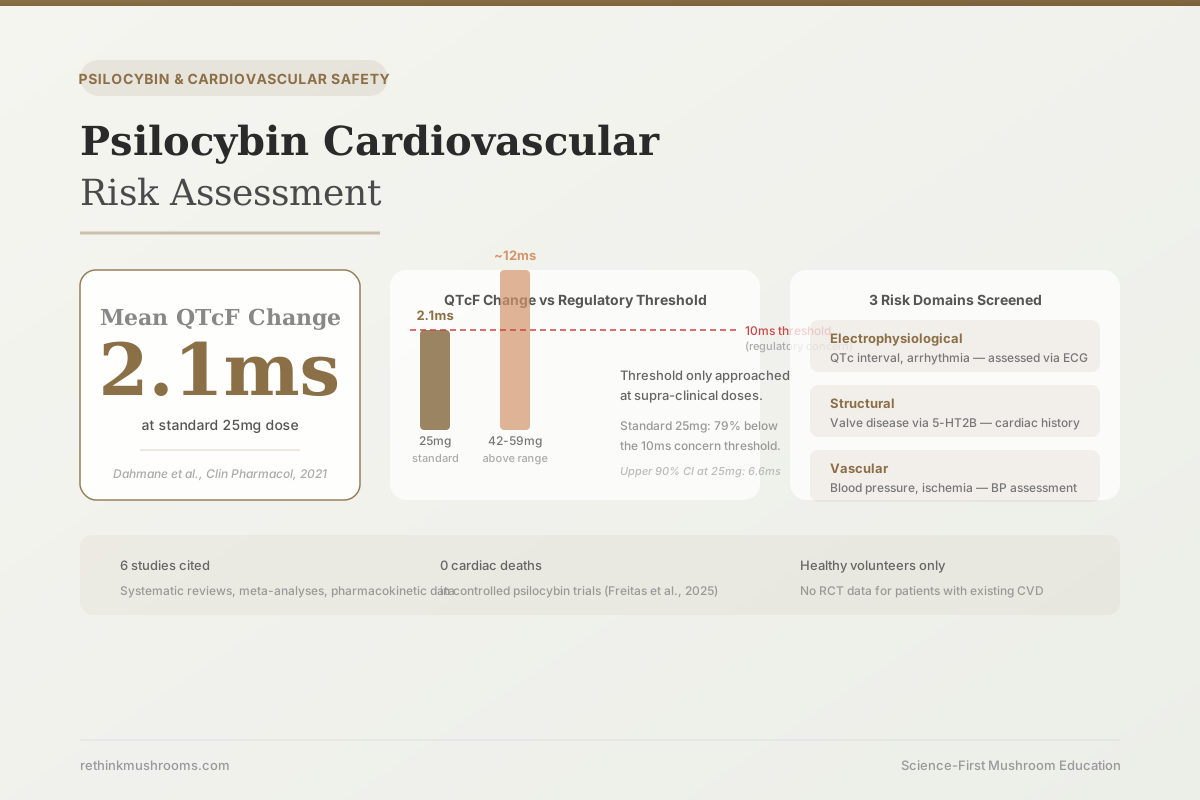
At the standard 25mg clinical dose, psilocybin produced a mean QTcF change of just 2.1ms, well below the 10ms regulatory threshold for cardiac concern.
Dahmane et al., Clinical Pharmacology in Drug Development, 2021
3 domains
of cardiovascular risk covered by pre-psilocybin screening, per Nature Cardiovascular Research, 2025
0 deaths
attributed to cardiac events in controlled psilocybin clinical trials (Freitas et al., 2025)
4.6 nM
psilocin's binding affinity at the cardiac 5-HT2B receptor, the key number for long-term valve risk (Rouaud et al., 2024)
Dahmane et al., Clinical Pharmacology in Drug Development, 2021
 View as image ↗
Clinical trial protocols for psilocybin universally require cardiovascular screening before dosing. What fewer people know is what that screening actually looks for, why each element is included, and what the underlying data shows about risk at standard clinical doses. The psilocybin cardiovascular risk assessment framework answers three mechanistically distinct questions, organized in a 2025 review by cardiologists from Massachusetts General Hospital published in Nature Cardiovascular Research by Nahlawi and colleagues.[1] This article explains what each domain requires, what the numbers show, and where the evidence genuinely runs out. For the broader physiological safety picture, the pillar article how safe is psilocybin: the complete safety research covers the full landscape.
Key Takeaways
- Cardiovascular risk assessment before psilocybin therapy covers three distinct domains: electrophysiological (QTc and arrhythmia risk), structural (cardiac valve disease via 5-HT2B receptor activation), and vascular (blood pressure and ischemia risk), per Nahlawi et al., Nature Cardiovascular Research, 2025
- At the standard 25mg therapeutic dose, psilocybin produces a mean QTcF change of 2.1ms; the regulatory threshold for concern is 10ms; QTcF approaches that threshold only at doses of 42 to 59mg, above the standard clinical range (Dahmane et al., Clinical Pharmacology in Drug Development, 2021)
- Psilocin binds the cardiac 5-HT2B receptor with a binding affinity (Ki) of 4.6 nM, the same receptor pathway behind historical drug-induced valvulopathy; existing valve disease is a contraindication for this reason (Rouaud et al., Journal of Psychopharmacology, 2024)
- Pooled data from multiple randomized controlled trials shows treatment-emergent cardiovascular events are not significantly elevated versus placebo at standard therapeutic doses (Yao et al., Psychiatry Research, 2024)
- No randomized trial has systematically enrolled patients with known cardiovascular disease; current screening thresholds are expert consensus, not RCT-derived verdicts, a distinction that matters when interpreting exclusion criteria
- In a 2025 systematic review of psilocybin-assisted psychotherapy safety, no deaths were attributed to cardiovascular events in controlled clinical trials (Freitas et al., 2025)
The Three Risk Domains That Define Psilocybin Cardiac Screening
When Nahlawi and colleagues reviewed cardiovascular safety across classic psychedelics for Nature Cardiovascular Research in 2025, they organized the risks into three distinct categories that now serve as the practical framework for clinical screening protocols.[1]
The first domain is electrophysiological: risks involving the heart's electrical conduction system, particularly QTc interval prolongation and arrhythmia susceptibility. These concerns are addressed by a pre-treatment ECG.
The second domain is structural: risks involving the physical integrity of cardiac tissue, specifically the heart valves. This domain matters because psilocin, the active compound after psilocybin is metabolized in the body, binds to a serotonin receptor subtype called 5-HT2B. That same receptor, when chronically activated by drugs like fenfluramine, caused cardiac valve fibrosis in human patients. Structural risk assessment therefore focuses on existing valvular disease and, for longer-term protocols, may include echocardiography.
The third domain is vascular: risks involving blood pressure and blood flow to the heart. Psilocybin causes acute, transient blood pressure increases through serotonergic signaling. For people with specific conditions, uncontrolled hypertension, coronary artery disease, or a recent cardiovascular event, that blood pressure increase carries clinical weight that it does not carry in healthy volunteers. The vascular domain is assessed through blood pressure measurement and cardiac history review.[5]
Each domain requires different information. A resting ECG does not screen for valve disease. A blood pressure measurement does not assess QTc liability. Understanding which screen targets which risk is what separates a real clinical evaluation from a checklist.
What a Standard Pre-Psilocybin Cardiac Workup Actually Includes
Clinical trial protocols have varied in their specific thresholds, but the cardiovascular assessment framework draws from the same mechanistic logic. Based on the three-domain structure described by Nahlawi et al. and the screening approaches documented in recent systematic reviews of psilocybin safety, a standard pre-treatment cardiac workup includes:[1][6]
- Resting ECG with QTc measurement: identifies pre-existing QTc prolongation before dosing; QTcF values above 450ms in men or 470ms in women typically prompt additional review; values above 500ms are a hard exclusion criterion in most protocols
- Medication review for QTc-prolonging drugs: certain antibiotics, antipsychotics, antidepressants, and antiarrhythmics prolong QTc independently of psilocybin; their presence in a patient's medication list raises the baseline electrical risk
- Blood pressure assessment and history: a resting blood pressure reading combined with medical history review; uncontrolled hypertension, typically above 160/100 mmHg at rest, triggers exclusion or deferral until blood pressure is adequately controlled
- Cardiac history review: prior arrhythmias, heart failure, coronary artery disease, myocardial infarction within the past six to twelve months, and stroke history are all reviewed to identify which risk domain is most relevant for each patient
- Cardiac valve disease history: relevant to the structural domain; existing valvulopathy is generally a contraindication given psilocin's binding profile at the 5-HT2B receptor; more significant for protocols involving repeat dosing sessions
- Electrolyte assessment when indicated: low potassium and low magnesium independently extend the QTc interval; electrolyte testing is added when other QTc risk factors are present
This list represents current clinical practice, not a regulatory standard. No FDA-approved cardiovascular screening protocol exists for psilocybin therapy, as the compound remains Schedule I. The criteria derive from trial protocols and the expert consensus captured in published safety reviews.
The ECG Threshold: At 25mg, the Mean QTcF Change Is Just 2.1ms
Understanding why psilocybin protocols include an ECG requires separating two distinct questions. Does psilocybin prolong the QT interval? And what does that mean for the people being screened?
On the first question, the data is precise. The QT interval is the time it takes for the heart's ventricles to reset their electrical state after each beat. Prolonged QT, especially when corrected for heart rate (which gives the QTc or QTcF value), increases the risk of a rare but dangerous arrhythmia. Regulatory agencies use a mean QTcF change of 10ms as the threshold for formal concern during drug development.
Dahmane and colleagues conducted a concentration-QTc analysis using data from clinical psilocybin trials, mapping how blood levels of psilocin related to QT interval changes across a dose range.[2] At the standard 25mg dose used in most phase 2 and phase 3 trials, the mean psilocin peak plasma concentration was 18.7 ng/mL. At that concentration, the mean QTcF change was 2.1ms, with an upper 90% confidence interval of 6.6ms. Psilocybin clears the 10ms regulatory threshold with considerable margin at this dose.[2]
The picture shifts at higher doses. At 42 to 59mg, psilocin concentrations reach around 31.1 ng/mL, and the upper 90% confidence bound for QTcF change crosses the 10ms threshold. These are doses above the standard clinical range, but the finding confirms the relationship is real and dose-dependent.
Pooled safety data from multiple randomized controlled trials tells a consistent story: across psychedelic treatment arms, QTc impact at standard therapeutic doses was minimal, and treatment-emergent cardiovascular events were not significantly elevated versus placebo.[4]
So why require an ECG at all? The pre-treatment ECG is not primarily screening for what psilocybin will do to a healthy person's QT interval. It is screening for people who arrive with elevated QTc before they take anything, who take QTc-prolonging medications that raise the baseline, or who have electrolyte disorders that independently extend the interval. For those individuals, even a 2.1ms additive contribution may push a borderline measurement past a clinically meaningful threshold. The screen is about their baseline, not the drug's typical effect.
For the full breakdown of the QTc dose-response curve and how psilocybin compares to SSRIs and antipsychotics on QTc liability, see psilocybin and QTc prolongation: what cardiac monitoring data shows.
Blood Pressure Screening: What the Vascular Domain Is Watching For
Psilocybin causes a real, acute elevation in blood pressure during sessions. The mechanism is direct: serotonin receptor agonism, primarily at 5-HT2A receptors, produces sympathomimetic effects that raise both heart rate and blood pressure. Wsół, in a 2023 comprehensive review of cardiovascular safety across classic psychedelics, identified this sympathomimetic mechanism as one of the primary cardiac safety considerations for clinical psilocybin use.[5] Nahlawi and colleagues placed these effects in the vascular risk domain: transient in healthy people, but potentially significant for those with specific underlying conditions.[1]
In people with normal cardiovascular health, this blood pressure rise is measurable, transient, and clinically manageable. The 2025 systematic review of psilocybin-assisted psychotherapy safety by Freitas and colleagues found that most adverse cardiovascular effects in controlled trials were transient and mild, with no deaths attributed to cardiovascular causes across the controlled trial evidence base.[6] The concern is population-specific, not universal.
The vascular domain screening identifies the people for whom that acute blood pressure elevation carries elevated risk: those with uncontrolled hypertension (where the baseline is already high), those with coronary artery disease or significant atherosclerosis (where increased myocardial oxygen demand can precipitate ischemia), and those with recent cardiovascular events such as stroke or myocardial infarction (where the vasculature is in an active recovery phase).
Blood pressure screening at baseline serves two purposes. It identifies people with uncontrolled hypertension who should not proceed until treatment brings their pressure into an acceptable range. It also creates a documented starting point so that changes during the session are tracked against a known baseline.
For the specific magnitude and time course of psilocybin's blood pressure and heart rate effects, see psilocybin and heart safety: blood pressure and heart rate effects. Drug interactions that dramatically amplify these vascular effects, particularly concurrent MAOI use, are covered in psilocybin and MAOIs: the dangerous combination.
Cardiac Valve Disease: The Contraindication Backed by Receptor Binding Data
The structural risk domain is the least intuitive part of the cardiovascular assessment. Unlike the QTc question, where the session-specific numbers are clear, and the blood pressure question, where the sympathomimetic mechanism is familiar, the valvular concern involves long-term biology and a pharmacological pathway most people encounter for the first time when researching psilocybin.
The pathway runs through the 5-HT2B serotonin receptor. This receptor is expressed on the interstitial cells that maintain cardiac valve integrity. When those cells receive persistent stimulation through 5-HT2B activation, they begin producing abnormal amounts of fibrous tissue. Valve leaflets thicken and stiffen. They stop closing properly. The clinical condition is called cardiac valvulopathy, and it was documented in large numbers of people who took drugs with high 5-HT2B agonist activity on a daily basis over months and years. The most prominent case was fenfluramine, the appetite suppressant withdrawn from the market in 1997 after causing valve disease in a significant fraction of long-term users.
Psilocin, the compound psilocybin becomes after metabolism, binds the 5-HT2B receptor with a binding affinity (Ki) of 4.6 nM, a value in the pharmacologically meaningful range for receptor activation.[3] This binding affinity raises a genuine question about long-term cardiac safety. The key variable is the structure of exposure.
Rouaud, Calder, and Hasler analyzed this specific question in the Journal of Psychopharmacology in 2024, comparing psilocin's 5-HT2B pharmacology to established cardiotoxins.[3] Their analysis drew a critical distinction: the intermittent psychiatric dosing model, which involves a small number of supervised sessions per year separated by months without the drug, is fundamentally different from the continuous daily exposure that produced the fen-phen valvulopathy epidemic. Duration and cumulative receptor stimulation appear to be the operative variables in valve damage, not a single instance of activation.
For clinical screening, this translates to two separate considerations that must not be conflated. The first concerns new valve disease developing from psilocybin therapy. For the standard intermittent dosing protocol, this risk is considered low based on the pharmacokinetic and mechanistic analysis, though no long-term echocardiographic data from human trials exists yet to directly confirm this. The second concern is existing valve disease. If valve leaflets are already compromised before treatment begins, any additional 5-HT2B receptor load carries a different risk calculation. Existing cardiac valvulopathy, particularly mitral or aortic valve disease with hemodynamic significance, is reviewed as part of the cardiac history and is generally treated as a contraindication rather than a factor requiring additional monitoring.
For the detailed evidence on the 5-HT2B mechanism and what the receptor binding data means for long-term psilocybin use, see 5-HT2B and cardiac valvulopathy: is long-term psilocybin use safe?. For how this calculation changes in microdosing contexts, see microdosing and heart health: the 5-HT2B valvulopathy concern.
The Honest Gap: No Trial Has Enrolled Patients With Existing Heart Disease
This is the part that most cardiovascular risk discussions leave out. Every study informing current clinical screening guidance was conducted in adults with normal or near-normal cardiovascular health. Phase 2 and phase 3 psilocybin trials systematically excluded people with pre-existing cardiac conditions. That means the population most likely to be asking whether they qualify for psilocybin-assisted therapy, people with a cardiac history, is also the population for whom there is essentially no direct trial data.
The 2025 Nature Cardiovascular Research review by Nahlawi and colleagues explicitly names this as a critical knowledge gap: controlled trial data on psilocybin's cardiovascular effects in people with established heart disease does not exist.[1] The 2023 comprehensive review by Wsół of cardiovascular safety across classic psychedelics reached the same conclusion: current safety data covers healthy volunteers, and the picture for CVD patients requires dedicated investigation.[5]
The practical implication matters for how exclusion criteria are interpreted. When clinical protocols list cardiovascular conditions as contraindications, they are often being conservative in the absence of data, not reporting documented harm in those populations. Controlled hypertension, mild valvular abnormalities, stable coronary artery disease: these conditions appear in exclusion criteria not because a clinical trial showed adverse outcomes in people with those conditions, but because those people have not been enrolled in trials at all.
Freitas and colleagues, in their 2025 systematic review of psilocybin-assisted psychotherapy safety, found no deaths attributable to cardiovascular events across the controlled trial evidence base.[6] That is a meaningful data point. But the absence of cardiac fatalities in trials of predominantly healthy volunteers does not establish safety in people with cardiac histories. The populations are different enough that the inference does not carry.
The honest position is this: for a person with a cardiac history exploring psilocybin-assisted therapy, current screening thresholds reflect expert consensus applied to an underdefined population. They encode reasonable caution given the three-domain risk framework, not proven harm at standard therapeutic doses in those specific populations. That distinction matters when evaluating what the evidence actually supports. For comparative context on why psilocybin's cardiovascular profile is generally considered favorable relative to other substances used in therapeutic settings, see psilocybin cardiovascular safety: why it's considered low-risk compared to MDMA.
The Bottom Line
Cardiovascular screening before psilocybin therapy evaluates three mechanistically distinct risk domains: electrophysiological (QTc and arrhythmia), structural (cardiac valve disease via 5-HT2B receptor activation), and vascular (blood pressure and ischemia risk). At the standard 25mg therapeutic dose, psilocybin's impact on QTc is well below regulatory thresholds, and pooled trial data shows no significant elevation in cardiac events versus placebo. The honest limitation is that this evidence comes entirely from healthy volunteers; no randomized trial has enrolled patients with known cardiovascular disease, and current exclusion criteria reflect cautious expert consensus rather than direct evidence of harm in cardiac populations.
Frequently Asked Questions
Sources & References
- 1. Source details for this reference are not yet available.
- 2. Source details for this reference are not yet available.
- 3. Source details for this reference are not yet available.
- 4. Source details for this reference are not yet available.
- 5. Source details for this reference are not yet available.
- 6. Source details for this reference are not yet available.