Microdosing Safety & Risks
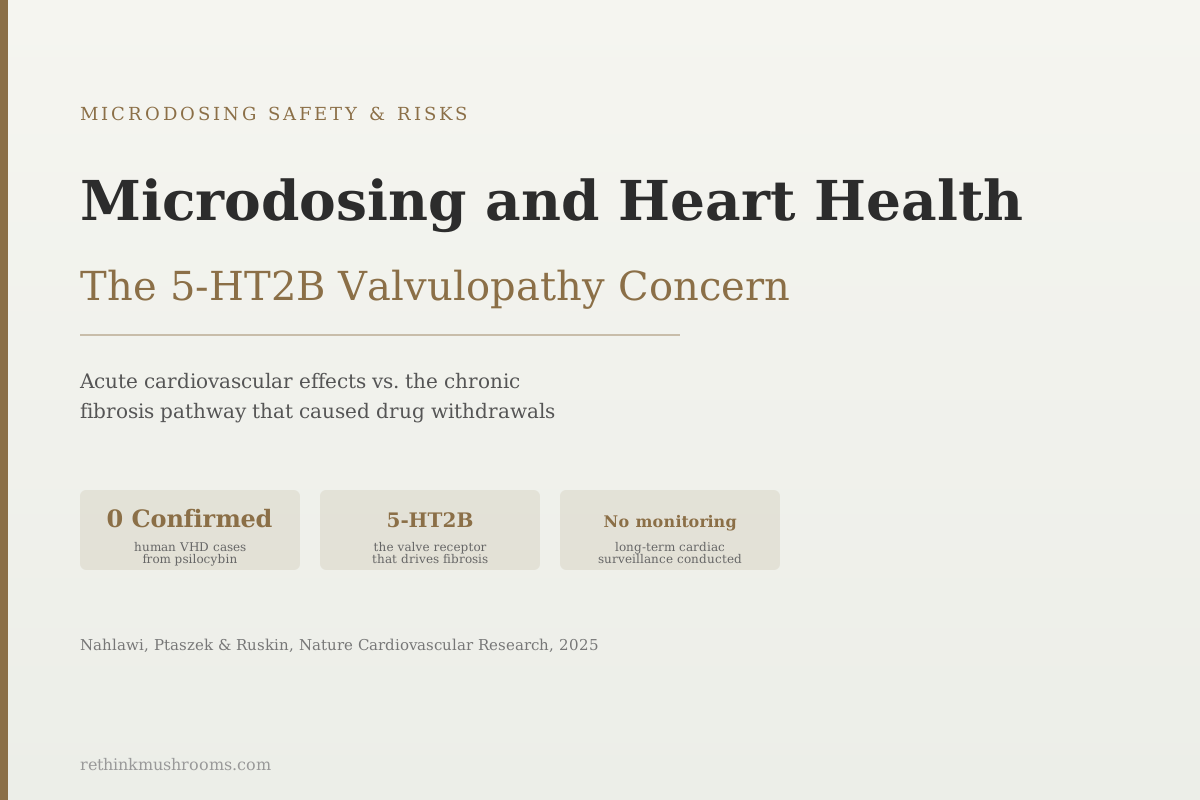
0 confirmed human cases
As of 2025, no human cases of valvular heart disease from psilocybin microdosing have been confirmed in the medical literature. But the theoretical risk is mechanistically credible, and long-term cardiac monitoring studies have never been conducted.
Nahlawi, Ptaszek & Ruskin, Nature Cardiovascular Research, 2025
5-HT2B
the specific serotonin receptor that drives cardiac fibrosis when activated chronically
Theoretical
the current medical classification of psilocybin microdosing valvulopathy risk
No monitoring
long-term cardiac surveillance studies in microdosers have never been conducted
Nahlawi, Ptaszek & Ruskin, Nature Cardiovascular Research, 2025
 View as image ↗
When people ask whether microdosing psilocybin affects the heart, the question actually covers two completely different mechanisms. One is well-characterized and largely benign. The other is theoretical, mechanistically credible, and has never been adequately studied in people who microdose long-term.
Confusing them leads to false reassurance in some cases and unnecessary alarm in others. The cardiovascular research literature has finally started separating them, and the distinction matters for anyone thinking seriously about microdosing safety.
For a broader overview of microdosing, see what is microdosing psilocybin.
Key Takeaways
- Psilocybin causes transient, dose-dependent increases in heart rate and blood pressure that resolve without intervention; these acute effects are well-documented and generally mild
- A separate and more serious concern involves the 5-HT2B serotonin receptor on heart valve cells; chronic activation of this receptor by certain drugs has caused cardiac valvulopathy, leading to drug withdrawals
- Psilocin (the active form of psilocybin) binds 5-HT2B with potency equal to or greater than 5-HT2A, the receptor responsible for hallucinations
- A 2024 mouse study found that serotonin caused ventricular thickening and fenfluramine caused aortic regurgitation within 4 weeks, while LSD showed no significant valve changes; this is partial but not conclusive animal evidence
- No human cases of valvular heart disease from psilocybin microdosing have been confirmed, but no systematic cardiac monitoring of long-term microdosers has been conducted
- The 2025 Nature Cardiovascular Research review recommends cardiac screening for individuals with pre-existing conditions before using classic psychedelics
The Two Cardiac Concerns That Should Not Be Confused
Acute cardiovascular effects are what happens during or shortly after taking psilocybin. Heart rate increases. Blood pressure rises. These effects are dose-dependent, transient, and typically resolve within hours. In clinical settings, they require no medical intervention. In people with normal cardiovascular function, they represent a physiological stress similar to moderate exercise.
Valvular heart disease risk is a different mechanism entirely. It involves what happens to heart valve tissue when a specific serotonin receptor, called 5-HT2B, is activated repeatedly over time by a drug. This activation triggers a cellular signaling cascade that causes the valve leaflets to thicken and stiffen, gradually impairing their function. The process can take months to years and produces no symptoms until valve function is substantially compromised.
The acute effects are not the concern. The valvulopathy mechanism is.
How Psilocybin Affects the Heart Acutely
Nahlawi, Ptaszek, and Ruskin published a comprehensive cardiovascular safety analysis in Nature Cardiovascular Research in 2025, covering the full range of cardiac effects from classic psychedelics.[1]
For psilocybin specifically, the acute cardiovascular profile involves dose-dependent increases in heart rate and blood pressure. These are mediated primarily through 5-HT2A and 5-HT1A receptor activation, which influences autonomic nervous system tone. The magnitude varies with dose, set and setting, and individual baseline cardiovascular state.
In structured clinical trials, these acute effects have been mild and transient. Nahlawi's review found no serious cardiovascular adverse events attributable to the acute effects of psilocybin in controlled research settings.
The concern for people with existing cardiac conditions is real, however. In individuals with cardiac arrhythmias, significant coronary artery disease, or a history of heart attack, an abrupt increase in heart rate and blood pressure represents more risk than in healthy adults. Nahlawi's review recommends cardiac screening for individuals with pre-existing conditions before using classic psychedelics.
What the 5-HT2B Receptor Is and Why It Matters for Valves
The heart's valves contain cells that express the 5-HT2B serotonin receptor. In the normal course of life, these receptors are not chronically stimulated. In the context of certain drugs that activate 5-HT2B repeatedly, a cellular process begins.
When 5-HT2B is chronically activated, it triggers a signaling protein called TGF-beta, which stands for transforming growth factor beta. TGF-beta is a powerful regulator of cell growth. In valve cells, its activation causes fibroblasts (the cells responsible for making connective tissue) to proliferate and deposit excess collagen. Over time, this thickens the valve leaflets, eventually making them less flexible and impeding blood flow. This process is called fibrosis, and the resulting condition is drug-induced valvulopathy.
The mechanism is not theoretical, at least not at the level of "does this process happen?" It has been confirmed as the causal pathway for valvulopathy from several drugs that were widely prescribed before the connection was understood.
The Cautionary History: Fenfluramine, Pergolide, and 5-HT2B
The cardiac risk from 5-HT2B agonism became a public health issue twice in recent decades.
Fenfluramine was one half of the weight-loss combination "fen-phen." It was withdrawn from the market in 1997 after it was found to cause valvular heart disease, particularly aortic and mitral regurgitation, in approximately 25% of patients using it for more than three months. The mechanism was subsequently identified as 5-HT2B agonism on valve fibroblasts.
Pergolide and cabergoline, dopamine agonists used to treat Parkinson's disease and hyperprolactinemia, were withdrawn or received black box warnings between 2007 and 2008 for the same reason. Both are potent 5-HT2B agonists, and long-term use produced clinically significant valve disease in a meaningful fraction of patients.
The pattern is clear: drugs that chronically activate 5-HT2B → cardiac fibrosis → valve disease. The question for psilocybin is whether it activates 5-HT2B sufficiently, at microdose plasma concentrations, with enough frequency, over long enough periods, to initiate this pathway.
Where Psilocybin Fits: What the Receptor Binding Data Shows
Tagen et al. published a systematic analysis in the Journal of Psychopharmacology in 2023 comparing the 5-HT2B binding potency of common psychedelics to known valvulopathogens.[2]
The finding: psilocybin, LSD, mescaline, DMT, and MDMA all bind 5-HT2B with potency equal to or greater than their binding to 5-HT2A, the receptor responsible for hallucinations. For psilocin (the active metabolite of psilocybin), 5-HT2B potency is comparable to 5-HT2A.
The safety margin calculation is more reassuring. Fenfluramine and pergolide achieved tissue concentrations that substantially exceeded the 5-HT2B threshold at their therapeutic doses. Psilocin at microdose plasma concentrations appears to have a greater safety margin, meaning the actual concentration the valve is exposed to is further from the threshold that caused problems with the withdrawn drugs.
But the safety margin calculation depends on plasma concentration data from microdosing studies that is still sparse. The comparison is not precise enough to rule out risk, only to suggest that the risk magnitude, if it exists, is likely lower than for fenfluramine at therapeutic doses.
What Animal Studies Show, and Where They Fall Short
Rouaud, Calder, and Hasler published a 2024 comparative study in the Journal of Psychopharmacology specifically designed to address the animal-model question.[3]
Mice were treated for four weeks with serotonin, fenfluramine, LSD, or vehicle control. The results:
Serotonin treatment produced ventricular thickening. Fenfluramine treatment produced aortic regurgitation (valve function impairment detectable by echocardiography). LSD treatment at microdose-range levels showed no significant valve changes compared to control.
This is partially reassuring, but several important caveats apply. LSD and psilocin are different compounds with different pharmacokinetics. The study did not test psilocin directly. The four-week timeline may be insufficient to detect early fibrotic changes that would become clinically relevant with longer exposure. Mouse cardiovascular physiology differs from human in meaningful ways, particularly heart rate and valve geometry.
The Rouaud study does not confirm that microdosing psilocybin is safe for heart valves. It suggests that one closely related compound, at levels analogous to a microdose range, did not cause measurable valve changes over four weeks in mice.
The Human Evidence Gap: Why "No Confirmed Cases" Is Not Reassurance
No human cases of valvular heart disease directly attributed to psilocybin microdosing have been confirmed in the published medical literature.[1]
This is true. It is also less reassuring than it sounds. The reason: no systematic cardiac monitoring of long-term microdosers has been conducted. Valvulopathy from 5-HT2B agonism typically takes months to years of exposure to produce clinically detectable changes. It produces no symptoms until function is substantially impaired. And the population that microdoses regularly is largely invisible to the medical system (microdosing involves a Schedule I substance in most jurisdictions, so it is rarely disclosed to physicians).
Absence of confirmed cases under these conditions is not the same as confirmed safety. The parallel would be if fenfluramine had been used illicitly for two years, without any systematic echocardiographic follow-up, before any valvulopathy cases were identified.
Savides and Outhoff, reviewing the literature in 2024, classified cardiac valvulopathy as a "theoretical concern" for psilocybin microdosing, explicitly noting that the absence of clinical trial data on long-term cardiac outcomes leaves the question open.[4]
Who Should Be Most Cautious?
Kinderlehrer's 2025 review in Neuropsychiatric Disease and Treatment addresses contraindications and risk stratification for psilocybin microdosing specifically.[5]
The populations for whom cardiac concern is most relevant include:
People with existing valvular heart disease. Any additional stimulus for fibrosis in already-compromised valves is worth avoiding. The risk calculus changes substantially for someone whose valve function is already marginal.
People with established coronary artery disease or recent cardiac events. The acute cardiovascular effects of psilocybin, while mild in healthy adults, represent a greater physiological challenge when the heart's reserve capacity is reduced.
People taking cardiovascular medications that interact with serotonin pathways. Certain antiarrhythmic drugs, monoamine oxidase inhibitors, and serotonergic medications interact with the same pathways psilocybin affects.
High-frequency, chronic users. The valvulopathy concern is fundamentally about cumulative receptor activation. Daily or near-daily dosing represents meaningfully more cumulative 5-HT2B exposure than less frequent protocols.
For the full-dose psilocybin cardiovascular risk profile and who is most at risk from therapeutic sessions, see Heart Conditions and Psilocybin: Who Should Be Cautious?.
The Dosing Schedule Question
The protocols most commonly used for microdosing include off-days: the Fadiman protocol uses one day on, two days off, while others use one day on, one off. These off-days were originally justified by psychological tolerance considerations, but they are also relevant to the cardiac question.
Chronic receptor stimulation is the mechanism behind 5-HT2B fibrosis. Receptor downregulation occurs between doses, which may reduce cumulative activation below the threshold that drove fibrosis in the drugs that were withdrawn. Whether the typical microdosing protocol achieves sufficient receptor rest to meaningfully reduce the risk is not established.
For the pharmacological rationale behind the scheduling structure, see The Fadiman Protocol: The Original Microdosing Schedule. For the broader safety research, see Microdosing Safety: What the Research Shows and Microdosing Long-Term Risks: Cardiac Valvulopathy Concerns and 5-HT2B.
The Bottom Line
The cardiac concern associated with psilocybin microdosing involves two distinct mechanisms. Acute effects (transient heart rate and blood pressure increases) are well-documented in controlled research and are generally mild in healthy adults. The valvulopathy concern, rooted in the 5-HT2B fibrosis pathway that caused withdrawn drugs like fenfluramine to damage heart valves, is mechanistically credible but unconfirmed in human microdosers. Psilocin binds 5-HT2B with potency equal to 5-HT2A, mouse studies show LSD at microdose levels produces no valve changes over four weeks (though psilocin was not directly tested), and no human VHD cases have been confirmed. The honest summary: the absence of confirmed cases reflects the absence of long-term monitoring, not confirmed safety.
Frequently Asked Questions
Sources & References
- 1RTHM-02156·Nahlawi, Acile et al. (2025). “Cardiovascular effects and safety of classic psychedelics..” Nature cardiovascular research.Study breakdown →PubMed →↩
- 2RTHM-01799·Tagen, Michael et al. (2023). “The risk of chronic psychedelic and MDMA microdosing for valvular heart disease..” Journal of psychopharmacology (Oxford.Study breakdown →PubMed →↩
- 3RTHM-00903·Rouaud, Antonin et al. (2024). “Microdosing psychedelics and the risk of cardiac fibrosis and valvulopathy: Comparison to known cardiotoxins..” Journal of psychopharmacology (Oxford.Study breakdown →PubMed →↩
- 4RTHM-00905·Savides, Isabella A et al. (2024). “Less is more? A review of psilocybin microdosing..” Journal of psychopharmacology (Oxford.Study breakdown →PubMed →↩
- 5RTHM-00929·Kinderlehrer, Daniel A (2025). “Mushrooms, Microdosing, and Mental Illness: The Effect of Psilocybin on Neurotransmitters, Neuroinflammation, and Neuroplasticity..” Neuropsychiatric disease and treatment.Study breakdown →PubMed →↩