Microdosing Safety & Risks
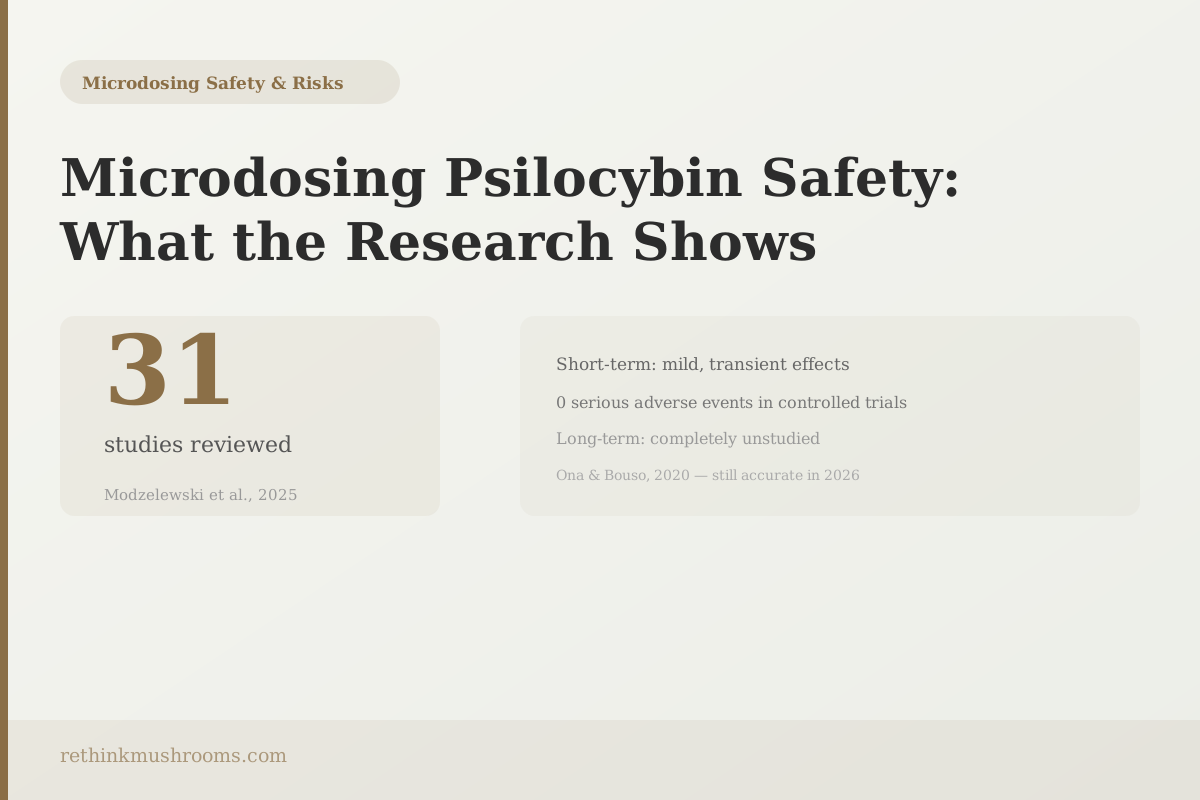
31 studies reviewed
The most comprehensive systematic review of microdosing adverse effects analyzed 31 studies and found side effects are typically dose-dependent, mild, and transient — with blood pressure increase, anxiety, and cognitive impairment as the most commonly reported.
Modzelewski et al., Neuropharmacology, 2025
0 serious adverse events
reported in any controlled microdosing trial reviewed to date
n=953
largest naturalistic safety dataset (Rootman et al., 2022)
0 long-term studies
no prospective safety studies beyond 30 days have been published
Modzelewski et al., Neuropharmacology, 2025
 View as image ↗
The honest one-sentence answer to "Is microdosing psilocybin safe?" is this: in short-term controlled studies, it appears to be, with mild and transient side effects and no serious adverse events on record. In long-term studies, we cannot say anything, because none have been conducted.
Most safety summaries stop at the first sentence. The second sentence is the one that matters for anyone making decisions about sustained use over months or years.
Modzelewski and colleagues published the most comprehensive systematic review of microdosing side effects in 2025, examining 31 studies ranging from high-quality controlled trials to naturalistic surveys and case reports.[1] Their finding: adverse effects are typically dose-dependent, mild, and transient. The most commonly reported were increased blood pressure, anxiety, and cognitive impairment. No serious adverse events were reported across the reviewed literature. That is the short-term safety picture, and it is reassuring as far as it goes.
This article covers what the research shows, from the most rigorous controlled studies to the largest naturalistic datasets. For specific cardiac risk and the 5-HT2B valvulopathy mechanism, see Microdosing and Cardiac Valvulopathy: The 5-HT2B Risk and Microdosing and Heart Health: The 5-HT2B Valvulopathy Concern. This is a cluster article within the complete guide to psilocybin microdosing.
Key Takeaways
- Modzelewski et al. (2025) reviewed 31 studies across three quality tiers and found microdosing side effects are typically dose-dependent, mild, and transient; most common: blood pressure increase, anxiety, cognitive impairment; no serious adverse events in any reviewed study
- Cavanna et al. (2022), the only fully double-blind placebo-controlled microdosing trial, reported more frequent acute anxiety in the active arm than placebo — no serious adverse events
- Szigeti et al. (2021) in a self-blinding RCT (n=191) found no serious adverse events and noted that anxiety rates in the active arm were similar to placebo once expectancy was controlled
- Rootman et al. (2022) in the largest naturalistic study (n=953, with 180 non-microdosing comparators tracked ~30 days) found no serious adverse events; psilocybin-specific microdosers reported the fewest adverse effects compared to other psychedelic users
- Ona and Bouso (2020), in the first systematic review of microdosing safety, concluded long-term safety is completely unstudied — that assessment remains accurate in 2026
- No long-term cardiac, neurological, or psychological safety studies in sustained microdosers have been published — the absence of reported harm reflects the absence of systematic monitoring
The Safety Evidence, Two Ways
Short-Term Safety Is Established. Long-Term Safety Is Not Studied.
These are two different evidence situations that deserve two different conclusions. The left panel is what the research supports; the right panel is what no one has measured.
Supported by data
Short-Term (Established)
Consistent across controlled trials, naturalistic cohorts, and systematic reviews.
31 studies systematically reviewed
Side effects dose-dependent, mild, transient (raised BP, anxiety, cognitive impairment)
Modzelewski 2025
0 serious adverse events
None reported in any controlled microdosing trial reviewed to date
Modzelewski 2025; Cavanna 2022; Szigeti 2021
Largest naturalistic cohort: n=953
953 microdosers vs 180 comparators tracked ~30 days — no serious adverse events
Rootman 2022
Most rigorous design: double-blind RCT
0.5 g dried Psilocybe cubensis vs placebo — acute anxiety up, no serious events
Cavanna 2022
No data exists
Long-Term (Unstudied)
The absence of reported harm reflects the absence of systematic monitoring.
Follow-up beyond ~30 days
No prospective cohort tracked longer; long-term safety unstudied since 2020
Ona & Bouso 2020; Savides & Outhoff 2024
Chronic cardiac (5-HT2B valvulopathy)
No confirmed cases, but no prospective cardiac monitoring in sustained microdosers
Nahlawi 2025
Tolerance & receptor desensitization
Whether repeated microdosing blunts response over months is untested in humans
Savides & Outhoff 2024
Drug interactions & developmental effects
SSRIs, MAOIs, lithium; pregnancy and adolescent brains — all uncharacterized
Savides & Outhoff 2024
Source: Modzelewski 2025, Cavanna 2022, Szigeti 2021, Rootman 2022 (short-term); Ona & Bouso 2020, Savides & Outhoff 2024, Nahlawi 2025 (long-term gaps)
Short-Term Safety in One Sentence: Mild, Transient, No Serious Events
In every controlled study of psilocybin microdosing conducted to date, no serious adverse events have been reported. Across the 31 studies Modzelewski's team reviewed, the side effect profile is consistent: effects appear at or shortly after dosing, are related to how much was taken, and resolve without intervention.[1]
The most common adverse effects in the literature are increased blood pressure and heart rate, anxiety or restlessness, and cognitive changes including impaired concentration. Nausea, headache, and sleep disruption appear in some studies, particularly at the higher end of the dose ranges used in microdosing research. Most effects last hours, not days.
This short-term safety picture holds across study designs. It appears in self-selected naturalistic samples, in fully controlled clinical trials, and in systematic reviews pooling data from multiple research groups. The consistency across designs gives it weight.
What "no serious adverse events" means in this context is specific. A serious adverse event in clinical research is one that is life-threatening, results in hospitalization, produces permanent harm, or requires significant medical intervention. By that definition, psilocybin microdosing has a clean record in research settings. Mild, temporary discomfort is a different category from a serious adverse event, and the former appears regularly while the latter does not.
The limitation that qualifies all of this: every study reviewed by Modzelewski's team was short-term. The longest follow-up in the controlled literature is around 30 days. Adverse effects that develop over months or years of repeated dosing fall outside the window these studies were designed to detect.
The Most Rigorous Safety Review: 31 Studies Across Three Quality Tiers
Modzelewski and colleagues' 2025 systematic review is the most comprehensive adverse effects analysis in the microdosing literature, and it introduced a useful methodological distinction: not all studies are equally positioned to detect adverse effects.[1]
The review classified 15 studies as high-quality laboratory studies, 14 as lower-quality, and included 2 case reports. High-quality lab studies are double- or single-blind, use verified doses, and have structured adverse event reporting. Lower-quality studies include surveys and naturalistic observational work where participants self-report effects without a standardized protocol and often without verification of what they actually took.
The adverse effect rates differ between these tiers. High-quality lab studies report adverse effects less frequently than surveys do. This matters for interpretation: a survey of committed microdosers who chose to participate in research may overrepresent adverse effects for the same reason it might overrepresent benefits — the participants bring strong expectations in both directions, and those expectations shape what they notice and report.
Polito and Liknaitzky's 2024 rapid review adds precision to this point.[2] Reviewing the controlled study literature specifically, they found that LSD and psilocybin produce real neurobiological and subjective changes compared to placebo — evidence of pharmacological activity — but that no serious adverse effects appeared in controlled studies. The gap between what controlled studies find and what surveys report is partly a function of who fills out surveys. Someone choosing to participate in naturalistic research on microdosing is not a random sample of the population. For more on how expectancy affects what people report, see Expectancy Effects in Microdosing: How Belief Shapes Experience.
One finding from Modzelewski's review is rarely mentioned in consumer health content: microdosing can impair certain cognitive functions. The cognitive effects are not uniformly positive. Some controlled studies found decreases in convergent thinking and certain attention measures in the active arm. The popular framing of microdosing as universally cognitively enhancing is not supported by the controlled research. Effects on cognition appear to depend on dose, timing, and the specific cognitive domain tested.
What Blinded Clinical Trials Found: The Cleanest Adverse Event Data
The gold standard for safety data in any drug research is the double-blind, placebo-controlled trial. In microdosing specifically, two studies reach this standard or close to it.
Cavanna and colleagues published the first fully double-blind, placebo-controlled psilocybin microdosing trial in 2022.[3] Participants received either a 0.5g dose of dried Psilocybe cubensis or a placebo under conditions where neither they nor the researchers knew which. The adverse event finding: acute anxiety was more frequent in the active arm than in the placebo arm. No serious adverse events occurred. The active arm also showed more intense acute subjective effects, which Cavanna's team interpreted as evidence that the doses were pharmacologically active even if the psychological benefits did not persist.
Szigeti and colleagues ran a self-blinding citizen science trial in 2021 with 191 participants, the largest randomized psychedelic microdosing study at the time of publication.[4] Participants prepared their own placebo and active capsules and used a random schedule to maintain uncertainty about what they were taking. No serious adverse events occurred. When expectancy was statistically controlled, anxiety rates in the active and placebo arms were similar. This is the cleanest demonstration that some adverse effect reporting in microdosing research reflects expectancy rather than pharmacology — people who expected a difficult experience were more likely to report one. For a full examination of the self-blinding design and what it found, see Is Microdosing Just Placebo? The Self-Blinding Studies.
These two studies together represent the most methodologically rigorous safety data available for psilocybin microdosing. Their consistent finding is: short-term controlled use at typical microdose levels does not cause serious harm, while mild acute anxiety is a real and expected effect in a subset of participants.
The Large Naturalistic Picture: What Hundreds of Real Microdosers Reported
Controlled trials give the most rigorous safety data but the smallest samples. The largest safety-relevant data comes from naturalistic research.
Rootman and colleagues' 2022 prospective cohort study enrolled 953 adults already microdosing psychedelics and tracked them for approximately 30 days alongside 180 non-microdosing comparators.[5] Over the study period, no serious adverse events were reported in either group. Psilocybin-specific microdosers showed the most favorable adverse effect profile among the psychedelic users studied, with lower rates of challenging psychological experiences compared to those using LSD or other compounds.
Anderson and colleagues' 2019 empirical codebook provides the qualitative picture, based on surveys of 278 self-identified microdosers.[6] Among the challenging outcomes reported: physiological discomfort (18.0%) and increased anxiety (6.7%). (The 14.8% focus figure sometimes cited from this codebook is actually improved focus, a reported benefit — not an adverse effect.) The overlap between what Modzelewski's 2025 synthesis found in controlled studies — anxiety, cognitive changes, physical discomfort — and what Anderson's survey found is consistent. The survey rates tend to be higher than controlled trial rates, which reflects the methodological differences described above.
Savides and Outhoff's 2024 comprehensive review consolidates these findings into a practical summary: psilocybin microdosing appears relatively safe in the short term, with cardiac valvulopathy as a theoretical concern, and with tolerance, drug interactions, and long-term cognitive effects all currently unstudied.[7] They called for rigorous, longer-duration randomized trials, which have not yet been conducted.
For a full breakdown of adverse effects from survey data with specific rates and comparisons between study designs, see Microdosing Side Effects: Survey Data on Adverse Experiences. For concerns about psychological contraindications, see Family History of Psychosis and Psilocybin: Risk Assessment.
The One Safety Question Nobody Has Answered: Cardiac Effects Over Years
The short-term cardiovascular effects of psilocybin are well-characterized. Psilocybin causes dose-dependent, transient increases in heart rate and blood pressure, typically peaking within one to two hours and resolving without intervention. Nahlawi, Ptaszek, and Ruskin's 2025 review in Nature Cardiovascular Research documented these effects comprehensively and confirmed that in controlled settings they are not clinically significant for healthy adults.[8]
The chronic cardiac question is different. Psilocin activates 5-HT2B receptors, the same receptor through which fenfluramine and two Parkinson's medications caused structural heart valve damage before being withdrawn from the market. Nahlawi's review found no confirmed human cases of valvulopathy from classic psychedelics. But it also noted, explicitly, that no prospective cardiac monitoring studies in long-term microdosers have been conducted. The absence of confirmed cases reflects genuine reassurance and the absence of systematic monitoring in equal measure.
Meshkat and colleagues' 2025 systematic review across psilocybin studies in substance use disorder treatment provides a useful data point: full-dose psilocybin in structured therapeutic settings is generally well-tolerated, with transient anxiety and blood pressure elevation as the most commonly reported adverse effects.[9] These are acute effects, not chronic valvulopathy, and they resolve. But the absence of serious cardiac events in therapeutic psilocybin studies does not answer the microdosing question: those studies involved controlled administration at therapeutic doses on a limited schedule, not repeated near-daily microdosing over months.
For a full mechanistic analysis of the 5-HT2B valvulopathy pathway, see Microdosing and Cardiac Valvulopathy: The 5-HT2B Risk.
The Long-Term Gap: "Generally Safe Short-Term" Is Not the Same as "Safe"
Ona and Bouso's 2020 systematic review was the first formal meta-level assessment of microdosing safety in the literature.[10] Their central safety conclusion: the controlled studies available showed no serious adverse effects, but long-term safety was completely unstudied. Six years later, that assessment remains accurate. No follow-up data beyond 30 days exists for any cohort of microdosers tracked prospectively.
The specific gaps that remain uncharacterized are concrete. Tolerance is one: whether repeated microdosing produces receptor desensitization, cross-tolerance with other serotonergic drugs, or a diminishing response over months has not been studied in humans. Savides and Outhoff identified tolerance as an explicit gap in their 2024 review. Drug interactions are another: psilocybin's interactions with SSRIs, MAOIs, lithium, and stimulants at microdose levels have not been systematically studied. Developmental risks, including effects during pregnancy or in adolescent brains, are entirely unknown.
The honest framing for anyone evaluating microdosing safety is this: the research available supports the conclusion that single or occasional microdoses of psilocybin are unlikely to cause serious harm in healthy adults without cardiac or psychiatric contraindications. What the research cannot support is any conclusion about sustained daily or near-daily use over six months, twelve months, or years. That particular question has not been studied. The population currently engaging in long-term microdosing has no prospective safety data available to them, because no one has collected it.
For a comprehensive look at all the specific unknowns in microdosing safety research, see Long-Term Microdosing Risks: What We Don't Know Yet.
Safety
ModerateReassuring short-term data does not cover sustained use or higher-risk individuals
Concern
The clean short-term record comes entirely from studies of 30 days or less. Psilocin activates the 5-HT2B receptor implicated in valvular heart disease, and no prospective cardiac monitoring exists for long-term microdosers. Interactions with SSRIs, MAOIs, lithium, and stimulants at microdose levels have not been systematically studied, and psychiatric contraindications are not captured in the safety literature.
What the research says
Single or occasional microdoses in healthy adults without cardiac or psychiatric contraindications are unlikely to cause serious harm based on the controlled evidence. No conclusion can be drawn about near-daily use over months or years, because that has not been studied.
Particularly relevant for: Anyone considering sustained microdosing, especially with a cardiac or psychiatric history or taking serotonergic medication
What to do
This is educational information, not medical advice. Consult a qualified clinician before microdosing, particularly if you have a cardiac or psychiatric history or take SSRIs, MAOIs, lithium, or other serotonergic drugs.
Nahlawi et al., Nature Cardiovascular Research, 2025; Savides & Outhoff, 2024; Ona & Bouso, 2020
The Bottom Line
The short-term psilocybin microdosing safety profile is one of the most consistent findings in the literature: mild, dose-dependent, transient adverse effects with no serious adverse events reported across 31 reviewed studies. Cavanna 2022 and Szigeti 2021 provide the most rigorous data, confirming this in controlled conditions. The long-term safety profile is genuinely unknown, with no prospective studies beyond 30 days, no cardiac monitoring in sustained microdosers, and no data on tolerance, drug interactions, or developmental effects. These are two different evidence situations that deserve different conclusions.
Frequently Asked Questions
Sources & References
- 1RTHM-02153·Modzelewski, Stefan et al. (2025). “Side effects of microdosing lysergic acid diethylamide and psilocybin: A systematic review of potential physiological and psychiatric outcomes..” Neuropharmacology.Study breakdown →PubMed →↩
- 2RTHM-00900·Polito, Vince et al. (2024). “Is microdosing a placebo? A rapid review of low-dose LSD and psilocybin research..” Journal of psychopharmacology (Oxford.Study breakdown →PubMed →↩
- 3RTHM-00748·Cavanna, Federico et al. (2022). “Microdosing with psilocybin mushrooms: a double-blind placebo-controlled study..” Translational psychiatry.Study breakdown →PubMed →↩
- 4RTHM-01441·Szigeti, Balázs et al. (2021). “Self-blinding citizen science to explore psychedelic microdosing..” eLife.Study breakdown →PubMed →↩
- 5RTHM-01611·Rootman, Joseph M et al. (2022). “Psilocybin microdosers demonstrate greater observed improvements in mood and mental health at one month relative to non-microdosing controls..” Scientific reports.Study breakdown →PubMed →↩
- 6RTHM-00541·Anderson, Thomas et al. (2019). “Psychedelic microdosing benefits and challenges: an empirical codebook..” Harm reduction journal.Study breakdown →PubMed →↩
- 7RTHM-00905·Savides, Isabella A et al. (2024). “Less is more? A review of psilocybin microdosing..” Journal of psychopharmacology (Oxford.Study breakdown →PubMed →↩
- 8RTHM-02156·Nahlawi, Acile et al. (2025). “Cardiovascular effects and safety of classic psychedelics..” Nature cardiovascular research.Study breakdown →PubMed →↩
- 9RTHM-02148·Meshkat, Shakila et al. (2025). “Efficacy and safety of psilocybin for the treatment of substance use disorders: A systematic review..” Neuroscience and biobehavioral reviews.Study breakdown →PubMed →↩
- 10RTHM-01271·Ona, Genís et al. (2020). “Potential safety, benefits, and influence of the placebo effect in microdosing psychedelic drugs: A systematic review..” Neuroscience and biobehavioral reviews.Study breakdown →PubMed →↩