Microdosing Safety & Risks
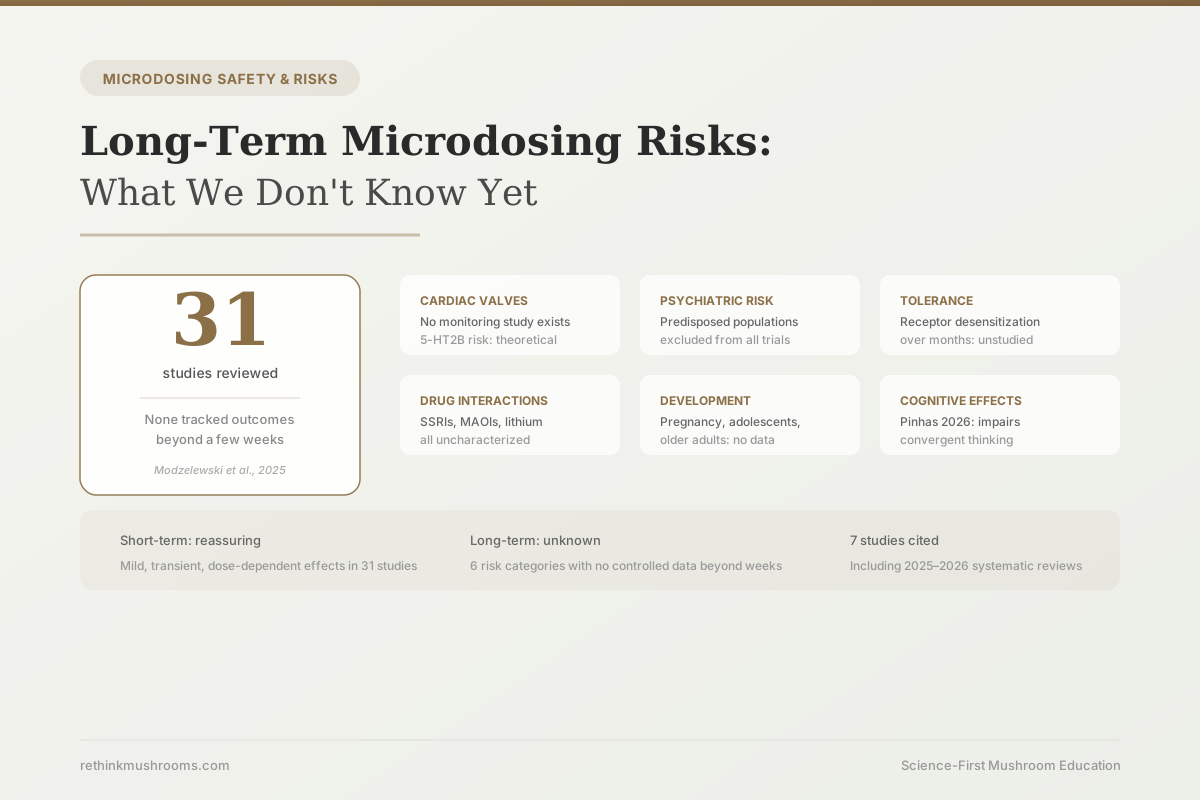
31 studies reviewed
Modzelewski's 2025 systematic review analyzed 31 microdosing studies and found that side effects are typically mild and transient. Not one of those studies tracked what happens after months of regular use.
Modzelewski et al., Neuropharmacology, 2025
0
controlled studies monitoring cardiac valve health in long-term microdosers
6
major risk categories with no long-term human data
Impairs
convergent thinking in some users, per Pinhas et al. 2026 meta-analysis
Modzelewski et al., Neuropharmacology, 2025
 View as image ↗
Tens of thousands of people are already microdosing psilocybin regularly. Some have been doing it for years. The long-term risks of that practice are, in controlled research terms, essentially unknown: not because researchers have looked and found safety, but because they largely haven't looked.
Short-term safety data is genuinely reassuring. A 2025 systematic review covering 31 microdosing studies found that side effects are typically mild, dose-dependent, and transient: elevated blood pressure, some anxiety, the occasional headache.[1] A 2020 systematic review found no serious adverse events in any controlled study at the time of publication.[2] That matters, and it's real.
The problem is that most of those studies ran for days to a few weeks. No one has followed regular microdosers for six months. No one has done cardiac monitoring. No one has tracked whether serotonin receptors (psilocybin's primary target) change their sensitivity with repeated low-dose exposure. No one has studied what happens to someone with a family history of psychosis who microdoses for a year.
This is not an argument that microdosing is dangerous. It is an argument that practice has outrun research, and the honest position is to say clearly what the science does and doesn't cover.
For a broader overview of what the evidence base currently shows, see What Is Microdosing Psilocybin: A Complete Guide.
Key Takeaways
- Modzelewski's 2025 review of 31 studies found microdosing side effects are mild and transient, but no study tracked outcomes beyond a few weeks.
- Ona and Bouso's 2020 systematic review concluded that long-term safety is "completely unstudied," a finding that remains accurate today.
- No controlled study has monitored heart valve health in long-term microdosers, despite a known theoretical cardiac risk from chronic 5-HT2B receptor activation.
- Kinderlehrer's 2025 review flagged personal or family history of psychosis as a contraindication, but this population has been excluded from all controlled trials.
- Whether tolerance builds over months of regular microdosing has not been studied; how microdosing interacts with SSRIs and MAOIs over extended periods is untested.
- A 2026 meta-analysis by Pinhas et al. found microdosing sometimes impairs convergent thinking, a finding that short-term survey studies routinely miss.
What 31 Reviewed Studies Found, and What None of Them Tracked
The most rigorous recent synthesis of microdosing adverse effects comes from Modzelewski and colleagues, published in Neuropharmacology in 2025.[1] They sorted 31 studies into quality tiers: 15 high-quality laboratory studies, 14 lower-quality studies, and 2 case reports. Their conclusion was that side effects are typically dose-dependent, mild, and transient. The most common findings across studies were increased blood pressure, anxiety, and some degree of cognitive disruption.
That's more systematic than most of what exists in this space, and it's useful. But Modzelewski also found that adverse event reporting across these studies was so inconsistent (different outcomes measured, different doses, different durations) that synthesizing true rates was unreliable. The research field hasn't agreed on what to measure or for how long.
Ona and Bouso had documented the same gap five years earlier, in a 2020 systematic review in Neuroscience and Biobehavioral Reviews: long-term safety had not been studied at all.[2] Five years later, that conclusion is unchanged.
Polito and Liknaitzky's 2024 rapid review in the Journal of Psychopharmacology confirmed the pattern: neurobiological effects from microdosing are real and distinguishable from placebo in controlled settings, but long-term safety is, in their words, completely uncharacterized.[3]
The short version: the research says something meaningful about short-term safety. It says essentially nothing about long-term safety, because the studies haven't been designed to answer that question.
For a detailed look at what the short-term controlled studies actually show, see Microdosing Safety: What the Research Shows.
What Long-Term Microdosing Research Has Never Actually Tested
Six specific risk categories have received essentially no controlled study time:
- Cardiac valve health: No study has monitored heart valve structure or function in people microdosing over months or years, despite a theoretical mechanism by which chronic stimulation of one receptor type (the 5-HT2B receptor) could cause fibrous valve changes.
- Psychiatric risk in predisposed individuals: Controlled trials have excluded people with personal or family history of psychosis or bipolar disorder. What happens to that population during extended microdosing is genuinely unknown.
- Tolerance and receptor desensitization: Whether repeated low-dose exposure gradually reduces the brain's serotonin receptor sensitivity, and whether that changes the drug's effects or carries downstream risks, has not been tested in any controlled setting.
- Drug interactions with psychiatric medications: How microdosing interacts with SSRIs, MAOIs, lithium, or other commonly prescribed drugs over extended periods is untested in controlled research.
- Developmental populations: No data exists on microdosing during pregnancy, in adolescents whose brains are still developing, or in older adults with age-related changes in neurobiology or cardiovascular status.
- Long-term cognitive effects: A 2026 meta-analysis found that microdosing sometimes impairs certain types of thinking, not just enhances them. Whether those effects accumulate, stabilize, or reverse with extended use is an open question.
The Heart Valve Question: A Theoretical Mechanism With No Monitoring Data
Psilocybin's active form in the body, psilocin, activates serotonin receptors throughout the brain and body. The brain effects are what most people think about. But heart valve cells carry a receptor called 5-HT2B, and activating this receptor repeatedly, with drugs that stay active long enough, has been shown to cause progressive fibrous thickening of the valve leaflets. That condition is called valvular heart disease, and once established it doesn't reverse.
This isn't theory without precedent. Fenfluramine, a diet drug withdrawn from the market in 1997, caused valve changes in roughly a quarter of long-term users through exactly this mechanism. Pergolide and cabergoline, two Parkinson's medications, were withdrawn for the same reason in 2007. The culprit in both cases was chronic 5-HT2B agonism: the same receptor that psilocin activates.
Rouaud, Calder, and Hasler reviewed this risk specifically for microdosing psychedelics in 2024, published in the Journal of Psychopharmacology.[4] Their analysis found that psilocin's 5-HT2B binding potency is comparable to methylergonovine, a drug known to cause valve damage. For LSD, an animal study found no significant valve lesions at microdose-equivalent levels, while serotonin and d-fenfluramine caused measurable cardiac changes in the same model. That's a cautiously reassuring data point for LSD specifically, though what it means for psilocybin in humans over months of use is uncertain.
What doesn't exist is any study that followed microdosers long enough to detect early valve changes. Cardiac monitoring of this kind hasn't been conducted. Rouaud's team recommended echocardiographic screening for people using psychedelics for extended periods; whether that recommendation is practical or widely followed is another matter.
Savides and Outhoff's 2024 comprehensive review in the Journal of Psychopharmacology reached the same conclusion: cardiac valvulopathy remains a theoretical concern with no direct human evidence either confirming or ruling out risk.[6]
For a deeper explanation of the 5-HT2B mechanism and how psychedelics compare to known cardiotoxins, see Microdosing and Heart Health: The 5-HT2B Valvulopathy Concern and Microdosing Long-Term Risks: Cardiac Valvulopathy Concerns and 5-HT2B.
Psychosis and Mania: The Excluded Population
One of the clearest recommendations from recent reviews is that people with a personal or family history of psychosis or bipolar disorder should be cautious with psychedelics, including at microdose levels. Kinderlehrer's 2025 review in Neuropsychiatric Disease and Treatment addresses this directly: psilocybin's effects on serotonin signaling and neuroplasticity (the rewiring of synaptic connections) may lower the threshold for psychotic episodes in people who are already predisposed.[5]
The fundamental problem with this concern is evidentiary: controlled trials have systematically excluded this population. The contraindication rests on plausible mechanism, case reports, and clinical caution accumulated from full-dose psychedelic research. It does not rest on controlled studies that enrolled predisposed individuals, tracked them over time, and measured what actually happened.
This creates an unusual asymmetry. The people most likely to be warned away from microdosing are also the people about whom the data is most absent. The actual risk magnitude has not been measured: how often microdosing triggers mania or psychosis in predisposed individuals, at what dose, and after what duration of use are all open questions.
For a detailed review of the evidence on psychosis risk and what family history means for psilocybin research, see Family History of Psychosis and Psilocybin: Risk Assessment.
Tolerance and Drug Interactions: The Pharmacology Nobody Has Tested
When serotonin receptors in the brain are stimulated repeatedly, they can become less responsive, a process called downregulation or desensitization. This is part of the logic behind scheduling rest days between microdose sessions: the idea is that receptor sensitivity needs time to recover before the next dose has the same effect.
Whether that recovery actually happens as expected over months of regular use has not been tested. Savides and Outhoff's 2024 review specifically identifies tolerance as an unstudied gap, calling for rigorous trials to characterize what happens to receptor sensitivity over an extended microdosing schedule.[6] Polito and Liknaitzky reached the same conclusion: optimal dosing schedule, interval between doses, and tolerance trajectory over time are all uncharacterized in the literature.[3]
Drug interactions add a second layer of unknowns. Many people who microdose are also taking SSRIs (drugs that keep serotonin active in the gaps between nerve cells) or, less commonly, MAOIs (drugs that prevent serotonin breakdown). Both classes affect the same serotonin system that psilocybin targets. SSRIs are thought to blunt psychedelic effects by occupying the receptors psilocybin would otherwise reach; MAOIs can amplify them significantly. The specific interaction profiles at microdose levels, over extended periods, haven't been characterized.
The Stamets Stack (combining psilocybin microdosing with lion's mane mushroom and niacin) introduces another variable. Niacin flushing is a known acute adverse effect of that combination. Whether long-term stack use creates interaction effects beyond acute flushing is unstudied. For more on that protocol, see The Stamets Stack: Lion's Mane, Niacin, and Psilocybin.
The Cognitive Trade-Off: When Microdosing Makes Thinking Harder
Most coverage of microdosing focuses on reported cognitive improvements: sharper focus, more creativity, better productivity. Survey data on these reports is real and the controlled trial data is mixed. But a 2026 meta-analysis by Pinhas and colleagues, published in Neuroscience and Biobehavioral Reviews, adds a complication that wellness coverage almost universally ignores.[7]
Pinhas found that microdosing produces both positive and adverse cognitive outcomes depending on what type of thinking is being measured. Convergent thinking, the kind that narrows in on a single correct answer to a defined problem, was impaired in some users. Divergent thinking, the kind associated with brainstorming and generating multiple possibilities, showed different patterns.
This distinction matters practically. Someone doing creative work has a different cognitive risk profile than someone doing analytical or precision work. The meta-analysis doesn't answer whether these impairments accumulate with months of use, reverse when use stops, or affect everyone equally. What it establishes is that "microdosing improves cognition" is an incomplete picture, and the honest accounting includes the performance trade-off.
Short-term surveys miss findings like this because participants self-report how they feel, not what cognitive test batteries measure. The Modzelewski review's finding that heterogeneous reporting methods make meta-analysis unreliable across the existing literature applies directly here: most studies weren't designed to detect convergent thinking impairment.[1]
Part of why self-reported safety data is hard to interpret is that positive expectations systematically shape what people report, an effect covered in depth at Expectancy Effects in Microdosing: How Belief Shapes Experience. For the full survey-level adverse effect data, including frequency estimates across populations, see Microdosing Side Effects: Survey Data on Adverse Experiences.
Pregnancy, Adolescents, and the Populations No Study Has Followed
No controlled data exists on microdosing during pregnancy, in adolescents, or in older adults.
For pregnancy, recruiting participants in controlled psychedelic research isn't ethically feasible at the current evidence stage. Psilocybin crosses the placental barrier; what effect it has on fetal neural development at microdose levels hasn't been studied. Kinderlehrer's 2025 review highlights that psilocybin activates neuroplasticity (the process by which neurons grow new connections and synapses restructure) as grounds for caution in any developmental context where this process is actively underway.[5]
For adolescents, the concern is structural. The prefrontal cortex, the brain region most central to planning, impulse regulation, and decision-making, continues developing into the mid-twenties. Repeated psychedelic exposure during this period could interact with normal developmental trajectories in ways that haven't been studied in any context.
For older adults, the question is different: whether age-related changes in serotonin receptor density, cardiovascular function, or drug metabolism shift the risk profile compared to the young adults who make up most study populations. Trials to date have predominantly enrolled adults in their twenties to forties.
None of this means these populations necessarily face serious risk from microdosing. It means the data that would let researchers say, with any confidence, whether they do or don't simply doesn't exist.
The Bottom Line
Short-term controlled microdosing research consistently finds side effects that are mild, dose-dependent, and transient. Six significant long-term risk categories have not been characterized in any controlled setting: cardiac valve health, psychiatric risk in predisposed individuals, tolerance, drug interactions, developmental safety, and long-term cognitive effects. The absence of confirmed harm from short-term studies is real and meaningful; it is not the same as confirmed safety over months or years of regular use.
Frequently Asked Questions
Sources & References
- 1RTHM-02153·Modzelewski, Stefan et al. (2025). “Side effects of microdosing lysergic acid diethylamide and psilocybin: A systematic review of potential physiological and psychiatric outcomes..” Neuropharmacology.Study breakdown →PubMed →↩
- 2RTHM-01271·Ona, Genís et al. (2020). “Potential safety, benefits, and influence of the placebo effect in microdosing psychedelic drugs: A systematic review..” Neuroscience and biobehavioral reviews.Study breakdown →PubMed →↩
- 3RTHM-00900·Polito, Vince et al. (2024). “Is microdosing a placebo? A rapid review of low-dose LSD and psilocybin research..” Journal of psychopharmacology (Oxford.Study breakdown →PubMed →↩
- 4RTHM-00903·Rouaud, Antonin et al. (2024). “Microdosing psychedelics and the risk of cardiac fibrosis and valvulopathy: Comparison to known cardiotoxins..” Journal of psychopharmacology (Oxford.Study breakdown →PubMed →↩
- 5RTHM-00929·Kinderlehrer, Daniel A (2025). “Mushrooms, Microdosing, and Mental Illness: The Effect of Psilocybin on Neurotransmitters, Neuroinflammation, and Neuroplasticity..” Neuropsychiatric disease and treatment.Study breakdown →PubMed →↩
- 6RTHM-00905·Savides, Isabella A et al. (2024). “Less is more? A review of psilocybin microdosing..” Journal of psychopharmacology (Oxford.Study breakdown →PubMed →↩
- 7RTHM-00961·Pinhas, Netta et al. (2026). “Effects of psychedelic microdosing on cognitive functions: A systematic review and meta-analysis..” Neuroscience and biobehavioral reviews.Study breakdown →PubMed →↩