Psilocybin Contraindications & Safety
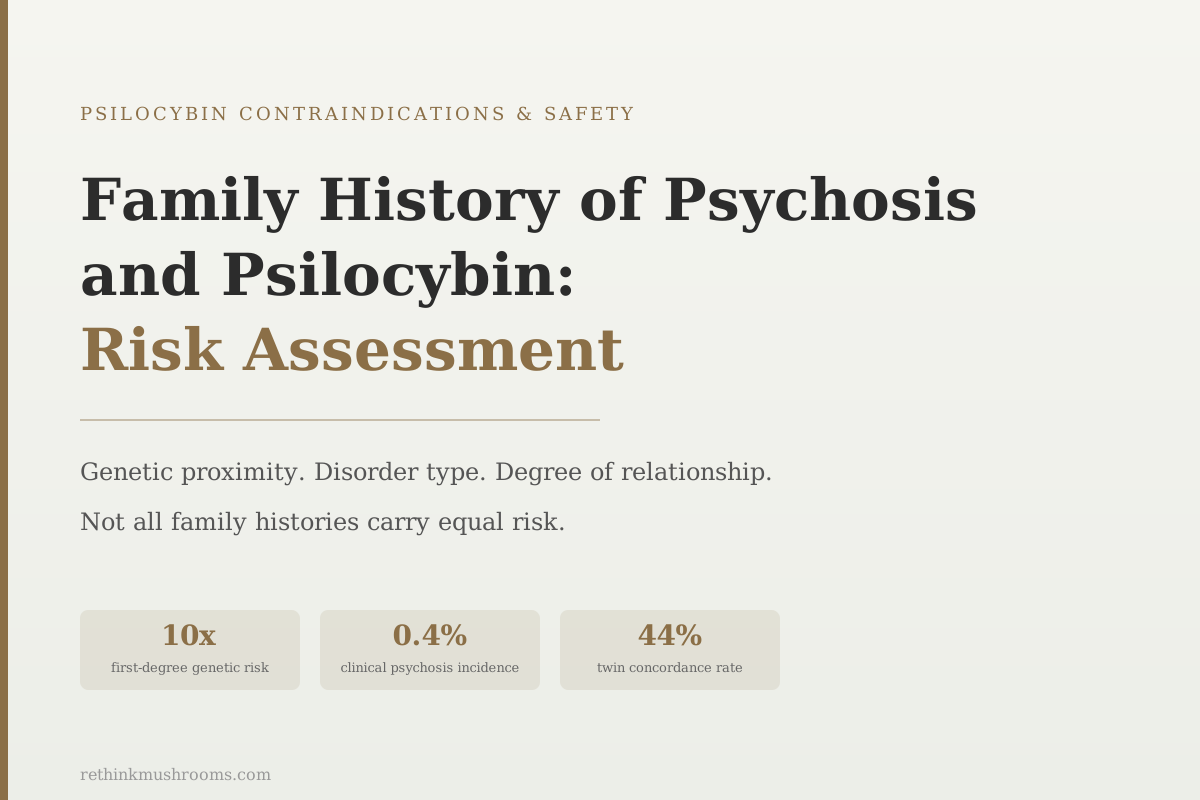
10x elevated genetic risk
A first-degree relative with schizophrenia raises a person's own lifetime schizophrenia risk roughly tenfold, the number that anchors psilocybin's family-history caution in clinical research.
Schindler et al., Psychedelic Med, 2024
0.4%
clinical psychosis incidence in psilocybin research (Sabé 2025)
44%
concordance rate in identical twins with schizophrenia
130K+
lifetime psychedelic users with no population-level mental health association (Johansen 2015)
Schindler et al., Psychedelic Med, 2024
 View as image ↗
For anyone researching psilocybin who also has a family history of psychosis, the answer from virtually every clinic, retreat center, and safety checklist is the same: disqualified. But that uniform answer applies identical caution to a first-degree relative with schizophrenia as it does to a distant relative with bipolar II, and a 2024 paper in Psychedelic Medicine argued that treating these as equivalent is scientifically indefensible.[1]
What the research actually shows is a spectrum. Genetic distance from the affected relative, the specific disorder in the family, and whether that disorder centrally involves psychosis or only sometimes includes it. Each factor changes the risk picture in meaningful ways. This article works through that evidence using the framework the research is now moving toward: risk stratification rather than binary exclusion. For the broader safety landscape, see the complete guide to how safe psilocybin actually is.
Key Takeaways
- A 2024 review in Psychedelic Medicine proposed replacing binary family-history exclusion with individualized genetic risk scoring, arguing the current approach excludes many low-risk people while using imprecise criteria
- First-degree relatives of people with schizophrenia carry roughly 10 times the general population's lifetime schizophrenia risk; identical twins of people with schizophrenia face a 44% concordance rate
- A 2025 meta-analysis of 33 studies found psilocybin-induced psychosis occurred in 0.4% of clinical research participants, with pre-existing psychotic vulnerability as the primary risk amplifier
- Family history of bipolar disorder is not the same risk category as family history of schizophrenia or schizoaffective disorder; the disorders carry different genetic profiles and different involvement of psychosis
- A 2026 comprehensive review found divergent evidence for Bipolar I (higher psychosis-triggering risk) vs. Bipolar II (more ambiguous, some benefit signals), and recommended against psilocybin use in Bipolar I
- Population data from 130,152 US adults found no association between lifetime psychedelic use and mental health problems, but this population-level finding does not resolve what happens in elevated-risk subgroups
Why the Binary Exclusion Rule Catches Very Different Levels of Risk
Almost every psilocybin clinical trial uses family history of a psychotic disorder as a screening criterion. In practice, this means if any first-degree relative has schizophrenia, bipolar disorder, or schizoaffective disorder, the participant is excluded. Some protocols extend that to second-degree relatives.
Schindler and colleagues published a direct challenge to this approach in 2024 in the journal Psychedelic Medicine.[1] Their paper, titled "A Plea for Nuance," reviewed how clinical trials actually screen for family history and found the criteria were based more on convention than on quantified individual risk. The core argument: a blanket rule that treats a second cousin with bipolar II as equivalent to an identical twin with schizophrenia is not doing the scientific work it claims to do.
That is not the same as saying family history is irrelevant. The research is consistent that pre-existing vulnerability to psychosis is the primary amplifier of psilocybin's psychosis risk. What the 2024 review pushed back against is the assumption that "family history" is a single thing rather than a spectrum with dramatically different risk levels depending on the specific relationship.
The problem the paper identifies is practical as well as scientific. Many people asking about family history have a distant relative, or a relative whose specific diagnosis is unclear, or a relative with a condition that carries mood symptoms without core psychotic features. Under the current convention, all of them receive the same excluded answer. None of them receive a quantified explanation of why.
The argument the paper makes is essentially: if clinical programs are going to use family history as a screening criterion, they should use the actual genetic risk numbers, not a categorical rule that provides no basis for distinguishing high from low risk within the excluded group.
First-Degree Relative with Schizophrenia: The 10x Number That Anchors Clinical Caution
The word "relative" in "family history" covers an enormous range of genetic relationships. The relevant numbers come from population genetics research on schizophrenia.
A person in the general population has approximately a 1% lifetime risk of developing schizophrenia. A first-degree relative, meaning a parent, sibling, or child, of someone with schizophrenia faces roughly 10 times that baseline risk, approximately 10%.[1] That tenfold increase is real and clinically meaningful. It is the number behind the clinical caution, not vague worry about heredity.
At the extreme end, identical twins (who share essentially the same genome) have a concordance rate of approximately 44% for schizophrenia.[1] If your identical twin has schizophrenia, nearly half of people in your genomic position develop the disorder. That is a categorically different risk level than any other familial relationship.
Second-degree relatives, meaning grandparents, aunts and uncles, and half-siblings, carry an intermediate elevated risk. The estimates typically land in the 3-5% range for schizophrenia, still above population baseline but considerably lower than first-degree.
The 2024 review argued that clinical screening should reflect this gradient directly. Under current convention, all of these groups receive the same excluded answer. Under a risk-stratification approach, they would be evaluated differently, with the most scrutiny directed at the closest genetic relationships to the most severe conditions.
This matters practically because many people in the family-history-excluded group are there due to a relatively distant relationship that carries modest elevation above population risk. The current screening approach does not distinguish between them and someone whose parent has schizophrenia.
A 2025 Meta-Analysis Puts Clinical Psychosis Risk at 0.4% and Names the Key Amplifier
Sabé and colleagues published a meta-analysis in Molecular Psychiatry in 2025, analyzing 33 studies of psychedelic use and psychosis outcomes.[2] It is the most comprehensive quantification of this risk in the literature to date.
In clinical and research settings, psychosis occurred in 0.4% of participants. In general population studies, people who had used psychedelics outside any research context, the rate was far lower: 0.002%. That is a gap of roughly 200-fold between clinical and population settings.
The difference almost certainly reflects who is in each population. Research participants are screened but still include some people who passed standard screening despite having underlying risk factors. General population users self-select heavily toward people without obvious predisposing conditions, and population studies dilute elevated-risk individuals across a much larger group.
The meta-analysis found that two factors primarily drove elevated risk: existing vulnerability to psychosis-related conditions and higher doses.[2]
This is the key connection to the family history question. Family history matters not as an independent risk variable but because it predicts something real: the probability that the person carries underlying biological vulnerability to conditions involving psychosis. Someone with a first-degree relative who has schizophrenia carries elevated risk of developing schizophrenia themselves, and that same biology is likely what the Sabé meta-analysis captured as "pre-existing psychotic vulnerability."
A person with a family history of a psychotic disorder who shows no personal signs of any psychosis-spectrum condition, no unusual perceptual experiences, no early warning symptoms, stable sense of reality, carries a different risk profile than someone who already shows attenuated early signs. The 2024 Schindler review explicitly noted this: genetic proximity is one input into risk assessment, not the only one.[1]
Bipolar Family History Is Not the Same Risk Category as Schizophrenia Family History
Schizophrenia and bipolar disorder are biologically different conditions despite sometimes presenting with overlapping symptoms. Their genetic profiles differ. Their involvement of psychosis differs. And their implications for psilocybin risk differ in ways that the standard family-history exclusion rule flattens out.
Schizophrenia and schizoaffective disorder are defined by recurring psychotic symptoms as core features. Psychosis, meaning the loss of connection to shared reality through hallucinations, delusions, or disorganized thinking, is not an occasional complication of these disorders. It is what they are.
Bipolar disorder, by contrast, is primarily a condition of episodic mood dysregulation, cycles of mania or hypomania and depression. Psychotic features can appear during severe bipolar episodes, particularly in Bipolar I, but they are not what defines the disorder. Many people with bipolar disorder never experience psychosis.
For psilocybin, this distinction has direct consequences. A family history of a condition where psychosis is the central feature is a stronger indicator of underlying psychotic vulnerability than a family history of a mood condition that sometimes includes psychosis at its most severe.
A 2023 international survey by Polito and colleagues gathered data specifically from people with bipolar disorder who had personal psilocybin experience, not family members with the condition but affected individuals themselves.[4] Outcomes were mixed. Some participants reported mood stabilization. A subset experienced mania or hypomanic episodes triggered by the experience. The survey found that Bipolar I was associated with worse outcomes on average than Bipolar II.
For family history assessment, this means a family history of Bipolar I carries a different signal than a family history of Bipolar II, even though both would typically fall under the same "family history of bipolar disorder" exclusion in standard screening.
The Bipolar I vs. Bipolar II Split: A 2026 Review Reached Different Conclusions for Each
A 2026 comprehensive review published in the Journal of Psychopharmacology examined all available evidence on psilocybin in bipolar disorder.[5] Its conclusions were explicitly split between the two subtypes.
For Bipolar I, the review recommended against psilocybin use. The reasoning was specific. Bipolar I involves manic episodes severe enough to require hospitalization, includes psychotic features at a meaningful rate during manic episodes, and shares genetic features with schizoaffective disorder. Psilocybin works primarily by activating a serotonin receptor in brain regions that govern mood and perception (called the 5-HT2A receptor). That mechanism creates significant overlap with the pathways that generate manic and psychotic states, making Bipolar I a condition where the risk-benefit calculation runs strongly against use.
For Bipolar II, the picture was more ambiguous. Bipolar II involves hypomania rather than full mania. Hypomanic episodes are less severe, typically do not include psychosis, and do not require hospitalization. The 2026 review found mixed evidence: some benefit signals in people with Bipolar II, some triggering of hypomanic episodes in others, and no clear consensus on net risk. Rather than recommending exclusion, the review called for carefully controlled research specifically in Bipolar II populations.[5]
The Polito 2023 survey supported this bifurcation: people identifying as Bipolar I reported worse outcomes on average than people identifying as Bipolar II.[4]
For family history purposes, this distinction matters directly. A parent with Bipolar I is a stronger risk signal than a parent with Bipolar II, both for inheriting the condition and for what that condition implies about psilocybin risk. Most current screening questions do not ask which subtype is in the family.
What 130,152 Lifetime Users Show, and What That Finding Cannot Resolve
Johansen and Krebs published a nationally representative survey of US adults in 2015, covering 130,152 people with data on both lifetime psychedelic use and a range of mental health outcomes.[3] After controlling for other factors, lifetime psychedelic use was not associated with increased rates of mental health problems or suicidal behavior.
This is the study most often cited when people argue that psychedelics are broadly safe at a population level. That citation is accurate. The finding contextualizes overall risk as low across the population of people who have ever used psychedelics.
But it has a structural limitation when applied to the family history question.
Population-level surveys average outcomes across everyone who was surveyed. They cannot isolate what happens in the specific subgroup of people with substantial genetic risk for psychotic disorders, because that group is relatively small and their outcomes are statistically diluted by the much larger group with no elevated risk. A finding of "no average population-level association" does not establish what happens at the tails of the risk distribution.
The Sabé 2025 meta-analysis makes this tension explicit: population incidence of psychosis from psychedelics is 0.002%, while clinical setting incidence is 0.4%.[2] Both numbers are accurate. They describe different populations. The Johansen finding lives in the 0.002% world. The family history question lives closer to the 0.4% world, and potentially higher still for people with close genetic proximity to schizophrenia or Bipolar I.
Population data does not dissolve the family history concern. It establishes that total risk is low for most people, while leaving the elevated-risk subgroup question open. Both things are true simultaneously.
A Risk Stratification Framework: What Researchers Propose Instead of Binary Exclusion
Based on the available evidence, the 2024 Plea for Nuance paper proposed moving from a binary exclusion rule to a tiered assessment approach.[1] The framework uses three inputs: genetic proximity to the affected relative, the specific diagnosis in the family, and whether the individual shows any personal signs of psychosis-spectrum vulnerability.
The evidence suggests the following rough stratification:
| Scenario | Relationship | Approximate Personal Risk | Where the Research Stands |
|---|---|---|---|
| Identical twin has schizophrenia or schizoaffective disorder | Monozygotic | ~44% concordance | Strong contraindication across all frameworks |
| Parent or sibling has schizophrenia | First-degree | ~10x population baseline (~10%) | High caution; most researchers recommend against |
| Parent or sibling has schizoaffective disorder | First-degree | Similar to schizophrenia | High caution; most researchers recommend against |
| Parent or sibling has Bipolar I | First-degree | Elevated; ~7% for Bipolar I itself | High caution; 2026 review recommends against Bipolar I patients themselves |
| Parent or sibling has Bipolar II | First-degree | Elevated but lower; more ambiguous | Most uncertain case; 2026 review calls for controlled research rather than blanket exclusion |
| Grandparent, aunt, or uncle has schizophrenia | Second-degree | ~3-5% estimated | Elevated above baseline; Schindler 2024 recommends individualized assessment |
| Distant relative with mood disorder only | Second-degree or beyond | Near population level | Weakest signal; binary exclusion hardest to justify on quantitative grounds |
This table is a description of where the research currently stands, not clinical guidance. Several important unknowns remain. The genetic risk numbers come from heritability research on developing the disorder itself, not from studies specifically measuring psilocybin-triggered psychosis risk in family-history subgroups. We do not yet have prospective data following people with defined family histories through psilocybin experiences and measuring outcomes. The field is genuinely in transition.
What the research does consistently support is that the risk is not uniform across the "family history" category, that genetic proximity and disorder type both modify it meaningfully, and that a blanket binary rule almost certainly excludes many people whose actual risk is modest while providing no basis for distinguishing them from people at genuinely high risk.
For people considering psilocybin who have any family history of psychotic or mood disorders, understanding these distinctions is a starting point, not a clearance. The companion articles on psilocybin and psychosis risk and who should not take psilocybin cover the adjacent evidence on absolute contraindications. For context on how low the physiological risk is for people without elevated risk factors, psilocybin's physiological safety overview and why psilocybin is considered low-risk compared to other substances provide that baseline. And for those thinking through what a challenging experience would involve, how to navigate a difficult psilocybin experience covers the evidence on harm reduction.
The Bottom Line
The research on family history of psychosis and psilocybin is moving away from binary exclusion toward risk stratification. A 2024 review in Psychedelic Medicine found that current screening protocols treat genetically disparate groups identically, and proposed scoring by genetic proximity and disorder type. The evidence is clearest at the extremes: an identical twin or first-degree relative with schizophrenia represents high caution, while a distant relative with a mood disorder represents a weak signal. A 2025 meta-analysis put clinical psychosis incidence at 0.4%, with pre-existing psychotic vulnerability as the primary amplifier. The Bipolar I vs. Bipolar II distinction is the most practically important refinement in the family-history question, with a 2026 review reaching opposite conclusions for each subtype. The data needed to precisely answer this question for many people in the middle of the risk spectrum does not yet exist.
Frequently Asked Questions
Sources & References
- 1. Source details for this reference are not yet available.
- 2. Source details for this reference are not yet available.
- 3. Source details for this reference are not yet available.
- 4. Source details for this reference are not yet available.
- 5. Source details for this reference are not yet available.