Challenging Psilocybin Experiences
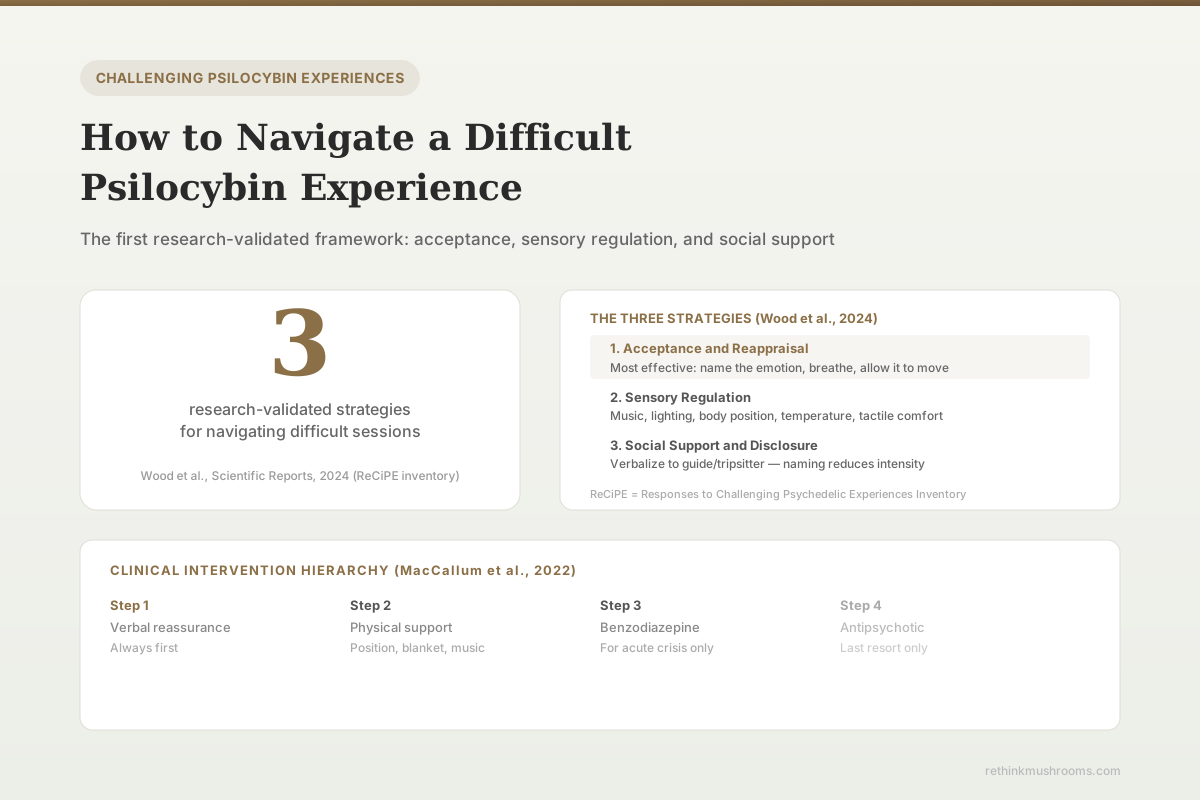
3 research-validated navigation strategies
Wood and colleagues analyzed how retreat participants navigated difficult psilocybin sessions and identified three strategies that resolved challenging experiences, formalized as the ReCiPE inventory. Acceptance and Reappraisal was the most effective of the three.
Wood et al., Scientific Reports, 2024
Acceptance first
named by researchers as the most effective strategy for resolving difficult psilocybin experiences more effective than sensory changes or social support alone
Verbal before medication
the MacCallum 2022 clinical hierarchy: verbal reassurance is first-line intervention; benzodiazepines only when verbal strategies fail; antipsychotics as a last resort
Resistance amplifies
Roseman 2017 found 'dread of ego dissolution' predicted negative outcomes in treatment-resistant depression (the resisted form of a challenging experience, not the accepted form)
Wood et al., Scientific Reports, 2024
 View as image ↗
Most guides for navigating a difficult psilocybin experience are built on practitioner experience and informal tradition. The advice to "surrender," "breathe," or "change the music" reflects real-world wisdom, but until 2024 there was no systematic research identifying which strategies actually work, which are most effective, and how different approaches compare to each other.
Wood and colleagues filled that gap. Their 2024 mixed-methods study analyzed how psilocybin retreat participants responded to difficult experiences and developed the first research-validated navigation framework: the Responses to Challenging Psychedelic Experiences Inventory (ReCiPE).[1] Three strategy clusters emerged. Acceptance and Reappraisal was the most effective. Sensory Regulation and Physical Interaction was the most immediate. Social Support and Disclosure was the most interpersonal.
This article explains each strategy, the research supporting it, and what the clinical literature adds about how trained facilitators approach the same problem. It describes what researchers have found; it is educational, not a substitute for professional harm reduction support or medical care.
For the broader safety context this article sits within, see how safe is psilocybin: the complete safety research.
Key Takeaways
- A 2024 mixed-methods study by Wood and colleagues identified three strategies retreat participants used to navigate difficult psilocybin experiences: Acceptance and Reappraisal (most effective), Sensory Regulation and Physical Interaction, and Social Support and Disclosure; these were formalized as the ReCiPE inventory (Wood et al., Sci Rep, 2024)
- Acceptance and Reappraisal involves naming the emotion, allowing it to be present without fighting it, and reframing the experience as part of the process rather than a problem to solve; research identifies this as the strategy most associated with emotional breakthrough
- Sensory Regulation covers immediate environmental modifications: music type and volume, lighting, room temperature, body position, and tactile comfort (blanket, water); these changes can shift attention and reduce psychological immersion in distressing content
- Social Support and Disclosure means verbalizing what is happening to a guide or tripsitter; the act of naming and communicating the experience reduces subjective intensity and connects the person to the external environment
- In clinical settings, the intervention hierarchy runs: verbal reassurance first, then physical support and sensory regulation, then benzodiazepines for acute crisis that does not respond to non-pharmacological strategies, then antipsychotics only for complete loss of contact with reality (MacCallum et al., Front Psychiatry, 2022)
- Roseman and colleagues found that "dread of ego dissolution" predicted negative five-week outcomes in treatment-resistant depression; but the mechanism was resistance to the experience, not the experience itself; the implication is that acceptance shifts which outcome follows from a difficult experience (Roseman et al., Front Pharmacol, 2017)
Why Resistance Amplifies Difficulty
Before the three strategies, there is a foundational principle: fighting a difficult psilocybin experience tends to intensify it.
Roseman and colleagues found evidence for this in a clinical study of psilocybin for treatment-resistant depression.[2] Patients who reported high "dread of ego dissolution" (the experience of feeling terrified by the loss of normal identity boundaries) had worse five-week outcomes than those who reported "oceanic boundlessness," which involves the same loss of boundaries but experienced without the dread. The difference was not the dissolution experience itself; it was the emotional register of resistance versus openness.
This maps to what practitioners have described for decades: two people can have nearly identical content in their session, and the one who fights it tends to have a harder time. The person who can find some way to allow the experience to continue, even when it is frightening, has a fundamentally different experience of the same pharmacological state.
The implication for navigation is practical: any strategy that reduces the impulse to fight, and increases the capacity to stay present with difficult content, is likely to help more than strategies that try to terminate the experience or force it in a different direction.
The Three Research-Backed Strategies
Wood and colleagues recruited psilocybin retreat participants who had experienced difficult sessions and analyzed both their narrative descriptions and structured questionnaire responses to identify what worked.[1] The ReCiPE inventory that emerged from this analysis covers three strategy clusters, described here in order of their association with positive outcomes.
Strategy 1: Acceptance and Reappraisal: Acknowledging the difficult emotion or content, allowing it to be present, and reframing the experience as meaningful or purposeful rather than threatening. This is what clinical guides mean by "trust, let go, be open." It is not about pretending the difficulty isn't there; it is about changing the relationship to the difficulty.
Strategy 2: Sensory Regulation and Physical Interaction: Modifying the sensory environment to shift physiological arousal and ground attention in the present. Music changes, lighting adjustments, physical repositioning, and temperature changes all fall here.
Strategy 3: Social Support and Disclosure: Telling a guide or tripsitter what is happening. Verbalizing the experience connects the person to external reality and to another human, both of which reduce the total immersion in distressing internal content.
The strategies are not mutually exclusive. Most people who navigated difficult experiences well used more than one. But if only one is available, the research suggests Acceptance and Reappraisal produces the most direct impact on the experience itself.
For a deeper examination of why difficult experiences can still produce therapeutic benefit, see why challenging psychedelic experiences can still be therapeutic.
Strategy 1: Acceptance and Reappraisal in Practice
Acceptance is a specific cognitive and emotional action. It is not passive, and it is not the same as resignation. It is the active choice to stop directing effort toward ending the experience, and instead to direct attention toward being present with it.
In practice, this means several things that participants in the Wood 2024 study described:
Naming the emotion. "I feel fear" or "This is grief" is qualitatively different from feeling submerged in fear or grief without language. Naming gives the person a small vantage point above the experience. Clinical guides commonly assist with this: "What are you feeling right now?" followed by silence.
Breathing deliberately. Slow, deep breathing activates the parasympathetic nervous system, reducing the physiological aspects of anxiety response. It also gives the person something concrete to focus on.
Allowing movement. Emotions and difficult content during psilocybin sessions typically move when they are not blocked. The practitioner phrase "there is a river running through you, let it run" captures what participants described: content that was painful in the first fifteen minutes often transformed or passed within thirty to sixty minutes when it was not resisted.
Reappraisal. This is the cognitive component: choosing to interpret the experience as part of a process rather than as evidence of something going wrong. Reminders like "this is the medicine working," "this is temporary," or "whatever is arising needs to be seen" are examples of reappraisal.
The Wood study found that Acceptance and Reappraisal was associated with the most direct emotional breakthrough among the three strategy clusters. It is also the hardest strategy to execute when fear is high, which is why preparation before a session and support during it both matter.
Strategy 2: Sensory Regulation and Physical Interaction
When the internal experience is overwhelming, the sensory environment provides an external anchor. Strategy 2 covers modifications to that environment, and they work through several mechanisms: reducing cognitive load, shifting physiological arousal, and redirecting attention.
The most commonly used and most documented sensory intervention is music. The emotional valence of music during a psilocybin session has a measurable effect on the emotional quality of the experience. Practitioners in clinical trials use carefully curated playlists, and the ability to change the music during a difficult passage is a standard facilitation tool. A track that is intensifying difficult emotional content can sometimes be shifted by moving to something more open, simpler, or more grounded.
Beyond music, participants in the Wood study described:
- Moving from lying down to sitting up (or the reverse): changing the relationship between body and environment
- Requesting a blanket: tactile warmth and the physical sensation of being held or contained
- Drinking water: the simple physical act of swallowing and tasting grounds attention in the body
- Changing rooms or stepping outside: a shift in physical space can shift the psychological frame entirely
- Opening or closing the eyes: if external visual stimuli are amplifying difficulty, eyes closed can help; if internal imagery is overwhelming, eyes open and focusing on a simple object can break the loop
None of these are pharmacological interventions. They work by modulating the sensory inputs that the brain is currently incorporating into the experience. They are available in any setting, require no training to deploy, and can be implemented within seconds.
Strategy 3: Social Support and Disclosure
Psilocybin experiences at higher doses involve a dissolution of the usual sense of where the self ends and the world begins. When that dissolution takes a frightening direction, the presence of another human being who remains calm and oriented provides a contrast. The person having the difficult experience can anchor partly to the guide's stable presence.
But Strategy 3 is not only about presence. The active element in the Wood study was disclosure: the act of telling the guide or tripsitter what is happening. "I'm very frightened right now" or "I feel like I'm dying" is not simply asking for help; it is the act of translating an internal experience into language, which requires a cognitive step that itself shifts the relationship to the content.
Participants described that verbalization reduced the subjective feeling of being trapped inside the experience. Speaking creates an observer position. It also allows the guide to respond specifically to what is happening rather than offering generic reassurance.
What makes support effective versus counterproductive:
- Effective: calm, unhurried presence; allowing silence; gentle non-directive prompts ("what's coming up for you?"); reminders of context ("you're in a safe place, the medicine is working")
- Counterproductive: visible anxiety in the support person; rushing to fix or terminate the experience; premature reassurance before the person has been heard; strong directive interventions before they are needed
For context on what increases the likelihood of needing active support, see risk factors for challenging psilocybin experiences.
What Trained Clinicians Add: The MacCallum Hierarchy
The three navigation strategies above describe what a person can do for themselves, or what a tripsitter can help facilitate. In formal clinical settings, the protocol extends further.
MacCallum and colleagues published a clinical guidance paper in 2022 covering practical management of difficult experiences in therapeutic psilocybin administration.[3] Their intervention hierarchy runs as follows:
-
Verbal reassurance: The therapist's voice and presence come first. Reminding the patient of the context, the safety of the environment, and the temporariness of the experience. This includes the non-pharmacological strategies above.
-
Physical support and sensory regulation: Repositioning, blanket, music changes (the same sensory tools described above, now deployed by a trained clinician who can adjust based on what the patient is communicating).
-
Benzodiazepines: For acute psychological crisis (typically severe panic, inability to engage with verbal support, or escalating distress that does not respond to the above) diazepam is the first-line pharmacological intervention. Benzodiazepines reduce the intensity of the experience without completely terminating it. They do not eliminate the psilocybin state; they reduce its amplitude.
-
Antipsychotics: Reserved for complete loss of contact with reality that is not responding to other interventions. MacCallum notes this is rare in properly screened participants. Antipsychotics are not a first-line choice partly because they can blunt the therapeutic effect of the session more severely and have a less favorable safety profile in acute distress than benzodiazepines.
The clinical hierarchy confirms that pharmaceutical intervention is the last resort, not the first response. It also reflects what the Wood 2024 strategies suggest: verbal and relational approaches are the first tools, not because they are the least powerful, but because they are most aligned with the therapeutic process.
For a full clinical perspective on this hierarchy and what constitutes a medical emergency versus a manageable difficult experience, see navigating a challenging psilocybin experience: clinical intervention strategies.
Can You Stop a Psilocybin Experience?
This is one of the most common questions when someone is struggling, and the honest answer is: not fully, but intensity can be reduced.
Benzodiazepines (diazepam, lorazepam) taken during a difficult psilocybin experience reduce the subjective intensity substantially. A standard clinical dose can shift a person from overwhelming distress to a more manageable state within fifteen to thirty minutes. The psilocybin pharmacology is still present, but its psychological amplitude is reduced.
Benzodiazepines do not eliminate the psilocybin state. They do not bring the person back to baseline, particularly if the psilocybin dose was large or was taken recently. They reduce the intensity of what is happening without creating sobriety.
Without benzodiazepines, the pharmacological timeline of oral psilocybin is relatively predictable: effects typically begin within twenty to forty minutes of ingestion, peak at approximately ninety minutes to three hours, and decline substantially over the next two to three hours, with full return to baseline at around five to six hours for most people. Knowing the timeline does not make a difficult experience feel shorter, but it provides an accurate framework: the most intense period has a ceiling and an end.
The Fireside Project (firesideproject.org) operates a free peer support line for people in difficult psychedelic experiences and their tripsitters. It is a harm reduction resource, not medical care, but it provides a trained human voice at a moment when that can make a significant difference.
For integration and making sense of what happened after a challenging session, see psychedelic integration: making sense of the experience. For how these mechanisms connect to why difficult experiences sometimes produce lasting positive change, see fear extinction and psilocybin: how psychedelics may reprocess trauma memories.
The Bottom Line
Wood and colleagues identified three research-backed strategies for navigating difficult psilocybin experiences: Acceptance and Reappraisal (most effective), Sensory Regulation and Physical Interaction, and Social Support and Disclosure, formalized as the ReCiPE inventory (Wood et al., 2024). The foundational principle is that resistance amplifies difficulty; Roseman 2017's clinical data in treatment-resistant depression found that dread-plus-resistance predicted negative outcomes, while acceptance converted the same difficult content toward therapeutic outcomes. Clinically, the MacCallum 2022 protocol runs: verbal reassurance first, then physical and sensory support, then benzodiazepines for acute crisis, with antipsychotics only as a last resort. Psilocybin's subjective intensity cannot be fully stopped without pharmacological intervention, but the five-to-six-hour typical duration provides a predictable framework.
Frequently Asked Questions
Sources & References
- 1RTHM-02019·Wood, Maximillian J et al. (2024). “Strategies for resolving challenging psychedelic experiences: insights from a mixed-methods study..” Scientific reports.Study breakdown →PubMed →↩
- 2RTHM-00907·Roseman, Leor et al. (2017). “Quality of Acute Psychedelic Experience Predicts Therapeutic Efficacy of Psilocybin for Treatment-Resistant Depression..” Frontiers in pharmacology.Study breakdown →PubMed →↩
- 3RTHM-01580·MacCallum, Caroline A et al. (2022). “Therapeutic use of psilocybin: Practical considerations for dosing and administration..” Frontiers in psychiatry.Study breakdown →PubMed →↩