Psychedelic Safety & Integration
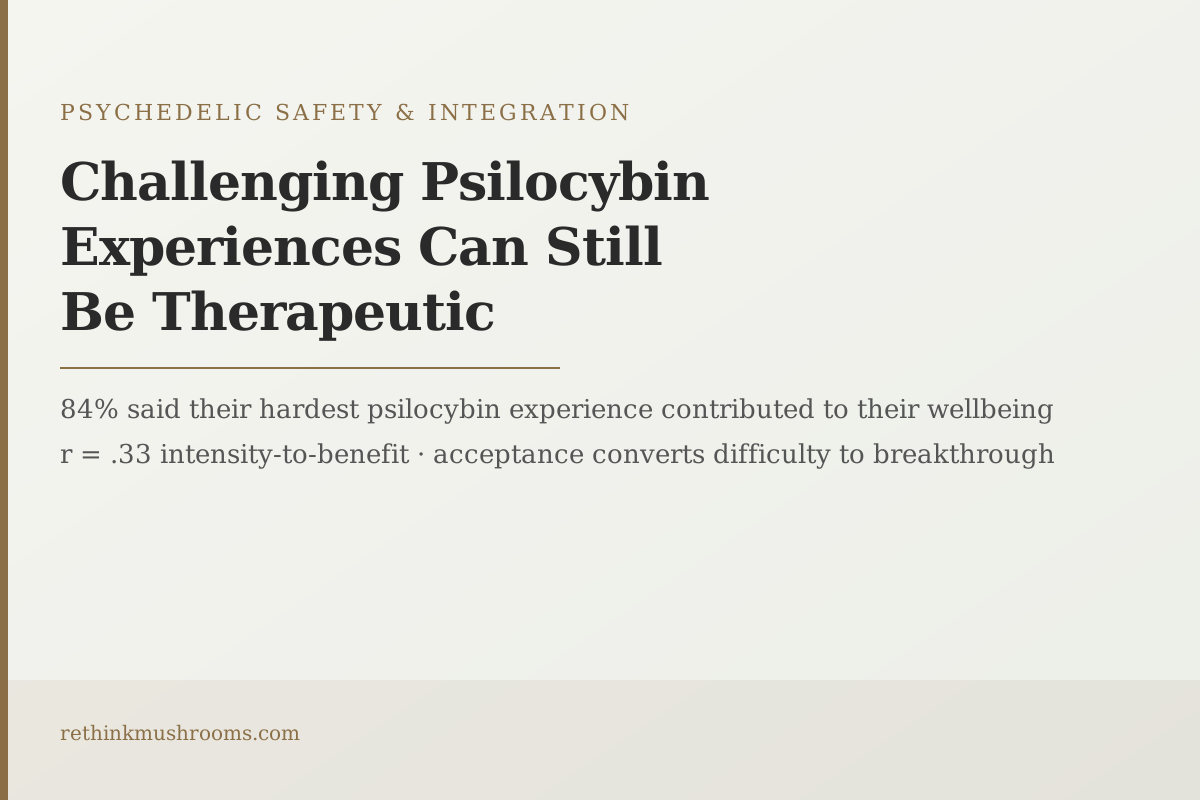
84% reported lasting benefit
Among 1,993 psilocybin users who reported their most difficult experience, 84% said that same experience had contributed positively to their long-term wellbeing, despite 39% rating it among the top-5 most challenging events of their entire lives.
Carbonaro et al., Journal of Psychopharmacology, 2016
r = .33
correlation between psychedelic experience intensity and therapeutic benefit across all studies in a 2025 meta-analysis (p < .0001); stronger for mood disorders (r = .41) and clinical settings (r = .50)
r = .50 vs .14
therapeutic benefit correlation in clinical settings vs. naturalistic use: clinical preparation and support more than triples the intensity-to-benefit relationship (Romeo 2025)
Acceptance, not avoidance
Wood 2024 found acceptance and reappraisal was the most effective of three research-validated strategies for converting difficult psilocybin experiences into positive outcomes
Carbonaro et al., Journal of Psychopharmacology, 2016
 View as image ↗
A difficult psilocybin experience is not the same as a failed one. Most people who have gone through the hardest kinds of psilocybin sessions (the ones involving grief, fear, disorientation, or encounters with their own mortality) describe those experiences, in retrospect, as among the most significant of their lives. Not despite the difficulty. Often because of it.
The research has now caught up to what experienced clinicians and many participants have reported anecdotally for years. A 2025 meta-analysis across all published psychedelic therapy studies found a significant positive correlation between the intensity of the psychedelic experience and clinical improvement.[1] The relationship is not that pleasant experiences lead to healing and difficult ones don't. The relationship is that deep, intense experiences of any kind are what predict the best outcomes.
This article explains what the research actually shows, why the distinction between accepted difficulty and resisted difficulty is the critical variable, and why clinical preparation more than triples the therapeutic value of this intensity. For the full psilocybin safety research context, psilocybin's complete safety research provides the broader picture.
Key Takeaways
- 84% of psilocybin users who reported their most difficult experience said it had contributed positively to their long-term wellbeing; 39% rated it among the top-5 most challenging events of their lives (Carbonaro 2016)
- A 2025 meta-analysis found experience intensity correlated with therapeutic benefit at r = .33 (p < .0001) across all psychedelic studies; the correlation was r = .41 for mood disorders and r = .50 in clinical settings (Romeo et al.)
- In treatment-resistant depression patients, "oceanic boundlessness" (a profound, self-transcendent experience) predicted positive outcomes at 5 weeks; "dread of ego dissolution" (the most common challenging experience) predicted negative outcomes specifically when it led to resistance rather than acceptance (Roseman 2017)
- Wood 2024 validated three strategies for navigating difficult psilocybin experiences; acceptance and reappraisal (engaging with rather than fighting the difficult material) was the most effective for emotional breakthrough
- Challenging experiences are not therapeutic by default: they require the right preparation, support, and response. Clinical settings achieve r = .50 intensity-to-benefit correlation vs. r = .14 in unsupported naturalistic use
- The research reframes the question from "bad trip vs. good trip" to "material that was engaged with vs. material that was avoided"
The 84% Finding: Why the Hardest Experiences Are Often the Most Meaningful
Carbonaro and colleagues (2016) surveyed 1,993 psilocybin users specifically about their most difficult experience.[2] They were asking about the worst: the session that had been most frightening, most disorienting, most psychologically intense.
Thirty-nine percent of those respondents rated that experience among the top-5 most challenging events of their entire lives. This is a high bar. A psilocybin session ranked alongside grief, trauma, or major illness in terms of psychological intensity.
And yet: 84% of the same respondents said that difficult experience had contributed positively to their long-term wellbeing. More than a third also said it was among the most meaningful experiences of their lives.
This is not a paradox. It is a consistent pattern across research on how people process difficult psychological material. Therapeutic work in almost every clinical modality involves approaching difficult content rather than avoiding it. Exposure therapy, EMDR, grief work, trauma-focused CBT: these modalities are all grounded in the same premise that difficulty, when faced rather than avoided, tends to resolve and integrate rather than persist and compound.
Psilocybin appears to accelerate that process by making psychological material more accessible and more vivid. The same property that makes difficult content more intense also makes it more workable.
Barrett and colleagues (2016) developed the Challenging Experience Questionnaire (CEQ) to standardize what "difficult" actually means in this context.[3] The seven domains the CEQ measures are grief, fear, death concerns, loss of sense of self, isolation, physical distress, and paranoia. Each of these is clinically recognizable as a category of psychological material that people generally avoid in daily life. Psilocybin can surface all seven, sometimes simultaneously, at intensities that are hard to disengage from. This is precisely what makes it potent for therapeutic work and precisely what makes it challenging.
The Meta-Analytic Evidence: Experience Intensity Predicts Clinical Benefit
Romeo and colleagues (2025) published a systematic review and meta-analysis covering all published psychedelic therapy studies, examining the relationship between the intensity of the psychedelic experience and clinical improvement.[1]
The overall correlation: r = .33, p < .0001. This is a reliable, medium-sized effect. Across studies with different conditions, different compounds, different measurement tools, and different populations, the depth of the experience reliably predicts the degree of clinical benefit.
The breakdown by context is where the findings get practically important:
-
Mood disorders (depression, anxiety): r = .41. The relationship is stronger here than in addiction research (r = .19), suggesting that the introspective and emotionally confrontational nature of intense experiences is particularly relevant for mood-based conditions.
-
Clinical settings: r = .50. When a trained therapist or guide is present, the experience has been prepared for, and the setting is designed for therapeutic work, the intensity-to-benefit correlation more than triples compared to unsupported use.
-
Naturalistic use (without clinical structure): r = .14. The correlation still exists but is far weaker. An intense experience in an unsupported, unprepared context often produces difficulty without the therapeutic integration that converts that difficulty into benefit.
This last point is the critical finding for understanding why challenging experiences can be therapeutic: the mechanism requires not just the intensity, but the context that allows the intensity to be processed.
The Critical Distinction: Acceptance vs. Resistance
Roseman and colleagues (2017) studied 20 patients with treatment-resistant depression who received psilocybin-assisted therapy and were followed for five weeks after their session.[4] They measured the quality of the acute experience using validated scales and correlated those measures with clinical outcomes.
Two experience types showed opposing relationships with outcomes.
Oceanic boundlessness, the dissolving of the sense of self into a feeling of unity, transcendence, or profound connection, predicted positive outcomes at five weeks. This is sometimes called a mystical experience. It tends to be intense and often emotionally overwhelming, but it is characterized by a quality of opening rather than closing.
Dread of ego dissolution, the experience of the self breaking apart with terror and resistance, predicted negative outcomes. This is the experience of the self disintegrating and the person fighting it, trying to hold themselves together, interpreting the dissolution as a threat to sanity or survival.
The critical insight: both of these involve the same underlying event: the ego (the ordinary sense of a bounded, continuous self) dissolving under high-dose psilocybin. The difference in outcome is not determined by the event itself but by the person's relationship to it.
When ego dissolution is experienced with acceptance, it becomes oceanic boundlessness and predicts benefit. When it is experienced with terror and resistance, it becomes dread of ego dissolution and predicts negative outcomes. The challenge and the breakthrough can emerge from the same moment. The variable is whether the person can engage with what is happening or fights against it.
This explains why "challenging experience" is not a unitary category. Grief, fear, and confrontation with death can be therapeutic when moved through. The same material, rigidly defended against, produces a different outcome.
What Research-Validated Navigation Looks Like
Wood and colleagues (2024) conducted a mixed-methods study of psilocybin retreat participants and developed the first research-validated framework for how people navigate difficult experiences during sessions.[5] They identified three primary strategies and developed the Responses to Challenging Psychedelic Experiences Inventory (ReCiPE) to measure them.
Acceptance and Reappraisal. The strategy of naming what is happening ("this is fear, it is moving through me"), breathing, and allowing the experience to continue without fighting it. Wood found this was the most effective strategy for emotional breakthrough, for reaching the resolution on the other side of the difficult material. This is the research-validated version of what clinicians and practitioners have called "trust, let go, be open."
Sensory Regulation and Physical Interaction. Changing the sensory environment to reduce overwhelm: adjusting music, changing position, using a blanket for grounding, dimming or brightening light, moving to a different space. This strategy helps regulate the experience's intensity without suppressing it entirely. It is most useful when the difficulty is primarily physical or when the person needs a brief stabilization before they can re-engage.
Social Support and Disclosure. Telling the guide or companion what is happening. Verbalizing the experience has its own integrative function and also allows the support person to respond appropriately. Wood found that disclosure to a trusted person reduced the experience's intensity and helped the person feel less alone in it.
The three strategies operate at different levels, and the most therapeutically valuable one (acceptance and reappraisal) is also the most psychologically demanding. It requires the person to trust that they can move through the difficult material, which in turn requires adequate preparation, a safe setting, and a guide whose presence makes that trust possible.
For a detailed guide to applying these strategies in practice, how to navigate a difficult psilocybin experience covers the practical application of Wood's framework.
Why Clinical Preparation More Than Triples the Benefit
The Romeo 2025 meta-analysis finding that clinical settings achieve r = .50 while naturalistic use achieves r = .14 is not just a data point about research quality. It quantifies what preparation and support actually contribute to therapeutic outcomes.
An intense experience in a clinical setting involves a person who has been screened, prepared, given a therapeutic frame for understanding what might happen, provided with specific strategies for navigating difficulty, and supported throughout by trained guides who know how to respond. The same difficult material that overwhelms someone in an unsupported, unprepared context is exactly the material that, with preparation and support, becomes the source of the most significant therapeutic movement.
The clinical setting's preparation work addresses the single variable that most separates therapeutic difficulty from non-therapeutic difficulty: the person's capacity to accept and engage with what is happening rather than fight it. Preparation teaches people what to expect, reduces the novelty-triggered panic that intensifies resistance, and establishes the therapeutic relationship that makes the guide's presence genuinely stabilizing rather than just theoretically present.
For context on what the risk factors are that make difficulty more likely to tip into distress rather than breakthrough, risk factors for challenging psilocybin experiences identifies the variables that modulate this relationship. For the clinical intervention strategies that trained guides use when difficulty escalates beyond what acceptance alone can address, navigating a challenging psilocybin experience: clinical intervention strategies covers that evidence.
The integration work that follows a challenging session matters too. A difficult experience that is not processed and made sense of afterward rarely converts fully into lasting benefit. For what that integration process involves, psychedelic integration: making sense of the experience covers the research on how difficult experiences become enduringly meaningful. For the neuroscience of why confronting feared material during psilocybin may work differently from other trauma approaches, fear extinction and psilocybin: how psychedelics may reprocess trauma memories examines that mechanism.
The Bottom Line
84% of people who described their worst psilocybin experience said it contributed to their long-term wellbeing. A 2025 meta-analysis found experience intensity reliably predicts therapeutic benefit (r = .33), with clinical settings producing more than three times the effect of unsupported use (r = .50 vs. r = .14). The critical variable is not the presence of difficulty but the person's relationship to it: acceptance converts difficult material into therapeutic breakthrough; resistance produces the opposite. Wood 2024's three validated navigation strategies confirm that the most effective approach is acceptance and reappraisal, which requires preparation and support to deploy.
Frequently Asked Questions
Sources & References
- 1RTHM-02171·Romeo, B et al. (2025). “The intensity of the psychedelic experience is reliably associated with clinical improvements: A systematic review and meta-analysis..” Neuroscience and biobehavioral reviews.Study breakdown →PubMed →↩
- 2RTHM-00418·Carbonaro, Theresa M et al. (2016). “Survey study of challenging experiences after ingesting psilocybin mushrooms: Acute and enduring positive and negative consequences..” Journal of psychopharmacology (Oxford.Study breakdown →PubMed →↩
- 3RTHM-00417·Barrett, Frederick S et al. (2016). “The Challenging Experience Questionnaire: Characterization of challenging experiences with psilocybin mushrooms..” Journal of psychopharmacology (Oxford.Study breakdown →PubMed →↩
- 4RTHM-00907·Roseman, Leor et al. (2017). “Quality of Acute Psychedelic Experience Predicts Therapeutic Efficacy of Psilocybin for Treatment-Resistant Depression..” Frontiers in pharmacology.Study breakdown →PubMed →↩
- 5RTHM-02019·Wood, Maximillian J et al. (2024). “Strategies for resolving challenging psychedelic experiences: insights from a mixed-methods study..” Scientific reports.Study breakdown →PubMed →↩