Psychedelic Integration: Processing and Applying Psilocybin Experiences
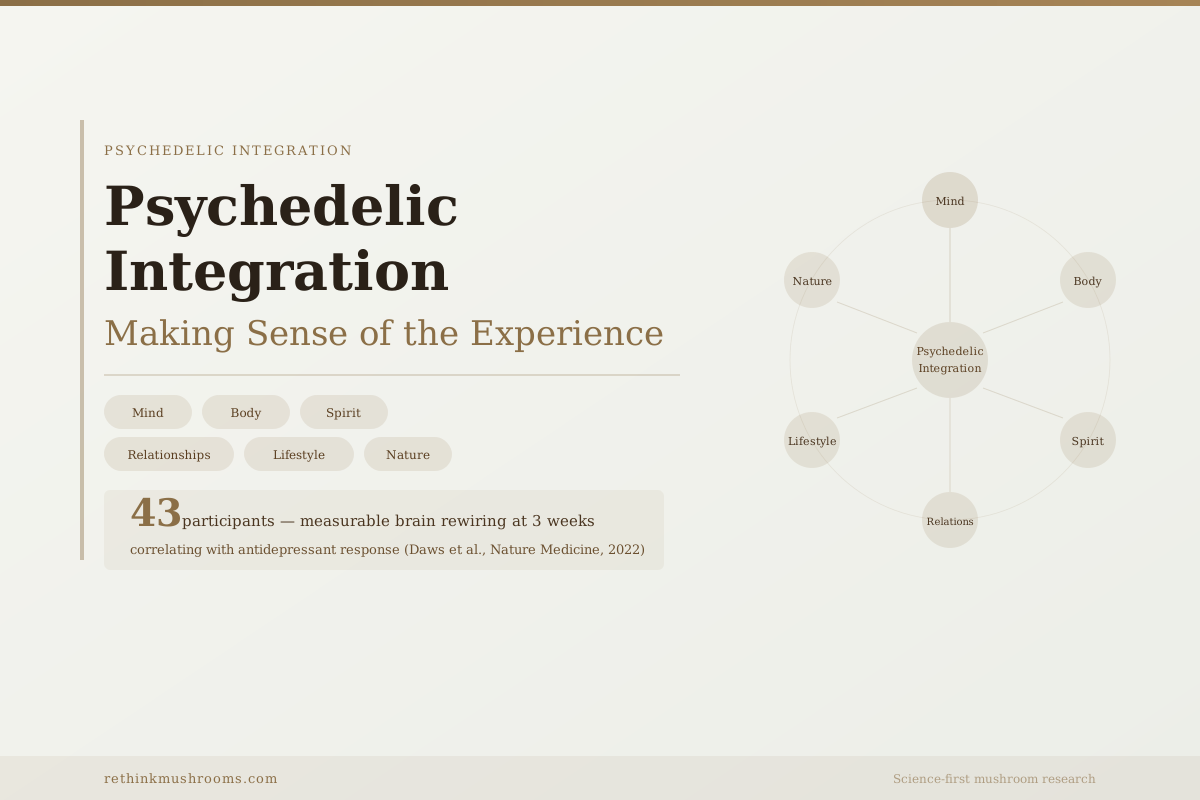
43 participants
In an fMRI study published in Nature Medicine, psilocybin therapy produced measurable increases in brain network connectivity that persisted at 3-week follow-up and correlated directly with antidepressant response.
Daws et al., Nature Medicine, 2022
3–4.5 years
psychological benefits persisted in Agin-Liebes 2020 cancer patient follow-up
Six domains
integration spans (not just mind and emotions) per Bathje 2022 framework
3 categories
of integration challenge identified by Aixalà 2024 that determine what support is needed
Daws et al., Nature Medicine, 2022
 View as image ↗
After a psilocybin experience, the brain enters a state of temporarily increased connectivity. In a 2022 fMRI study published in Nature Medicine, Daws et al. measured this directly: 43 people who received psilocybin therapy for depression showed increased global brain integration that persisted for three weeks after the session and correlated with how much their depression improved.[1] That three-week window is not just psychological. It is biological. The brain is, briefly, more able to form new connections and revise old patterns.
What you do during that window determines whether the psilocybin experience produces lasting change or fades like a memorable dream. This process is psychedelic integration.
Psychedelic integration is the active process of understanding, accepting, and applying insights from a psilocybin experience into daily life. Unlike the acute experience itself (4-6 hours), integration unfolds over weeks to months and determines whether the session produces lasting change. This clear definition is what the featured snippet question "what is psychedelic integration" is asking for.
The safety research on psilocybin covers what makes the substance itself relatively low-risk. Integration is the complementary question: once you have had a session, how do you actually use it?
Key Takeaways
- Psilocybin therapy produces measurable increases in brain network connectivity persisting at 3-week follow-up; the integration period is when those neurological changes consolidate into lasting psychological change (Daws et al., Nature Medicine, 2022)
- Integration spans six life domains, not just mental or emotional content: Mind, Body, Spirit, Relationships, Lifestyle, and Nature (Bathje et al., Frontiers in Psychology, 2022)
- The quality of a psilocybin session was the strongest predictor of antidepressant efficacy, but integration determines whether that potential actually converts to lasting benefit (Roseman et al., Frontiers in Pharmacology, 2017)
- Aixalà et al. (2024) distinguish integration challenges that require professional clinical support (destabilizing or adverse reactions) from those suited to self-directed work; the type you face determines the support you need
- At 3-4.5 year follow-up, 60-80% of cancer patients who received psilocybin-assisted therapy still showed clinically significant improvements in depression and anxiety (Agin-Liebes et al., 2020)
- At 14-month follow-up, 58-67% of participants in the landmark Johns Hopkins study rated their psilocybin session as one of the five most meaningful experiences of their lives and attributed lasting positive changes to it (Griffiths et al., 2008)
Psilocybin Changed Your Brain's Wiring. What You Do Next Determines Whether It Sticks.
The Daws et al. (2022) finding deserves a closer look, because it reframes what integration is from the ground up.[1]
Before a psilocybin session, the brain operates in relatively segregated networks. Different regions specialize in different tasks (self-referential thinking, sensory processing, memory retrieval) and communicate primarily within those specialized networks. This segregation is efficient and largely adaptive. But it also means the brain tends to cycle through the same established patterns. Rumination, rigid self-beliefs, and habitual emotional responses all reflect this structured segregation.
Psilocybin disrupts that segregation. During the session, brain networks that normally operate independently begin communicating with each other. After the session, Daws et al. measured something specific: a reduction in the brain's "modularity" (how compartmentalized its networks are) and an increase in "global efficiency" (how well different regions communicate).[1] These changes were measurable at 3 weeks post-session and correlated with how much each participant's depression had improved.
This is the neurological substrate of integration. The brain is briefly in a state where new patterns are easier to form. How psilocybin affects the brain's default mode network describes the broader network dynamics at play. For integration purposes, the practical implication is direct: the weeks immediately after a psilocybin session are not a passive recovery period. They are the window in which the temporary neurological changes can either consolidate into lasting restructuring or revert to baseline.
What activates that consolidation? The practices, reflections, conversations, and behavioral changes of integration. For psilocybin and global brain connectivity specifically, the research points toward active engagement with the insights from the session as the mechanism by which neurological change becomes psychological change.
This is why integration is not optional for anyone who wants more than a powerful temporary experience. It is the process through which the window gets used.
What Integration Actually Covers: A Six-Domain Framework Beyond Mind and Emotions
Most discussions of psychedelic integration focus on emotional and mental processing: journaling insights, working through difficult emotions, making meaning from unusual experiences. That is a real and important part of integration. But it is not the whole picture.
Bathje et al. (2022) conducted a conceptual analysis of the integration literature and arrived at a six-domain model that maps everything integration touches.[2] Adapted for practical use, the six domains are:
Mind. Cognitive shifts, new perspectives, insights about beliefs, thought patterns, or assumptions that emerged during the session. This is the most commonly discussed domain: the "aha" moments and re-framings that psilocybin experiences often produce.
Body. Physical awareness, somatic responses, changes in how you inhabit your body, movement practices, sleep, and physical energy. Psilocybin experiences are often intensely physical as well as mental; many people find the body holds content that the mind does not immediately understand.
Spirit. Meaning, purpose, connection to something larger than the self, or existential questions about what matters. Griffiths et al. (2008) found that 58-67% of participants at 14-month follow-up described their session as one of the most spiritually significant experiences of their lives.[6] That kind of experience creates integration demands in the spiritual domain regardless of whether the person considers themselves religious.
Relationships. Changes in how you relate to specific people, shifts in social needs, recognition of relational patterns, or the impulse to repair or deepen connections. Insights about relationships that surface during psilocybin sessions often require active, real-world follow-through to integrate.
Lifestyle. Behavioral changes, daily routines, habits, work, diet, or creative practices that now feel misaligned or worth reconsidering. Lifestyle integration is often where the most concrete and durable changes occur. This is when insights from a session translate into actual behavioral shifts.
Nature. Connection to the natural world, environmental values, and sense of belonging in a larger ecological context. This domain is less commonly discussed in clinical contexts but is reported frequently in qualitative accounts of psilocybin experiences.
The six-domain model matters because it reframes where to look for integration work. Someone who has thoroughly processed a psilocybin experience emotionally but has not examined the relational or lifestyle domains may have left significant integration work undone. The framework also helps identify where the experience had the most impact, and therefore where to direct attention in the weeks that follow.
The Session Was the Spark. Integration Is the Fire.
Roseman et al. (2017) studied 20 people receiving psilocybin for treatment-resistant depression and measured the quality of their acute sessions using a standard scale for mystical-type experiences.[3] Their finding: the depth of the acute experience was the strongest predictor of antidepressant efficacy at follow-up. People who had more profound, complete sessions tended to show greater depression improvements.
Roseman, Nutt & Carhart-Harris (2017) · Frontiers in Pharmacology
- Population
- 20 adults with treatment-resistant depression
- Intervention
- Psilocybin, with the acute experience rated on a mystical-type experience scale (Oceanic Boundlessness)
- Finding
- The quality and depth of the acute session was the strongest predictor of antidepressant response at follow-up: the more complete the experience, the greater the improvement.
positive A correlation within a small, open-label sample. It shows session quality creates potential; it does not prove the experience alone determines the outcome.
Roseman L, Nutt DJ, Carhart-Harris RL. Frontiers in Pharmacology, 2017;8:974.
What this reveals, and what it does not reveal, is important. The data shows that session quality creates potential. It does not show that session quality alone determines outcomes. The profound session is the spark. Integration is the process by which that spark becomes lasting fire.
Practically, this means two things. First, a less-than-ideal session is not a wasted session. Even confusing, incomplete, or difficult experiences carry integration material. The session does not need to have been transcendent to be worth integrating. Second, a remarkable session is not automatically a life-changing one. The reports of profound meaning and lasting change in the long-term follow-up studies come from people in structured therapeutic contexts with deliberate integration support, not just from people who had powerful experiences. The experience is necessary but not sufficient.
For people who had a difficult or destabilizing session, the integration question is different but equally important. How to navigate a difficult psilocybin experience covers that territory. Integration after a challenging session often requires more support, not less.
Three Types of Integration Challenge: Which One Describes Your Experience?
Aixalà et al. (2024), drawing on more than a decade of integration casework at ICEERS, distinguish challenges that call for professional clinical intervention (adverse reactions, traumatic episodes, the exacerbation of pre-existing conditions) from those a person can work through with lighter support.[4] Building on that distinction, the challenges people actually report sort cleanly into three practical types:
Category 1: Challenging or destabilizing experiences. These include experiences that were frightening, overwhelming, or involved content (past trauma, difficult emotions, unusual perceptions) that did not resolve during the session. People in this category often feel unsettled after the experience rather than well. This category requires professional support for integration; self-directed journaling and meditation are not adequate for stabilizing acute psychological distress.
Category 2: Ambiguous insights requiring meaning-making. The experience produced meaningful content but the person is not sure what it means or how to apply it. Unusual perceptions, symbolic imagery, emotions without clear context, or insights that feel important but are hard to articulate all fall here. This category is where most people end up after a reasonably positive session. It benefits from some support: a therapist, an integration circle, or a trusted person who can help hold and examine the content. It does not necessarily require clinical intervention.
Category 3: Lifestyle integration challenges. The person understands what the experience revealed but implementing the changes required is hard. Wanting to quit a job, end a relationship, change a major habit, or restructure daily life in response to psilocybin insights involves practical and social friction. This category is well-suited to self-directed integration work and peer support.
The category matters because it determines what integration support to seek. Most consumer content about integration is written as if Category 3 is universal: here are your journaling prompts, here is your meditation practice. For people in Category 1, that guidance is insufficient and potentially harmful through false reassurance. For people in Category 2, it is a starting point but not the whole picture. Honest integration guidance begins with diagnosing which category you are in.
The Benefits Can Last 4 Years: What the Long-Term Follow-Up Data Shows
How long does integration need to last? The data from long-term follow-up studies gives a concrete answer, and it is longer than most discussions suggest.
Agin-Liebes et al. (2020) followed the surviving participants from an NYU trial of psilocybin-assisted therapy for cancer-related depression and anxiety; 15 of the 16 patients still alive took part, an average of 3.2 and 4.5 years after their session.[5] At the 4.5-year follow-up, roughly 60-80% still showed clinically significant decreases in depression and anxiety. Between 71% and 100% continued to rate their psilocybin session as one of the most personally meaningful or spiritually significant experiences of their lives. These people had one session, years earlier, that continued to shape how they understood themselves and faced a terminal diagnosis.
Agin-Liebes et al. (2020) · Journal of Psychopharmacology
- Population
- 15 of the 16 surviving cancer patients from an NYU psilocybin trial, followed an average of 3.2 and 4.5 years later
- Intervention
- A single dose of psilocybin with psychotherapy for cancer-related depression and anxiety
- Finding
- At 4.5 years, ~60-80% still met criteria for a clinically significant antidepressant or anxiolytic response, and 71-100% rated the session among their most meaningful and spiritually significant experiences.
positive Durable, but from a small cohort with a crossover design — the authors caution it cannot establish efficacy on its own.
Agin-Liebes GI, et al. Journal of Psychopharmacology, 2020;34(2):155-166.
Griffiths et al. (2008) reported the 14-month follow-up to the landmark Johns Hopkins psilocybin study.[6] At that 14-month mark, 58-67% of participants rated the psilocybin session as among the five most personally meaningful experiences of their lives and attributed lasting positive changes in attitudes, mood, and behavior to it. The most important of those lasting changes in their own accounts: increased well-being, openness, and a sense of personal meaning.
What these follow-up studies show is that integration is not a fixed-duration process. The insights from a significant psilocybin experience do not expire. Many people report that new layers of meaning from a session emerge months or years later, as life circumstances create new context for what the experience revealed. Annual reflection on the insights from a session is a legitimate integration practice, not just an initial processing exercise.
The practical question of how long active integration should last, as distinct from the open-ended reflection that follow-up studies describe, is addressed in depth at how long psilocybin integration should last. The research suggests active integration for 4-8 weeks post-session, with the understanding that insights continue to surface and deepen beyond that window.
When DIY Integration Is Enough, and When It Is Not
For most people after a reasonably positive session, self-directed integration is both feasible and adequate. Journaling, meditation, time in nature, and honest conversations with trusted people cover the majority of Category 2 and Category 3 integration work. DIY integration practices covers the evidence base for specific approaches.
The question of when to seek professional integration support is more important to answer than it often gets addressed in consumer content. Aixalà et al. (2024) give a clear signal: if the experience produced content that still feels destabilizing, frightening, or psychologically disorienting days or weeks after the session, professional support is warranted.[4] This includes persistent dissociation, intrusive traumatic content that did not resolve during the session, significant mood disruption, or ongoing difficulty distinguishing the experience's symbolic content from consensus reality.
Safety
ModerateWhen to seek professional support, not just self-directed practice
Concern
A minority of psilocybin experiences leave a person destabilized rather than settled. Persistent dissociation, intrusive traumatic content that did not resolve, significant mood disruption, or trouble telling the experience's imagery from reality are signs that journaling and meditation alone are not enough.
What the research says
Contact a licensed mental-health professional, ideally one experienced with psychedelic integration. Aixalà et al. (2024) treat this class of challenge as needing clinical intervention rather than self-guided work.
Particularly relevant for: Anyone with ongoing distress in the days-to-weeks after a session, and especially those with a personal or family history of psychosis or bipolar disorder.
What to do
If you are in acute crisis or thinking about harming yourself, contact emergency services or a crisis line now.
Aixalà et al., Current Topics in Behavioral Neurosciences, 2024. Educational content, not medical advice.
For everyone else, and for people who want more structured support than pure DIY provides, integration therapy describes what professional integration support looks like, what credentials to look for, and what a session typically involves. This is distinct from the preparatory sessions that clinical psilocybin programs conduct before a session. Integration therapy specifically addresses what happens after.
It is also worth being clear about what professional integration support is not. It is not required for every psilocybin experience. It is not guaranteed to improve outcomes compared to self-directed work. It is a resource that becomes more relevant as the complexity of the integration challenge increases. The evidence-based best practices for integration examines what clinical research actually says about which approaches have the strongest data behind them.
The psilocybin experience opened a window. Integration is the active work of deciding what to do with it, across all six domains of life and across however many weeks or years the insights continue to unfold.
The Bottom Line
Psychedelic integration is the process of understanding and applying insights from a psilocybin experience into daily life. It is biologically grounded in a window of increased brain plasticity documented by neuroimaging research, and psychologically validated by long-term follow-up studies showing benefits persisting 3-4 years after a single session. The type of integration challenge determines the right approach: lifestyle integration is well-suited to DIY practices, while destabilizing or ambiguous experiences benefit from professional support. Integration is not a one-time processing event but an ongoing relationship with the insights a session made available.
Frequently Asked Questions
Sources & References
- 1RTHM-00752·Daws, Richard E et al. (2022). “Increased global integration in the brain after psilocybin therapy for depression..” Nature medicine.Study breakdown →PubMed →↩
- 2RTHM-01483·Bathje, Geoff J et al. (2022). “Psychedelic integration: An analysis of the concept and its practice..” Frontiers in psychology.Study breakdown →PubMed →↩
- 3RTHM-00907·Roseman, Leor et al. (2017). “Quality of Acute Psychedelic Experience Predicts Therapeutic Efficacy of Psilocybin for Treatment-Resistant Depression..” Frontiers in pharmacology.Study breakdown →PubMed →↩
- 4RTHM-01847·Aixalà, Marc (2024). “Deepening Psychedelic Integration: Exploring Complex Settings, Understanding User's Struggles, and Implementing Safe Interventions..” Current topics in behavioral neurosciences.Study breakdown →PubMed →↩
- 5RTHM-01160·Agin-Liebes, Gabrielle I et al. (2020). “Long-term follow-up of psilocybin-assisted psychotherapy for psychiatric and existential distress in patients with life-threatening cancer..” Journal of psychopharmacology (Oxford.Study breakdown →PubMed →↩
- 6RTHM-00250·Griffiths, Roland R et al. (2008). “Mystical-type experiences occasioned by psilocybin mediate the attribution of personal meaning and spiritual significance 14 months later..” Journal of Psychopharmacology.Study breakdown →PubMed →↩