Psychedelic Integration
3–4.5 years of persisting benefit
At 3-4.5 year follow-up, 60-80% of cancer patients who received a single psilocybin-assisted session still showed clinically significant reductions in depression and anxiety, establishing the outer boundary of what a psilocybin integration arc looks like.
Agin-Liebes et al., Journal of Psychopharmacology, 2020
14 months
58-67% of participants in Griffiths 2006 rated their session among the 5 most personally meaningful experiences of their lives at follow-up
67%
smoking abstinence rate at 12-month follow-up in psilocybin-assisted cessation study (Garcia-Romeu et al., 2017)
3 weeks
fMRI-measurable increase in brain network integration after psilocybin that correlates with antidepressant response (Daws et al., 2022)
Agin-Liebes et al., Journal of Psychopharmacology, 2020
 View as image ↗
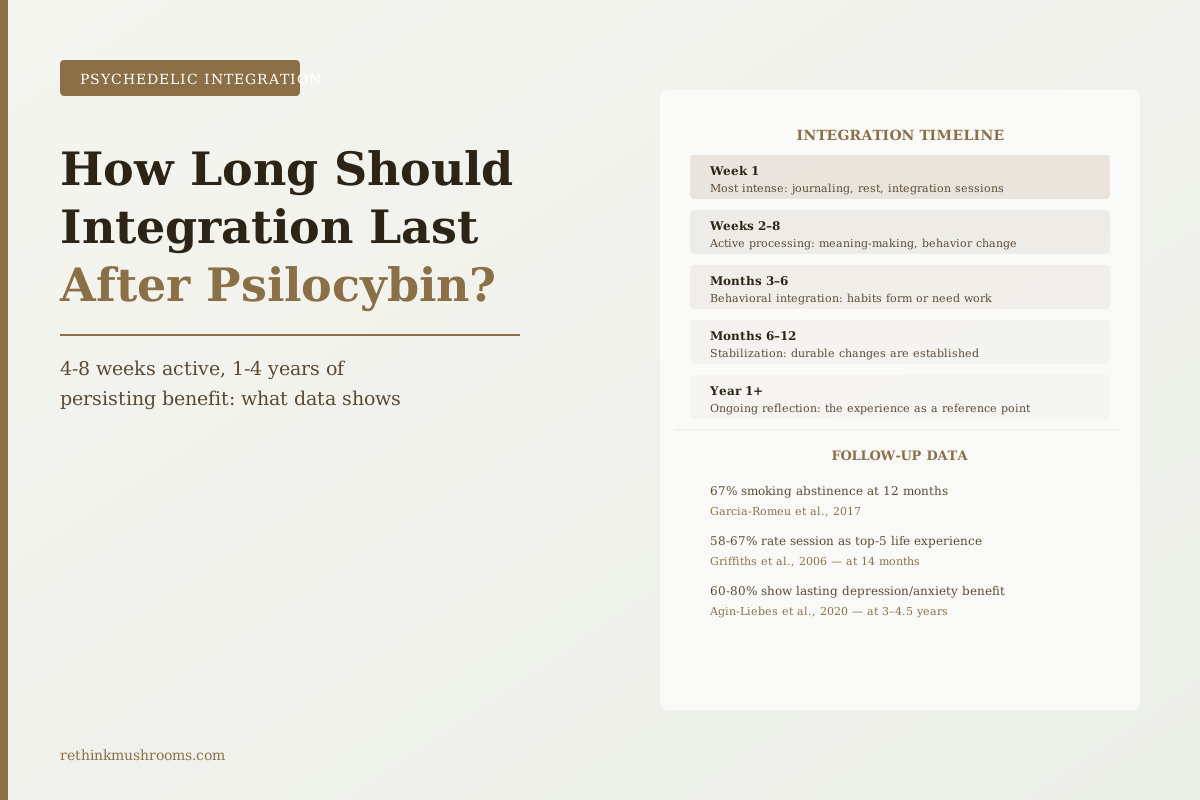
At 3 to 4.5 year follow-up, 60 to 80 percent of cancer patients who received a single psilocybin-assisted therapy session still showed clinically significant reductions in depression and anxiety.[1] In a landmark Hopkins study, 58 to 67 percent of participants rated the session as among the five most personally meaningful experiences of their lives, measured at the 14-month mark.[2] These numbers set the outer boundary of what psilocybin integration actually involves: not a one-month exercise, but a relationship with an experience that can continue shaping a person's life for years.
The timeline in brief: Active integration, the deliberate work of journaling, meaning-making, therapy, or meditation focused on the experience, typically runs 4 to 8 weeks post-session in clinical protocols. But meaningful psychological and behavioral changes from a single session have been documented at 12 months, 14 months, and 3 to 4.5 years in published follow-up studies. The experience's influence does not end with the acute phase; it often deepens with time.
This article answers the duration question with clinical data and explains what happens at each stage of the integration arc. For the broader context on psilocybin safety, including how integration relates to overall therapeutic safety, see how safe is psilocybin: the complete safety research.
Key Takeaways
- Active integration work in clinical protocols typically lasts 4 to 8 weeks post-session, including journaling, therapy sessions, and behavioral practice
- Long-term follow-up studies document clinically meaningful benefits persisting 1 year (Garcia-Romeu 2017), 14 months (Griffiths 2006), and 3-4.5 years (Agin-Liebes 2020) after a single session
- Neurologically, fMRI shows measurable changes in brain network integration persisting at 3 weeks, the neural substrate for why the post-session period matters for consolidating change (Daws et al., Nature Medicine, 2022)
- Psilocybin sessions that produce mystical-type experiences predict better outcomes at follow-up, but only if integration work converts that potential into behavioral and psychological change (Swift et al., 2017)
- Ongoing mindfulness practice during the integration window extends benefits: psilocybin combined with meditation produced significantly better 4-month outcomes than psilocybin alone in an RCT (Smigielski et al., 2020)
- Integration may never feel "complete": Agin-Liebes participants continued rating their session as meaningful years later; ongoing reflection is a feature of a deep experience, not a failure of integration
Why the Post-Session Period Has a Neurological Basis
Before discussing how long integration should last, it helps to understand why the post-session period matters at all. The answer comes partly from brain imaging.
Daws and colleagues used fMRI to image the brains of 43 people before and after psilocybin therapy for depression.[3] Three weeks after the session, their brains showed measurably increased network integration; the brain's previously isolated circuits were communicating more with each other. The participants whose brains showed the most increased connectivity were also the ones whose depression responded best to treatment.
The practical implication is that psilocybin creates a period of heightened neuroplasticity, when the brain's established patterns are temporarily more malleable. The 3-week timepoint in the imaging study is not a ceiling; it is simply when researchers measured. The behavioral and psychological changes associated with this shifted brain state appear to extend far beyond the acute window.
This neurological context is why integration practices during and after the post-session period are not optional add-ons to the pharmacological effect. The brain's increased flexibility during this window creates conditions where deliberate input (therapy, journaling, behavior change) has amplified leverage. The window eventually closes; what was consolidated during it persists.
For the neuroscience of how psilocybin changes brain network connectivity, see psilocybin and the default mode network: how it quiets the ego.
The First Week: The Most Intense Phase of Integration
The week immediately following a psilocybin session is typically described in clinical protocols as the highest-intensity integration period. The experience is recent enough that emotions, imagery, and insights are vivid and accessible. This is also when the neuroplasticity window is at its most open.
Swift and colleagues tracked 20 patients with treatment-resistant depression who received psilocybin therapy, measuring both the quality of the acute experience and the outcomes at follow-up.[5] The quality of the session, specifically whether it included mystical-type features, was the strongest predictor of antidepressant benefit. But this finding also reveals a limit: the experience creates the potential; integration work determines whether that potential is realized.
During the first week, the clinical approach used across most published trials involves:
- Detailed journaling or narrative recording while the experience is vivid
- One or more integration sessions with a therapist or support person
- Reduced external obligations where possible, with intentional rest
- Minimal alcohol, cannabis, or substances that might compete with or blur the post-session state
Research participants in clinical trials often describe this week as emotionally tender: potentially beautiful, sometimes difficult, always significant. The goal in clinical protocols is not to interpret the experience immediately but to create space for it. Meaning emerges over the weeks that follow.
For guidance on specific practices that have the most evidence behind them, see integration best practices: evidence-based approaches. For those without access to professional support, see DIY integration: journaling, meditation, and community.
Weeks 2 to 8: Active Integration and the Work of Meaning-Making
Most clinical integration protocols treat weeks 2 through 8 as the active integration window, the phase when insights begin to crystallize from raw experience into actionable understanding.
Smigielski and colleagues tested what happens when psilocybin is combined with a structured mindfulness retreat, following participants for 4 months.[6] The group that received psilocybin within the meditation context showed significantly higher mindfulness scores, self-compassion, and trait openness at 4-month follow-up compared to placebo. The comparison group that received psilocybin without the structured retreat context showed smaller, less sustained effects.
This finding points toward a practical principle: what happens during the weeks after the session shapes how much of the acute experience's potential is retained. The neuroplasticity window remains partially open during this period, and deliberate engagement with the themes of the experience appears to extend and consolidate the benefit.
In clinical trials, weeks 2 to 8 typically involve:
- Regular integration sessions (usually 1 to 2 per week with a therapist, or structured self-reflection)
- Active engagement with themes from the experience: writing, art, movement, or conversation
- Observation of changes in automatic reactions, relationships, and habitual behaviors
- Gradual implementation of behavioral changes that align with insights (if relevant)
The 8-week boundary is not a hard cutoff. It represents when the most intensive integration work tends to taper in clinical protocols, not when the integration ends.
What the Long-Term Follow-Up Data Shows: Benefits at 1 Year, 14 Months, and Beyond
The most compelling evidence for how long psilocybin integration benefits can last comes from studies that followed participants well beyond the acute period.
12 months (Garcia-Romeu 2017): Garcia-Romeu and colleagues followed 15 smokers who received psilocybin-assisted cessation therapy.[4] At 12-month follow-up, 67 percent remained abstinent from smoking. At an average 16-month follow-up, 60 percent were still not smoking. The integration work involved structured behavioral support between sessions, and the behavioral change persisted well beyond the pharmacological effect.
14 months (Griffiths 2006): In the foundational Johns Hopkins study of psilocybin and mystical experience, 36 healthy volunteers received a high-dose psilocybin session.[2] At the 14-month follow-up interview, 58 to 67 percent rated it as one of the five most personally meaningful or spiritually significant experiences of their lives, and attributed lasting positive changes in attitudes, mood, and behavior to the session. These were healthy volunteers, not patients; the finding suggests psilocybin's long-term impact on meaning, identity, and behavior extends beyond clinical populations.
3 to 4.5 years (Agin-Liebes 2020): The longest published follow-up used the same NYU cancer study population as an earlier report. Agin-Liebes and colleagues conducted interviews 3 to 4.5 years after participants' psilocybin-assisted therapy sessions.[1] Findings:
- 60 to 80 percent still showed clinically significant reductions in depression and anxiety
- 71 to 100 percent continued to rate the experience as one of the most personally meaningful or spiritually significant of their lives
- Many described the session as producing a "fundamental shift" in their relationship to death, meaning, and purpose
These numbers are not benchmarks for what everyone should expect from a psilocybin session. They describe what happened in a specific population (cancer patients with existential distress) who received high-quality therapeutic support. But they establish something important about the timescale: the integration arc for a profound session is measured in years, not weeks.
When Is Integration "Complete"? The Better Question
Clinical researchers rarely use the language of integration being "complete." The Agin-Liebes data shows that participants were still actively meaning-making and attributing positive life changes to a single session 3 to 4.5 years later. Rather than framing this as incomplete integration, researchers described it as evidence that the experience continued functioning as a reference point for personal growth.
This framing resolves the question "when is integration done?" differently than most popular articles suggest. Integration is not a task with a finish line. It is a process of ongoing return to an experience that was, for many participants, among the most significant of their lives. The question shifts from "am I done?" to "am I still learning from this?"
This does not mean the intense work of weeks 1 through 8 is indefinitely sustained. The specific integration practices (daily journaling, weekly therapy sessions, behavioral change implementation) do taper. What persists is not the labor of integration but its fruits: changed relationships, revised values, altered behavioral patterns, and the ongoing availability of the experience as a touchstone.
Clinical researchers who work in integration settings generally distinguish three categories of integration challenge: experiences that were destabilizing enough to require professional support, ambiguous insights that require meaning-making work with a trained guide, and lifestyle integration challenges that can often be addressed through self-directed practice. The first category may require months of professional support. The third category, behavioral and lifestyle integration, can continue indefinitely as circumstances change and life creates new opportunities to apply what was learned.
For the specific question of when professional support is needed versus when self-directed integration is sufficient, see what is integration therapy: how to process a psilocybin experience.
A Practical Integration Timeline
Based on what clinical trials have used and the follow-up data shows, here is how the phases tend to unfold:
Days 1 to 7 (immediate processing): The most emotionally intense and vivid phase. Clinical protocols prioritize journaling, rest, and integration sessions while the experience is fresh. The neuroplasticity window is maximally open.
Weeks 2 to 4 (active processing): Core meaning-making work. Themes from the session become clearer through reflection. Connections to daily life and relationships emerge. Behavioral intentions formed during the session begin to be tested.
Weeks 4 to 8 (consolidation): Insights are tested against real-world experience. Some behavioral changes take hold; others require further work. Therapy sessions or reflection practice continues, though typically less intensively.
Months 3 to 6 (behavioral integration): The period when changes become habitual or when resistance to change becomes clear. Some participants describe this phase as when the "work" of the session fully arrives: the insights are clear, and the question becomes whether they will be acted on.
Months 6 to 12 (stabilization): Behavioral changes that occurred are either stabilized into new patterns or have not yet been integrated. Garcia-Romeu's smoking abstinence data shows that changes persisting to 12 months tend to be durable.
Beyond 1 year (ongoing): The experience remains available as a reference point. Annual or periodic reflection on what changed and what is still changing is described by long-term follow-up participants as meaningful, not burdensome.
For context on how psilocybin's safety profile relates to this extended timeline of effects, see psilocybin's physiological safety: what the data shows and psilocybin is one of the safest recreational substances: the evidence.
The Bottom Line
Active psilocybin integration in clinical protocols typically runs 4 to 8 weeks, anchored by journaling, therapy, and deliberate behavioral engagement. Follow-up data from published trials shows clinically meaningful benefits persisting at 12 months (Garcia-Romeu 2017), 14 months (Griffiths 2006), and 3 to 4.5 years (Agin-Liebes 2020). The neurological basis for this extended window is documented by Daws et al. (2022): psilocybin increases brain network integration, creating a period of heightened plasticity. Integration is not a task that concludes but a process where the intensive work tapers while the benefits and ongoing meaning-making persist for years.
Frequently Asked Questions
Sources & References
- 1. Source details for this reference are not yet available.
- 2. Source details for this reference are not yet available.
- 3. Source details for this reference are not yet available.
- 4. Source details for this reference are not yet available.
- 5. Source details for this reference are not yet available.
- 6. Source details for this reference are not yet available.