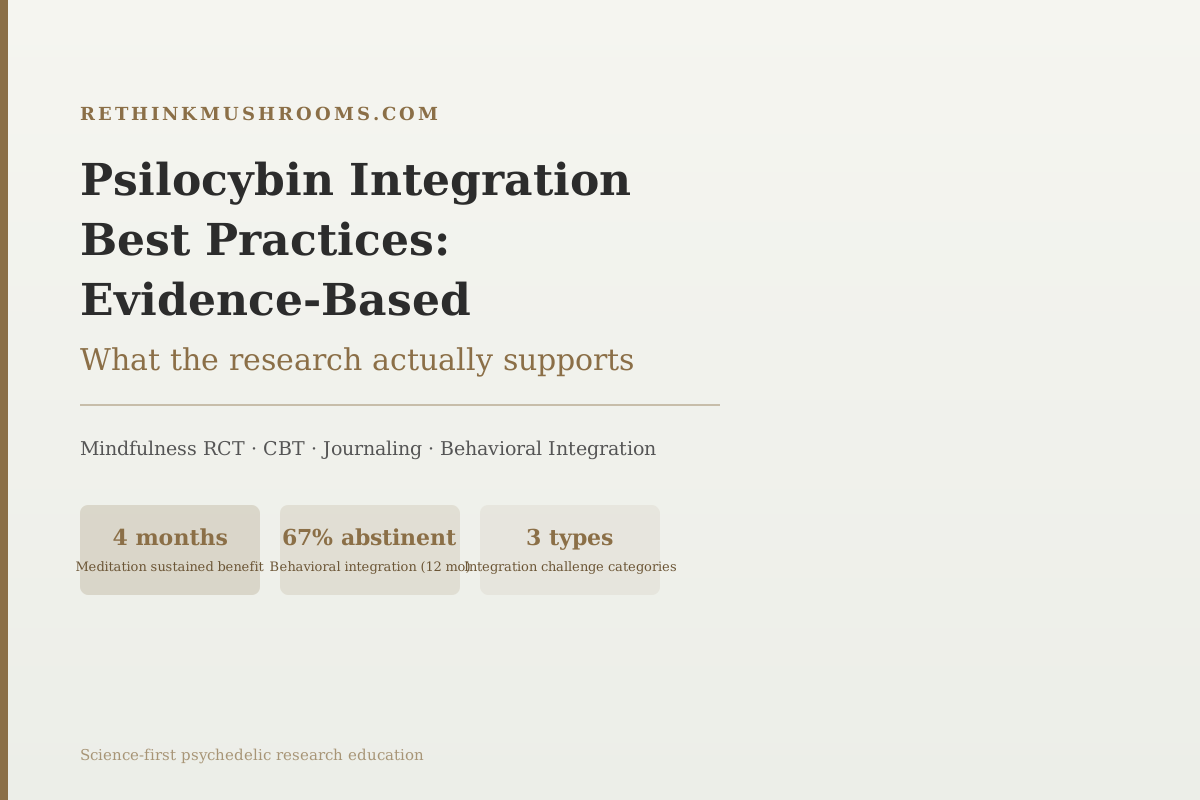
Psilocybin Integration
4 months sustained benefit
Participants who received psilocybin alongside a meditation retreat showed significantly greater increases in mindfulness and self-compassion at 4-month follow-up compared to placebo, providing the strongest evidence that any specific integration practice extends psilocybin's therapeutic window.
Smigielski et al., 2020
CBT + mindfulness
the two therapeutic frameworks with the most clinical support for integration sessions according to a 2023 systematic review, though the review found evidence for specific practices remains limited (Thal et al., Clinical Psychology and Psychotherapy, 2023)
67% abstinent
the proportion of psilocybin-assisted smoking cessation participants who remained smoke-free at 12-month follow-up, demonstrating that structured behavioral integration can produce remarkable and sustained outcomes (Garcia-Romeu et al., 2017)
3 categories
the types of integration complexity identified by Aixalà et al. (2024): destabilizing experiences needing professional support, ambiguous insights needing meaning-making, and lifestyle integration challenges addressable through self-directed practice
Smigielski et al., 2020
 View as image ↗
Most integration guides give you a list of things to do after a psilocybin session: journal, meditate, spend time in nature, talk to a therapist. What they don't tell you is which practices have actual clinical evidence behind them and which are based on reasonable intuition or practitioner tradition without systematic data.
The honest answer is that the evidence base for specific integration practices is thinner than most guides imply. But that doesn't mean nothing is known. A 2023 systematic review identified which approaches have the most research support. One specific practice has randomized controlled trial data showing it extends psilocybin's benefits for at least four months. And real-world follow-up studies show that behavioral integration can produce outcomes that persist for years.
This article gives you the evidence ratings you won't find anywhere else and explains which approach fits which situation.
For the foundational overview of what integration is and why it matters neurologically, see psychedelic integration: making sense of the experience. For the safety context, see how safe is psilocybin: the complete safety research.
Key Takeaways
- A 2023 systematic review of clinical trials found CBT and mindfulness-based approaches have the most evidence for integration sessions, but concluded that 'clinical and experimental research regarding therapeutic conduct in integration sessions is rare' (Thal et al., 2023)
- Mindfulness practice post-psilocybin has the strongest single-practice evidence: an RCT showed psilocybin combined with a meditation retreat produced significantly greater increases in mindfulness and self-compassion at 4-month follow-up vs. placebo (Smigielski et al., 2020)
- The acute experience quality predicts therapeutic outcome, but integration is what converts that potential into lasting change; without it, even high-quality sessions may not produce durable benefit (Swift et al., 2017)
- Aixalà et al. (2024) identified three distinct types of integration challenge requiring different approaches: destabilizing experiences needing professional support, ambiguous insights needing meaning-making frameworks, and lifestyle integration manageable with self-directed practice
- Structured behavioral integration can produce lasting outcomes: psilocybin-assisted smoking cessation produced 67% abstinence at 12 months and 60% at 16 months (Garcia-Romeu et al., 2017)
- No consensus exists on a single optimal integration framework; the choice of approach should match the type of experience and what aspects of life it challenged
Why Practice Quality Matters: The Experience-Outcome Gap
Psilocybin sessions can produce experiences that participants rate as among the most significant of their lives. But the acute experience, however profound, does not automatically translate into lasting psychological change. Something has to happen between the session and the outcome.
Swift and colleagues demonstrated this in 2017: mystical experience quality during the psilocybin session was the strongest predictor of antidepressant efficacy at follow-up in treatment-resistant depression patients.[4] Participants who had deeper, more complete mystical experiences were more likely to show antidepressant benefit months later. But the key word is "predictor," not "cause." A strong experience creates potential for lasting change. Integration is the process that determines whether that potential is actualized.
This is the experience-outcome gap: the thing that distinguishes a session that produces lasting benefit from one that produces an interesting memory. Integration practices are the tools for closing that gap.
What the Research Actually Tested (And Where the Evidence Is Sparse)
Thal and colleagues conducted a systematic review of therapeutic frameworks used in integration sessions in substance-assisted psychotherapy, published in Clinical Psychology and Psychotherapy in 2023.[1] This is the most rigorous review of integration approaches available.
Their conclusion was more honest than most integration guides acknowledge: CBT and mindfulness-based approaches have the most clinical support, but "clinical and experimental research regarding therapeutic conduct in integration sessions is rare." The review found no consensus on an optimal framework and noted that most published guidance is based on clinical tradition rather than controlled trial evidence.
This matters for anyone evaluating integration resources. When an article lists five integration practices with confident recommendations, those recommendations often reflect practitioner experience and reasonable inference rather than RCT data. The distinction is:
High evidence (RCT or systematic review): Mindfulness/meditation practice post-session
Moderate evidence (multiple clinical studies, consistent findings): CBT-informed approaches, structured journaling with prompts, integration circles in clinical contexts
Expert consensus (widely used in clinical practice, plausible rationale, no controlled trials): Somatic work, creative expression, nature immersion, community sharing
Being honest about these evidence levels doesn't invalidate the lower-evidence practices. It means approaching them appropriately: try what resonates, notice what works for you, and don't mistake widespread clinical use for rigorous proof.
| Practice | Evidence Level | Best For | Typical Duration |
|---|---|---|---|
| Mindfulness/meditation | High (RCT) | Extending and consolidating benefit | Ongoing daily practice |
| CBT-informed therapy | High (systematic review) | Restructuring thought patterns from session | 4-12 weekly sessions |
| Structured journaling | Moderate | Meaning-making, capturing insights | Daily in first 1-4 weeks |
| Integration therapy | Moderate | All types, especially complex experiences | 1-4 sessions minimum |
| Somatic work | Expert consensus | Body-based content, trauma themes | Variable; ongoing |
| Integration circles | Expert consensus | Community, sense-making, connection | Weekly or monthly |
Mindfulness and Meditation: The Only Practice With RCT Evidence
Smigielski and colleagues conducted an RCT testing psilocybin in combination with a meditation retreat against placebo plus retreat and placebo alone.[2] The group receiving psilocybin combined with the mindfulness context showed significantly greater increases in mindfulness and self-compassion at 4-month follow-up compared to placebo participants. These improvements were sustained well beyond the acute effects.
The study provides two important insights for integration practice. First, meditation amplifies and extends psilocybin's effect rather than being a separate intervention that happens to be used at the same time. The combination produces something different from either alone. Second, the 4-month timepoint confirms that what you do during the integration window has a measurable effect on how long the benefit persists.
The practical implication: if you start or deepen a meditation practice during the integration period after a psilocybin session, you are working with the strongest available evidence that this approach extends benefit. The specific form of meditation in Smigielski's study was retreat-based mindfulness; whether secular mindfulness apps or less intensive practice produce similar results has not been specifically tested.
For context on the neurological mechanism that makes this integration window important, see psilocybin and the default mode network: how it quiets the ego.
Three Types of Integration Challenge: Matching Approach to Experience
Not all post-session integration needs are the same, and the approach should fit the type of experience.
Aixalà and colleagues' 2024 analysis of integration complexity identified three distinct categories based on what participants actually struggle with:[3]
Destabilizing or challenging experiences. Some sessions include difficult content: confronting trauma, experiencing ego dissolution that felt frightening, or having visions or emotions that remain disturbing afterward. These experiences require professional integration support rather than self-directed practice. Journaling and meditation are insufficient when the content is destabilizing. A trained integration therapist who understands the psychedelic context provides the container needed to process this category of experience safely.
Ambiguous insights requiring meaning-making. Many sessions produce experiences that feel significant but unclear in meaning: a sense that something important happened without knowing what to do with it, images or symbols that don't have obvious interpretations, or emotional shifts without clear cause. This category benefits most from structured meaning-making support: working with an integration therapist or coach, joining an integration circle where shared processing is the explicit purpose, or using systematic journaling prompts that move from description to interpretation to application.
Lifestyle integration challenges. A common third category: the session produced clear insights about life changes (relationship patterns, work, habits, values) but implementing them in real life is difficult. This is where self-directed practice can be most effective. Behavioral change techniques, accountability structures, and community support for implementing specific changes are the appropriate tools here.
Knowing which category your integration falls into helps you direct effort appropriately. Trying to journal your way through a destabilizing experience isn't enough. Seeking out a therapist for a primarily lifestyle-integration challenge may be unnecessary. Matching approach to need is more important than following any single integration protocol.
For situations where trauma is part of the integration challenge, see how psilocybin therapy approaches trauma differently.
Behavioral Integration: What Sustained Change Actually Requires
Garcia-Romeu and colleagues' long-term follow-up of psilocybin-assisted smoking cessation provides the most striking evidence for what behavioral integration can achieve.[5] At 12-month follow-up, 67% of participants who received psilocybin alongside structured smoking cessation behavioral support remained abstinent. At an average 16-month follow-up, 60% were still abstinent. The Varenicline (Chantix) comparison rate is roughly 35% at 12 months.
What makes this finding relevant to integration best practices is what the study actually measured. The participants didn't receive psilocybin and then simply not smoke. They received psilocybin embedded in a structured program that included motivational counseling, cognitive-behavioral techniques, and specific behavioral targets. The integration component was explicit and structured.
This is what "behavioral integration" means in practice: not just reflecting on insights but constructing specific behavioral commitments, tracking progress against them, and using the motivational energy from the session to establish new patterns before that window closes. The research suggests this approach can produce outcomes well above what behavioral therapy achieves without the psilocybin component.
The practical application goes beyond smoking cessation. If the session revealed patterns around exercise, diet, relationships, or work that you want to change, the integration period is the optimal time to set specific targets and begin. The motivational and neuroplasticity window creates conditions that may not persist indefinitely.
How to Know If Your Integration Is Working
There is no validated test for integration progress, but several signals indicate active and productive integration versus stagnation.
Signs integration is progressing: You can describe the experience coherently and with some emotional distance (not overwhelm). You are noticing the themes that appeared in the session recurring in daily life in recognizable ways. You have identified at least one specific change in behavior or perspective that you are actively working on. You feel the experience has added something meaningful to your understanding of yourself or your priorities.
Signs you may need more support: The experience continues to feel destabilizing or frightening weeks after the session. You are having persistent intrusive thoughts or images from the experience. You feel more disconnected from daily life rather than more connected. You are using the session as a reason to avoid rather than engage with important aspects of your life.
The Aixalà 2024 framework is useful here: if you are in the destabilizing category, the signal that you need professional help is clear. If you are in the meaning-making category and feel stuck after several weeks of journaling, an integration therapist can often unlock the process with a different perspective. If you are in the lifestyle category and not making progress on the changes you identified, accountability support (a coach, a circle, a committed friend) may be more useful than more reflection.
For DIY approaches across all three categories with specific journaling prompts and practices, see DIY integration: journaling, meditation, and community. For timeline guidance on how long active integration typically takes, see how long should integration last after psilocybin?.
The Bottom Line
Evidence for specific psilocybin integration practices is more limited than most guides imply. A 2023 systematic review (Thal et al.) found CBT and mindfulness-based approaches have the most clinical support, with research otherwise "rare." The strongest single-practice evidence is for meditation: an RCT showed psilocybin plus meditation retreat produced sustained mindfulness improvements at 4 months (Smigielski et al., 2020). Aixalà et al. (2024) identified three integration categories requiring different approaches: destabilizing experiences (need professional support), ambiguous insights (need meaning-making), and lifestyle challenges (self-directed practice sufficient). Structured behavioral integration can produce remarkable sustained outcomes: 67% smoking abstinence at 12 months when psilocybin was paired with behavioral support (Garcia-Romeu et al., 2017).
Frequently Asked Questions
Sources & References
- 1. Source details for this reference are not yet available.
- 2. Source details for this reference are not yet available.
- 3. Source details for this reference are not yet available.
- 4. Source details for this reference are not yet available.
- 5. Source details for this reference are not yet available.