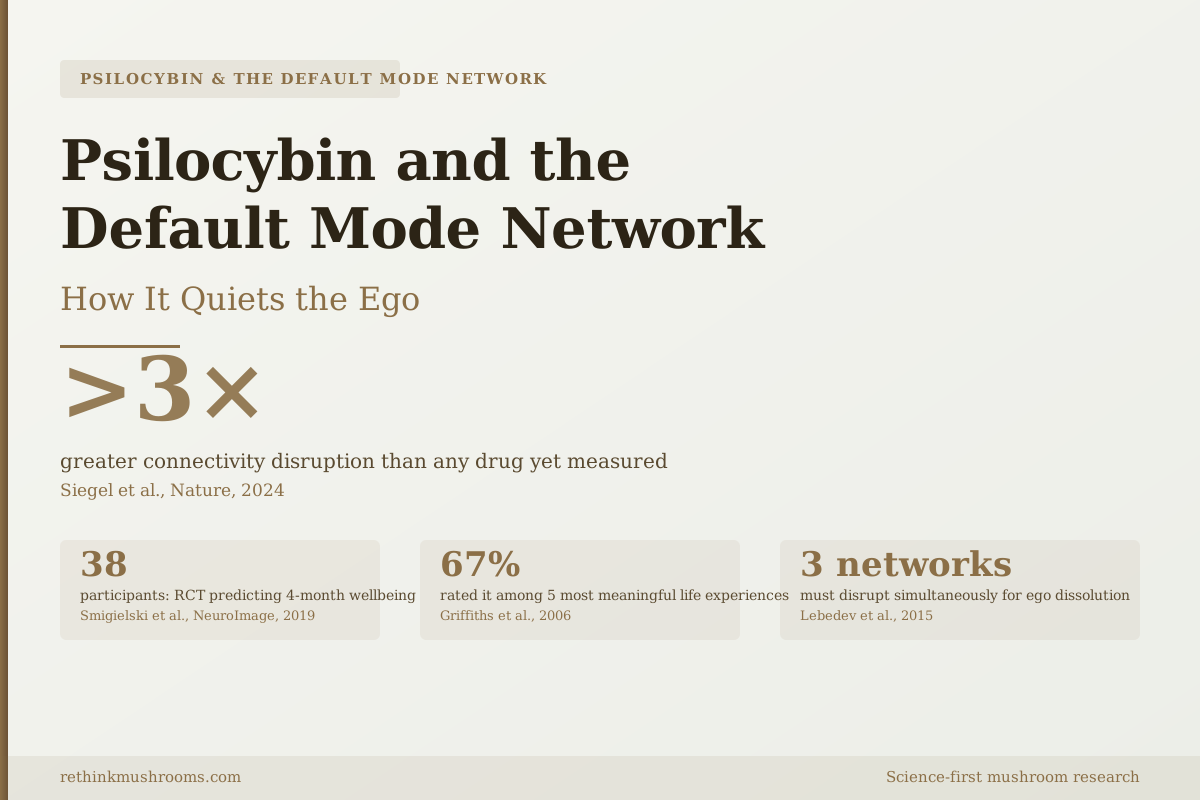
Psilocybin & the Default Mode Network
>3x greater brain desynchronization than methylphenidate (Siegel, Nature, 2024)
A 2024 Nature study found psilocybin disrupts functional connectivity across all brain networks more than three times more powerfully than methylphenidate — with hippocampal-DMN changes persisting for weeks after the experience.
Siegel JS et al., Nature, 2024
38
participants in an RCT where mPFC-PCC decoupling during psilocybin predicted psychosocial wellbeing 4 months later (Smigielski, NeuroImage, 2019)
67%
rated psilocybin among their 5 most meaningful life experiences in the first placebo-controlled trial (Griffiths, Psychopharmacology, 2006)
3 networks
must simultaneously disrupt for ego dissolution to occur — DMN alone is necessary but not sufficient (Lebedev, Human Brain Mapping, 2015)
Siegel JS et al., Nature, 2024
 View as image ↗
In 2024, a team at Washington University published the most comprehensive human brain imaging study of psilocybin ever conducted. The paper appeared in Nature. Their headline number: psilocybin disrupts functional connectivity across the brain more than three times more powerfully than methylphenidate, the gold-standard stimulant comparison drug.[2]
The phrase "psilocybin and the default mode network" has been circulating in popular science for over a decade, ever since early fMRI studies suggested that psilocybin quiets the brain's self-referential hub and dissolves the sense of self. That basic story is correct. But the full picture, assembled from more than a dozen neuroimaging studies spanning 2012 to 2024, is considerably richer than a simple on/off switch. The psilocybin default mode network story turns out to involve at least three separate network systems disrupting simultaneously, a consciousness-gating structure called the claustrum, a receptor-level remodeling whose individual variability predicts lasting mindfulness gains, and a specific neurobiological state that predicts antidepressant outcomes four months after a single session.
Key Takeaways
- A 2024 Nature study found psilocybin caused more than 3x greater disruption to brain functional connectivity than methylphenidate, with hippocampal-DMN connectivity changes persisting for weeks (Siegel et al., n=7)
- In the foundational 2012 fMRI study (two cohorts of n=15 each), the magnitude of mPFC-PCC decoupling under psilocybin directly predicted the intensity of the subjective experience — a dose-response relationship in the brain itself (Carhart-Harris et al., PNAS)
- Ego dissolution requires three simultaneous network disruptions: DMN decoupling, medial temporal lobe-cortex disconnection, and salience network collapse — not DMN suppression alone (Lebedev et al., 2015, n=15)
- In a double-blind RCT (n=38), the extent of mPFC-PCC decoupling during the session predicted positive psychosocial functioning four months later (Smigielski et al., NeuroImage, 2019)
- The therapeutic biomarker for antidepressant response was not DMN suppression alone but global brain integration — the degree to which previously isolated networks began to communicate (Daws et al., Nature Medicine, 2022, n=59)
- In a PET study of 10 healthy volunteers, a single psilocybin dose produced significant increases in Openness and mindfulness at 3-month follow-up; at the individual level, those with greater reductions in 5-HT2AR binding at one week showed greater mindfulness gains — suggesting receptor-level variability may influence lasting effects (Madsen et al., Eur Neuropsychopharmacol, 2020, n=10)
What the Default Mode Network Does (And Why It Is So Hard to Quiet)
The default mode network is a set of brain regions that activate when you are not focused on an external task. The name comes from an observation: these regions are active by default, when you are daydreaming, recalling the past, imagining the future, worrying about a conversation, or constructing a narrative about who you are. Task-focused attention suppresses the DMN. Internal, self-referential thought activates it.
Anatomically, the network is anchored by two principal hub regions. The medial prefrontal cortex (mPFC) handles self-referential thought: it activates when you are thinking about yourself, evaluating whether something is personally relevant, and modeling what other people are thinking. The posterior cingulate cortex (PCC) handles autobiographical memory and self-reflection: it connects current experience to personal history and contributes to the continuous sense of being the same self across time.
These two hubs maintain near-constant communication. When the mPFC and PCC are strongly coupled, the phenomenological result is a coherent sense of self. The "I" that persists through time, that has a past and a planned future, that interprets incoming experience through the lens of an ongoing personal narrative.
This self-model serves essential functions. Human cognition is built on it. The problem emerges when the DMN becomes hyperactive, when the mPFC-PCC circuit gets locked generating repetitive self-referential thought that serves no adaptive purpose. In major depression, the DMN does not merely stay active. It becomes rigid, over-connected, and unable to disengage, generating loops of negative self-evaluation that resist interruption. Rumination, at a mechanistic level, is a hyperactive DMN problem.
A 2023 systematic review by Gattuso and colleagues in the International Journal of Neuropsychopharmacology pooled the neuroimaging literature on how classical psychedelics — LSD, psilocybin, and ayahuasca — modulate the DMN.[12] Across studies, the finding was consistent: psychedelics acutely disrupted resting-state connectivity within the DMN while increasing functional connectivity between canonical resting-state networks that are normally more segregated. The replicated pattern across this body of work establishes the basic relationship: when the DMN's self-referential circuit is disrupted, the brain's network architecture reorganizes — and that reorganization is the substrate the rest of this article unpacks.
The 2024 Nature Paper: Psilocybin Desynchronizes the Brain, Not Just the DMN
Until 2024, most psilocybin neuroimaging studies were methodologically constrained: single scan sessions, limited temporal sampling, modest sample sizes. Siegel and colleagues changed the approach. Using dense-sampling fMRI, with multiple scans across multiple sessions before, during, and after psilocybin, they produced the most detailed mapping of psilocybin's brain effects ever conducted.[2]
The quantitative headline: psilocybin disrupted functional connectivity across all brain networks at more than three times the magnitude of methylphenidate. But the conceptual contribution matters as much as the number. The Siegel team characterized psilocybin's effect not as quieting or suppressing the DMN — language that implies a localized off switch — but as desynchronization. Psilocybin disrupts the coordinated, synchronized activity that normally defines each brain network. The DMN does not go dark. Its temporal structure, the coordinated firing patterns that make it a functional network, breaks down.
This is a meaningful distinction. "Quieting the ego" suggests a reduction in activity. Desynchronization describes something different: a collapse of the normal structured relationship between brain regions, a dissolving of the temporal coordination that constitutes network identity. The networks remain. Their synchrony dissolves.
The Siegel study also identified a lasting effect not previously demonstrated with this clarity: hippocampal-DMN functional connectivity remained decreased for weeks after the psilocybin session ended.[2] The hippocampus, central to memory consolidation and spatial navigation, normally maintains close functional connectivity with the DMN. After psilocybin, that connection stays suppressed. This persistent hippocampal-DMN disconnection is one candidate mechanism for how a single 4-6 hour session produces lasting psychological change. For a closer look at the mechanistic sequence, what happens step by step as the DMN goes offline and what returns in the days after, see what happens when the DMN goes offline.
The 2012 Experiment: Mapping the Ego's Neural Architecture
The current understanding of psilocybin's specific effects on the DMN traces to a 2012 PNAS study by Carhart-Harris and colleagues. It was the first fMRI study to map psilocybin's acute effects on the DMN in humans with sufficient precision to identify specific functional connections. Two separate cohorts of 15 healthy volunteers each were scanned — one with arterial spin labeling and one with BOLD fMRI — using a double-blind crossover design.[1]
The central finding was specific. Psilocybin caused a significant decrease in positive coupling between the mPFC and the PCC. The two principal hubs of the self-referential network decoupled from each other. Critically, the magnitude of that decoupling directly predicted the intensity of the subjective psychedelic experience: more mPFC-PCC disconnection correlated with more profound alteration of consciousness.[1] There was a dose-response relationship in the brain itself: the more the self-referential circuit broke apart, the more intensely the sense of self dissolved.
This established the core mechanistic hypothesis. The continuous sense of self depends on constant dialogue between mPFC and PCC. When psilocybin interrupts that dialogue, the self temporarily dissolves.
What drives the uncoupling? A 2019 PET study by Madsen and colleagues examined the pharmacological mechanism directly in 8 participants, measuring both 5-HT2A serotonin receptor occupancy via PET and plasma psilocin levels alongside subjective psychedelic intensity.[10] Higher receptor occupancy directly correlated with more intense psychedelic effects. Given that 5-HT2A receptors are densely expressed in both the mPFC and PCC, this provides a clean mechanistic chain: psilocin activates 5-HT2A receptors in the DMN's principal hubs, disrupting their synchronized activity, and the mPFC-PCC coupling that normally sustains the sense of self breaks apart.
The upstream story, how 5-HT2A agonism translates into network-level desynchronization at the cellular level, is covered in depth at psilocybin and 5-HT2A receptors.
Ego Dissolution Is Not Just DMN Suppression: Three Networks Go Offline at Once
Here is where the popular science account undersells the science.
In 2015, Lebedev and colleagues studied 15 participants under psilocybin using fMRI, specifically measuring the neural correlates of ego dissolution as quantified on standardized phenomenological scales.[3] Ego dissolution did not correlate with DMN suppression alone. It correlated with three simultaneous and partly independent network disruptions.
First: decreased functional connectivity between the medial temporal lobe (MTL, including the hippocampus) and high-level cortical regions. The hippocampus is central to the construction of autobiographical narrative and the grounding of self in spatial and temporal context. When it decouples from cortex, the self loses its contextual anchoring.
Second: disintegration of the salience network, the system that normally determines what is significant, what deserves attention, and what is self-relevant. When the salience network loses coherence, the normal filtering that flags events as personally meaningful breaks down.
Third: reduced interhemispheric communication, a loosening of the tight temporal coordination between the brain's two hemispheres. The left-right integration that normally sustains a unified subjective experience becomes less rigid.
Ego dissolution, in other words, requires multiple systems to decouple simultaneously. The DMN is central to the story, but the phenomenological sense of self is more distributed than a single network, and psilocybin disrupts all the networks that contribute to it. This helps explain why ego dissolution, when complete, feels as total as it does. It is not one subsystem going offline. It is the coordinated infrastructure of self-experience becoming incoherent across several parallel systems at once.
Mechanism · Ego Dissolution
Ego Dissolution Is Not One Network Going Offline — It Is Three at Once
The popular “DMN off-switch” framing undersells the science. Lebedev et al. (2015) found ego dissolution correlates with three partly-independent disruptions happening simultaneously — the DMN is necessary but not sufficient.
DMN decoupling
The self-referential hub circuit uncouples. The magnitude of mPFC-PCC decoupling tracks the depth of the experience.
Carhart-Harris 2012 (n=30) · Lebedev 2015
Medial temporal lobe ⇄ cortex
The structure that anchors self in autobiographical and spatial context disconnects from high-level cortex.
Lebedev 2015 (n=15)
Salience network collapse
The system that flags what is personally meaningful loses coherence, so the normal self-relevance filter breaks down.
Lebedev 2015 (n=15)
Because three systems must decouple together, full ego dissolution feels total — it is the coordinated infrastructure of self-experience becoming incoherent across parallel systems, not a single switch. Siegel 2024 reframes even the DMN piece as desynchronization, not suppression.
Source: Lebedev et al. (2015); Carhart-Harris et al. (2012); Siegel et al. (2024)
The scientific measurement of ego dissolution was formalized by Nour and colleagues in a 2016 Frontiers in Human Neuroscience paper, which validated the Ego Dissolution Inventory (EDI): an 8-item self-report scale now used across psilocybin trials to quantify the experience on a continuous scale.[13] Its existence as a validated tool matters: ego dissolution is not a loose phenomenological description but a measurable psychological state with specific neural correlates, studied systematically in controlled trials.
For a detailed account of what ego dissolution involves at the neuroimaging level, the dose-response data, and the lasting receptor changes that follow it, see how ego dissolution changes the brain.
When the Brain Gets Quieter, It Gets More Complex: The Entropy Angle
Here is the counterintuitive finding. Psilocybin does not simply reduce brain activity. In 2017, Schartner and colleagues measured MEG brain signals in 15 participants under psilocybin, LSD, and ketamine, all at psychoactive doses, comparing them to placebo.[7]
Psilocybin significantly increased MEG neural signal diversity compared to placebo. Signal diversity is a measure of information complexity: how varied, unpredictable, and rich the brain's electrical activity is from moment to moment. Under psilocybin, the brain became more informationally complex, not less. The neural signal carried more distinct patterns, not fewer.
The theoretical framework that best integrates this finding is the "entropic brain" theory, proposed by Carhart-Harris and colleagues in a 2014 Frontiers in Human Neuroscience paper.[14] The central argument: the normal waking brain operates under significant top-down constraint. The DMN and high-level association cortices impose a structured narrative on experience, filtering the torrent of incoming sensory information through a predictive self-model. This constraint is useful: it produces efficient, goal-directed cognition. But it also limits the range of brain states accessible to conscious experience.
Psilocybin releases this constraint. When the DMN's structured activity breaks down, the brain enters a state with higher entropy: less organized by a top-down self-model, more variable, less predictable, more resembling the "primary" states of consciousness associated with dreaming or early development, and less like the organized, self-referential default mode.
This reframes the story from suppression to liberation. The DMN going offline is not the brain becoming less active or less capable. It is the brain's principal organizing structure becoming temporarily incoherent, and in the absence of that constraint, the rest of the brain generating richer, more varied, more complex activity. The experience of perceptual openness and expanded awareness that characterizes psilocybin may reflect this: not a brain doing less, but a brain doing more, in more dimensions at once.
The full account of what this increased entropy means, and why that might be therapeutically useful, is at how psilocybin increases brain entropy.
The Consciousness Gatekeeper Nobody Talks About: The Claustrum
One of the underreported findings in psilocybin neuroscience involves not the DMN itself but a structure that helps regulate it: the claustrum.
Barrett and colleagues, in a 2020 NeuroImage study of 15 participants, used fMRI to examine how psilocybin affects claustrum connectivity with other brain networks.[9] The claustrum is a thin strip of gray matter tucked between the cortex and the basal ganglia. It does not process sensory information directly. Instead, it coordinates simultaneous activity across large numbers of brain regions, helping synchronize which networks are active at any given moment. Some researchers describe it as the brain's "orchestra conductor" for conscious attention: it keeps the major sensory, attentional, and executive networks in a specific temporal relationship with each other.
Under psilocybin, claustrum connectivity with the DMN was significantly decreased, while effects on fronto-parietal attentional networks were bidirectional: right claustrum connectivity with the fronto-parietal task control network increased, while left claustrum connectivity with that network decreased.[9] When the claustrum's normal coordinating relationships are disrupted in this differentiated way, the tight temporal gating between brain networks loosens. The visual system, auditory system, attentional networks, and self-referential networks exist in a specific relationship maintained by claustrum coordination. When that coordination breaks down, networks that do not normally communicate directly can begin to interact more freely.
This mechanism may explain aspects of the psilocybin experience that don't follow cleanly from DMN suppression alone: synesthesia (sensory modalities blending), the dissolution of the self-world boundary, and the unusual quality of sensory perception under psilocybin. The claustrum finding adds a second mechanistic thread, parallel to and partly independent of the DMN story, that contributes to the full texture of the psilocybin state.
Depression Is a Rigid DMN Problem. Psilocybin Breaks the Loop.
The clinical relevance of psilocybin's DMN effects sharpens considerably in the context of depression.
In treatment-resistant depression, the DMN does not merely stay active. It becomes rigid: the mPFC-PCC circuit that normally generates adaptive self-reflection gets stuck in self-amplifying loops of negative self-evaluation. The network's connectivity becomes excessive and inflexible, producing a brain that cannot easily exit the ruminative state. Psilocybin attacks this specifically.
In 2017, Carhart-Harris and colleagues published an open-label fMRI study of 19 patients with treatment-resistant depression (16 with usable pre- and post-treatment fMRI data) who received two psilocybin doses (10mg and 25mg) one week apart.[5] Acutely, psilocybin decreased cerebral blood flow in the mPFC, the primary DMN self-referential hub, directly confirming the drug's targeting of the depressed DMN. But the more clinically important finding came post-treatment. Post-session fMRI showed increased functional connectivity in these patients, networks that had been rigidly over-connected in the depressed state became more variable, more open, and more communicative with other brain systems. The brain "opened up" after psilocybin.
Daws and colleagues, in a 2022 Nature Medicine paper using fMRI data from the Carhart-Harris NEJM psilocybin trial (n=59), identified the specific biomarker that predicted antidepressant response.[6] It was not DMN suppression per se, but global brain integration: the degree to which networks that had previously been functionally isolated from each other began to communicate. When the DMN's rigid boundaries dissolved, cross-network connectivity emerged, and the degree of that emergence predicted the degree of symptom improvement over the following six weeks. The brain's isolation from itself, the modular rigidity that maintains separate, non-communicating functional networks, appears to be one of depression's structural features. Psilocybin disrupts it.
The contrast with SSRIs is mechanistically instructive. SSRIs modulate serotonin availability chronically, gradually shifting receptor sensitivity over weeks. Psilocybin produces a single massive disruption of DMN connectivity that triggers lasting network reorganization, an acute reset rather than a chronic adjustment. A fundamentally different mechanism producing, in some trials, comparable or superior outcomes. For the full clinical evidence, including the NEJM head-to-head data and the cancer anxiety RCT numbers, see the default mode network and depression.
Why the Mystical Experience Predicts Recovery: Not a Correlation But a Mechanism
In 2006, Griffiths and colleagues at Johns Hopkins published the first double-blind, placebo-controlled RCT of psilocybin, designed to test whether psilocybin reliably occasions complete mystical-type experiences in healthy volunteers. Thirty-six participants received psilocybin (30mg/70kg) or methylphenidate in a crossover design with psychological support provided.[8]
Two months after the session, 67% of participants in the psilocybin condition rated the experience among the five most personally meaningful of their entire lives.[8] A 14-month follow-up study of the same cohort found that 64% of participants indicated the experience had increased their well-being or life satisfaction, and 67% rated it among the five most spiritually significant experiences of their lives.[15] This was not a diffuse positive mood effect. It was a lasting alteration in participants' relationship to their own experience, traceable to a specific type of consciousness produced during a specific neurobiological state.
The controlled study that most directly tested whether the DMN disruption during a session predicts lasting outcomes was Smigielski and colleagues' 2019 NeuroImage RCT. In 38 participants at a five-day mindfulness retreat, randomly assigned to psilocybin or placebo double-blind, the researchers measured fMRI during the session and psychosocial outcomes at four-month follow-up.[4]
The decoupling of the mPFC from the PCC during the psilocybin session predicted positive psychosocial functioning four months later.[4] The depth of ego dissolution during the session, quantified neurobiologically as the extent of mPFC-PCC decoupling, was not merely correlated with lasting benefit. In a randomized controlled trial, it predicted it. The brain state during the session was itself the mechanism of lasting change, not a side effect accompanying some other process.
This is the mechanistic basis for what researchers have called the "therapeutic mediator hypothesis": the subjective qualities of the psilocybin session, the dissolution of self-world boundaries, the sense of unity, the loss of self-importance that characterizes the mystical state, appear to reflect a neurobiological state (multi-network disruption anchored in DMN decoupling) that is itself what produces lasting psychological change. The experience is not a vehicle for the therapy. It is the therapy.
For the full analysis of how specific mystical experience dimensions (Oceanic Boundlessness vs. Dread of Ego Dissolution) each predict outcomes, and how receptor density determines the depth of the mystical state, see DMN disruption and mystical experience.
Why the Effects Last: What Persists After the Session Ends
A single psilocybin session lasting 4-6 hours producing psychological effects that persist for months raises a straightforward question: what neurobiological changes outlast the acute state?
The Siegel 2024 Nature study provides one neuroimaging answer: the hippocampal-DMN connectivity decrease persists for weeks after the session.[2] The hippocampus's normal close functional relationship with the DMN remains attenuated. Given that the hippocampus is central to memory consolidation, contextual learning, and the formation of new associative patterns, this persistent hippocampal-DMN disconnection may facilitate the consolidation of the new psychological perspectives and behavioral shifts that the acute experience makes available. The window stays open longer than the experience itself.
A 2020 PET study by Madsen and colleagues in 10 healthy volunteers provides a receptor-level perspective.[11] They measured 5-HT2A receptor binding in the neocortex at baseline and one week post-dose, and assessed personality and mindfulness at baseline and three-month follow-up. At the group level, 5-HT2A receptor binding did not change significantly one week after psilocybin. However, at the individual level, a post-hoc analysis revealed a significant negative correlation: participants whose 5-HT2AR binding showed greater individual reductions at one week reported greater increases in mindfulness at three months. The study also found significant group-level increases in Openness and mindfulness at three-month follow-up. This suggests that while psilocybin reliably produces lasting improvements in mindfulness, the degree to which individual receptor-level changes contribute to that effect varies — and individual variability in receptor response may be one mechanism through which single-session psilocybin produces lasting psychological change.
The Smigielski 2019 RCT added a third data point at the network level: lasting DMN connectivity changes measured at four-month follow-up correlated with positive psychosocial outcomes.[4] Not just the acute disruption, but the persistent reorganization of how the DMN connects to the rest of the brain, tracked with lasting benefit.
Three converging lines of evidence — hippocampal connectivity, individual receptor variability, and network organization — all pointing to lasting change from a single acute experience. For the full account of these changes and what they imply for neuroplasticity, see psilocybin and neuroplasticity.
What the Popular Narrative Gets Wrong: Important Nuances in the Science
The "psilocybin turns off your ego network" framing is useful shorthand. It is not wrong in its broad strokes. But it is imprecise in ways that matter for understanding the actual science.
First: the DMN does not "turn off." Siegel 2024 characterizes the effect as desynchronization.[2] The DMN's activity becomes incoherent and variable, not absent. The network doesn't go dark. Its temporal structure dissolves.
Second: ego dissolution is not solely a DMN phenomenon. Lebedev 2015 showed it specifically correlates with three simultaneous disruptions beyond DMN decoupling alone: medial temporal lobe-cortex disconnection, salience network disintegration, and reduced interhemispheric communication.[3] The DMN is a necessary background condition, but these three additional network disruptions drive the phenomenological state. Treating "DMN suppression = ego dissolution" as a precise equivalence misses the multi-network nature of the state.
Third: the therapeutic mechanism is not simply DMN quieting. Daws 2022 identified global integration, not DMN suppression, as the biomarker predicting antidepressant response.[6] The therapeutic state involves not just the DMN going offline but other networks coming online in new configurations. The reset, not the suppression, is the mechanism.
Fourth: the ego-DMN equation, while useful, is somewhat indirect. The DMN underlies self-referential cognition, but the phenomenological sense of self, the continuous, embodied, spatially located "I," is a more distributed construction than any single network. Treating "DMN = ego" as a precise identity rather than a useful shorthand can mislead more than it clarifies.
These caveats don't undermine the research. They are what the research actually shows. The science is more interesting, and more complete, than the popular summary.
The Bottom Line
Psilocybin's effects on the default mode network are among the most replicated phenomena in human neuroscience: the drug decouples the mPFC and PCC, the hubs of the self-referential circuit, and the degree of that decoupling predicts both the subjective depth of ego dissolution and, in controlled trials, the lasting psychological benefit. The 2024 Siegel Nature study sharpened this picture considerably, characterizing the effect as whole-brain desynchronization rather than localized DMN suppression, and identifying persistent hippocampal-DMN changes lasting weeks after the session as one structural substrate of the lasting effect. The therapeutic relevance is now mechanistically grounded: global brain integration after DMN disruption is the specific biomarker predicting antidepressant response, and the mystical experience during the session, far from a side effect, appears to be the active mechanism.
Frequently Asked Questions
Sources & References
- 1RTHM-00245·Carhart-Harris, Robin L et al. (2012). “Neural correlates of the psychedelic state as determined by fMRI studies with psilocybin..” Proceedings of the National Academy of Sciences of the United States of America.Study breakdown →PubMed →↩
- 2RTHM-00911·Siegel, Joshua S et al. (2024). “Psilocybin desynchronizes the human brain..” Nature.Study breakdown →PubMed →↩
- 3RTHM-00706·Lebedev, Alexander V et al. (2015). “Finding the self by losing the self: Neural correlates of ego-dissolution under psilocybin..” Human brain mapping.Study breakdown →PubMed →↩
- 4RTHM-01123·Smigielski, Lukasz et al. (2019). “Psilocybin-assisted mindfulness training modulates self-consciousness and brain default mode network connectivity with lasting effects..” NeuroImage.Study breakdown →PubMed →↩
- 5RTHM-00463·Carhart-Harris, Robin L et al. (2017). “Psilocybin for treatment-resistant depression: fMRI-measured brain mechanisms..” Scientific reports.Study breakdown →PubMed →↩
- 6RTHM-00752·Daws, Richard E et al. (2022). “Increased global integration in the brain after psilocybin therapy for depression..” Nature medicine.Study breakdown →PubMed →↩
- 7RTHM-00489·Schartner, Michael M et al. (2017). “Increased spontaneous MEG signal diversity for psychoactive doses of ketamine, LSD and psilocybin..” Scientific reports.Study breakdown →PubMed →↩
- 8RTHM-00096·Griffiths, R R et al. (2006). “Psilocybin can occasion mystical-type experiences having substantial and sustained personal meaning and spiritual significance..” Psychopharmacology.Study breakdown →PubMed →↩
- 9RTHM-00608·Barrett, Frederick S et al. (2020). “Psilocybin acutely alters the functional connectivity of the claustrum with brain networks that support perception, memory, and attention..” NeuroImage.Study breakdown →PubMed →↩
- 10RTHM-00578·Madsen, Martin K et al. (2019). “Psychedelic effects of psilocybin correlate with serotonin 2A receptor occupancy and plasma psilocin levels..” Neuropsychopharmacology : official publication of the American College of Neuropsychopharmacology.Study breakdown →PubMed →↩
- 11RTHM-00635·Madsen, Martin Korsbak et al. (2020). “A single psilocybin dose is associated with long-term increased mindfulness, preceded by a proportional change in neocortical 5-HT2A receptor binding..” European neuropsychopharmacology : the journal of the European College of Neuropsychopharmacology.Study breakdown →PubMed →↩
- 12RTHM-01697·Gattuso, James J et al. (2023). “Default Mode Network Modulation by Psychedelics: A Systematic Review..” The international journal of neuropsychopharmacology.Study breakdown →PubMed →↩
- 13RTHM-00812·Nour, Matthew M et al. (2016). “Ego-Dissolution and Psychedelics: Validation of the Ego-Dissolution Inventory (EDI)..” Frontiers in human neuroscience.Study breakdown →PubMed →↩
- 14RTHM-00579·Carhart-Harris, Robin L et al. (2014). “The entropic brain: a theory of conscious states informed by neuroimaging research with psychedelic drugs..” Frontiers in human neuroscience.Study breakdown →PubMed →↩
- 15RTHM-00250·Griffiths, Roland R et al. (2008). “Mystical-type experiences occasioned by psilocybin mediate the attribution of personal meaning and spiritual significance 14 months later..” Journal of Psychopharmacology.Study breakdown →PubMed →↩