Psilocybin Entropic Brain Theory & REBUS Model
3 Drugs, same result
Psilocybin, ketamine, and LSD all significantly increased spontaneous brain signal diversity in the first direct measurement of neural entropy under psychedelics; a dose-dependent effect correlated with subjective experience intensity.
Schartner et al., Scientific Reports, 2017
3x
greater connectivity disruption than methylphenidate (Siegel 2024, Nature)
1 Month
well-being predicted by entropy at 1-2 hours post-dose
25mg Only
belief revision seen at therapeutic dose, not 1mg (Zeifman 2025)
Schartner et al., Scientific Reports, 2017
 View as image ↗
Psilocybin changes how the brain organizes its own activity. The specific change is an increase in neural entropy: the brain visits more varied patterns of activity, less predictably, than it does during normal waking consciousness. This has been measured directly with three different brain scanning technologies, across multiple research groups, in participants who received psilocybin at psychedelic doses. The consistent finding is that psilocybin brain entropy increases significantly, and the magnitude of that increase appears to matter for clinical outcomes.
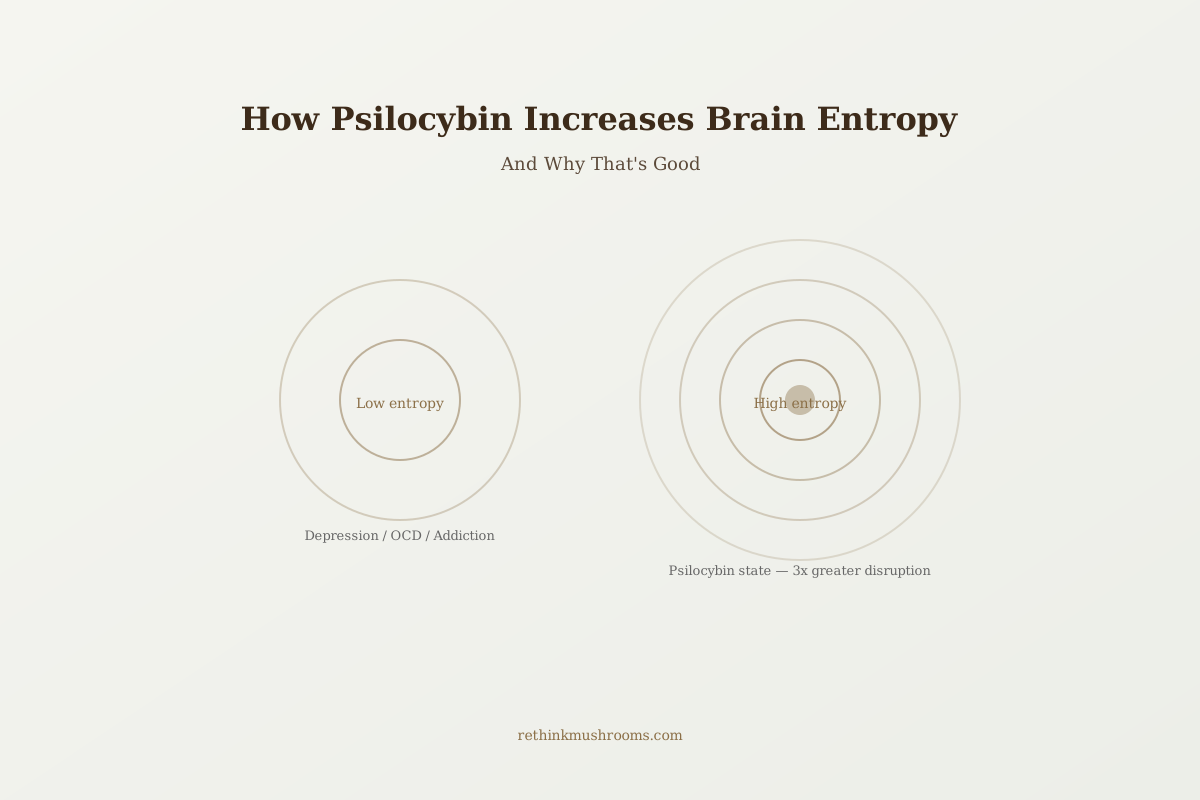
The question of why this is good, rather than simply strange or disorienting, has a research-based answer. The theory that connects brain entropy to mental health proposes that depression, OCD, and addiction all involve brains running in abnormally narrow, rigid activity patterns, and that therapeutic disruption of those patterns enables recovery. The empirical data from three direct entropy studies now test that proposal in different ways. For the full theoretical context, see The Entropic Brain Theory: Robin Carhart-Harris's Framework. The DMN's specific role in this process is covered in the cluster pillar, Psilocybin and the Default Mode Network: How It Quiets the Ego.
Key Takeaways
- Three chemically distinct psychedelics (psilocybin, ketamine, and LSD) all significantly increased spontaneous brain signal diversity (neural entropy) versus placebo in the first direct MEG measurement, with dose-dependent effects correlated with subjective ratings (Schartner et al., Scientific Reports, 2017)
- Psilocybin caused more than 3x greater acute functional connectivity disruption than methylphenidate in the most precise neuroimaging study to date, with entropy increases concentrated in association cortex, the region richest in 5-HT2A receptors (Siegel et al., Nature, 2024)
- The degree of entropy increase at 1-2 hours post-dose predicted better psychological well-being at one month follow-up, establishing a link between acute brain disruption and durable clinical benefit (Siegel et al., Nature, 2024)
- Psilocybin therapy increased global brain integration in two depression trials; this integration increase, correlated with antidepressant response magnitude, was absent after escitalopram treatment (Daws et al., Nature Medicine, 2022)
- The entropy increase during a 25 mg psilocybin session (but not a 1 mg session) correlated directly with decreased confidence in negative self-beliefs, persisting at four weeks post-dose (Zeifman et al., Scientific Reports, 2025)
- The entropic brain theory proposes that depression, OCD, and addiction reflect pathologically low-entropy brain states, making psilocybin-induced entropy increase therapeutically relevant rather than merely pharmacological noise (Carhart-Harris et al., 2014)
3 Ways Psilocybin Increases Brain Entropy
Before going into each study in depth, the snippet version:
-
Desynchronizing normally synchronized brain networks. Siegel et al. (2024) found psilocybin caused more than 3x greater connectivity disruption than methylphenidate in a head-to-head comparison. Normal brain networks have stable, repeating coordination patterns. Psilocybin disrupts those patterns across the whole brain, with the largest effects in association cortex.[1]
-
Increasing MEG signal diversity across multiple psychedelics. Schartner et al. (2017) measured spontaneous neural signal diversity under psilocybin, ketamine, and LSD using magnetoencephalography. All three drugs significantly increased signal diversity versus placebo, in a dose-dependent pattern. The effect was not specific to psilocybin's chemistry: it is a general property of psychedelic-state brains.[2]
-
Producing post-therapy global integration that SSRIs do not. Daws et al. (2022) found that post-psilocybin therapy brains showed increased global integration (reduced functional boundaries between networks). This is the downstream consequence of the acute entropy event: the brain reorganizes into more flexible connectivity after the disruption resolves.[4]
The First Direct Measurement: MEG Signal Diversity Under Three Psychedelics
The question of whether psychedelics actually increase brain entropy in a measurable way, rather than just in theory, was first directly answered in 2017.
Schartner et al. recruited participants who received either psilocybin, ketamine, LSD, or a control condition, then measured their spontaneous brain activity using magnetoencephalography (MEG).[2] MEG captures the weak magnetic fields produced by neural electrical currents and can record brain signal patterns at millisecond resolution, fast enough to measure the moment-to-moment variability that defines entropy.
The measure Schartner's team used was "signal diversity": how varied the MEG patterns are from one moment to the next across the entire recording session. A brain cycling through familiar patterns produces low diversity. A brain exploring an unusual range of states produces high diversity.
All three drugs increased signal diversity relative to control. The increases were statistically significant and not subtle. Psilocybin, ketamine, and LSD each pushed the brain into signal territory that it does not typically visit during normal waking consciousness. The effect was dose-dependent: higher doses produced greater increases in diversity. Subjective experience ratings also correlated with the signal diversity measures, connecting the brain-level measurement to the internal experience.
The cross-drug finding is theoretically important. Psilocybin works primarily through serotonin 2A receptors. Ketamine works through NMDA glutamate receptors. LSD works through a combination of serotonin and dopamine receptors. Three chemically distinct compounds, acting through different receptor systems, all producing the same directional change in brain entropy. This suggests that entropy increase is a general property of psychedelic brain states, not a specific consequence of any one drug's pharmacology.
What "Desynchronizing the Brain" Actually Means
Siegel et al. (2024) published the most precise measurement of psilocybin's entropy effect in Nature, using a method called "precision functional mapping."[1]
Most neuroimaging studies average brain data across many participants, which smooths out individual differences in brain architecture. Siegel's team took a different approach: they spent weeks mapping each of six individual participants' unique brain network structure before any drug exposure, then measured how psilocybin deviated each person from their own individual baseline. This approach yields results that are more interpretable at the individual level than group averages.
Each participant received a single 25 mg psilocybin dose and a 40 mg methylphenidate dose (an active control) in separate sessions, with follow-up imaging six to twelve months later. Methylphenidate was chosen as the control because it is also psychoactive and produces subjective effects, but is not expected to cause the same brain-level changes as psilocybin.
The result: psilocybin caused more than threefold greater disruption to functional connectivity than methylphenidate. The disruption was not confined to any single brain region. It was brain-wide, affecting networks across the cortex and subcortex simultaneously. The largest entropy effects, however, were concentrated in the association cortex: the regions that integrate information across sensory domains, generate abstract thought, and maintain the sense of a continuous self.
This regional concentration has a mechanistic explanation: the association cortex has the highest density of serotonin 2A receptors, which psilocybin activates. The brain regions where psilocybin binds most are the regions that show the greatest entropy increase. The receptor distribution predicts the entropy distribution.
The Theory Behind Why Entropy Increase Helps
Why would disrupting normal brain patterns be therapeutic? The entropic brain theory provides a framework.[3]
Carhart-Harris proposed in 2014 that the brain has an entropy "sweet spot" associated with healthy, flexible functioning. Below that sweet spot (what the theory calls sub-critical states), the brain becomes repetitive, cycling through a limited repertoire of patterns. Depression, OCD, and addiction are sub-critical conditions: the brain is running loops rather than exploring the space of available states.
Above the sweet spot (super-critical), brain activity becomes too chaotic to maintain coherent experience. Psychosis maps to this region of the spectrum. The psychedelic state sits between optimal criticality and super-criticality during the acute experience: highly entropic but not fully disorganized.
The therapeutic hypothesis is that temporarily elevating entropy in a sub-critical brain creates a window during which rigid patterns are disrupted enough to allow new patterns to form. The disruption is not the therapy. It is the condition under which therapy becomes possible, including the psychological processing, belief revision, and new associative connections that may occur during and after a supported psilocybin experience.
For a fuller treatment of the sub-criticality framework and which conditions it maps to, see Entropy and Mental Health: Why a More Flexible Brain Is Healthier.
After Entropy: What Global Integration Looks Like
Siegel et al. (2024) measured entropy during and immediately after the psilocybin session. Daws et al. (2022) measured what happens to the brain in the days and weeks afterward.
Daws et al. combined neuroimaging data from two clinical trials of psilocybin for depression: an open-label trial in treatment-resistant depression, and a double-blind randomized controlled trial comparing psilocybin to escitalopram in major depressive disorder.[4]
In both trials, psilocybin therapy was followed by decreased brain network modularity on post-treatment fMRI. Brain network modularity measures how strictly networks maintain their functional boundaries. High modularity means networks are isolated from each other. Low modularity means cross-network communication is more common. Psilocybin decreased modularity; networks became more globally integrated after treatment than before.
The degree of integration increase correlated with the degree of antidepressant response: more integration, more improvement. The correlation held across both trials, in different patient populations, with different study designs.
The escitalopram comparison: in the second trial, participants in the escitalopram arm also showed depression improvement, but showed no change in brain network modularity. The drug that adjusts serotonin reuptake gradually, producing clinical benefit over weeks, does not produce the network reorganization that follows psilocybin's acute entropy event. The two drugs produce similar symptom trajectories through different brain-level mechanisms.
The Causal Link: Entropy During the Session Predicts Belief Change at 4 Weeks
Siegel et al. showed that acute entropy predicts well-being one month later. Zeifman et al. (2025) went further, measuring whether entropy correlates with a specific mechanism: the revision of negative self-beliefs.[5]
Eleven participants with elevated negative self-beliefs completed a crossover study receiving 1 mg psilocybin (below the threshold for psychedelic effects) and 25 mg psilocybin in separate sessions.
The 25 mg dose produced entropy increases during the session. The entropy increases correlated with a specific behavioral change: decreased confidence in the participants' own negative self-beliefs. This belief confidence decrease was measured during the session and persisted when participants were reassessed at four weeks post-dose.
The 1 mg dose produced none of these effects. No entropy increase, no belief confidence decrease during the session, no lasting change at four weeks. The dose-response pattern (nothing at 1 mg, significant effects at 25 mg) is difficult to explain as a placebo or expectation effect, because participants received both doses in the same study and reported no psychedelic effects at 1 mg.
The entropy-to-belief-change correlation is the closest thing the literature currently has to a mechanistic link: entropy during the session predicted the cognitive outcome (belief revision) that predicted the well-being outcome (improvement at four weeks). This is the chain that connects the brain-level measurement to what the therapy is trying to accomplish.
Is the Entropy Effect Permanent?
The Siegel 2024 study measured brain connectivity at baseline, during the psilocybin experience, and at six to twelve months post-dose. The large acute disruption during dosing did not persist unchanged at follow-up. Individual brain network architecture at six to twelve months was more similar to individual baselines than to the acute disruption pattern.
This is what the theory predicts. The acute entropy increase is not supposed to be permanent. Super-critical brain states are not sustainable. The therapeutic effect is the lasting network reorganization (Daws 2022: decreased modularity) and the belief revision (Zeifman 2025: lower negative self-belief confidence at four weeks) that the acute entropy event enables. The disruption is a window, not a destination.
Whether the lasting network changes eventually revert to baseline is an open question. The Daws 2022 study measured brain changes at one to three days post-treatment. The Siegel 2024 follow-up measured at six to twelve months, by which point network patterns had largely returned toward individual baselines. Whether the antidepressant benefit (which can last months to years in clinical responders) outlasts measurable brain changes is a central open question in the field.
How Psilocybin's Brain Effect Differs From Antidepressants
The clearest empirical comparison comes from the Daws 2022 Nature Medicine study, which directly compared brain imaging data from psilocybin and escitalopram treatment arms.
Escitalopram produces antidepressant effects, but it does not produce the acute entropy event. No high-entropy disruption occurs. No subsequent global integration increase is measurable. The brain changes that correlate with psilocybin's antidepressant response simply do not happen under escitalopram at equivalent clinical effect sizes.
The two drugs address the same symptom (depression) through mechanisms that are measurably distinct at the brain network level. Psilocybin produces a large temporary disruption followed by reorganization. Escitalopram produces gradual chemical adjustment without equivalent network-level effects.
This does not mean psilocybin is definitively superior for all patients or all contexts. The sample sizes are small, escitalopram was compared to a very low dose of psilocybin in the randomized trial, and the populations may not be comparable. But it does mean that describing psilocybin as "working through serotonin like antidepressants" is inaccurate at the mechanistic level. The brain-level data shows that the two treatments produce different kinds of change.
For a full account of the synthesis from theory to clinical mechanism, see The Entropic Brain: How Psilocybin Increases Neural Disorder to Heal. For the clinical outcomes that these brain changes predict, see Psilocybin for Depression: Results from the Largest Clinical Trials.
The Bottom Line
Three direct measurements confirm that psilocybin increases brain entropy: MEG signal diversity increased under psilocybin, ketamine, and LSD (Schartner 2017); psilocybin produced more than 3x greater connectivity disruption than methylphenidate, concentrated in association cortex, with 1-month well-being predicted by entropy at 1-2 hours (Siegel 2024, Nature); and session entropy correlated with decreased confidence in negative self-beliefs persisting at four weeks (Zeifman 2025). After the acute entropy event resolves, brain networks show increased global integration correlating with antidepressant response, absent after escitalopram (Daws 2022, Nature Medicine). Entropy increase appears to be a transitional state, not a permanent condition.
Frequently Asked Questions
Sources & References
- 1RTHM-00911·Siegel, Joshua S et al. (2024). “Psilocybin desynchronizes the human brain..” Nature.Study breakdown →PubMed →↩
- 2RTHM-00489·Schartner, Michael M et al. (2017). “Increased spontaneous MEG signal diversity for psychoactive doses of ketamine, LSD and psilocybin..” Scientific reports.Study breakdown →PubMed →↩
- 3RTHM-00579·Carhart-Harris, Robin L et al. (2014). “The entropic brain: a theory of conscious states informed by neuroimaging research with psychedelic drugs..” Frontiers in human neuroscience.Study breakdown →PubMed →↩
- 4RTHM-00752·Daws, Richard E et al. (2022). “Increased global integration in the brain after psilocybin therapy for depression..” Nature medicine.Study breakdown →PubMed →↩
- 5RTHM-02216·Zeifman, Richard J et al. (2025). “From relaxed beliefs under psychedelics (REBUS) to revised beliefs after psychedelics (REBAS)..” Scientific reports.Study breakdown →PubMed →↩