Psilocybin Entropic Brain Theory & REBUS Model
4 Weeks lasting belief shift
Decreased confidence in negative self-beliefs formed during a 25 mg psilocybin session persisted at four weeks post-dose, correlated with entropy increase during the experience.
Zeifman et al., Scientific Reports, 2025
2 Trials
both showing integration increase, absent with SSRIs (Daws 2022)
1 Month
well-being predicted by entropy at 1-2 hours (Siegel 2024)
DMN + Entropy
ego dissolution correlated with both (Lebedev 2015)
Zeifman et al., Scientific Reports, 2025
 View as image ↗
There is a concept in neuroscience that reframes what mental illness actually is, and it does not require any knowledge of psilocybin to understand. The concept is brain entropy: a measure of how much the brain varies its own activity patterns from moment to moment. A brain that constantly cycles through new patterns has high entropy. A brain that repeats the same narrow set of patterns again and again has low entropy. The surprising finding from a decade of neuroimaging research is that several major psychiatric conditions share a common feature: abnormally low brain entropy, a brain trapped in its own loops.
This framing has implications that extend well beyond psychedelic therapy. It suggests that brain flexibility (the capacity to move between states, to shift perspective, to respond to new information rather than filtering it through existing patterns) is not just a metaphor for psychological health. It is a measurable property of the brain, and it is reduced in conditions that clinicians treat as chemically distinct but that may share a common underlying neurobiology. For the foundational theory behind this, see the article on The Entropic Brain Theory: Robin Carhart-Harris's Framework.
Key Takeaways
- Brain entropy (the unpredictability of neural activity patterns) indexes psychological flexibility; depression, OCD, and addiction are associated with pathologically low-entropy brain states according to the entropic brain theory (Carhart-Harris et al., 2014)
- Ego dissolution under psilocybin correlated with increased brain entropy (BOLD signal diversity) and with deactivation of the default mode network, particularly the PCC and mPFC, providing a mechanistic link between entropy, the sense of self, and therapeutic experience (Lebedev et al., Human Brain Mapping, 2015)
- In 20 patients with treatment-resistant depression, psilocybin therapy decreased amygdala blood flow and increased hippocampal connectivity; both changes correlated with improvement in depressive symptoms (Carhart-Harris et al., Scientific Reports, 2017)
- Psilocybin therapy increased global brain integration in two separate clinical trials, with the integration increase correlating with antidepressant response magnitude; escitalopram produced clinical improvement without any equivalent network reorganization (Daws et al., Nature Medicine, 2022)
- Brain entropy increase at 1-2 hours post-dose predicted better psychological well-being at one month, in the most precise neuroimaging study of psilocybin to date (Siegel et al., Nature, 2024)
- Zeifman et al. (Scientific Reports, 2025) found that 25 mg psilocybin (but not 1 mg) decreased confidence in negative self-beliefs, with that decrease persisting at four weeks post-dose and correlated with entropy increase during the session
What Brain Entropy Actually Means
The word entropy carries mathematical baggage from thermodynamics and information theory, but the concept it captures is intuitive.
Think of a brain's activity as a sequence of states: which regions are active, how active, and in what combinations. A brain with high entropy visits many different states across time. Its next moment of activity is genuinely hard to predict from the current moment. A brain with low entropy is repetitive: knowing the current state tells you a great deal about the next one, because the brain keeps cycling through the same small repertoire.
The technical measure used in brain imaging research is usually signal diversity: how varied the patterns of neural firing are across a recording session. This can be measured with fMRI (blood oxygen-level dependent signal), MEG (magnetic fields from neural currents), or EEG (electrical signal at the scalp). Whichever method is used, the underlying question is the same: how many different states does this brain visit, and how unpredictably does it move between them?
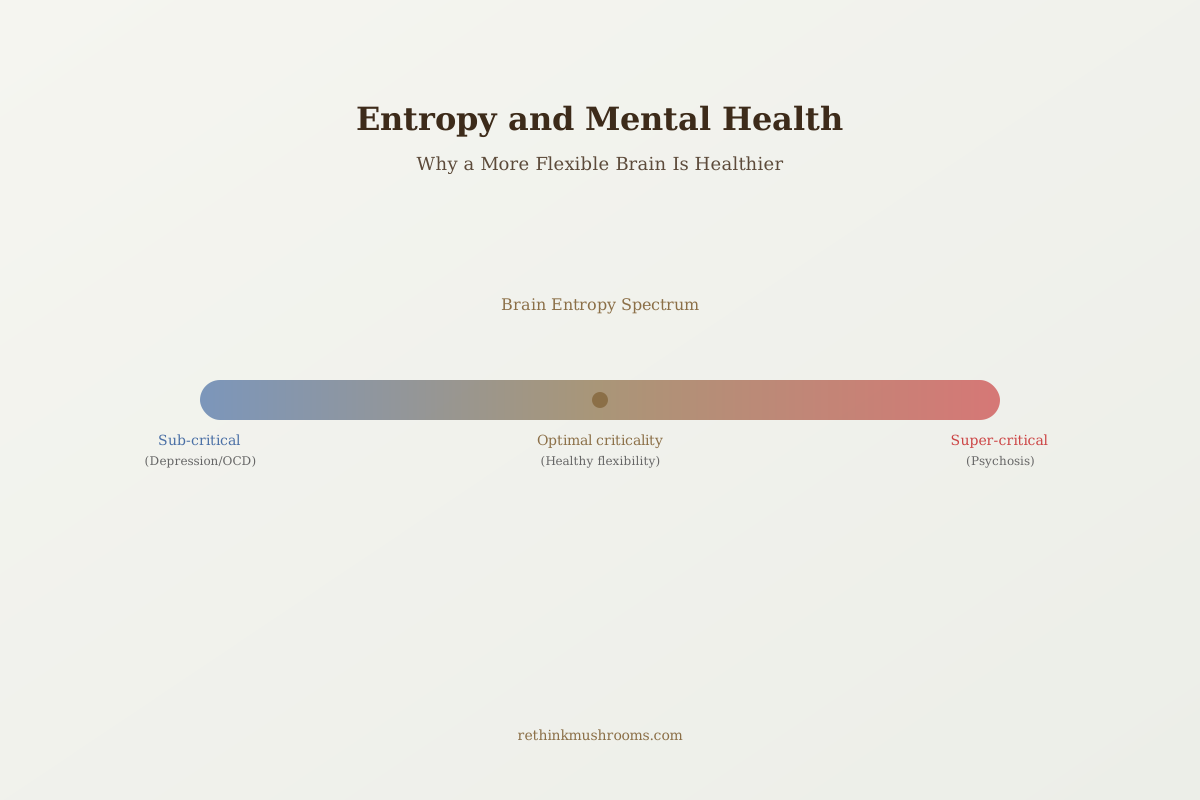
Carhart-Harris's 2014 theory proposed that healthy waking consciousness sits at a "critical point" on the entropy spectrum: complex enough to process the world flexibly, ordered enough to maintain coherent reality-testing.[1] Below that critical point (sub-critical), the brain becomes rigid and repetitive. Above it (super-critical), brain activity becomes too chaotic to maintain coherent experience. The theory named depression, OCD, and addiction as sub-critical conditions, and psychosis as a state of excessive entropy. Psychedelics, on this account, temporarily push sub-critical brains toward and past criticality. This is a therapeutic disruption of an otherwise stuck system.
Which Mental Health Conditions Map to Low Entropy
The sub-critical category is not a vague claim. Each condition the theory identifies has specific neuroimaging evidence of reduced flexibility.
Depression involves what clinicians call rumination: repetitive negative thought loops that persist regardless of external context. Neuroimaging of depressed patients consistently shows an overactive, rigidly connected default mode network, the set of brain regions that generate self-referential thought. The network cycles through familiar negative self-evaluations instead of responding to incoming information. The brain is not stuck randomly. It is stuck in a specific groove.[1]
OCD involves compulsive, repetitive behaviors that the person recognizes as irrational but cannot stop. Neuroimaging shows hyperactivity in cortico-striatal loops, circuits connecting frontal planning areas to deeper motor and habit-formation structures. The brain has locked into a particular response pattern and cannot disengage. This is sub-criticality expressed as behavioral rigidity rather than cognitive rumination.
Addiction involves compulsive approach behavior toward specific stimuli (drugs, alcohol) despite negative consequences. The brain assigns abnormally high value to addiction-related cues and responds to them with near-automatic intensity. Flexibility (the ability to weigh the cue against context and choose a different response) is reduced. Again: fewer available states, more repetitive cycling.
The shared feature is not a shared symptom. It is a shared architecture: a brain that has lost access to parts of its normal state space and is circling the available territory.
How Rigid Thinking Patterns Maintain Themselves
Understanding how sub-critical states persist requires one more framework: predictive coding.[2]
The brain is not a passive recording device. It is constantly generating predictions about incoming sensory information and sending those predictions downward from high-level regions (beliefs, context, prior experience) to low-level regions (raw sensory data). When incoming data matches predictions, the brain suppresses the signal. It is not news. When incoming data violates predictions, a prediction error travels upward and triggers belief updating.
In a flexible, high-entropy brain, this cycle runs openly. Prediction errors get through. Beliefs update in response to experience. The brain remains responsive to its environment.
In a rigidly depressed brain, something different happens. Negative self-beliefs are held with very high "precision." The system has assigned them a high confidence value. Incoming information that might challenge those beliefs is filtered before it can trigger genuine updating. The belief that "things won't improve" prevents the person from noticing evidence that things might improve. The low-entropy state maintains itself partly through the belief structure it has generated.
Carhart-Harris and Friston's REBUS model (2019) proposed that psilocybin interrupts this cycle by temporarily reducing the precision weighting of top-down beliefs. The high-level predictions lose their grip, and prediction errors from lower brain regions (including the limbic system) travel upward more freely. The sub-critical brain is temporarily pushed past its usual operating point, and the beliefs that maintained the sub-critical state can be revised. For a full treatment of this mechanism, see REBUS Model: How Psilocybin Relaxes the Brain's Beliefs.
The Ego-Dissolution Data: When Entropy Increases, the Self Loosens
Lebedev et al. (2015) asked a specific question: what brain changes accompany the experience of ego dissolution under psilocybin?[3]
Ego dissolution is the psilocybin-associated experience of boundaries between the self and the external world becoming indistinct. Participants describe it in different ways: as a feeling that the self has expanded to include everything, or as a temporary absence of the usual "observer" quality of consciousness. It is consistently reported as one of the more therapeutically significant aspects of the psilocybin experience.
Lebedev's team measured ego dissolution scores in participants who received psilocybin and correlated those scores with brain imaging data. The results showed that ego dissolution scores correlated with higher brain entropy (measured as BOLD signal diversity), and with deactivation of specific default mode network hubs: the posterior cingulate cortex (PCC) and medial prefrontal cortex (mPFC). These two regions are the brain's primary generators of self-referential thought, the structures most associated with the sense of being a bounded, continuous self.
This finding connects three things: entropy increase, DMN quieting, and therapeutic experience. When the brain enters a higher-entropy state under psilocybin, self-referential processing in the DMN decreases. The experience of this is ego dissolution. And ego dissolution, in turn, has been associated with the therapeutic outcomes of psilocybin treatment across multiple studies.
For more on the DMN's specific role, see Psilocybin and the Default Mode Network: How It Quiets the Ego.
What Psilocybin Does to Depressed Brains, and Why SSRIs Work Differently
Carhart-Harris et al. (2017) conducted fMRI scans in 20 patients with treatment-resistant depression before and after psilocybin therapy.[4]
The post-treatment scans showed two changes: decreased cerebral blood flow in the amygdala, and increased hippocampal connectivity. Both changes correlated with improvements in depressive symptoms. The amygdala reduction suggests that psilocybin quiets the brain's threat-detection circuitry. The hippocampal connectivity increase suggests greater access to emotional memory and to more flexible associative thinking.
The critical comparison came in the 2022 Nature Medicine study by Daws et al., which combined neuroimaging data from two separate psilocybin clinical trials and compared the brain changes to those produced by escitalopram (an SSRI antidepressant).[5]
Both psilocybin and escitalopram produced antidepressant effects. But only psilocybin produced a change in brain network organization: decreased modularity, meaning networks that normally maintain rigid functional boundaries became more integrated with each other. The degree of that integration increase correlated with the degree of antidepressant response. Escitalopram produced no equivalent network reorganization, despite producing clinical improvement.
This dissociation matters for the entropy framework. SSRIs adjust serotonin availability over weeks. They do not produce the acute entropy event (the temporary disruption of normal brain organization) that the entropic brain theory identifies as the mechanism for lasting pattern change. Psilocybin's clinical benefit, on this account, is not serotonin modulation per se. It is the network reorganization that a controlled episode of high entropy enables.
Entropy at 1-2 Hours Predicts Well-Being at 1 Month
Siegel et al. (2024) published the most technically precise psilocybin neuroimaging study to date in Nature, using individual-specific brain network maps in six healthy adults.[6]
Rather than averaging brain data across participants, the team constructed individualized maps of each person's functional brain network architecture, then measured how psilocybin deviated those networks from their individual baselines. Psilocybin caused more than threefold greater connectivity disruption than methylphenidate (an active control stimulant drug), with the entropy increases concentrated in the association cortex, the high-level regions that integrate information across domains and that generate abstract, self-referential thought.
The finding with direct clinical relevance: the degree of entropy increase measured at one to two hours after dosing predicted better psychological well-being at one month follow-up. The brains that were most disrupted at the peak of the psilocybin experience showed the greatest improvements in well-being one month later. The acute disorder, expressed as brain-level measurement, predicted the therapeutic benefit weeks later.
For a focused treatment of all three entropy measurement studies and the evidence chain they form, see How Psilocybin Increases Brain Entropy (And Why That's Good).
Measuring Cognitive Flexibility Directly: The REBAS Findings
Zeifman et al. (2025) moved from measuring neural flexibility to measuring cognitive flexibility directly: specifically, confidence in self-defeating beliefs.[7]
Eleven participants with elevated negative self-beliefs received both 1 mg psilocybin (below the threshold for any psychedelic effect) and 25 mg psilocybin in a crossover design. The 25 mg dose decreased the participants' confidence in their own negative self-beliefs during the session itself. At four weeks post-dose, that confidence remained lower than baseline. The 1 mg dose produced none of these effects.
The dose-dependent pattern is important. The belief revision did not occur at the sub-psychedelic dose, only at the dose that produces significant entropy increase. This supports the interpretation that entropy increase is part of the mechanism, not a side effect.
The entropy increase during the 25 mg session correlated directly with how much belief confidence decreased. Higher entropy during the session equaled greater belief revision. And greater belief revision at the session equaled better well-being at four weeks.
Zeifman et al. coined the term REBAS (Revised Beliefs After pSychedelics) to describe this extended process. The beliefs are not just temporarily relaxed during the experience. They are lastingly revised. Whether this revision persists beyond four weeks remains unknown, as the study tracked participants only to that timepoint. For durable outcome data, see Psilocybin for Depression: 6-Month and 12-Month Follow-Up Data.
From Correlation Toward Causation
The Entropy Evidence Chain (2015–2025)
No single study proves that entropy increase causes psilocybin’s benefit. The case is built from five studies that each close a different gap — from healthy volunteers, to patients, to a prospective prediction of outcome.
Lebedev et al. — Human Brain Mapping[3]
Healthy volunteers, fMRI (correlational)
Ego-dissolution scores correlated with higher brain entropy (BOLD signal diversity) and with deactivation of the DMN hubs (PCC, mPFC).
Closes the gap: Links entropy to the sense of self and to therapeutic experience
Carhart-Harris et al. — Scientific Reports[4]
20 patients, treatment-resistant depression (open-label)
Post-treatment: decreased amygdala blood flow and increased hippocampal connectivity, both correlating with symptom improvement.
Closes the gap: Brain changes track clinical benefit in patients, not just volunteers
Daws et al. — Nature Medicine[5]
Two clinical trials pooled; escitalopram comparison
Increased global brain integration correlated with antidepressant response. Escitalopram produced clinical improvement with no equivalent network reorganization.
Closes the gap: The reorganization is psilocybin-specific, absent with an SSRI
Siegel et al. — Nature[6]
6 healthy adults, individual-specific network maps
More than threefold greater connectivity disruption than methylphenidate. Entropy increase at 1–2 hours predicted better well-being at one month.
Closes the gap: Acute entropy prospectively predicts the later outcome
Zeifman et al. — Scientific Reports[7]
11 participants, 25 mg vs 1 mg crossover
Session entropy correlated with a decrease in confidence in negative self-beliefs that persisted at four weeks. The 1 mg dose produced neither effect.
Closes the gap: The most direct dose-dependent test of entropy and belief revision to date
The chain is correlational, and the largest samples remain small (6 and 11 participants). It is a convergent, dose-dependent, multi-study pattern — not yet proof of causation.
Sources: Lebedev (2015); Carhart-Harris (2017); Daws (2022); Siegel (2024); Zeifman (2025)
Taken individually, none of these studies proves that entropy increase causes the clinical benefit. Taken together, they form a chain: each one closes a gap the previous one left open, moving from a correlation in healthy volunteers toward a prospective prediction of patient outcomes.
Can You Increase Brain Entropy Without Psilocybin?
The entropic brain theory maps multiple states across the entropy spectrum, and psilocybin is not the only one above normal waking consciousness.
Carhart-Harris's original 2014 paper noted that REM sleep, creative flow states, and some forms of meditation also occupy higher-entropy positions on the spectrum than ordinary alert waking. The brain during REM dream sleep visits unusual, associative patterns of activity that are not constrained by the normal precision-weighted predictions of waking consciousness. Creative states involve access to unusual connections between concepts that are not part of habitual thinking. Certain meditation practices, particularly those aimed at increasing awareness of the present moment over habitual self-narrative, also show measurable changes in default mode network activity.
None of these alternatives produce entropy levels comparable to psilocybin. The Siegel 2024 data showed threefold greater disruption than a stimulant drug, a magnitude of acute entropy increase that no other common experience appears to match. But the spectrum concept itself is useful: it suggests that the goal of mental health interventions is not a fixed chemical state but a range of accessible entropy, the capacity to move upward from sub-critical loops toward flexible, adaptive brain activity.
What Remains Unknown
The entropy framework is a compelling synthesis of evidence from distinct research groups using different methods. Several important limits apply.
The evidence base for sub-criticality in depression, OCD, and addiction comes largely from resting-state fMRI studies measuring functional connectivity rather than direct entropy measures. Translating from "reduced functional connectivity variability" to "brain entropy is low" involves assumptions that the field continues to debate, as Rankaduwa and Owen noted in their 2023 review of entropic brain theory critiques.[8]
The evidence that entropy increase is causally responsible for psilocybin's therapeutic effects (rather than simply correlated with them) is still indirect. The Zeifman 2025 correlation between session entropy and belief revision is the most direct test yet, but it is a correlation in 11 people. The sample needs replication in larger groups before firm causal claims can be made.
Whether the entropy framework applies to anxiety disorders, PTSD, or eating disorders, as the sub-critical model might predict, has not been systematically tested. The current evidence base is concentrated on depression, with some representation of OCD and addiction in the theoretical literature.
For a full account of how the entropic brain connects to neural disorder and healing, see The Entropic Brain: How Psilocybin Increases Neural Disorder to Heal.
The Bottom Line
Brain entropy, meaning the unpredictability of neural activity patterns, appears to be a measurable correlate of psychological flexibility, and low entropy is associated with depression, OCD, and addiction. Psilocybin produces acute entropy increases that predict clinical outcomes across multiple neuroimaging studies: ego dissolution correlates with entropy and DMN quieting (Lebedev 2015); brain integration increases correlate with antidepressant response, absent after SSRIs (Daws 2022, Nature Medicine); acute entropy predicts one-month well-being (Siegel 2024, Nature); and session entropy correlates with belief revision persisting at four weeks (Zeifman 2025). The evidence does not yet establish strict causation, but the dose-dependent, multi-study correlation pattern is consistent with the therapeutic role of entropy increase.
Frequently Asked Questions
Sources & References
- 1RTHM-00579·Carhart-Harris, Robin L et al. (2014). “The entropic brain: a theory of conscious states informed by neuroimaging research with psychedelic drugs..” Frontiers in human neuroscience.Study breakdown →PubMed →↩
- 2RTHM-01038·Carhart-Harris, R L et al. (2019). “REBUS and the Anarchic Brain: Toward a Unified Model of the Brain Action of Psychedelics..” Pharmacological reviews.Study breakdown →PubMed →↩
- 3RTHM-00706·Lebedev, Alexander V et al. (2015). “Finding the self by losing the self: Neural correlates of ego-dissolution under psilocybin..” Human brain mapping.Study breakdown →PubMed →↩
- 4RTHM-00463·Carhart-Harris, Robin L et al. (2017). “Psilocybin for treatment-resistant depression: fMRI-measured brain mechanisms..” Scientific reports.Study breakdown →PubMed →↩
- 5RTHM-00752·Daws, Richard E et al. (2022). “Increased global integration in the brain after psilocybin therapy for depression..” Nature medicine.Study breakdown →PubMed →↩
- 6RTHM-00911·Siegel, Joshua S et al. (2024). “Psilocybin desynchronizes the human brain..” Nature.Study breakdown →PubMed →↩
- 7RTHM-02216·Zeifman, Richard J et al. (2025). “From relaxed beliefs under psychedelics (REBUS) to revised beliefs after psychedelics (REBAS)..” Scientific reports.Study breakdown →PubMed →↩
- 8RTHM-01773·Rankaduwa, Sidath et al. (2023). “Psychedelics, entropic brain theory, and the taxonomy of conscious states: a summary of debates and perspectives..” Neuroscience of consciousness.Study breakdown →PubMed →↩