Psilocybin Antidepressant Duration & Sustained Remission
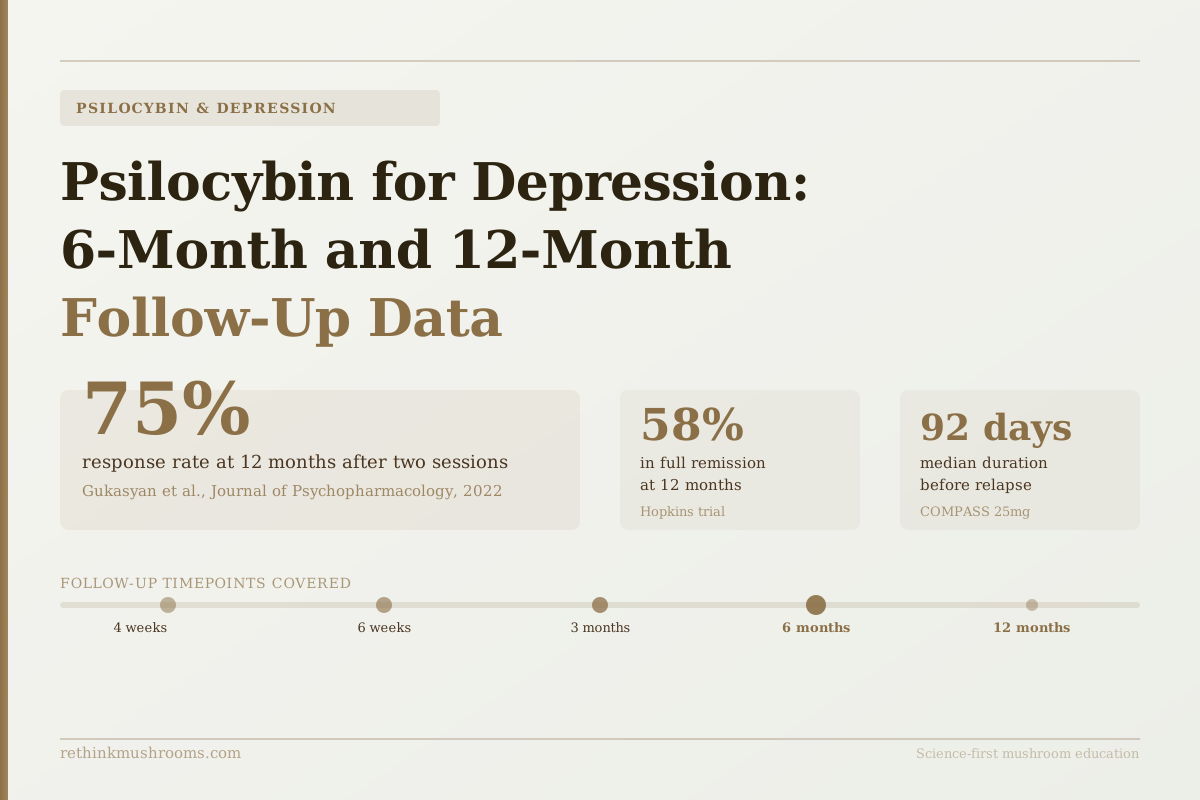
75% response at 12 months
After two psilocybin sessions, three-quarters of participants were still responding to treatment a full year later. Fifty-eight percent met criteria for complete remission.
Gukasyan et al., Journal of Psychopharmacology, 2022
58%
in full remission at 12 months, Hopkins two-session protocol
92 days
median time before relapse on single 25mg dose (COMPASS trial)
6 months
timepoint at which psilocybin outperformed escitalopram on work, social, and meaning measures
Gukasyan et al., Journal of Psychopharmacology, 2022
 View as image ↗
In 2021, Davis and colleagues at Johns Hopkins published a randomized controlled trial showing that two sessions of psilocybin-assisted therapy produced large reductions in depression scores in 27 adults with major depressive disorder. At four weeks, 54% of participants met the threshold for remission.[1] A trial that ends at four weeks answers a specific clinical question. It does not answer the question most people actually have: how long does it last?
The same team spent the next year tracking those participants. In 2022, Gukasyan and colleagues published what they found: 75% of participants were still responding to treatment and 58% were in full remission at 12 months.[2] Separately, a European trial generated its own six-month follow-up data, and a pharmaceutical trial tracked how long a single dose holds before depressive symptoms return. This article synthesizes what those follow-up studies measured, timepoint by timepoint, across the major trial programs.
For a broader introduction to how psilocybin performs in controlled trials for depression, see Psilocybin for Major Depression: The Clinical Evidence. For a consumer-focused overview of the duration question, see How Long Does Psilocybin's Antidepressant Effect Last?.
Key Takeaways
- Davis and colleagues (JAMA Psychiatry, 2021) found 71% response and 54% remission at 4 weeks after two psilocybin sessions in a randomized trial of 27 adults with major depressive disorder[1]
- Gukasyan and colleagues (Journal of Psychopharmacology, 2022) tracked the same participants to 12 months: 75% response rate, 58% remission rate, mean GRID-HAMD score dropped from 22.8 to 7.7 (Cohen's d = 2.4)[2]
- At 6 months, Erritzoe and colleagues (eClinicalMedicine, 2024) found psilocybin and escitalopram produced comparable depression scores; psilocybin patients showed significantly greater improvements in work functioning, social connectedness, and sense of meaning[4]
- In the COMPASS Phase IIb trial (Goodwin et al., NEJM, 2022), a single 25mg dose produced a median 92 days before depressive symptoms returned, versus 62 days for the 1mg comparison dose, in 233 adults with treatment-resistant depression[5]
- Three systematic reviews spanning 2023 to 2025 confirm the antidepressant effect of psilocybin is robust and consistent across trials[6]
- All follow-up data beyond 6 weeks was collected without randomized control groups; the Hopkins and European naturalistic follow-ups reflect what happened to participants after trials ended, not controlled comparisons
What the Follow-Up Studies Actually Tracked
The 6-month and 12-month psilocybin depression data comes from two distinct trial programs, each built on a different initial design.
The Hopkins program started with Davis and colleagues' 2021 randomized controlled trial.[1] Twenty-seven adults with moderate-to-severe major depressive disorder were assigned to begin psilocybin-assisted therapy immediately or wait eight weeks before starting. Each person in the treatment group received two psilocybin sessions (25mg and then 30mg, separated by approximately two weeks) with extensive preparation before each session and integration support afterward. The randomized, controlled portion of the trial ended at four weeks. Gukasyan and colleagues then followed the same participants without a control group for an additional 11 months, collecting data at 3-month, 6-month, and 12-month marks.[2]
The European program started with Carhart-Harris and colleagues' 2021 head-to-head trial published in the New England Journal of Medicine.[3] Fifty-nine adults with moderate-to-severe major depressive disorder were randomly assigned to receive either psilocybin therapy (two sessions, 25mg each) or daily escitalopram (a standard SSRI antidepressant) for six weeks. Three years later, Erritzoe, Carhart-Harris, and colleagues published what had happened to those same participants in the six months following the trial, collected without any ongoing randomized design.[4]
Both follow-up datasets share the same structural limitation: once the formal trial ended, the control group comparison ended with it. What the researchers measured was the natural course of outcomes in people who had received psilocybin. Whether those outcomes were different from what would have happened without treatment is no longer answerable from the follow-up data alone.
A third data source adds a different kind of durability evidence. Goodwin and colleagues enrolled 233 adults with treatment-resistant depression in the COMPASS Phase IIb RCT, testing a single dose of synthetic COMP360 psilocybin at 25mg, 10mg, or 1mg, then tracking them for relapse.[5] This trial did not publish fixed-timepoint response rates. Instead, it reported median time to depressive event, which allows a different kind of durability calculation.
The Data at a Glance
The table below consolidates the primary outcomes from the major follow-up datasets. Response means a 50% or greater reduction in depression rating scale scores from baseline. Remission means a score falling below the threshold for mild depression.
| Timepoint | Study | Participants | Response | Remission | Key Finding |
|---|---|---|---|---|---|
| 4 weeks | Davis et al., JAMA Psychiatry, 2021 | n=27 | 71% | 54% | Randomized comparison with wait-list control; both rates established with a control group |
| 6 weeks | Carhart-Harris et al., NEJM, 2021 | n=59 | Not separately reported | Not separately reported | Comparable to escitalopram on primary depression measure; psilocybin better on secondary well-being outcomes |
| 3 months | Gukasyan et al., J Psychopharmacology, 2022 | n=24 | Not separately reported | Not separately reported | Cohen's d = 2.0; large effect sustained well below baseline; no control group |
| 6 months | Erritzoe et al., eClinicalMedicine, 2024 | n=59 | Not separately reported | Not separately reported | Depression scores comparable to escitalopram; psilocybin significantly better on work functioning, social connectedness, and meaning |
| 12 months | Gukasyan et al., J Psychopharmacology, 2022 | n=24 | 75% | 58% | GRID-HAMD: 22.8 to 7.7; Cohen's d = 2.4; no control group |
For a focused breakdown of these numbers month by month, see Psilocybin's Antidepressant Effect at 3, 6, and 12 Months.
At 4 Weeks and 6 Weeks: The First Signs the Effect Was Real
The Davis 2021 trial was designed to test whether psilocybin-assisted therapy works for major depressive disorder, not specifically how long it lasts. The four-week primary endpoint fell within the randomized, controlled portion of the study, so the results have a comparator: 71% response and 54% remission in the psilocybin group versus significant continued depression in participants still waiting for treatment.[1]
The four-week numbers matter because they are the last data collected with a control group still in place. Everything after that is naturalistic observation. The fact that those same 24 completers showed 75% response at 12 months means the effect held or slightly improved over time. But it also means the 12-month number has no comparator to help separate psilocybin's specific contribution from recovery that might have occurred anyway.
At six weeks, the Carhart-Harris 2021 NEJM trial told a more complicated story.[3] On the primary endpoint, a self-reported depression scale called the QIDS-SR16, psilocybin therapy was not significantly different from escitalopram. The trial had not been designed or powered to show superiority over an active antidepressant at this timepoint, and it didn't. On secondary measures (emotional well-being, connection to other people, sense of meaning, range of positive feelings), psilocybin participants showed larger improvements. Secondary outcomes from underpowered trials require careful interpretation. What they set up, though, was the six-month Erritzoe follow-up that would later test whether those differences persisted.
At 3 Months: Holding Without Continued Treatment
After the randomized portion of the Hopkins trial ended, participants received no additional psilocybin and no ongoing structured psychotherapy. Gukasyan and colleagues measured their depression scores at three months and found an effect size comparing current scores to baseline of Cohen's d = 2.0.[2]
An effect size is a standardized way of expressing how large a difference is, independent of the scale used. An effect size of 0.8 or above is conventionally called "large" in psychiatric research. An effect size of 2.0 means the average treated participant's score was two full standard deviations below where they started, equivalent to a far greater separation than most antidepressant medications produce in meta-analyses, where pooled effect sizes typically fall in the 0.3 to 0.5 range. Whether this translates to better real-world outcomes for a broader population is a separate question from whether the effect held in these 24 Hopkins participants, which it clearly did.
The COMPASS trial adds important context for the three-month timepoint. In 233 adults with treatment-resistant depression who received a single COMP360 dose, the 25mg group had a median time to first depressive event of 92 days, compared to 62 days for the 1mg comparison dose.[5] Ninety-two days is just over three months. The "median" is critical here: half of the 25mg participants had already experienced a return of depressive symptoms within that time; half had not. The COMPASS population had treatment-resistant depression, a generally more difficult-to-treat group than the MDD participants in the Hopkins trial. Direct comparison across studies with different populations, protocols, and outcome measures is not straightforward. But the COMPASS data suggests that at three months, for a meaningful portion of people, the durability question becomes relevant.
At 6 Months: Where Psilocybin Outperformed an SSRI on Wellbeing
The Erritzoe 2024 six-month follow-up is the most practically important finding in the duration literature, and the most underreported piece of the long-term psilocybin data.[4]
When Carhart-Harris and colleagues ran the original 2021 NEJM trial, psilocybin and escitalopram produced similar depression scores at six weeks. The secondary outcomes (well-being, meaning, emotional range) suggested something distinct about psilocybin's effect, but the trial wasn't powered to confirm them. Three years later, Erritzoe and colleagues contacted the same 59 participants and collected six-month naturalistic follow-up data on what had happened since the trial ended.
The finding on depression symptom scales: the two groups were still comparable at six months. On its face, this says psilocybin did not outperform escitalopram over time. What Erritzoe and colleagues also measured told a different story. On work and social functioning, emotional connectedness, and sense of meaning and purpose in life, the psilocybin group showed significantly greater sustained improvements than the escitalopram group.
The distinction is not subtle. Standard depression rating scales measure whether depressive symptoms are present: low mood, sleep disruption, reduced appetite, cognitive slowing, feelings of worthlessness. They are not designed to measure whether someone is engaged in their relationships, finding meaning in their work, or feeling emotionally alive. At six months, those dimensions had diverged between the two treatment groups. Symptom scores were similar. The broader functional and existential measures were not.
This finding has a biological basis. Psilocybin disrupts rigid, self-focused patterns of brain activity that are associated with depression, particularly in the brain's default mode network, the set of regions that activate during self-referential thinking and rumination. For more on how that mechanism works and why it may produce effects that outlast the drug itself, see Psilocybin and the Default Mode Network: How It Quiets the Ego. For a direct comparison of psilocybin's and SSRIs' mechanisms of action, see How Psilocybin Treats Depression Differently Than SSRIs.
Also at six months, the Hopkins participants showed an effect size of Cohen's d = 2.6 from baseline, slightly higher than the 2.4 observed at 12 months.[2] The six-month point may represent the peak of the observed antidepressant effect in this cohort, with a modest decline between six and twelve months.
At 12 Months: 75% Still Responding, 58% Still in Remission
The Gukasyan 2022 twelve-month data is the most cited evidence on psilocybin's long-term antidepressant effects, and worth reading carefully.[2]
Twenty-four participants completed the 12-month assessment. They had started with a mean score of 22.8 on the GRID-HAMD, a clinician-administered depression scale where scores above 17 indicate moderate-to-severe depression. At 12 months, the mean score was 7.7. A score of 7 or below is the threshold the researchers used to define remission. The Cohen's d comparing these two scores was 2.4.
Response, defined as a 50% or greater reduction in GRID-HAMD from baseline, was achieved by 75% of completers at 12 months. Remission, defined as a score of 7 or below, was achieved by 58%.
Compare those rates to the four-week numbers from the same participants: 71% response, 54% remission. The 12-month rates are slightly higher. This is unusual for antidepressant treatments, where response typically peaks in the first months after treatment and then gradually declines once treatment ends. The researchers note that this pattern may partly reflect selection: participants who were doing well enough at 12 months were more likely to remain engaged in the study and less likely to have sought other treatments that might complicate interpretation.
What Three Systematic Reviews Found
Individual trials can produce results that are specific to their population and protocol. What do the pooled analyses say?
Perez and colleagues published a systematic review and dose-response meta-analysis in European Neuropsychopharmacology (2023), finding robust antidepressant effects across the psilocybin trials reviewed and identifying a dose-response relationship: larger doses produced larger and more durable effects.[6] This is consistent with the clinical trial data, where 25mg and 30mg doses produced substantially larger effects than lower doses.
A 2024 systematic review and meta-analysis confirmed significant and clinically meaningful reductions in depression symptoms across multiple psilocybin trials, with pooled effect sizes across available follow-up timepoints that are consistent with the individual Hopkins and COMPASS findings.[7]
The most current synthesis used a network meta-analysis design, which allows comparison across trials with different comparators and designs by treating all available studies as nodes in a common network.[8] This 2025 analysis of all major randomized placebo-controlled psilocybin trials for major depressive disorder confirmed that evidence for efficacy across doses is robust, that higher doses produce the most favorable outcomes, and that the overall direction of evidence is consistent across the available literature.
For the purpose of interpreting the 6-month and 12-month data: the pooled meta-analysis effect sizes are consistent with the Hopkins single-study results. The 75% response and 58% remission numbers from Gukasyan 2022 are striking, but they are not outliers relative to what the broader literature shows for psilocybin.
Why These Numbers Need Context
The 12-month data is genuinely striking. It also comes with caveats that most coverage omits.
Small sample size. The Hopkins 12-month study had 24 completers. Single-study results from 24 participants, collected without a control group, cannot establish causal effects with the certainty of a large RCT. Effect sizes from small studies are also more variable, which means the true population effect could be meaningfully lower than what this study found.
No long-term control group. The randomized design ended at four weeks. After that point, the question "how much of this improvement is attributable to psilocybin versus time, the therapeutic relationship, expectation effects, or natural recovery?" has no controlled answer. Depression has a natural course that includes periods of spontaneous improvement. Long-term observational data cannot fully isolate treatment effects from recovery that might have occurred regardless of treatment.
The therapy is inseparable from the drug. Participants in the Hopkins trial received multiple preparatory sessions with trained therapists, had therapists present throughout each psilocybin session, and attended integration meetings afterward. What Gukasyan 2022 measured was the outcome from psilocybin-assisted psychotherapy as a complete package. How much of the 12-month result is attributable to the drug, the therapeutic context, or the combination cannot be determined from this design. For a look at what individual predictors within that experience are associated with lasting remission, see Sustained Remission After Psilocybin: What Predicts It?.
Population matters. The Hopkins trial enrolled adults with moderate-to-severe major depressive disorder who were not treatment-resistant. The COMPASS trial enrolled treatment-resistant depression patients and found a shorter median durability (92 days for 25mg). These populations likely differ in ways that affect treatment response. How the Hopkins durability numbers would look in a broader or more treatment-resistant population is an open question.
For a direct examination of whether one session is enough or whether multiple sessions improve outcomes, see Do You Need Multiple Psilocybin Sessions for Lasting Depression Relief?.
The Bottom Line
The strongest follow-up evidence for psilocybin-assisted therapy for depression comes from two trial programs. In the Hopkins two-session protocol, 75% of participants were still responding and 58% were in full remission at 12 months, with an effect size that held or slightly improved from the 4-week through 12-month timepoints. In the European escitalopram comparison, psilocybin and the SSRI produced comparable depression symptom scores at 6 months, but psilocybin patients showed significantly greater improvements in work functioning, social connectedness, and sense of meaning. Both 6-month and 12-month datasets were collected without control groups, from small samples, after their respective trials formally ended. Three systematic reviews confirm the direction of evidence is consistent across the broader psilocybin literature, but the Hopkins numbers in particular should be read as strong preliminary evidence rather than a settled estimate of what most people with depression can expect.
Frequently Asked Questions
Sources & References
- 1RTHM-00682·Davis, Alan K et al. (2021). “Effects of Psilocybin-Assisted Therapy on Major Depressive Disorder: A Randomized Clinical Trial..” JAMA psychiatry.Study breakdown →PubMed →↩
- 2RTHM-01529·Gukasyan, Natalie et al. (2022). “Efficacy and safety of psilocybin-assisted treatment for major depressive disorder: Prospective 12-month follow-up..” Journal of psychopharmacology (Oxford.Study breakdown →PubMed →↩
- 3RTHM-00675·Carhart-Harris, Robin et al. (2021). “Trial of Psilocybin versus Escitalopram for Depression..” The New England journal of medicine.Study breakdown →PubMed →↩
- 4RTHM-01887·Erritzoe, David et al. (2024). “Effect of psilocybin versus escitalopram on depression symptom severity in patients with moderate-to-severe major depressive disorder: observational 6-month follow-up of a phase 2, double-blind, randomised, controlled trial..” EClinicalMedicine.Study breakdown →PubMed →↩
- 5RTHM-00761·Goodwin, Guy M et al. (2022). “Single-Dose Psilocybin for a Treatment-Resistant Episode of Major Depression..” The New England journal of medicine.Study breakdown →PubMed →↩
- 6RTHM-01764·Perez, Natacha et al. (2023). “Psilocybin-assisted therapy for depression: A systematic review and dose-response meta-analysis of human studies..” European neuropsychopharmacology : the journal of the European College of Neuropsychopharmacology.Study breakdown →PubMed →↩
- 7. Source details for this reference are not yet available.
- 8. Source details for this reference are not yet available.