Psilocybin & Depression
71% response rate
In the first randomized clinical trial of psilocybin therapy specifically for major depressive disorder, 71% of participants responded and 54% achieved full remission at 4 weeks from just two treatment sessions.
Davis et al., JAMA Psychiatry, 2021
25mg
Identified as the optimal dose in a 2025 network meta-analysis of all psilocybin RCTs for MDD (Swieczkowski 2025)
233 patients
Enrolled in the Phase 2b COMP360 trial, confirming dose-response before Phase 3 (Goodwin 2022)
13 studies
Peer-reviewed trials and meta-analyses examined in this analysis
Davis et al., JAMA Psychiatry, 2021
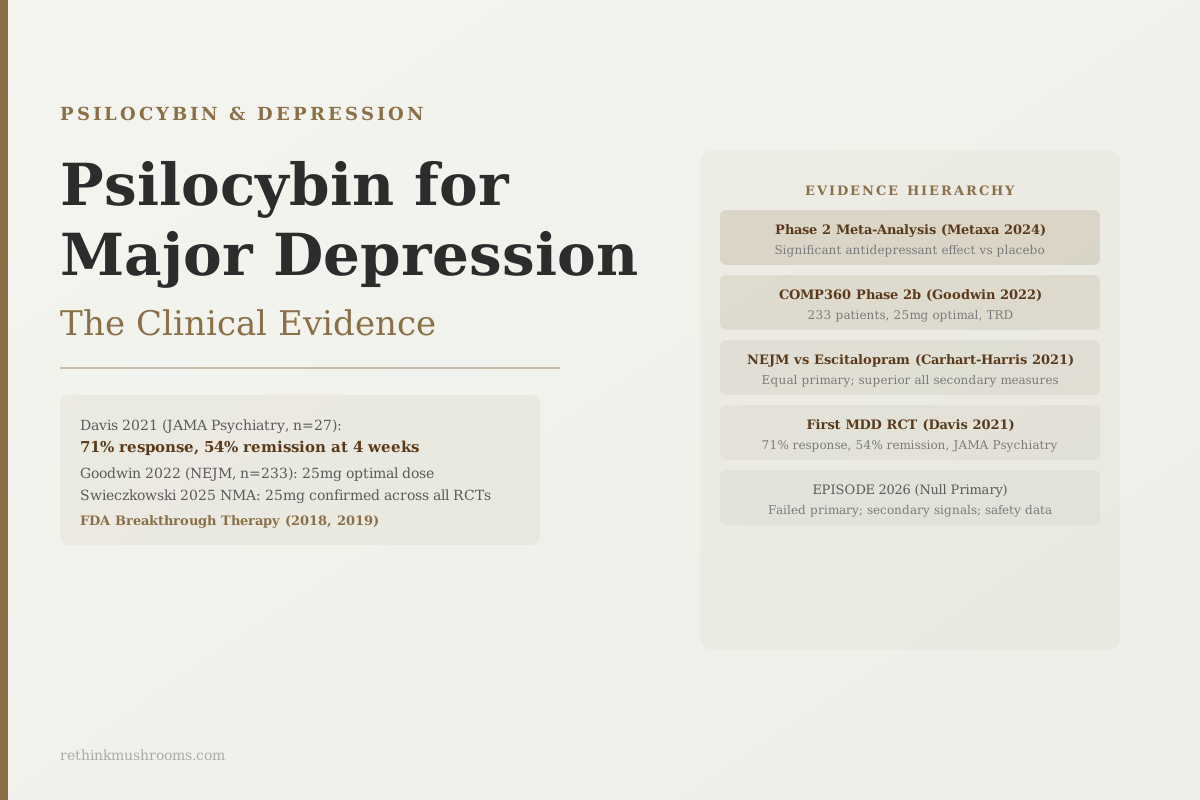 View as image ↗
Psilocybin is a naturally occurring compound in certain mushroom species that activates serotonin receptors in the brain, particularly the 5-HT2A receptor. For most of the twentieth century its clinical potential was untested. Since 2017, a series of randomized trials has changed that.
Here is what the clinical evidence for psilocybin in major depression actually says: psilocybin is a compound that activates serotonin 2A receptors in the brain and is under clinical investigation as a treatment for major depressive disorder. Phase 2 randomized trials show response rates of 54-71%, with antidepressant effects lasting up to 12 months from one or two sessions. A 2024 meta-analysis confirmed significant antidepressant effects versus placebo across trials. A 2025 dose-response network meta-analysis, which pooled results from multiple RCTs simultaneously, identified 25 milligrams as the optimal dose for treating MDD.[1][2]
That is the headline. What matters beyond the headline is the full evidence hierarchy: where those numbers come from, how large and well-designed the trials were, what happened when a larger trial used an active placebo and got a different result, and what the safety data shows across all trials combined.
Key Takeaways
- A 2024 BMJ meta-analysis confirmed psilocybin significantly reduces depression symptoms versus placebo across Phase 2 RCTs, with effect sizes described as clinically meaningful (Metaxa et al., 2024)
- The first randomized clinical trial for major depressive disorder (not cancer anxiety or treatment-resistant depression) found a 71% response rate and 54% remission at 4 weeks using two doses of 20mg and 30mg psilocybin with psychotherapy support (Davis et al., JAMA Psychiatry, 2021)
- A 59-person NEJM trial found psilocybin equaled escitalopram (Lexapro) on the primary depression measure but was superior on every secondary measure, including emotional wellbeing, anhedonia, and psychological connectedness (Carhart-Harris et al., NEJM, 2021)
- A 233-patient Phase 2b trial confirmed a dose-response relationship: 25mg was significantly more effective than 10mg and substantially more effective than 1mg in treatment-resistant depression (Goodwin et al., NEJM, 2022)
- A 2025 network meta-analysis comparing all psilocybin RCTs simultaneously identified 25mg as the optimal dose, with greater efficacy than 10mg at comparable tolerability (Swieczkowski et al., 2025)
- The EPISODE 2026 trial failed its primary endpoint but showed meaningful secondary outcomes, illustrating the challenge of trial design in psychedelic research, including the active placebo problem (Mertens et al., JAMA Psychiatry, 2026)
The Current Evidence Summary: What Meta-Analyses Confirm
Meta-analyses sit at the top of the evidence hierarchy because they pool results from multiple individual trials, reducing the risk that any one trial's quirks drive the conclusion.
Metaxa and colleagues published the current gold-standard synthesis in the BMJ in 2024, pooling Phase 2 randomized controlled trials of psilocybin for depression.[1] The conclusion: psilocybin significantly reduced depression symptoms compared to placebo, with effect sizes that met the threshold for clinical meaningfulness, not just statistical significance. Clinical meaningfulness means the change was large enough that a clinician or patient would notice it, not merely that it cleared a p-value threshold.
Perez and colleagues' 2023 dose-response meta-analysis in European Neuropsychopharmacology confirmed the same direction, pooling seven fixed-dose RCTs (489 participants) and modeling the dose-response curve directly.[4] The 95% effective dose landed near 25mg per 70kg for primary depression, with efficacy plateauing above that point rather than continuing to climb.
Yao and colleagues' 2024 systematic review and meta-analysis in Psychiatry Research examined psychedelics across a range of mental disorders and found that psilocybin produced the largest antidepressant effect of the compounds studied (Hedges' g = -1.49).[3] The review echoed a recurring caveat: larger and longer trials were needed, a point that the subsequent Phase 3 program has begun to address.
The FDA granted psilocybin Breakthrough Therapy designation in 2018 for treatment-resistant depression and again in 2019 for major depressive disorder. This designation does not mean approval; it accelerates the review process for compounds that show early evidence of substantial improvement over existing treatments.
How the Evidence Built: The Trial Chronology
Understanding where the numbers come from requires following the sequence of trials that produced them. The evidence did not arrive all at once.
In 2017, Carhart-Harris and colleagues at Imperial College London published the first open-label trial of psilocybin in treatment-resistant depression (TRD) with brain imaging. Twenty patients who had not responded to at least two adequate antidepressant trials received two doses of psilocybin (10mg then 25mg) with psychological support.[12] Twelve of the twenty showed rapid antidepressant responses. fMRI imaging showed decreased activity in the amygdala (the brain's threat-processing region) in response to negative stimuli, and changes in the brain's default mode network (a set of regions involved in self-referential thinking that is often overactive in depression). This was an uncontrolled study with no placebo group, which limits what conclusions can be drawn, but it established the mechanism hypotheses that later trials tested.
The controlled trials came next. The sequence matters because each trial built on the last, progressively larger and more rigorous.
The Clinical Evidence, Trial by Trial
Six Pivotal Psilocybin Depression Trials (2017–2026)
Carhart-Harris et al. — Neuropharmacology (fMRI)
Positive20 patients, treatment-resistant (open-label) · Two doses, 10mg then 25mg
Rapid antidepressant response in 12 of 20; reduced amygdala reactivity and altered default-mode activity on fMRI
First mechanistic imaging study; uncontrolled, no placebo
Davis et al. — JAMA Psychiatry
Positive27 adults with MDD (waitlist-controlled RCT) · Two doses, 20mg then 30mg / 70kg
71% response and 54% remission at 4 weeks; benefits largely sustained at 12 months
First randomized trial in major depressive disorder
Carhart-Harris et al. — NEJM
Mixed59 adults, moderate-to-severe depression (vs escitalopram) · Two doses, 25mg, 3 weeks apart
Tied escitalopram on the primary depression scale; superior on every secondary measure
Primary endpoint not significant vs an active comparator
Goodwin et al. — NEJM
Positive233 adults, treatment-resistant depression · Single dose, 25mg vs 10mg vs 1mg
25mg significantly outperformed 1mg on MADRS at week 3; largest trial to that point
Set the 25mg dose carried into Phase 3
Raison et al. — JAMA
Positive104 adults with MDD (vs niacin placebo) · Single dose, 25mg
12.3-point greater MADRS reduction than placebo at day 43; effect detectable by day 8
Single-dose confirmation in non-resistant MDD
Mertens et al. (EPISODE) — JAMA Psychiatry
Null / Negative142 adults, treatment-resistant (active placebo) · Two doses, 25mg vs 5mg vs nicotinamide
Primary endpoint missed (17% vs 10.6% response; OR 1.73, P = .19); secondary measures favored psilocybin
Active-placebo design; inconclusive result
Sources: Carhart-Harris (2017); Davis (2021); Carhart-Harris (2021); Goodwin (2022); Raison (2023); Mertens / EPISODE (2026)
The First MDD Randomized Trial: Davis 2021 at 71% Response
Davis and colleagues at Johns Hopkins published the first randomized clinical trial of psilocybin specifically for major depressive disorder (not TRD, not cancer anxiety) in JAMA Psychiatry in 2021.[5] Twenty-seven adults with MDD were randomized to receive psilocybin-assisted therapy immediately or after an 8-week waitlist.
The psilocybin treatment protocol used two sessions: 20mg in the first session and 30mg in the second, administered with trained therapist support. HAMD-17 scores (a clinician-rated depression scale from 0 to 52, with higher numbers indicating more severe depression) fell substantially. At the 4-week follow-up, 71% of participants met criteria for response and 54% met criteria for full remission.
Twelve-month follow-up data confirmed that the majority of participants maintained antidepressant effects well beyond the initial 4-week measurement. This durability finding was notable because most antidepressant trials measure outcomes at 8-12 weeks and do not follow participants for a year.
The sample size (n=27) is small, which limits confidence in the generalizability of the result. But the study was the first randomized evidence that psilocybin could work in garden-variety MDD, not just in patients facing death from cancer or those who had exhausted all other options.
Psilocybin vs. a Standard Antidepressant: The NEJM Head-to-Head
Carhart-Harris and colleagues published the most clinically relevant comparison in the New England Journal of Medicine in 2021.[6] Fifty-nine participants with moderate-to-severe depression were randomized to either psilocybin (two 25mg doses, three weeks apart) plus placebo capsules, or escitalopram (a standard SSRI antidepressant sold as Lexapro) plus placebo capsules. The design was blinded, meaning participants did not know which treatment arm they were in.
On the primary outcome (the QIDS-SR depression scale), both groups improved, and the difference between them did not reach statistical significance. This is frequently cited as evidence that psilocybin is "no better than SSRIs."
What that summary misses is the secondary outcomes, where psilocybin was superior across every measure:
- Emotional wellbeing: psilocybin superior
- Anhedonia (the inability to feel pleasure): psilocybin superior
- Psychological connectedness: psilocybin superior
- Trait anxiety: psilocybin superior
Participants on escitalopram also reported a common SSRI side effect that psilocybin did not produce: emotional blunting, the feeling that emotions are flattened or numbed. The psilocybin group, by contrast, reported heightened emotional engagement. This is not a minor footnote: emotional blunting is one of the most commonly reported reasons patients stop taking SSRIs.
A brain imaging sub-study drawing on the same NEJM trial, published by Daws and colleagues in Nature Medicine in 2022, found that psilocybin increased brain-wide functional integration (measured as reduced network modularity), an effect not seen with escitalopram, and the size of that integration change tracked the antidepressant response.[14] For a full comparison of how these two treatments differ mechanistically and clinically, see How Psilocybin Treats Depression Differently Than SSRIs.
The Largest Phase 2 Trial: 233 Patients and One Clear Dose Signal
The COMP360 Phase 2b trial, published by Goodwin and colleagues in the New England Journal of Medicine in 2022, was at that point the largest randomized trial of psilocybin for any form of depression.[8] Two hundred thirty-three adults with treatment-resistant depression (defined as failing to respond to at least two adequate antidepressant trials) were randomized to receive a single dose of either 25mg, 10mg, or 1mg of COMP360 (a synthetic psilocybin formulation developed by COMPASS Pathways).
The 1mg dose served as an active control, low enough to produce some physical sensation and thus preserve blinding without producing meaningful antidepressant effects.
MADRS scores (the Montgomery-Asberg Depression Rating Scale, a standard 60-point depression severity measure) at 3 weeks showed a clear hierarchy: 25mg was significantly more effective than 1mg, 10mg occupied an intermediate position. The 25mg group showed rapid onset by the end of week one.
This study was designed primarily to determine the dose for Phase 3 and to build the safety case for regulatory submission. It did both. The result was not subtle: the dose-response curve was robust, 25mg was clearly superior, and the study's safety profile was acceptable.
Raison and colleagues published a separate single-dose MDD trial in JAMA in 2023 with 104 participants with MDD (not TRD), randomized to a single 25mg dose of psilocybin or a 100mg dose of niacin as an active placebo.[7] Psilocybin reduced MADRS scores significantly more than niacin, with a mean between-group difference of 12.3 points at day 43 (the primary endpoint) and 12.0 points as early as day 8 (both P < .001). Antidepressant effects were therefore detectable within about a week. This is fast: SSRIs typically require 4-6 weeks before patients notice a clinical effect.
25mg as the Optimal Dose: What a Network Meta-Analysis Confirms
A network meta-analysis is a statistical method that compares multiple treatments simultaneously by combining data from different trials, including trials that did not directly compare the same doses head-to-head. It is more powerful than any single trial for dose-optimization questions.
Swieczkowski and colleagues published a network meta-analysis in Psychiatry Research in 2025 pooling all published placebo-controlled RCTs of psilocybin for MDD.[2] Their conclusion: 25mg is the optimal dose. Efficacy at 25mg was superior to 10mg with a manageable safety profile. The analysis confirmed the dose-response relationship observed in individual trials: higher doses produce greater antidepressant effect, up to 25mg. The analysis found no compelling evidence that doses above 25mg further increase efficacy while they do increase the risk of adverse experiences.
This is the most actionable finding in the psilocybin depression literature for anyone thinking about clinical implementation: the dose that most Phase 2 trials used (25mg) is also the dose that a pooled analysis of all trials confirms is optimal.
For a detailed look at what the largest individual trials found at each dose point, see Psilocybin for Depression: Results from the Largest Clinical Trials.
The Null Result That Deserves Honest Coverage: EPISODE 2026
In 2026, Mertens and colleagues published the EPISODE trial in JAMA Psychiatry, a Phase 2b randomized trial of psilocybin for treatment-resistant depression that used an active placebo comparator rather than a low-dose psilocybin control.[9] The primary endpoint was not met: the odds ratio for response was 1.73 with a p-value of 0.19, meaning the difference between psilocybin and active placebo did not reach statistical significance.
This is a null result. It deserves the same coverage as the positive trials, because the evidence base is incomplete without it.
Several factors complicate the interpretation. Active placebo designs are methodologically difficult in psychedelic research: if participants can tell they received the active drug (and with psilocybin, most can), the placebo arm may experience heightened expectations that inflate the control group response. This design problem may explain why EPISODE found a smaller treatment effect than trials using low-dose controls. The secondary outcomes in EPISODE showed clinically meaningful effects that the primary endpoint did not capture.
The trial also documented a 4% rate of suicidal ideation on dosing days in the psilocybin group, compared to 1-2% in the comparator group, and one case of hallucinogen-persisting perception disorder (HPPD). These are safety signals worth tracking in future research.
Ross and colleagues' 2021 analysis provides an important counterpoint on the suicidality question: in a randomized trial of patients with life-threatening cancer and existential distress, psilocybin-assisted psychotherapy produced acute and sustained reductions in suicidal ideation and in loss of meaning.[11] That population differs from treatment-resistant depression, so the finding does not neutralize the EPISODE signal, but together they underscore that dosing-day monitoring for suicidality is important.
The honest summary: EPISODE failed its primary endpoint in a population with severe treatment-resistant depression using a trial design that introduced interpretive complications. It is neither proof that psilocybin does not work nor negligible evidence. It is one data point in a developing field.
Safety: What a 2025 Systematic Review Found
Safety data from individual trials is limited by sample size. A 2025 systematic review in the Australian and New Zealand Journal of Psychiatry collated adverse-event data across 24 psilocybin-assisted psychotherapy trials to produce a larger evidence base.[10]
The findings across all trials combined:
Common adverse events (mild and transient): nausea, headache, and transient anxiety during the session. These typically resolve within hours of the session ending.
Psychological distress during sessions: some participants experience anxiety, confusion, or challenging emotional content during psilocybin sessions. In all published trials, this was managed with psychological support from trained therapists present during sessions. In the trials reviewed, no participant experienced a lasting psychiatric adverse event attributed to the drug that required acute psychiatric admission.
HPPD (hallucinogen-persisting perception disorder): rare cases were documented across trials. HPPD involves persistent visual disturbances after the drug experience has ended. Its prevalence in the trial literature is low, though case reports suggest it may be underreported.
Deaths: none reported across all reviewed trials.
Cardiovascular effects: transient blood pressure and heart rate increases during sessions. These resolved as the drug effect passed. Screening for cardiovascular conditions was part of all trial protocols.
The systematic review concluded that psilocybin-assisted psychotherapy is generally well-tolerated in properly screened participants. The screening protocols used in trials (excluding personal or family history of psychosis, bipolar I disorder, active suicidality, and certain cardiovascular conditions) are a meaningful part of the safety picture: the safety data describes outcomes in screened populations.
How Long Effects Last: Durability Evidence
One of the most important questions about psilocybin for depression is how long antidepressant effects last after treatment. This directly affects the cost-benefit calculation relative to daily antidepressants.
A 2025 long-term observational follow-up (COMP 004) tracked participants from the COMP360 program over 52 weeks.[13] Durability was dose-ordered but modest in this treatment-resistant population: the median time to a prespecified depressive event was 92 days for the 25mg group, versus 83 days for 10mg and 62 days for 1mg. About half of the 25mg group (37 of 75) had experienced a depressive event by Week 12, which means a single dose does not durably resolve treatment-resistant depression for most patients and that re-treatment or a maintenance strategy is likely necessary. The authors concluded that a single 25mg dose suggested longer maintenance of effect than lower doses, while calling for larger long-term studies to confirm it.
Durability appears stronger outside the treatment-resistant population. Davis and colleagues' 12-month follow-up of the JAMA Psychiatry 2021 MDD trial found that the majority of participants maintained antidepressant effects without any additional psilocybin sessions in the interval.[5]
For a timeline breakdown of durability data from specific trials, see One Dose of Psilocybin for Depression: How Long Do Effects Last?.
FDA Status and What Comes Next
Psilocybin is not FDA-approved for any indication as of the time of writing. It remains a Schedule I substance in the United States at the federal level, though some states and cities have created legal frameworks for supervised use.
The FDA granted Breakthrough Therapy designation for psilocybin for treatment-resistant depression (2018) and major depressive disorder (2019). This designation means the FDA will work more closely with the developer to expedite development and review. It is not approval and does not guarantee approval.
COMPASS Pathways' COMP360 program completed two Phase 3 trials in 2025-2026, and both are reported to have met primary efficacy endpoints. If confirmed in the full publications, this would make psilocybin the first psychedelic compound to produce Phase 3 success in a randomized trial for depression, a significant regulatory milestone.
For an in-depth look at who is most likely to respond to psilocybin therapy and how brain imaging data is being used to predict treatment outcomes before the first session, see Who Responds Best to Psilocybin for Depression? Predictors of Outcome.
For people whose depression has not responded to standard antidepressants, see Psilocybin for Treatment-Resistant Depression: When Nothing Else Works. For people exploring non-psychedelic mushroom options for mood support, see Functional Mushrooms for Depression: Non-Psychedelic Options.
This article summarizes clinical research for educational purposes and is not medical advice or a substitute for care from a qualified clinician. The efficacy and safety data described here come from trials that carefully screened participants and delivered psilocybin with psychological support; they do not describe unsupervised use. Psilocybin remains a Schedule I substance under U.S. federal law, and self-treatment for depression carries legal and health risks.
The Bottom Line
The clinical evidence for psilocybin in major depression has built progressively from a 2017 open-label fMRI study through multiple Phase 2 RCTs and into Phase 3. The strongest positive findings include a 71% response rate in the first MDD RCT (Davis 2021), superiority over escitalopram on all secondary measures in the NEJM head-to-head (Carhart-Harris 2021), and a 2025 network meta-analysis confirming 25mg as the optimal dose. The EPISODE 2026 null result demonstrates that trial design choices in psychedelic research are not straightforward. A 2025 safety systematic review found the adverse event profile is generally mild and transient in screened populations. Psilocybin is not FDA-approved and remains under active clinical investigation.
Frequently Asked Questions
Sources & References
- 1RTHM-01948·Metaxa, Athina-Marina et al. (2024). “Efficacy of psilocybin for treating symptoms of depression: systematic review and meta-analysis..” BMJ (Clinical research ed.).Study breakdown →PubMed →↩
- 2RTHM-02191·Swieczkowski, Damian et al. (2025). “Efficacy and safety of psilocybin in the treatment of Major Depressive Disorder (MDD): A dose-response network meta-analysis of randomized placebo-controlled clinical trials..” Psychiatry research.Study breakdown →PubMed →↩
- 3RTHM-02028·Yao, Yuan et al. (2024). “Efficacy and safety of psychedelics for the treatment of mental disorders: A systematic review and meta-analysis..” Psychiatry research.Study breakdown →PubMed →↩
- 4RTHM-01764·Perez, Natacha et al. (2023). “Psilocybin-assisted therapy for depression: A systematic review and dose-response meta-analysis of human studies..” European neuropsychopharmacology : the journal of the European College of Neuropsychopharmacology.Study breakdown →PubMed →↩
- 5RTHM-00682·Davis, Alan K et al. (2021). “Effects of Psilocybin-Assisted Therapy on Major Depressive Disorder: A Randomized Clinical Trial..” JAMA psychiatry.Study breakdown →PubMed →↩
- 6RTHM-00675·Carhart-Harris, Robin et al. (2021). “Trial of Psilocybin versus Escitalopram for Depression..” The New England journal of medicine.Study breakdown →PubMed →↩
- 7RTHM-00848·Raison, Charles L et al. (2023). “Single-Dose Psilocybin Treatment for Major Depressive Disorder: A Randomized Clinical Trial..” JAMA.Study breakdown →PubMed →↩
- 8RTHM-00761·Goodwin, Guy M et al. (2022). “Single-Dose Psilocybin for a Treatment-Resistant Episode of Major Depression..” The New England journal of medicine.Study breakdown →PubMed →↩
- 9RTHM-02237·Mertens, Lea J et al. (2026). “Efficacy and Safety of Psilocybin in Treatment-Resistant Major Depression: The EPISODE Randomized Clinical Trial..” JAMA psychiatry.Study breakdown →PubMed →↩
- 10RTHM-02083·Freitas, Rosana R et al. (2025). “The safety of psilocybin-assisted psychotherapy: A systematic review..” The Australian and New Zealand journal of psychiatry.Study breakdown →PubMed →↩
- 11RTHM-01425·Ross, Stephen et al. (2021). “Acute and Sustained Reductions in Loss of Meaning and Suicidal Ideation Following Psilocybin-Assisted Psychotherapy for Psychiatric and Existential Distress in Life-Threatening Cancer..” ACS pharmacology & translational science.Study breakdown →PubMed →↩
- 12RTHM-00463·Carhart-Harris, Robin L et al. (2017). “Psilocybin for treatment-resistant depression: fMRI-measured brain mechanisms..” Scientific reports.Study breakdown →PubMed →↩
- 13RTHM-00926·Goodwin, Guy M et al. (2025). “Results From a Long-Term Observational Follow-Up Study of a Single Dose of Psilocybin for a Treatment-Resistant Episode of Major Depressive Disorder..” The Journal of clinical psychiatry.Study breakdown →PubMed →↩
- 14RTHM-00752·Daws, Richard E et al. (2022). “Increased global integration in the brain after psilocybin therapy for depression..” Nature medicine.Study breakdown →PubMed →↩