Treatment-Resistant Depression
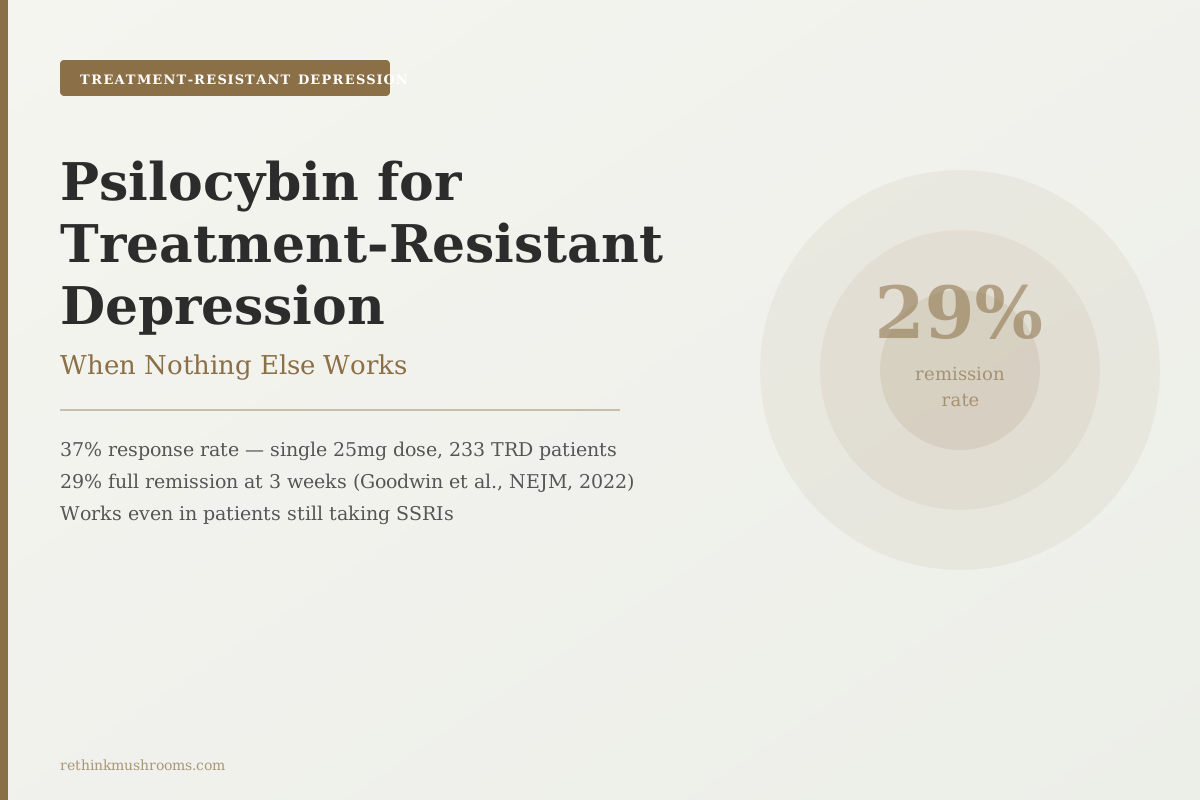
29% remission rate
In 233 patients who had already failed at least two antidepressants, a single 25mg psilocybin dose produced full remission in 29% at three weeks.
Goodwin et al., New England Journal of Medicine, 2022
37%
response rate at week 3 in the COMPASS Phase IIb trial
233
TRD patients across 22 sites and 10 countries
~30%
of all people with depression have treatment-resistant depression
Goodwin et al., New England Journal of Medicine, 2022
 View as image ↗
About one in three people diagnosed with depression doesn't get better on antidepressants, even after trying several. That's the population psilocybin has been tested in. When two or more medications have failed at the right dose for long enough, the clinical term is treatment-resistant depression, or TRD. Roughly 100 million people worldwide meet that definition.
The most significant controlled test of psilocybin specifically in this population was the COMPASS Pathways Phase IIb trial, published in the New England Journal of Medicine in 2022. It enrolled 233 TRD patients across 22 sites in 10 countries, all of whom had already failed at least two antidepressants. A single 25mg dose produced significantly better outcomes than the 1mg control: 37% of patients met the criteria for treatment response and 29% achieved full remission at three weeks.[1]
This article covers the clinical trial evidence specifically for treatment-resistant depression. For the broader picture of psilocybin and depression across all populations, see Psilocybin for Major Depression: The Clinical Evidence.
Key Takeaways
- Treatment-resistant depression (TRD) is defined as failing at least two antidepressant medications at adequate doses, affecting approximately 30% of people with major depression and an estimated 100 million people worldwide
- In the COMPASS Phase IIb trial (233 TRD patients, 10 countries), a single 25mg psilocybin dose produced 37% treatment response and 29% full remission at 3 weeks vs. near-zero rates in the 1mg control group (Goodwin et al., NEJM, 2022)
- Even patients with severe TRD (five or more failed antidepressant trials) showed clinically meaningful response to psilocybin in a 2025 open-label trial (Aaronson et al., American Journal of Psychiatry, 2025)
- Psilocybin produced antidepressant effects in TRD patients who remained on SSRIs throughout treatment, with no medication taper required (Goodwin et al., Neuropsychopharmacology, 2023)
- A dose-response meta-analysis found 25mg is the effective threshold; 10mg and 1mg doses produced substantially smaller effects (Perez et al., European Neuropsychopharmacology, 2023)
- Adverse effects in controlled clinical settings are transient: nausea, headache, elevated blood pressure, and anxiety during the session, with no persistent serious adverse events attributed to psilocybin (Yerubandi et al., JAMA Network Open, 2024)
What "Treatment-Resistant" Actually Means (and How Often It Happens)
"Treatment-resistant depression" has a precise clinical definition. A patient has TRD when they have not adequately responded to at least two different antidepressant medications, each taken at the correct dose for a sufficient period, typically 6 to 8 weeks per trial.
"Adequate response" means achieving a clinically meaningful reduction in symptoms: not necessarily full remission, but a substantial improvement. When two proper medication trials don't produce that, the diagnosis becomes TRD.
This definition matters because it describes a specific failure of the standard approach. It's not that the patient gave up early, used the wrong dose, or tried medications for too short a time. Two real treatment attempts, done correctly, didn't work.
About 30% of people with major depressive disorder meet this definition. That puts the global TRD population somewhere around 100 million people. The path to a TRD diagnosis is often slow: most people try one medication, then another, spend months adjusting doses or adding augmentation drugs, and only accumulate enough failed trials to be formally classified as treatment-resistant after five to seven years of struggling. By the time TRD is recognized, many patients have cycled through antidepressants from several different drug classes.
At the most severe end (sometimes called highly refractory depression), five or more adequate medication trials have failed. Treatment guidelines have the least to offer this population. Standard algorithms run out.
The question this population is asking is different from general depression: not "should I try an antidepressant?" but "what do I do when antidepressants have already stopped working?"
The COMPASS Trial: 233 Patients Who Had Already Failed Treatment
The most rigorous controlled test of psilocybin specifically for TRD enrolled 233 patients across 22 clinical sites in 10 countries. All participants had already failed at least two antidepressants at adequate dose and duration. This was not a sample of people with untreated or mild depression. It was the population treatment guidelines define as treatment-resistant.
COMPASS Pathways used a synthetic form of psilocybin called COMP360. Participants were randomized to a single dose of either 1mg, 10mg, or 25mg, administered under clinical supervision with psychological support before and after the session. The 1mg dose served as the active control: low enough to produce minimal pharmacological effect, but high enough that participants couldn't easily distinguish it from an active dose by feel alone.
The primary outcome was change in depression severity at three weeks, measured using the MADRS, the Montgomery-Åsberg Depression Rating Scale. MADRS is a standard clinician-rated tool that tracks 10 symptoms of depression on a 0 to 6 scale each, producing a total score ranging from 0 (no depression) to 60 (severe depression). A score below 10 is the standard remission threshold.
The 25mg arm outperformed the 1mg control on MADRS score reductions with high statistical confidence (p less than 0.001), meaning the probability of this difference arising by chance was below 0.1%.[1] At week three:
- 37% of patients in the 25mg group were classified as treatment responders, defined as a 50% or greater reduction in MADRS from baseline
- 29% achieved full remission, meaning their MADRS score dropped to 10 or below
- The 10mg arm showed no statistically significant difference from the 1mg control
That last finding is one of the most important details in the trial. The 10mg dose (still a pharmacologically meaningful amount of psilocybin) produced outcomes statistically indistinguishable from the near-placebo 1mg group. The separation happened between 10mg and 25mg, not between 1mg and 10mg. The dose-response curve is not linear.
Effects in the 25mg group remained measurable at 12 weeks, though response rates had declined from the three-week peak. The durability picture from a single dose is weeks to months for most responders, not permanent remission. For a detailed breakdown of the COMPASS trial methodology, dose comparisons, and statistical analysis, see Psilocybin for Treatment-Resistant Depression: COMPASS Pathways Phase IIb Results.
The Dose That Works, and the Doses That Don't
The COMPASS dose finding is consistent with a broader synthesis of the literature. A 2023 systematic review and dose-response meta-analysis published in the European Journal of Neuropsychopharmacology analyzed the available human psilocybin studies and found the same pattern: 25mg is where antidepressant effects become reliably and clinically meaningful, with moderate-to-large effect sizes, while lower doses showed substantially reduced efficacy.[2]
This clarifies what "psilocybin therapy" means in the trial evidence. It is not microdosing, the sub-perceptual small daily amounts some people use outside of clinical research. The trials showing antidepressant effects in TRD use a full therapeutic session: a single supervised dose high enough to produce several hours of altered perception, with a trained facilitator present.
The proposed explanation for why dose matters so much relates to the brain's default mode network, the self-referential thought circuit that tends to be overactive in depression and drives the repetitive negative thinking that characterizes the condition. At higher doses, psilocybin appears to produce a temporary disruption of that network's usual activity patterns. At lower doses, the disruption seems insufficient to produce lasting antidepressant effects. The dose-response relationship suggests a threshold below which the mechanism doesn't operate.
How Long the Effects Last, and What Repeated Sessions Add
One of the most practical questions for TRD patients is durability. If psilocybin helps, how long does the benefit last after a single session?
The COMPASS trial provides the clearest controlled data: effects measurable at 12 weeks, but response rates declining from the week-three peak.[1] A portion of patients who initially responded had returned toward their baseline depression by three months. This is an honest finding: the single-session protocol provides weeks of benefit for most responders, not permanent change.
A 2024 randomized controlled trial tested a different approach, using multiple psilocybin sessions rather than a single dose.[5] Researchers found that repeated doses produced additive antidepressant effects, with response rates improving across sessions. This suggests that scheduled re-dosing, rather than a one-time session, may better address the durability question for TRD patients.
What the optimal session spacing and total number of sessions looks like for TRD specifically is still being studied. The evidence so far supports the idea that additional sessions after an initial response provide continued benefit rather than plateauing. For a dedicated look at what the evidence shows on single versus multiple sessions, see Do You Need Multiple Psilocybin Sessions for Lasting Depression Relief?.
The SSRI Question: Do You Have to Stop Your Current Medication?
Most TRD patients are actively taking antidepressants when they start researching alternatives, including SSRIs, the most commonly prescribed antidepressant class. Stopping these medications is often difficult: tapering too quickly can trigger withdrawal symptoms, and stopping entirely may worsen depression in the short term for some patients.
A 2023 study from COMPASS examined psilocybin's effects specifically in TRD patients who stayed on their SSRIs throughout treatment, with no medication taper required before the session.[3] The finding: psilocybin produced antidepressant effects even in patients who remained on their SSRI.
This challenges a concern that was theoretically plausible before the data existed. SSRIs increase available serotonin at synapses. Psilocybin's active form in the body, psilocin, activates the 5-HT2A receptor, a specific type of serotonin receptor. There was reasonable concern that concurrent SSRI use might blunt psilocybin's effects by competing for the same receptor system. The 2023 data suggests the relevant pathway was not meaningfully blocked.
The proposed reason is that SSRIs and psilocybin operate through different downstream effects even within the serotonin system. SSRIs primarily affect synaptic serotonin levels. Psilocybin's effects appear to depend on direct activation of 5-HT2A receptors and downstream receptor interactions that SSRIs don't replicate. The two mechanisms don't simply cancel each other out.
This doesn't mean concurrent SSRI use has zero effect on a psilocybin session. Some research suggests it may modify aspects of the experience. But the antidepressant signal remained in patients who stayed on their medication, which has direct relevance for TRD patients who cannot easily taper off existing drugs. For the mechanistic picture in more depth, see How Psilocybin Helps When Antidepressants Fail.
When Five Medications Have Already Failed: The Evidence for Severe TRD
The COMPASS trial enrolled patients who had failed at least two antidepressants, the standard TRD definition. A separate question is whether the psilocybin response holds for patients who have failed five or more.
This is the population treatment guidelines have the least guidance for. These patients have been through the standard antidepressant options, add-on medications designed to boost antidepressant effects, and often non-drug approaches as well. Multiple algorithms have been tried and exhausted.
A 2025 open-label trial published in the American Journal of Psychiatry focused specifically on severe TRD: patients who had failed five or more adequate antidepressant trials.[4] A single psilocybin dose produced clinically meaningful antidepressant response in this population.
This is an open-label study, meaning participants knew they were receiving psilocybin rather than a placebo. That limits the confidence of the conclusions compared to a blinded randomized trial, since expectation effects can influence outcomes. But the result matters because it extends the evidence to the most treatment-refractory end of the spectrum, a group the COMPASS trial didn't address specifically.
It also answers an implicit question about how severity of treatment resistance relates to psilocybin response. If the signal held only for patients who had failed exactly two antidepressants, that would suggest deeper treatment resistance predicts weaker response. The 2025 data suggests that isn't the case. Having failed five treatments didn't appear to rule out meaningful response to psilocybin.
What the Safety Profile Looks Like in Clinical Settings
Safety concerns about psilocybin are worth addressing directly. The substance is psychoactive, and a therapeutic session at the 25mg level typically lasts four to six hours and can include challenging emotional experiences, altered perceptions, and anxiety.
A 2024 meta-analysis of adverse effects from therapeutic psilocybin clinical trials, published in JAMA Network Open, provides the most systematic summary of the safety picture from controlled studies.[7] The findings:
- The most common adverse effects are transient: nausea (typically during or shortly after ingestion), headache (often the following day), elevated blood pressure during the session, and anxiety or difficult emotions during the session
- These effects resolved within hours to a day in virtually all reported cases
- No persistent serious adverse events were causally attributed to psilocybin in controlled clinical settings with psychological support
The COMPASS trial reported one case of suicidal ideation in the 25mg arm, disclosed directly in the New England Journal of Medicine publication.[1] Monitoring suicidality in psilocybin trials is standard practice. Across the broader trial literature, psilocybin has not been associated with increased rates of suicidal ideation compared to control conditions; several studies have found reductions. The reporting of this case reflects appropriate scientific transparency.
One essential qualifier for all of this data: it comes from controlled clinical settings. Participants were pre-screened for contraindications, trained facilitators were present during sessions, and structured psychological preparation and integration support were provided before and after the dose. The adverse effect profile in supervised clinical settings is not directly transferable to unsupervised contexts.
Standard exclusion criteria across trials include personal or family history of psychosis, schizophrenia, or bipolar I disorder. The safety data reflects a screened patient population.
Where Things Stand: Australia Approved It, Phase 3 Results Are Positive
As of mid-2025, psilocybin for TRD is not approved by the U.S. FDA. But the regulatory picture has shifted considerably since the COMPASS Phase IIb results were published.
In July 2023, Australia's Therapeutic Goods Administration became the first regulatory body in the world to authorize psilocybin as a prescription treatment for treatment-resistant depression. Authorized psychiatrists in Australia can now prescribe COMP360 in a supervised clinical setting. This is a specific access pathway, not a full commercial market approval, but it represents the first regulatory green light for psilocybin in TRD anywhere in the world.
In June 2025, COMPASS Pathways announced positive Phase 3 results from the COMP005 study: 258 patients, a mean reduction in MADRS scores 3.6 points greater than placebo, with p less than 0.001. This is announced data, not yet peer-reviewed or published in a journal. It should be understood as a strong preliminary readout (the Phase 3 primary endpoint was met), rather than a final confirmed finding until full publication. If regulatory submission follows and is accepted, the earliest plausible FDA approval timeline is approximately 2027.
The independent evidentiary picture is also strong. A 2024 systematic review and meta-analysis published in the BMJ, one of the most rigorous platforms for medical evidence synthesis, found that psilocybin significantly reduces depressive symptoms with effects maintained at follow-up, providing the most authoritative published summary of the data to date.[6]
For context on how psilocybin compares to the existing TRD treatment options (ECT, ketamine, esketamine, MAOIs, TMS), see Treatment-Resistant Depression and Psilocybin: A New Paradigm. For the full regulatory timeline, see Psilocybin's Path to FDA Approval for Depression: Where Things Stand. For a complete tracker of the clinical trials in this space, see Psilocybin for Depression: Results from the Largest Clinical Trials.
What remains genuinely open: the optimal psychological support protocol that should accompany psilocybin treatment, which specific TRD patient subtypes are most likely to respond, how payer coverage will develop, and the safety profile beyond 12-week trial windows. These are the questions that Phase 3 completion and post-approval monitoring will start to answer.
The Bottom Line
The evidence for psilocybin in treatment-resistant depression now includes the COMPASS Phase IIb RCT published in the New England Journal of Medicine (233 patients, 37% response and 29% remission after a single 25mg dose), a positive Phase 3 announcement in 2025, a 2024 BMJ meta-analysis, and findings that the response extends to patients who have failed five or more antidepressants and to those still taking SSRIs. Australia authorized psilocybin for TRD prescription in 2023. The picture is encouraging; open questions on optimal protocols, durability, and long-term safety remain active areas of investigation.
Frequently Asked Questions
Sources & References
- 1RTHM-00761·Goodwin, Guy M et al. (2022). “Single-Dose Psilocybin for a Treatment-Resistant Episode of Major Depression..” The New England journal of medicine.Study breakdown →PubMed →↩
- 2RTHM-01764·Perez, Natacha et al. (2023). “Psilocybin-assisted therapy for depression: A systematic review and dose-response meta-analysis of human studies..” European neuropsychopharmacology : the journal of the European College of Neuropsychopharmacology.Study breakdown →PubMed →↩
- 3RTHM-01698·Goodwin, Guy M et al. (2023). “Psilocybin for treatment resistant depression in patients taking a concomitant SSRI medication..” Neuropsychopharmacology : official publication of the American College of Neuropsychopharmacology.Study breakdown →PubMed →↩
- 4RTHM-02043·Aaronson, Scott T et al. (2025). “Single-Dose Psilocybin for Depression With Severe Treatment Resistance: An Open-Label Trial..” The American journal of psychiatry.Study breakdown →PubMed →↩
- 5RTHM-01977·Rosenblat, Joshua D et al. (2024). “Psilocybin-assisted psychotherapy for treatment resistant depression: A randomized clinical trial evaluating repeated doses of psilocybin..” Med (New York.Study breakdown →PubMed →↩
- 6RTHM-01948·Metaxa, Athina-Marina et al. (2024). “Efficacy of psilocybin for treating symptoms of depression: systematic review and meta-analysis..” BMJ (Clinical research ed.).Study breakdown →PubMed →↩
- 7RTHM-02030·Yerubandi, Akhila et al. (2024). “Acute Adverse Effects of Therapeutic Doses of Psilocybin: A Systematic Review and Meta-Analysis..” JAMA network open.Study breakdown →PubMed →↩