Psilocybin & Depression
71% response, 54% remission after a 2-session escalating-dose protocol
Two sessions of psilocybin (20 mg/70 kg, then 30 mg/70 kg) produced 71% clinical response and 54% remission at four weeks in 24 of 27 participants with non-treatment-resistant MDD (Hopkins, Davis 2021). A 2024 RCT showed that a flexible 1-3 session protocol is feasible in complex treatment-resistant depression including bipolar II (Rosenblat 2024).
Davis et al., JAMA Psychiatry, 2021
92 days
median to depressive event after a single 25 mg dose, COMPASS 25mg arm (n=79)
1-3 doses
tested in Rosenblat 2024 RCT (n=30) for complex treatment-resistant depression
Meta-analysis
Metaxa 2024 confirmed psilocybin antidepressant signal across pooled trials
Davis et al., JAMA Psychiatry, 2021
 View as image ↗
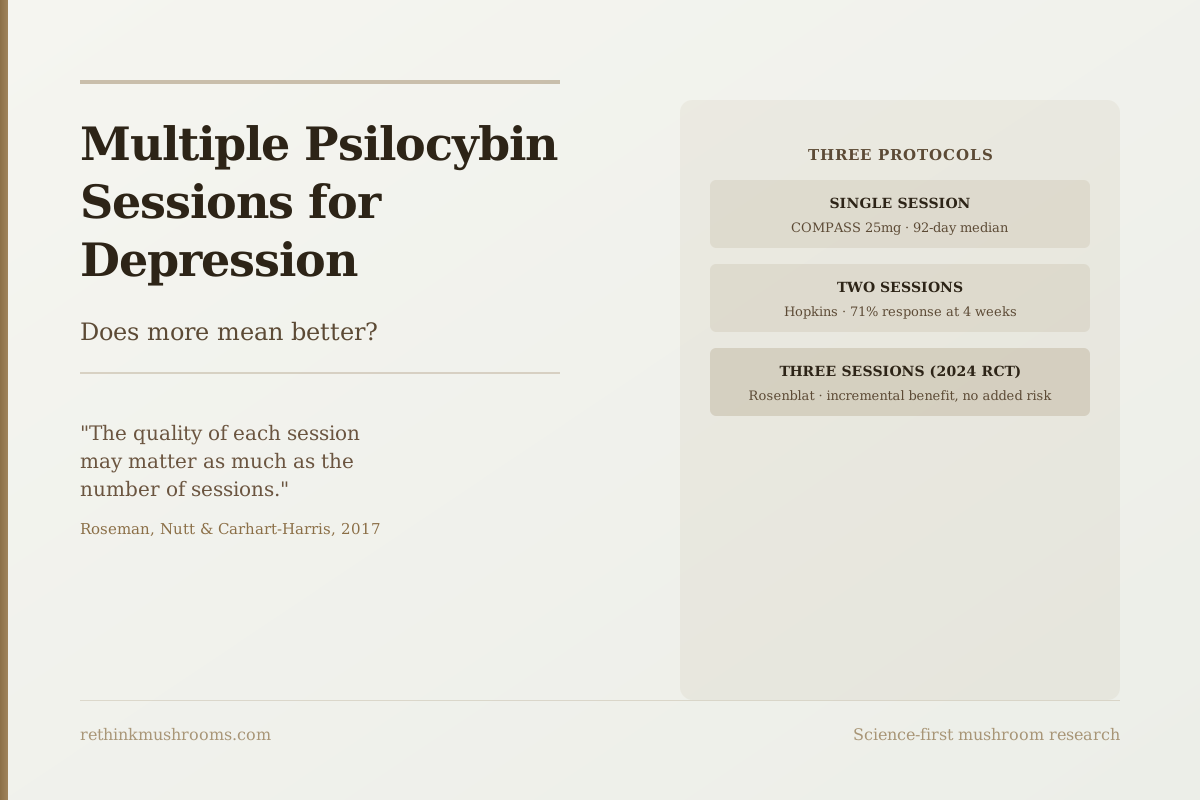
The clinical literature on psilocybin for depression doesn't give one answer to the session question. It gives three: one session, two sessions, and now, with a 2024 randomized controlled trial, up to three sessions. Each protocol has been tested in published research, and each shows meaningful antidepressant effects. The question of which is best remains genuinely open.
Most consumer content describes only the Hopkins two-session protocol or the COMPASS single-session protocol, as if one is standard and the other is the exception. Neither is standard. Both are active research protocols with different patient populations, dose sizes, and outcome timeframes. This article covers what the evidence from multiple psilocybin sessions depression research actually shows across all three approaches. It is part of the broader evidence review for psilocybin and major depression.
Key Takeaways
- Davis et al. 2021 (JAMA Psychiatry, n=27 randomized, 24 completed) used two escalating-dose psilocybin sessions (20 mg/70 kg → 30 mg/70 kg) in the Hopkins protocol and found 71% clinical response and 54% remission at four weeks in non-treatment-resistant MDD
- Goodwin et al. 2022 COMPASS Phase IIb (n=233 across three arms) showed the 25 mg arm produced significantly greater MADRS reduction than the 1 mg control arm at week 3 in treatment-resistant depression
- The COMPASS 52-week observational follow-up (Goodwin 2025) reported median time to a depressive event of 92 days for the 25 mg arm, 83 days for 10 mg, and 62 days for 1 mg
- Raison et al. 2023 (JAMA, n=104 randomized 1:1) tested a single 25 mg dose vs niacin placebo in non-treatment-resistant MDD with assessments at days 2, 8, 15, 29, and 43
- Rosenblat et al. 2024 (Med, n=30) tested flexible 1-3 dose psilocybin-assisted psychotherapy for treatment-resistant depression including bipolar II; the immediate arm showed a between-arm Hedge's g of 1.07 at the week-2 endpoint
- Roseman, Nutt and Carhart-Harris 2017 found Oceanic Boundlessness (mystical-type experience) during the 25 mg session predicted long-term depression outcome in 20 TRD patients; sensory effects had negligible predictive value
- Metaxa et al. 2024 systematic review and meta-analysis confirmed antidepressant effects of psilocybin vs placebo across pooled randomized trials, with effect-size moderators including dose, depression type, and outcome measure
The Three Protocols Tested in Published Research
Three distinct dosing structures appear in the psilocybin depression literature:
| Protocol | Sessions | Dose (typical) | Population | Key trial |
|---|---|---|---|---|
| Single-session | 1 | 25mg | Treatment-resistant MDD; standard MDD | COMPASS (Goodwin 2022); JAMA 2023 |
| Two-session | 2 | 25mg per session | Standard MDD | Hopkins (Davis 2021) |
| Multi-session | Up to 3 | 25mg per session | Treatment-resistant MDD | Rosenblat 2024 |
The protocols differ in more than session count. They also differ in the patient populations studied (treatment-resistant depression versus standard MDD), the follow-up periods used to measure outcomes, and how "booster" sessions are defined. Comparing them directly requires keeping those differences in mind.
Three Session-Count Protocols, Side by Side
One, two, or three sessions — each has RCT evidence, in a different population
The filled dots show how many psilocybin dosing sessions each protocol tested. Because the populations and follow-up windows differ, the headline results are not directly comparable — no trial has tested one vs two vs three sessions in the same patients.
Single session
92 daysOne 25 mg dose · Treatment-resistant MDD (n=233); standard MDD (n=104)
COMPASS · Goodwin 2022 (NEJM); Raison 2023 (JAMA)
Two sessions
71% / 54%20 mg then 30 mg / 70 kg, ~1.6 weeks apart · Standard MDD (n=27 randomized, 24 completed)
Hopkins · Davis 2021 (JAMA Psychiatry)
Up to three sessions
g = 1.07One to three 25 mg doses over 6 months · Treatment-resistant MDD incl. bipolar II (n=30)
Rosenblat 2024 (Med, Cell Press)
Sources: Goodwin et al., NEJM (2022) and J Clin Psychiatry (2025, 52-week follow-up); Raison et al., JAMA (2023); Davis et al., JAMA Psychiatry (2021); Rosenblat et al., Med (2024).
Treatment-resistant depression refers to a patient who has not responded to at least two different antidepressant medications at adequate doses. The COMPASS and Rosenblat trials enrolled treatment-resistant populations, which are generally harder to treat than standard MDD cohorts. The Hopkins protocol enrolled patients with standard MDD.
One Session: What COMPASS and the 2023 JAMA Trial Found
The clearest evidence for a single-session protocol comes from two sources: the COMPASS Phase IIb trial and a 2023 JAMA randomized controlled trial.
In the COMPASS Phase IIb trial, Goodwin et al. randomized 233 patients with treatment-resistant depression to a single dose of synthetic psilocybin (COMP360) at 25 mg (n=79), 10 mg (n=75), or 1 mg (n=79; the 1 mg arm served as a low-dose control), each with psychological support.[3] The primary endpoint was MADRS change from baseline to week 3 (MADRS range 0-60, higher scores = more severe). Mean changes were −12.0 in the 25 mg group, −7.9 in the 10 mg group, and −5.4 in the 1 mg group. The 25 mg vs 1 mg between-group difference was −6.6 (95% CI −10.2 to −2.9; P < 0.001); the 10 mg vs 1 mg difference was not statistically significant.[3]
The durability finding from this trial line — and what the multiple-sessions debate hinges on — comes from the 52-week observational follow-up reported by Goodwin et al. 2025 (COMP 004), which tracked time to a prespecified depressive event in COMPASS participants. Median time to depressive event was 92 days for the 25 mg group, 83 days for 10 mg, and 62 days for 1 mg, with most participants in each arm having a depressive event by Week 12.[5] Roughly three months of benefit from a single 25 mg session in a treatment-resistant population is the baseline any multi-session protocol would need to improve on.
The Raison 2023 JAMA trial took a different approach: it enrolled patients with standard major depressive disorder of at least 60 days' duration with moderate-or-greater symptom severity (excluding active substance use disorder, history of psychosis or mania, or active suicidal ideation with intent), randomizing 1:1 to a single 25 mg psilocybin dose vs 100 mg niacin placebo, each with psychological support.[4] The primary outcome was MADRS change from baseline to day 43, with assessments at days 2, 8, 15, 29, and 43. This is the largest single-dose RCT for non-treatment-resistant MDD and provides the cleanest evidence that a single session can produce sustained antidepressant effects in patients who haven't already failed two medications.
Two Sessions: The Hopkins Protocol
The Hopkins research group, led by Alan Davis and Roland Griffiths, developed a two-session protocol with preparation sessions before each psilocybin dose and integration sessions after. Davis et al. published the first RCT using this structure in JAMA Psychiatry in 2021.[2]
Twenty-seven patients with major depressive disorder (not treatment-resistant) were randomized to immediate treatment or to an eight-week delay; 24 of 27 completed both intervention sessions and follow-ups. Two psilocybin sessions were given approximately 1.6 weeks apart. The doses escalated between sessions: session 1 used 20 mg/70 kg, and session 2 used 30 mg/70 kg, which translates to roughly 25-37 mg for an average-weight adult.
In the immediate-treatment arm, 71% of participants showed a clinically significant response (≥50% reduction in GRID-HAMD score) at week 1 after intervention and 71% at week 4. Remission (GRID-HAMD ≤7) was reached by 58% of participants at week 1 and 54% at week 4.[2]
These numbers are large by antidepressant trial standards. Typical SSRI response rates in RCTs run 40-60% over 6-8 weeks. The Hopkins two-session protocol reached 71% response at one week.
A meta-analysis published in 2024 that synthesized results across multiple psilocybin depression trials confirmed these effects hold up across studies.[7] Pooled effect sizes were significant and clinically meaningful, though the meta-analysis noted that most trials were small and heterogeneous in design.
Three Sessions: The Rosenblat 2024 RCT
The central question for this article is whether the second or third session adds meaningful benefit over the first. The answer, for treatment-resistant depression specifically, comes from a 2024 randomized controlled trial published in Med, a Cell Press journal.
Rosenblat et al. enrolled 30 adults with treatment-resistant depression as part of major depressive or bipolar II disorder, including patients with baseline suicidality and significant comorbidity — populations that earlier trials had typically excluded.[1] Sixteen were randomized to immediate psilocybin-assisted psychotherapy and 14 to a waitlist control, with all eventually receiving the intervention. Each participant received one, two, or three 25 mg fixed-dose sessions over a 6-month period, with preparation and integration psychotherapy around each dose.
At the week-2 primary endpoint, the immediate-treatment arm showed greater MADRS reductions than the waitlist arm, with a large between-arm effect size (Hedge's g = 1.07).[1] Adverse events were transient with no serious adverse events reported across the flexible repeated-dose schedule.[1]
This is the first RCT to test flexible repeated psilocybin dosing (1-3 sessions over 6 months) in a complex treatment-resistant population that included bipolar II and high-suicidality patients. The 30-participant sample limits the certainty of conclusions about per-session incremental benefit specifically, since the abstract reports the between-arm comparison rather than dose-response gradients across one, two, and three sessions.
The Rosenblat trial is the primary feasibility evidence for repeated-dose psilocybin in complex depression. Before this trial, the question of whether multiple sessions could be safely repeated in a real-world treatment-resistant population — including bipolar II — was largely an open one.
Does Session Quality Matter More Than Session Count?
Before the question of how many sessions becomes relevant, there is a prior question the data suggests matters more: how effective is each individual session?
Roseman, Nutt and Carhart-Harris examined what predicted antidepressant outcomes in 20 patients with treatment-resistant depression who received two psilocybin sessions (10 mg followed by 25 mg).[6] They scored the 25 mg session using the Altered States of Consciousness questionnaire and tested two specific dimensions: Oceanic Boundlessness (OBN, sharing features with mystical-type experience) and Dread of Ego Dissolution (DED, similar to anxiety). The depression outcome measure was the Self-Reported Quick Inventory of Depressive Symptoms at 5 weeks.
The mystical-type quality of the session (OBN) predicted long-term depression-symptom reduction. Sensory-perceptual effects, by contrast, had negligible predictive value. The challenging-experience dimension (DED) was also examined as a predictor of long-term outcome. The implication for clinical translation is that the psychological texture of the session — particularly mystical-type experience — appears to mediate the antidepressant outcome rather than dose count alone.[6]
The implication for the session-count debate: a poorly prepared single session may produce less benefit than a well-prepared single session, and adding a second or third session that is also poorly prepared may not close that gap. Preparation, psychological support, and the integration period after each session appear to be mediators of efficacy that operate independent of dose count.
No published trial has directly compared a well-prepared single session against a poorly-prepared two-session protocol. This is a gap in the research. What the existing evidence points toward is that preparation quality and the therapeutic relationship are not secondary to session count. They may be at least as important.
For a deeper look at how psilocybin's mechanism differs from SSRIs and why these session-level factors matter, see How Psilocybin Treats Depression Differently Than SSRIs. The brain changes psilocybin produces, including its effects on the default mode network, help explain why the quality of the experience during a session predicts durable outcome: see also Psilocybin and the Default Mode Network: How It Quiets the Ego.
When the Effect Fades: What Happens Next?
The median 92-day time-to-depressive-event from the COMPASS 52-week follow-up (Goodwin 2025) means that roughly half of treatment-resistant patients in the 25 mg arm experienced a prespecified depressive event within about three months of a single dose, with the majority of participants in each arm having had a depressive event by Week 12.[5] For non-treatment-resistant MDD, the Raison 2023 JAMA trial only followed patients to Day 43, so the durability picture beyond six weeks is not known from that source.[4]
What happens when a patient's depression returns after an initial response? Current clinical trials have addressed this in two ways:
Pre-planned booster sessions: Several protocols allow a second psilocybin session at a specified follow-up interval if relapse signs appear, regardless of whether the initial protocol was one or two sessions. The COMPASS trial used this structure.
Repeated-dose protocols: The Rosenblat 2024 design went further, spacing multiple full doses across the treatment period rather than treating the second dose as a rescue measure.
The practical distinction matters clinically. A "booster" session is a response to relapse; a "repeated-dose" protocol treats multiple sessions as the planned course of therapy. The evidence for both exists, but the repeated-dose approach (Rosenblat 2024) now has an RCT behind it for the treatment-resistant population, while the booster approach remains largely embedded in trial protocols rather than published as an independent comparison.
For context on what the full long-term follow-up data shows, see Psilocybin for Depression: 6-Month and 12-Month Follow-Up Data and How Long Does Psilocybin's Antidepressant Effect Last?.
What the Evidence Does Not Yet Resolve
The 2024 meta-analysis included in this article's evidence base synthesized results across multiple psilocybin trials and confirmed the antidepressant signal is real and clinically significant.[7] What it could not resolve, because no trial has been designed to do so, is the head-to-head comparison of one versus two versus three sessions in the same population under the same conditions.
Each published trial has used a different protocol, patient population, dosing interval, and outcome measure. The COMPASS single-session results came from a treatment-resistant population. The Hopkins two-session results came from a standard MDD population. The Rosenblat repeated-dose results came from a treatment-resistant population. Direct comparison across protocols is not possible from this evidence base.
What researchers and clinicians are learning through this trial landscape is that the correct number of sessions is likely not a universal answer. It depends on:
- Whether the patient has treatment-resistant versus standard MDD
- The quality and completeness of the first session's therapeutic experience
- Whether the initial response fades, and at what timeframe
- The patient's own integration and psychological work between sessions
The current state of the evidence supports one well-conducted session as a meaningful treatment for standard MDD. It supports up to three sessions as progressively more beneficial for treatment-resistant MDD, without safety concerns at that frequency. And it suggests the quality of each session matters for predicting outcomes, independent of how many sessions occur.
For an overview of the largest clinical trials and their results, see Psilocybin for Depression: Results from the Largest Clinical Trials.
Safety
ModerateSession count is a clinical decision, not a self-dosing plan
Concern
Every protocol described here — one, two, or three sessions — was delivered inside a controlled trial with medical screening, dose supervision, and preparation and integration psychotherapy around each dose. Psilocybin remains a Schedule I substance and is not an FDA-approved depression treatment; the trials also excluded people with a personal or family history of psychosis or bipolar I, and cardiovascular contraindications apply.
What the research says
The evidence supports psilocybin's antidepressant effect, but it does not identify a session count that a person can choose on their own. In the trials, how many sessions a patient received — and whether to re-treat — was determined by clinicians tracking response and relapse, not set in advance by the patient.
Particularly relevant for: Anyone considering psilocybin for depression outside a trial or a regulated program (such as Oregon or Colorado)
What to do
This is not medical advice. Do not use psilocybin to self-treat depression or adjust psychiatric medication on your own; discuss investigational and regulated options with a qualified clinician.
Based on the protocols in Davis 2021 (JAMA Psychiatry), Goodwin 2022 (NEJM), Raison 2023 (JAMA), and Rosenblat 2024 (Med).
The Bottom Line
Three dosing structures have published RCT evidence for psilocybin in depression: a single 25 mg session (COMPASS / Goodwin 2022 in TRD, n=233; Raison 2023 in non-TR MDD, n=104), two escalating-dose sessions of 20→30 mg/70 kg (Hopkins / Davis 2021, n=27 randomized), and a flexible 1-3 dose protocol (Rosenblat 2024, n=30, including bipolar II and high-suicidality patients). All show antidepressant signals. The COMPASS 52-week follow-up (Goodwin 2025) reported median time-to-depressive-event of 92 days in the 25 mg arm vs 62 days in the 1 mg control. Roseman 2017 found mystical-type experience during the session predicted long-term depression outcome in 20 TRD patients. No trial has directly compared all three protocols head-to-head in the same population, so the optimal session count for a given patient remains an open clinical question.
Frequently Asked Questions
Sources & References
- 1RTHM-01977·Rosenblat, Joshua D et al. (2024). “Psilocybin-assisted psychotherapy for treatment resistant depression: A randomized clinical trial evaluating repeated doses of psilocybin..” Med (New York.Study breakdown →PubMed →↩
- 2RTHM-00682·Davis, Alan K et al. (2021). “Effects of Psilocybin-Assisted Therapy on Major Depressive Disorder: A Randomized Clinical Trial..” JAMA psychiatry.Study breakdown →PubMed →↩
- 3RTHM-00761·Goodwin, Guy M et al. (2022). “Single-Dose Psilocybin for a Treatment-Resistant Episode of Major Depression..” The New England journal of medicine.Study breakdown →PubMed →↩
- 4RTHM-00848·Raison, Charles L et al. (2023). “Single-Dose Psilocybin Treatment for Major Depressive Disorder: A Randomized Clinical Trial..” JAMA.Study breakdown →PubMed →↩
- 5RTHM-00926·Goodwin, Guy M et al. (2025). “Results From a Long-Term Observational Follow-Up Study of a Single Dose of Psilocybin for a Treatment-Resistant Episode of Major Depressive Disorder..” The Journal of clinical psychiatry.Study breakdown →PubMed →↩
- 6RTHM-00907·Roseman, Leor et al. (2017). “Quality of Acute Psychedelic Experience Predicts Therapeutic Efficacy of Psilocybin for Treatment-Resistant Depression..” Frontiers in pharmacology.Study breakdown →PubMed →↩
- 7RTHM-01948·Metaxa, Athina-Marina et al. (2024). “Efficacy of psilocybin for treating symptoms of depression: systematic review and meta-analysis..” BMJ (Clinical research ed.).Study breakdown →PubMed →↩