Psilocybin & Depression
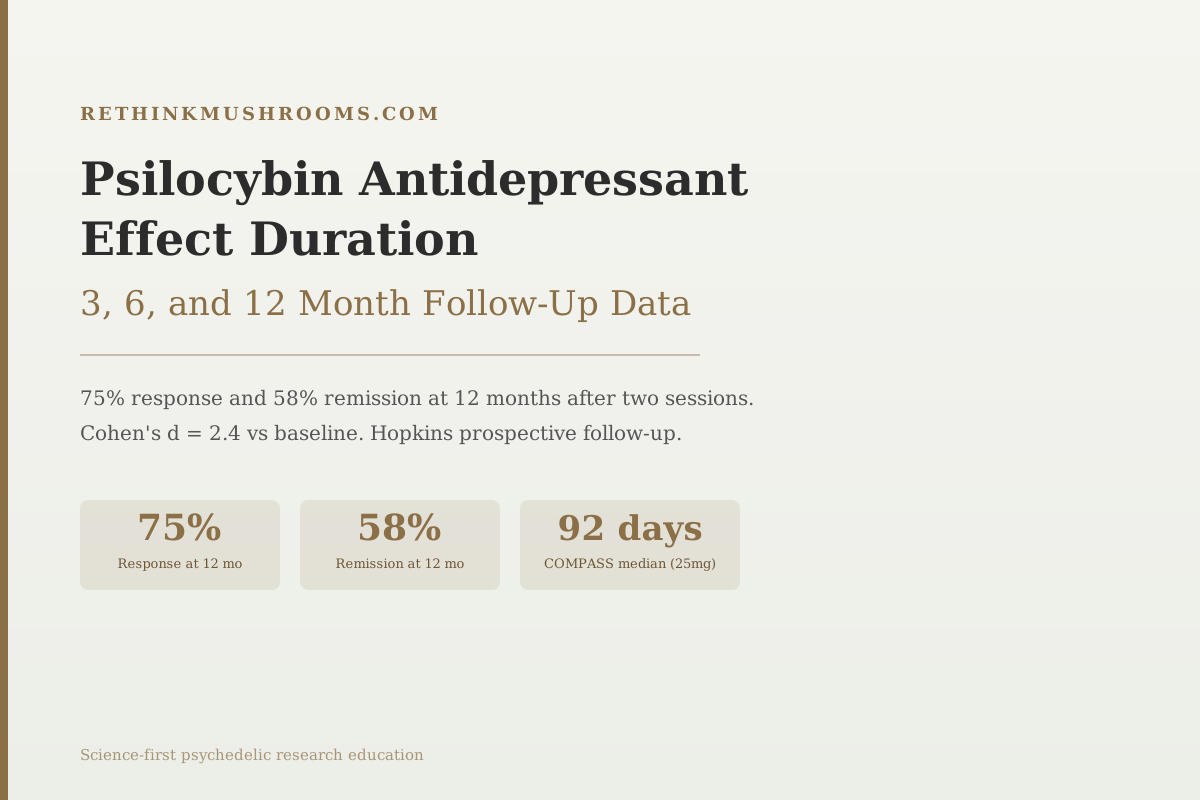
75% response at 12 months
75% of participants in the Hopkins prospective follow-up retained clinical response 12 months after psilocybin therapy, with 58% in full remission. GRID-HAMD scores fell from 22.8 at baseline to 7.7 at 12 months.
Gukasyan et al., J Psychopharmacol, 2022
Cohen's d 2.4
effect size at 12 months (Hopkins study), among the largest sustained antidepressant effect sizes on record
92 days
median time to depressive event for 25mg COMP360 in the COMPASS Phase IIb trial (Goodwin et al., 2022)
6 months
psilocybin outperformed escitalopram on work function, connectedness, and meaning even when symptom scores were comparable (Erritzoe 2024)
Gukasyan et al., J Psychopharmacol, 2022
 View as image ↗
When clinical researchers ask how long psilocybin's antidepressant effect duration lasts, the answer they are most commonly citing is from Gukasyan and colleagues' 2022 12-month follow-up: 75% clinical response and 58% remission one year after two psilocybin sessions, in a population with major depressive disorder.[1] For a broader overview of what psilocybin does for depression, see the psilocybin for major depression clinical evidence guide.
This article presents the month-by-month data across all major follow-up studies, as a structured reference for readers who want the specific numbers rather than a narrative summary. For the consumer-facing overview of the same evidence, see how long does psilocybin's antidepressant effect last?.
Key Takeaways
- At 12 months after two-session psilocybin therapy, 75% of participants retained clinical response and 58% were in full remission; GRID-HAMD fell from 22.8 to 7.7 (Cohen's d = 2.4) in the Hopkins prospective follow-up (Gukasyan et al., 2022, n=24)
- At 6 months, psilocybin and escitalopram showed comparable depression symptom reduction, but psilocybin participants showed significantly greater improvements in work and social functioning, connectedness, and meaning in life (Erritzoe, Carhart-Harris et al., 2024, n=59)
- In the COMPASS Phase IIb trial, a single 25mg dose of psilocybin produced a median 92 days before the next depressive event, compared to 62 days for the 1mg control dose (Goodwin et al., 2022, n=233)
- Long-term COMPASS follow-up data confirmed that the 25mg group maintained significantly longer antidepressant effects than the 1mg group; median 92 vs 62 days post-session (2025, J Clin Psychiatry)
- A 2023 dose-response meta-analysis confirmed robust antidepressant effects across follow-up timepoints, with response correlated to dose (Perez et al., 2023)
- All long-term follow-up data beyond 6 weeks is observational rather than controlled; participants were not randomized to conditions at the follow-up assessments
The Follow-Up Data at a Glance
The table below synthesizes the primary duration data across major trials. Where studies provided explicit response and remission rates, those are given. Where studies reported effect sizes or time-to-event data instead, those are shown.
| Timepoint | Study | Population | Key Outcome |
|---|---|---|---|
| 6 weeks | Carhart-Harris 2021 NEJM (n=59)[5] | MDD (moderate-to-severe) | Non-inferior to escitalopram on QIDS-SR primary endpoint; superior on 8 of 16 secondary QoL measures |
| 6 months | Erritzoe, Carhart-Harris et al. 2024 (n=54)[2] | MDD (moderate-to-severe) | Comparable symptom reduction vs escitalopram; significantly greater work/social functioning, connectedness, and meaning in life |
| 3 months | Gukasyan 2022 (n=24)[1] | MDD (non-TRD) | Cohen's d vs baseline = 2.0; sustained reduction from acute post-treatment response |
| 12 months | Gukasyan 2022 (n=24)[1] | MDD (non-TRD) | 75% response, 58% remission; GRID-HAMD 22.8 to 7.7; Cohen's d = 2.4 |
| 92 days median | Goodwin/COMPASS 2022 (n=233)[4] | TRD | Median time to depressive event: 25mg = 92d, 10mg = 83d, 1mg = 62d |
| Extended follow-up | COMPASS long-term 2025 (n=233)[3] | TRD | 25mg group sustained effects significantly longer than 1mg group; median 92 vs 62 days |
6 Weeks: The Primary Endpoint and Non-Inferiority to Escitalopram
The 6-week timepoint is where most randomized controlled trial primary endpoints are measured, because it aligns with the typical assessment window for antidepressant drug trials.
Carhart-Harris and colleagues published the most rigorous 6-week comparison in 2021: a head-to-head randomized trial of psilocybin against six weeks of escitalopram in 59 MDD patients.[5] Psilocybin was not significantly different from escitalopram on the primary endpoint (QIDS-SR change). On secondary measures (including emotional well-being, meaning, anhedonia, and connectedness), psilocybin outperformed escitalopram on 8 of 16 measures, with escitalopram outperforming on none.
The 6-week primary endpoint is a floor, not a ceiling, for psilocybin's effect duration. Unlike an SSRI that requires continuous dosing to maintain the 6-week level, psilocybin's effects were established in two sessions before week 6 and were being sustained without ongoing dosing. This design difference is central to why the duration question matters.
3 Months: Sustained Effect After the Acute Window
The 3-month timepoint is where psilocybin's longer-acting profile becomes clinically distinguishable from standard antidepressant timelines.
Gukasyan and colleagues' 2022 prospective follow-up tracked 24 Hopkins patients after two-session psilocybin therapy for MDD.[1] At 3 months, the effect size relative to baseline was Cohen's d = 2.0, still within the large-to-very-large range. The acute post-treatment response had not reverted to baseline at this interval.
A 2023 systematic review and dose-response meta-analysis by Perez and colleagues confirmed that antidepressant effects were robust across follow-up assessments in the studies they pooled, with higher doses correlated with larger and more sustained effects.[6]
For the COMPASS trial design context: the COMPASS Phase IIb primary endpoint was at 3 weeks, but the 25mg group's median 92-day response duration means most of that group was still in the response window at the 3-month mark.[4] Only at the median would half the 25mg participants have reached their depressive event.
6 Months: Where Psilocybin Diverges From Escitalopram
The 6-month follow-up of the Imperial College trial produced one of the most important and least-covered findings in the duration literature.
Erritzoe and Carhart-Harris and colleagues followed up 54 of the original 59 participants at 6 months in a naturalistic observational design (both groups had exited the controlled trial by this point and could access any treatment).[2] Depression symptom scores were comparable between the psilocybin and escitalopram groups at 6 months; neither had a statistically significant advantage on the primary depression measure.
But on well-being measures, the groups had diverged. Psilocybin participants showed significantly greater sustained improvements in:
- Work and social functioning
- Connectedness to others
- Meaning in life
- Emotional responsiveness
These dimensions are not captured by standard depression rating scales like MADRS or QIDS-SR. They represent a class of outcomes that escitalopram and psilocybin affected differently, and the 6-month data suggests that the psilocybin advantage in these areas persists beyond the acute treatment window.
This is why the comparison "psilocybin vs. escitalopram at 6 months" has two different correct answers depending on what you measure: symptom scales said they were equivalent; functional and well-being measures said psilocybin maintained a meaningful advantage.
For the mechanism behind why psilocybin might produce different quality-of-life outcomes than SSRIs, see how psilocybin treats depression differently than SSRIs and psilocybin and the default mode network: how it quiets the ego.
12 Months: The Hopkins Headline Numbers
The 12-month data from Gukasyan and colleagues is the most widely cited duration data in the psilocybin depression literature.[1]
The participants were 24 adults with moderate-to-severe MDD (not treatment-resistant) who received two sessions of psilocybin-assisted therapy as part of the Davis 2021 JAMA Psychiatry trial. The 12-month follow-up assessed outcomes without any intervening psilocybin treatment; this was naturalistic observation of what happened after the trial concluded.
Results at 12 months:
- 75% showed a clinical response (defined as at least a 50% reduction in GRID-HAMD from baseline)
- 58% were in full remission (GRID-HAMD score below the clinical threshold)
- GRID-HAMD had fallen from a baseline mean of 22.8 to 7.7 at 12 months
- Cohen's d = 2.4 versus baseline
A Cohen's d of 2.4 is among the largest sustained effect sizes ever measured for any antidepressant treatment in a clinical study. Standard antidepressant trials typically report d values around 0.3-0.5 at their primary endpoint. The comparison is not entirely fair (different measurement contexts, different populations, different definitions of response), but the magnitude is genuine and is the reason these numbers attract sustained research attention.
The primary limitation: this is a 24-person study with no active control group at 12 months. Without randomized comparison, it is impossible to attribute the 12-month outcomes entirely to the psilocybin sessions versus spontaneous remission, placebo effects, or other treatment these participants received during the follow-up year.
COMPASS Data: Single-Dose Duration in a Larger Trial
The Hopkins data comes from a two-session protocol with a small sample. The COMPASS trial provides a larger-sample perspective on single-dose duration from a treatment-resistant population.
Goodwin and colleagues' 2022 Phase IIb trial enrolled 233 TRD patients across multiple sites, randomized to 25mg, 10mg, or 1mg COMP360.[4] The median time to the next depressive event after the single session was:
- 25mg: 92 days (approximately 3 months)
- 10mg: 83 days
- 1mg: 62 days (active comparator dose)
The primary endpoint was MADRS reduction at 3 weeks, not median event-free time, but the event-free survival data provides the clearest single-number answer to "how long does one dose last?" in a large, controlled sample: the median responder in the 25mg group went approximately 3 months before meeting criteria for a depressive relapse.
The 2025 long-term observational follow-up of these same participants confirmed the dose-response durability relationship.[3] The 25mg group maintained significantly longer antidepressant effects than the 1mg group at the extended observation point, consistent with the original trial's event-free survival data.
What Meta-Analyses Say About the Duration Evidence
Individual trials have small samples and open-label follow-up designs at longer timepoints. Meta-analyses provide pooled perspective.
Perez and colleagues' 2023 systematic review and dose-response meta-analysis synthesized data across multiple psilocybin depression trials and confirmed robust antidepressant effects that correlated with dose, across follow-up assessments.[6]
A 2025 network meta-analysis provided the most comprehensive synthesis to date: dose-response data across all major placebo-controlled psilocybin RCTs, confirming that 25mg was the most effective dose and that the antidepressant effects were significant and clinically meaningful across the trials examined.[7]
These meta-analyses do not directly report follow-up duration data in the same way as the individual studies, because most contributing trials only have 6-week endpoints. Their value is in confirming that the efficacy signal is real and dose-dependent, which is the foundation on which the follow-up duration studies rest.
For a broader look at results across the major psilocybin depression trials, see psilocybin for depression: results from the largest clinical trials.
Reading These Numbers Correctly: Critical Limitations
Follow-up studies lack controls. The Hopkins 12-month data and the Imperial College 6-month data are observational. Participants were not randomized to conditions after the controlled trial phase ended. They may have received other treatments during the follow-up period. The observed outcomes cannot be attributed entirely to psilocybin.
Sample sizes are small. Gukasyan 2022 followed 24 participants. The Imperial College 6-month follow-up covered 54 of 59 original participants. Small samples mean wide confidence intervals and limited generalizability.
The COMPASS durability data is from TRD. The 92-day median event-free time comes from treatment-resistant patients who had already failed multiple antidepressants. The Hopkins 12-month data comes from non-treatment-resistant MDD. These are different populations and the numbers are not directly comparable.
Durability varies across individuals. The median response times and response rates describe the center of a distribution. Some participants in every study had durable remission for the entire follow-up period; others relapsed within weeks. The predictors of who falls into which category are covered in sustained remission after psilocybin: what predicts it?.
The multiple-session question. The Hopkins protocol used two sessions; COMPASS used one. What happens when effects diminish is addressed in do you need multiple psilocybin sessions for lasting depression relief?.
The Bottom Line
The available follow-up data places psilocybin's antidepressant effect duration at 3 months (Cohen's d = 2.0 in Hopkins two-session study), 6 months (comparable depression symptoms to escitalopram; significantly better quality of life in Imperial College follow-up), and 12 months (75% response, 58% remission, Cohen's d = 2.4 in Hopkins study). COMPASS single-dose data shows a median 92-day event-free period for the 25mg dose in TRD patients. All long-term data beyond 6 weeks is observational without active controls. Effect size magnitudes substantially exceed those reported for standard antidepressant trials, though direct comparisons are complicated by different study designs and populations.
Frequently Asked Questions
Sources & References
- 1RTHM-01529·Gukasyan, Natalie et al. (2022). “Efficacy and safety of psilocybin-assisted treatment for major depressive disorder: Prospective 12-month follow-up..” Journal of psychopharmacology (Oxford.Study breakdown →PubMed →↩
- 2RTHM-01887·Erritzoe, David et al. (2024). “Effect of psilocybin versus escitalopram on depression symptom severity in patients with moderate-to-severe major depressive disorder: observational 6-month follow-up of a phase 2, double-blind, randomised, controlled trial..” EClinicalMedicine.Study breakdown →PubMed →↩
- 3. Source details for this reference are not yet available.
- 4RTHM-00761·Goodwin, Guy M et al. (2022). “Single-Dose Psilocybin for a Treatment-Resistant Episode of Major Depression..” The New England journal of medicine.Study breakdown →PubMed →↩
- 5RTHM-00675·Carhart-Harris, Robin et al. (2021). “Trial of Psilocybin versus Escitalopram for Depression..” The New England journal of medicine.Study breakdown →PubMed →↩
- 6RTHM-01764·Perez, Natacha et al. (2023). “Psilocybin-assisted therapy for depression: A systematic review and dose-response meta-analysis of human studies..” European neuropsychopharmacology : the journal of the European College of Neuropsychopharmacology.Study breakdown →PubMed →↩
- 7. Source details for this reference are not yet available.