Psilocybin & Depression
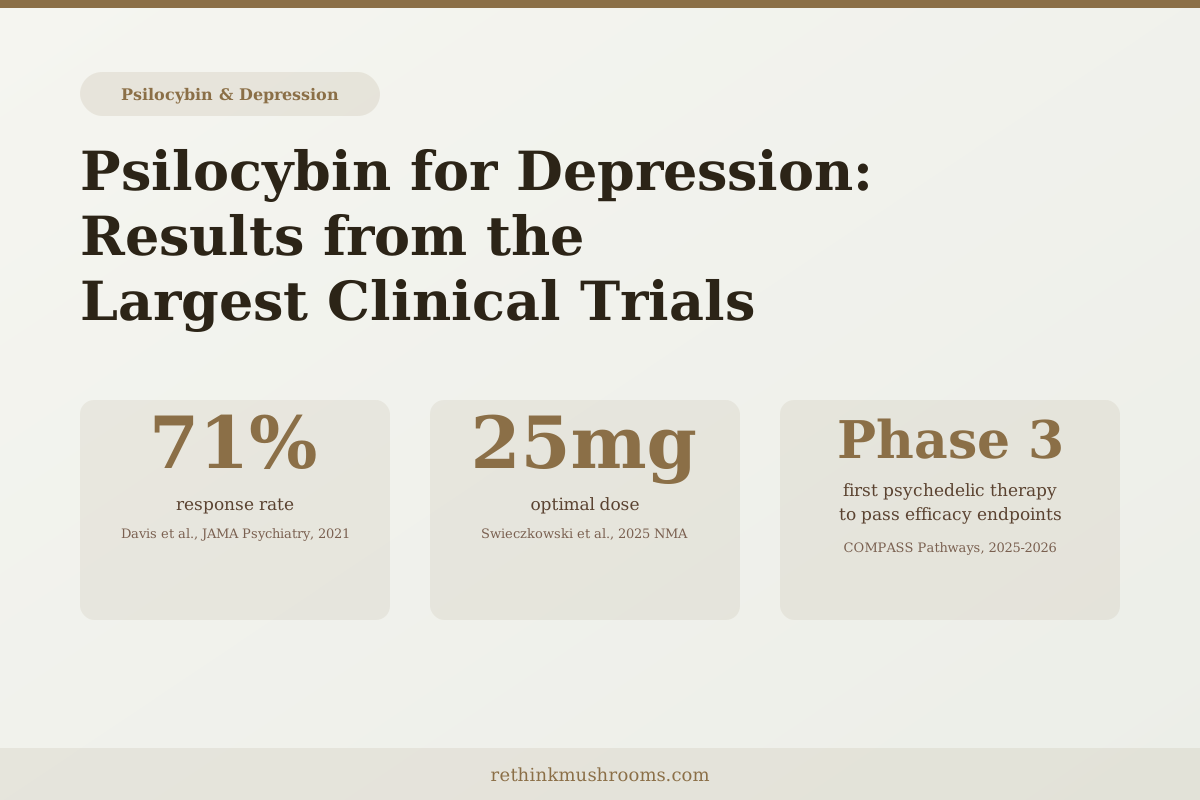
71% response rate
In the first randomized controlled trial of psilocybin-assisted therapy for major depressive disorder, 71% of participants responded and 54% achieved full remission within four weeks of two psilocybin sessions.
Davis et al., JAMA Psychiatry, 2021
233
patients in the largest published Phase 2 dose-optimization trial (Goodwin et al., NEJM, 2022)
25mg
confirmed as optimal dose by a 2025 network meta-analysis across five randomized trials
Phase 3
first psychedelic therapy to pass two Phase 3 efficacy endpoints (COMPASS Pathways, 2025-2026)
Davis et al., JAMA Psychiatry, 2021
 View as image ↗
The psilocybin clinical trial landscape for depression has changed faster in the last five years than in the previous five decades. What began as a 20-person open-label study has expanded into a body of randomized evidence spanning more than 700 patients, a direct head-to-head comparison against a leading antidepressant, the largest Phase 2 trial ever run in treatment-resistant depression, and, as of 2025, the first Phase 3 data ever to demonstrate efficacy for any psychedelic therapy. This article covers the complete arc of that evidence, including the trial that failed its primary endpoint and what that failure actually means. For a broad overview of the therapeutic case, see Psilocybin for Major Depression: The Clinical Evidence.
Key Takeaways
- Davis et al. (JAMA Psychiatry, 2021) enrolled 27 patients with major depressive disorder: 71% responded and 54% achieved full remission at four weeks from two psilocybin sessions (20mg then 30mg)
- Carhart-Harris et al. (NEJM, 2021) randomized 59 patients to psilocybin versus escitalopram: psilocybin matched the primary outcome but was statistically superior on every secondary measure, including emotional wellbeing and anhedonia
- Goodwin et al. (NEJM, 2022) ran the largest Phase 2 trial in 233 treatment-resistant depression patients: a single 25mg dose outperformed 1mg control at three weeks; the dose-response relationship was clear
- Goodwin et al. (JAMA, 2023) confirmed in 104 patients that 25mg produced roughly 37% MADRS score reduction versus 21% for 10mg, with antidepressant effects measurable by Day 8
- COMPASS Pathways reported that two Phase 3 trials (COMP005: n=258; plus a second confirmatory trial) both met primary efficacy endpoints in 2025-2026, the first Phase 3 success for any psychedelic therapy
- The EPISODE trial (Mertens et al., JAMA Psychiatry, 2026) failed its primary endpoint against an active placebo (p=0.19), adding important nuance about blinding design and flagging a suicidal ideation signal on dosing days
The Five Largest Psilocybin Depression Trials: Key Results at a Glance
Ranked by sample size and clinical significance:
-
COMP360 Phase 3 Program (COMPASS Pathways, 2025-2026): Two trials enrolling hundreds of patients with treatment-resistant depression. COMP005 (n=258) met its primary endpoint on the MADRS depression rating scale (p less than 0.001), with a treatment difference of approximately 3.6 points; a second confirmatory trial reported a 3.8-point treatment difference. First Phase 3 efficacy data for any psychedelic therapy. Full peer-reviewed publications were pending as of April 2026; results were reported through COMPASS Pathways' regulatory communications.
-
Goodwin et al. (NEJM, 2022) -- COMP360 Phase 2b: 233 patients with treatment-resistant depression randomly assigned to 1mg, 10mg, or 25mg synthetic psilocybin. The 25mg dose produced the greatest reduction in MADRS scores at three weeks and was statistically superior to the 1mg control.[3]
-
Goodwin et al. (JAMA, 2023) -- Single-Dose MDD Trial: 104 patients with major depressive disorder; 25mg produced approximately 37% MADRS reduction versus 21% for 10mg; antidepressant effects apparent by Day 8.[4]
-
Carhart-Harris et al. (NEJM, 2021) -- Psilocybin vs. Escitalopram: 59 patients; head-to-head comparison with six weeks of SSRI therapy; psilocybin (two 25mg doses) was equal or superior on all measured outcomes.[2]
-
Davis et al. (JAMA Psychiatry, 2021) -- First MDD RCT: 27 patients with major depressive disorder; 71% response and 54% remission at four weeks from a two-dose protocol.[1]
Davis 2021: The First Randomized MDD Trial Gets 71% Response and 54% Remission
Before 2021, every psilocybin depression trial either studied terminal illness patients or used open-label designs without a proper control group. Davis and colleagues changed that.
Their trial, published in JAMA Psychiatry, enrolled 27 adults with major depressive disorder — not cancer-related distress, not specifically treatment-resistant patients, just major depression — and randomly assigned them to begin treatment immediately or after an eight-week delay.[1] All participants eventually received two psilocybin sessions: 20mg in the first and 30mg in the second, two weeks apart, supported by structured therapy before, during, and after each dose.
By week four: 71% of participants met response criteria, meaning at least a 50% drop in depression scores. More striking, 54% achieved full remission.
Those numbers need context. Standard antidepressant trials typically show 40-60% response rates in non-treatment-resistant populations, but at 12 weeks or longer, not four. Davis found this response at four weeks from two sessions.
The effects also persisted. At 12-month follow-up, the majority of initial responders maintained significant improvements. That durability is covered in depth at One Dose of Psilocybin for Depression: How Long Do Effects Last?.
What Davis 2021 didn't answer: which dose is optimal, whether a single session would work, and whether the effect holds against an active comparator rather than a waitlist control.
Carhart-Harris 2021: Head-to-Head Against Escitalopram in NEJM
The most clinically meaningful comparison in antidepressant research is also the one most often misrepresented: psilocybin versus an established SSRI, in a proper randomized trial.
Carhart-Harris and colleagues ran exactly that at Imperial College London. Their trial, published in the New England Journal of Medicine, enrolled 59 patients with moderate-to-severe depression.[2] One group received two psilocybin sessions (25mg each, three weeks apart) plus a placebo pill for six weeks. The other group received escitalopram (a commonly prescribed SSRI) for six weeks plus low-dose psilocybin (1mg, an inactive amount) to keep participants blinded.
On the primary outcome, the QIDS-SR depression rating scale, the two groups were statistically tied. Psilocybin did not beat escitalopram on that specific measure.
On every secondary measure, psilocybin was superior.
Patients on psilocybin reported significantly greater improvements in emotional wellbeing, anhedonia (the inability to feel pleasure), anxiety, and a sense of psychological connectedness. Patients on escitalopram showed the emotional blunting pattern common to SSRIs; patients on psilocybin did not. They felt more, not less.
The trial was likely underpowered for the primary endpoint at 59 patients -- that is a small sample for detecting a difference between two active treatments. Most researchers interpret the result as comparable primary efficacy with a better secondary profile, not as escitalopram winning the comparison.
For a full analysis of how these mechanisms differ, see How Psilocybin Treats Depression Differently Than SSRIs.
Goodwin 2022: 233 Patients Set the Dose at 25mg
The question Davis and Carhart-Harris couldn't answer was which dose to use. The Phase 2b COMP360 trial published in the New England Journal of Medicine in 2022 answered it in the most important population: people who had already failed standard antidepressant treatment.
Goodwin and colleagues enrolled 233 patients with treatment-resistant depression (defined as failure of at least two prior antidepressant courses) across multiple clinical sites.[3] COMP360 is COMPASS Pathways' synthetic psilocybin formulation. Participants were randomly assigned to a single dose of 1mg (the control), 10mg, or 25mg, delivered with supportive therapy.
The dose-response relationship was clear. At three weeks: 25mg produced the largest MADRS score reduction, statistically superior to 1mg. The 10mg dose showed a smaller intermediate effect that did not reach statistical significance versus 1mg. The 25mg dose had a manageable safety profile at this therapeutic level.
At the time of publication, this was the largest Phase 2 depression study ever conducted with psilocybin. It established 25mg as the target dose and provided COMPASS Pathways with the data to proceed to Phase 3.
The population matters here. Treatment-resistant depression is a harder condition to treat than general major depressive disorder. Getting a significant antidepressant effect in patients who had already failed at least two prior treatments suggests psilocybin is working through a different pathway than the drugs those patients already tried.
Goodwin 2023: 104 Patients Confirm 25mg Works -- 10mg Falls Short
A separate 2023 trial published in JAMA -- distinct from the 2022 NEJM Phase 2b -- enrolled 104 patients with major depressive disorder (not specifically treatment-resistant) to compare a single dose of 10mg against a single dose of 25mg.[4]
The results replicated what the 2022 trial found in the treatment-resistant population: 25mg works; 10mg produces a smaller and less reliable effect.
At six weeks, the 25mg group showed approximately 37% reduction in MADRS scores versus roughly 21% for the 10mg group. Antidepressant effects were detectable by Day 8 in the 25mg group -- rapid by the standards of any antidepressant, which typically require 4-6 weeks to take effect.
The practical implication: two trials, two different patient populations, the same finding. The 10mg dose that appears in wellness discussions does not produce reliable therapeutic antidepressant effects in clinical trials. The therapeutic signal consistently sits at 25mg.
The Phase 3 Breakthrough: COMP360 Passes in Two Back-to-Back Trials
For most of the history of psychedelic research, Phase 3 trials were a distant ambition. Phase 3 trials are the regulatory standard for drug approval: they need to be large, randomized, controlled, and powered to detect a clinically meaningful treatment effect. No psychedelic therapy had ever passed one.
COMP005, COMPASS Pathways' first COMP360 Phase 3 trial, enrolled 258 patients with treatment-resistant depression. According to COMPASS Pathways' regulatory and investor communications, the trial met its primary endpoint: patients receiving 25mg COMP360 showed a statistically significant reduction in MADRS scores compared to control (p less than 0.001), with an estimated treatment difference of approximately 3.6 points.
A second Phase 3 trial also met its primary endpoint, with a comparable estimated treatment difference of approximately 3.8 points.
As of April 2026, the full peer-reviewed publications from both trials had not yet been released. The data above comes from COMPASS Pathways' regulatory filings and investor announcements; the program has been submitted for regulatory review.
The clinical significance of a 3-4 point MADRS difference in treatment-resistant depression is a legitimate question. Minimal clinically important differences in TRD populations are typically estimated at 1.6 to 3.0 points, so the Phase 3 effect sizes fall within or above that range. What is not in question is the regulatory milestone: COMP360 became the first psychedelic-based therapy to demonstrate efficacy in two Phase 3 randomized controlled trials.
The EPISODE Trial: Failed Primary Endpoint, Meaningful Secondary Signal
In early 2026, JAMA Psychiatry published the EPISODE trial -- the largest independent Phase 2b study of psilocybin for treatment-resistant depression, using an active placebo comparator rather than a low-dose psilocybin control.[5]
It failed its primary endpoint.
Mertens and colleagues found an adjusted odds ratio of 1.73 for psilocybin versus active placebo, with a p-value of 0.19. By the trial's own pre-registered definition, psilocybin did not significantly outperform the active comparator.
Several things complicate a simple "it didn't work" interpretation.
The active placebo in EPISODE was not an inert sugar pill. It was a drug with real psychological effects, specifically designed to blind participants to whether they received psilocybin or the comparator. This made the blind more rigorous than most prior trials. In less-blinded designs, a strong expectancy effect inflates response rates in the psilocybin group -- participants who know they took psilocybin may report feeling better partly because they expected to. Active placebo designs correct for that expectancy. A tighter blind can make it harder to separate from an active comparator even when psilocybin has genuine pharmacological effects.
Secondary outcomes in EPISODE showed clinically meaningful trends in the psilocybin group. The trial was not a null result in the sense that psilocybin did nothing; it was a null result in the sense that psilocybin did not clearly outperform an active comparator under tighter blinding conditions.
EPISODE also reported a safety signal worth tracking: 4% of participants in the psilocybin group experienced suicidal ideation specifically on dosing days, compared to 1-2% in the comparator group.[5] One participant experienced hallucinogen persisting perception disorder (HPPD), a rare condition where perceptual disturbances continue after the drug has cleared.
A 2025 systematic review of safety across all psilocybin therapy trials found that most adverse events are mild and transient -- nausea, headache, and temporary anxiety during the session -- and that no deaths had been reported across the full evidence base.[10] The EPISODE signals are not typical, but they are not entirely surprising in a severely depressed population, and they inform what careful screening and monitoring protocols need to address.
The honest interpretation: EPISODE adds important data about active-placebo-controlled effect sizes and trial design. It does not overturn the Phase 3 results or the meta-analytic evidence from Phase 2 RCTs, but it does suggest the effect may be more modest than early open-label studies indicated.
Beyond the Flagship Trials: Veterans and Repeated Dosing
Two additional studies extend the evidence base to populations and protocols the flagship trials did not cover.
Aaronson and colleagues (2025) tested a single-dose psilocybin protocol specifically in U.S. military veterans with severe treatment-resistant depression -- people with multiple prior treatment failures, often including comorbid conditions.[6] This population is substantially harder to treat than the standard TRD samples in the COMPASS trials. Meaningful antidepressant responses were observed even in this group. The study was observational rather than randomized, which limits causal conclusions -- but it suggests the signal is not confined to carefully selected academic medical center patients.
Rosenblat and colleagues (2024) addressed a practical question the flagship trials leave unanswered: what if one session is not enough?[7] Their randomized trial used a repeated-dose protocol in treatment-resistant depression -- two psilocybin sessions rather than one. The repeated protocol produced sustained antidepressant response. For patients who respond initially but relapse within months, the evidence suggests a second session may extend or restore the benefit.
For a deeper look at which patients respond most reliably, see Who Responds Best to Psilocybin for Depression? Predictors of Outcome.
Two Meta-Analyses Synthesize What the Trials Show
With a body of randomized evidence this large and varied, meta-analyses provide the appropriate synthesis.
Metaxa and colleagues (2024) published a systematic review and meta-analysis in the BMJ synthesizing the Phase 2 randomized controlled trial evidence.[9] The conclusion: psilocybin produced significantly greater reductions in depression symptoms than placebo across trials, with clinically meaningful effect sizes. The BMJ analysis confirmed that the individual trial results are not statistical artifacts of small samples.
Swieczkowski and colleagues (2025) took a complementary approach: a network meta-analysis in Psychiatry Research that modeled the dose-response relationship across all randomized placebo-controlled trials.[8] Their finding: 25mg is the optimal dose for major depressive disorder, producing greater efficacy than 10mg with an acceptable safety profile. Doses above 25mg have not been systematically tested in this population in controlled trials.
The honest limits of the current evidence: most Phase 2 trials ran 8-12 weeks, so long-term efficacy beyond six months rests primarily on observational follow-up data rather than randomized evidence. The Phase 3 trials used synthetic psilocybin delivered alongside structured psychotherapy -- effects may not generalize to unstructured or unsupported settings. The EPISODE null result is a real caution about how much of the Phase 2 signal may be expectancy-driven.
For people tracking ongoing research, all active psilocybin trials for depression are listed at Every Active Psilocybin Clinical Trial for Depression: A 2026 Tracker.
The trial evidence for depression also connects to adjacent populations. Research in cancer-related depression and anxiety -- the population that helped restart the entire field -- is covered at Psilocybin for Cancer-Related Depression and Anxiety: Combined Effects. The foundational Johns Hopkins and NYU cancer anxiety trials are reviewed at The Johns Hopkins and NYU Cancer Anxiety Studies: Landmark Results.
The Bottom Line
The psilocybin clinical trial evidence for depression has moved from a 20-person open-label study in 2017 to two Phase 3 trials meeting primary endpoints in 2025-2026, with a Phase 2 randomized evidence base confirming meaningful antidepressant effects at 25mg. Response rates across Phase 2 trials range from 37-71% depending on population and protocol. The EPISODE trial's failure against active placebo adds a methodological caution: the effect size in tightly blinded designs may be smaller than early open-label trials suggested, and patient selection matters. No randomized trial has yet demonstrated reliable 12-month durability as a pre-specified endpoint.
Frequently Asked Questions
Sources & References
- 1. Source details for this reference are not yet available.
- 2. Source details for this reference are not yet available.
- 3. Source details for this reference are not yet available.
- 4. Source details for this reference are not yet available.
- 5. Source details for this reference are not yet available.
- 6. Source details for this reference are not yet available.
- 7. Source details for this reference are not yet available.
- 8. Source details for this reference are not yet available.
- 9. Source details for this reference are not yet available.
- 10. Source details for this reference are not yet available.