Psilocybin & Cancer
78-83% clinical response
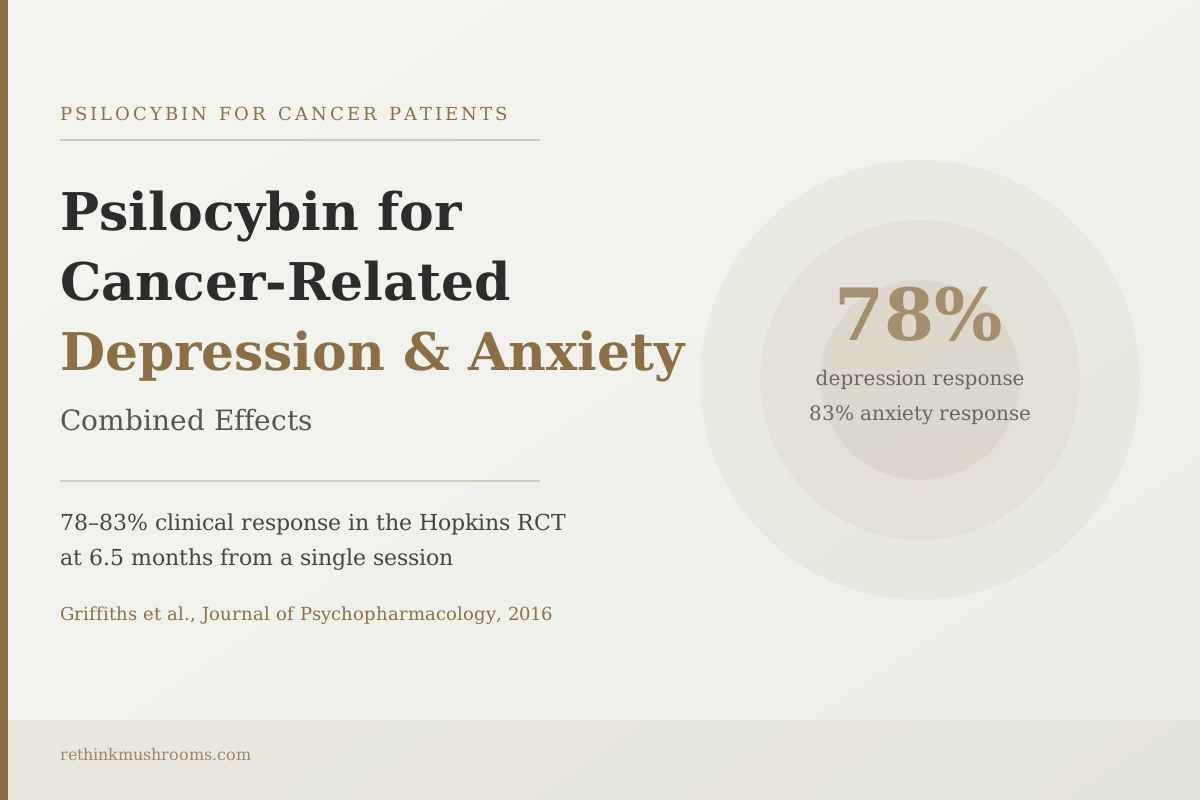
In the Hopkins RCT (N=51), 78% of patients showed clinically significant depression reduction and 83% showed anxiety reduction at 6.5 months — from a single psilocybin session.
Griffiths et al., Journal of Psychopharmacology, 2016
4.5 years
sustained reductions maintained in 60-80% of participants at 4.5-year follow-up (Agin-Liebes 2020)
53.6%
significant depression reduction maintained 2 years after single session (Agrawal 2025)
SUCRA 94.2%
highest-dose psilocybin ranked first for trait anxiety in 2025 network meta-analysis (Swieczkowski 2025)
Griffiths et al., Journal of Psychopharmacology, 2016
 View as image ↗
Cancer-related depression and anxiety are almost always covered separately in the medical literature. Different scales, different studies, different treatment guidelines. In practice, for patients living with a life-threatening diagnosis, they arrive together, shaped by the same source: the knowledge that death is real, near, and beyond negotiation.
Psilocybin treats both in a single session. That is the clinical finding that distinguishes it from every pharmacological alternative currently in use. For the broader picture of what psilocybin offers cancer patients, psilocybin for cancer patients: reducing existential anxiety covers the full evidence arc. This article focuses specifically on the depression-anxiety co-occurrence and why psilocybin addresses them together.
Key Takeaways
- In the Hopkins RCT (N=51), a single psilocybin session produced 78% clinical response for depression and 83% for anxiety at 6.5 months, with approximately 60% in remission (Griffiths et al., 2016)
- The NYU trial (N=29) found 83% showed reduced depression vs. 14% on active placebo at 7 weeks, plus significant improvements in spiritual well-being and demoralization — outcomes antidepressants don't target (Ross et al., 2016)
- Agin-Liebes 2020 followed NYU participants for 4.5 years: 60-80% maintained clinically significant reductions in both anxiety and depression without retreatment
- Agrawal 2025 reported that 53.6% of patients maintained significant depression reduction 2 years after a single 25 mg session
- In a 2025 network meta-analysis, the highest psilocybin dose scored SUCRA values of 87.81% for depression, 91.58% for state anxiety, and 94.2% for trait anxiety, ranking first among all interventions compared (Swieczkowski et al.)
- The most recent meta-analysis (Moshfeghinia 2026) confirms strong effects on depression but notes more mixed, time-dependent effects on anxiety
Cancer-Related Depression and Anxiety Aren't What SSRIs Are Designed For
Conventional antidepressants and anti-anxiety medications target brain chemistry: serotonin reuptake, GABA receptors, norepinephrine. They are designed for primary mood disorders that arise from neurochemical dysregulation. They take four to six weeks to produce effects and require ongoing dosing to maintain benefit.
Cancer-related depression and anxiety arise from something different. They are responses to an existential fact: a diagnosis that confronts the patient with real uncertainty about survival, real loss of function, and real proximity to death. The emotional distress is rational, not dysregulated. It is tied to meaning, identity, and relationship with mortality rather than to a neurotransmitter imbalance.
This is why SSRIs have limited effectiveness in cancer patients. They address the symptom layer without touching the existential layer beneath it. A cancer patient who takes an antidepressant may feel less acutely sad without developing any different relationship to the fact of their illness.
Psilocybin does something different. Rather than suppressing the emotional response, it facilitates an experiential shift in how the patient relates to their situation, including to death itself. That shift, when it occurs, addresses both depression and anxiety at the same source, which is why both improve simultaneously rather than requiring two separate pharmacological interventions.
For context on how this compares to research on psilocybin for anxiety that is not cancer-related, can psilocybin help chronic anxiety covers the general anxiety evidence separately.
The Hopkins RCT: 78% Depression Response, 83% Anxiety Response, One Dose
In 2016, Roland Griffiths and colleagues at Johns Hopkins published a randomized double-blind crossover trial in 51 patients with cancer-related depression and anxiety. Half received high-dose psilocybin (22-30 mg/70 kg) first, then a very low dose. Half received the low dose first, then high dose. The very low dose served as an active control — it is pharmacologically active enough that patients don't know they received a placebo, but not psychedelic at that dose level.[1]
At 6.5 months after the high-dose session: 78% showed clinical response on a standardized depression measure and 83% showed clinical response on anxiety, both rated by a clinician rather than self-reported. Approximately 60% met criteria for remission. These were large effects, not marginal improvements.[1]
The Hopkins trial also documented one of the most important mechanistic findings in this literature: the strength of the mystical experience during the session predicted the therapeutic outcome. Patients who had stronger mystical experiences (measured by the MEQ30, a validated questionnaire assessing the quality of psychedelic experience including unity, sacredness, and insight) showed greater reductions in depression and anxiety. This finding means the therapeutic effect is not simply sedation or mood alteration from a drug. It is mediated by an experience that has a specific character and quality that can be measured.[1]
The NYU Trial: Spiritual Well-Being and Demoralization That Hopkins Didn't Measure
Published in the same December 2016 issue of the Journal of Psychopharmacology alongside the Hopkins trial, the NYU study by Ross and colleagues tested 29 cancer patients using niacin (vitamin B3) rather than very low-dose psilocybin as the control. Niacin produces mild flushing and physical sensations that can convince participants they received an active treatment, making it a stronger challenge to expectation bias than the Hopkins control design.[2]
At 7 weeks: 83% of the psilocybin group showed reduced depression compared to 14% in the niacin group. The effect was large and statistically significant.
The Ross 2016 trial uniquely measured outcomes that the Hopkins trial did not. Spiritual well-being, assessed with the FACIT-Sp scale (a validated measure used in oncology clinical trials that asks about peace, meaning, and faith), improved significantly in the psilocybin group. Demoralization and hopelessness, measured separately from depression, also improved.[2]
Demoralization deserves its own explanation because it is clinically distinct from depression. Demoralization in terminal illness is the loss of meaning and purpose, the sense that nothing matters and that life is no longer worth living, without necessarily meeting criteria for major depressive disorder. Antidepressants do not address demoralization. Psilocybin, apparently, does.
For a deeper look at the specific Hopkins and NYU trial designs and what made each methodologically distinctive, the Johns Hopkins and NYU cancer anxiety studies covers the comparison in detail.
How Psilocybin Addresses Both at Once: The Shared Mechanism
The parallel improvement in depression and anxiety from a single session is pharmacologically puzzling if you think of psilocybin as a conventional drug. Conventional drugs target specific receptor systems: an antidepressant affects serotonin, a benzodiazepine affects GABA. Addressing both depression and anxiety would normally require two drugs or two mechanisms.
Psilocybin operates differently. As a partial agonist at the 5-HT2A receptor (a serotonin receptor subtype concentrated in the cortex), it disrupts the default mode network, a set of brain regions that are active during self-referential thought, mind-wandering, and narrative identity construction. Plain version: the network that produces the ongoing inner monologue of "I" is temporarily silenced.
This disruption produces what researchers call ego dissolution: a temporary loosening or loss of the narrative self. In that state, the psychological structures that make "my death" feel threatening are also loosened. The result is an experience in which death is perceived differently, not through cognitive reframing but through a direct perceptual shift in how the self and its boundaries feel.
Roseman and colleagues (2017) demonstrated this mediation pathway in treatment-resistant depression, showing that the quality of the experience during the session specifically the "oceanic boundlessness" dimension (a feeling of unity and dissolution of self-other boundaries) predicted antidepressant response. The same mechanism that produces mystical experience also produces the therapeutic shift in relationship to death.[3]
Griffiths 2016 established that mystical experience mediates outcomes in the cancer population specifically. The relationship between session quality and therapeutic benefit is consistent across both depression and anxiety outcomes, which explains why a single session improves both simultaneously rather than requiring targeted treatment for each separately.[1]
For a detailed look at the DMN disruption pathway and how it relates to death anxiety specifically, how a single dose of psilocybin reduces death anxiety covers the neuroscience and mechanism.
What Happens at 2 Years and 4.5 Years: The Durability Data
The most clinically striking aspect of psilocybin's effects in cancer patients is not the response rate at 6 months. It is that those effects persist for years after a single session.
Agin-Liebes and colleagues followed 15 of the 16 surviving participants from the NYU Ross 2016 trial at both 3.2 and 4.5 years after their single psilocybin session. Sustained reductions in anxiety, depression, hopelessness, demoralization, and death anxiety were present at both follow-up points. Between 70 and 80% of participants reported the psilocybin experience among the most personally meaningful events of their entire lives. No long-term adverse effects were reported.[4]
The Bader 2024 meta-analysis (7 studies, 132 participants) documented the pooled trajectory: STAI anxiety scores (a standardized anxiety scale) measured at 4-4.5 months and again at 6-6.5 months continued declining, and approximately 60-80% of participants maintained clinically significant reductions at follow-up.[7]
Agrawal and colleagues (2025) reported 2-year follow-up data specifically for depression: 53.6% of cancer patients maintained significant depression reduction from a single 25 mg psilocybin session combined with psychotherapy. This is the longest depression-focused follow-up data currently published for any psilocybin cancer intervention.[8]
No pharmacological treatment for cancer-related depression produces this profile. SSRIs require daily dosing and maintain effects only while the drug is taken. The duration of psilocybin's benefit from a single session has no precedent in the psychopharmacology of mood disorders.
For the full analysis of psilocybin's quality-of-life impact in terminal cancer patients beyond the depression and anxiety measures, psilocybin and quality of life in terminal cancer patients covers those outcomes in depth.
The 2025 Network Meta-Analysis: SUCRA Values Show a Clear Dose Relationship
Swieczkowski and colleagues (2025) conducted a network meta-analysis designed to answer a specific question: among the different doses and protocols studied, which perform best? The analysis used SUCRA values (Surface Under the Cumulative Ranking Curve), a statistical tool that ranks treatment options across multiple head-to-head comparisons simultaneously, with 100% representing the theoretical perfect treatment.[10]
The highest psilocybin dose tested (0.3 mg/kg) ranked first for all three primary outcomes:
- Depression (BDI scale): SUCRA 87.81%
- State anxiety (STAI-State scale): SUCRA 91.58%
- Trait anxiety (STAI-Trait scale, measuring stable baseline anxiety): SUCRA 94.2%
The effects were detectable at both day 1 and day 14 after treatment, confirming the rapid-onset mechanism that distinguishes psilocybin from delayed-onset pharmacotherapy.[10]
The Yu 2021 meta-analysis (5 studies, n=132) had earlier quantified these effects using Hedges' g, a standardized measure of effect size where g above 0.5 indicates a medium effect and above 0.8 indicates a large effect. Psilocybin outperformed placebo for state anxiety at month 1 (g = -0.73), for trait anxiety at month 1 (g = -1.04) and month 6 (g = -1.03), with no serious adverse events reported across all included trials.[5]
What the 2026 Meta-Analysis Confirms and Where It Is More Cautious
The most recent synthesis of the evidence, Moshfeghinia and colleagues (2026) in BMC Psychology, provides the most current assessment of where the evidence stands.[11]
The depression finding is robust: psilocybin produced significant reductions in depressive symptoms as measured by the Beck Depression Inventory, with strong effect sizes across the included trials. The Goel 2022 systematic review similarly confirmed consistent safety and efficacy in medically ill populations including cancer patients.[6]
The anxiety finding is more nuanced. Moshfeghinia 2026 found mixed effects on anxiety with time-dependent improvements: the pattern is not uniformly strong across all time points and all anxiety measures. Quality of life improvements were also found to be time-dependent rather than immediate across all dimensions.[11]
This is a genuinely honest finding that competitors do not report. The frequently cited 83% anxiety response rate from Griffiths 2016 reflects clinician-rated assessment at a specific time point with a specific measure. The meta-analytic picture across all studies and all time points is more variable. The depression evidence is stronger and more consistent than the anxiety evidence when viewed across the full literature.
That nuance does not undermine the clinical significance of the trials. It means that the evidence base is most robust for depression specifically, with anxiety outcomes varying by measure and time point.
Ross 2025 Phase 2b: Where the Research Is Heading
Ross and colleagues published a Phase 2b randomized controlled trial in 2025 in General Hospital Psychiatry, testing psilocybin-assisted psychotherapy for depression and anxiety in patients with life-threatening illness. This is the most methodologically rigorous trial in this indication to date, representing the next step in the clinical development pathway beyond the 2016 trials.[9]
The significance of a Phase 2b trial is clinical: it is the stage that generates data to support regulatory approval discussions. The 2016 trials were the proof-of-concept generation. The Ross 2025 trial is the beginning of the clinical development phase that would support a potential New Drug Application.
The fact that this research has reached Phase 2b in the cancer-specific population means the trajectory is toward clinical availability rather than continued preclinical investigation. What has been studied is no longer a research curiosity. It is a therapy in late-stage clinical development.
The Bottom Line
Psilocybin addresses cancer-related depression and anxiety simultaneously through a shared mechanism: mystical experience mediated by default mode network disruption. The Hopkins RCT produced 78% depression response and 83% anxiety response at 6.5 months from a single session. NYU trial follow-up data shows 60-80% maintaining benefit at 4.5 years. The 2025 network meta-analysis found the highest psilocybin dose ranked first for both depression and anxiety outcomes, with rapid-onset effects appearing at day 1. The 2026 meta-analysis confirms stronger and more consistent effects for depression than for anxiety across the full evidence base.
Frequently Asked Questions
Sources & References
- 1RTHM-00426·Griffiths, Roland R et al. (2016). “Psilocybin produces substantial and sustained decreases in depression and anxiety in patients with life-threatening cancer: A randomized double-blind trial..” Journal of psychopharmacology (Oxford.Study breakdown →PubMed →↩
- 2RTHM-00445·Ross, Stephen et al. (2016). “Rapid and sustained symptom reduction following psilocybin treatment for anxiety and depression in patients with life-threatening cancer: a randomized controlled trial..” Journal of psychopharmacology (Oxford.Study breakdown →PubMed →↩
- 3RTHM-00907·Roseman, Leor et al. (2017). “Quality of Acute Psychedelic Experience Predicts Therapeutic Efficacy of Psilocybin for Treatment-Resistant Depression..” Frontiers in pharmacology.Study breakdown →PubMed →↩
- 4RTHM-01160·Agin-Liebes, Gabrielle I et al. (2020). “Long-term follow-up of psilocybin-assisted psychotherapy for psychiatric and existential distress in patients with life-threatening cancer..” Journal of psychopharmacology (Oxford.Study breakdown →PubMed →↩
- 5RTHM-01466·Yu, Chia-Ling et al. (2021). “Psilocybin for End-of-Life Anxiety Symptoms: A Systematic Review and Meta-Analysis..” Psychiatry investigation.Study breakdown →PubMed →↩
- 6RTHM-00760·Goel, Dev B et al. (2022). “Potential Therapeutic Effects of Psilocybin: A Systematic Review..” Cureus.Study breakdown →PubMed →↩
- 7RTHM-01856·Bader, Husam et al. (2024). “Investigating the therapeutic efficacy of psilocybin in advanced cancer patients: A comprehensive review and meta-analysis..” World journal of clinical oncology.Study breakdown →PubMed →↩
- 8RTHM-02045·Agrawal, Manish et al. (2025). “Long-term benefits of single-dose psilocybin in depressed patients with cancer..” Cancer.Study breakdown →PubMed →↩
- 9RTHM-00949·Ross, Margaret L et al. (2025). “Psilocybin-assisted psychotherapy for depression and anxiety associated with life threatening illness: A phase 2b randomized controlled trial..” General hospital psychiatry.Study breakdown →PubMed →↩
- 10RTHM-02190·Swieczkowski, Damian et al. (2025). “Psilocybin-assisted psychotherapy as a rapid-acting treatment for cancer-related depression and anxiety: Evidence from a network meta-analysis..” International journal of psychiatry in medicine.Study breakdown →PubMed →↩
- 11RTHM-02238·Moshfeghinia, Reza et al. (2026). “The effects of psilocybin on psychological distress in cancer patients: a systematic review and meta-analysis..” BMC psychology.Study breakdown →PubMed →↩