Generalized Anxiety
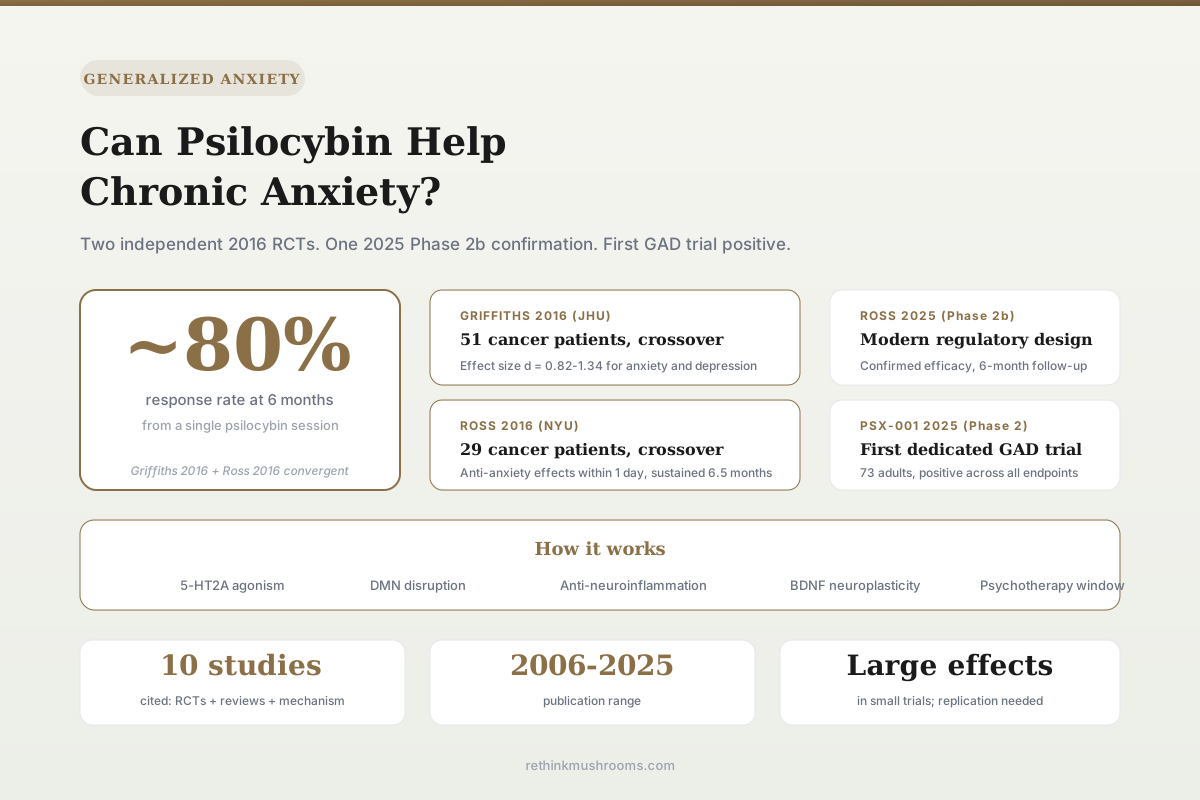
80% sustained response
In a crossover trial of 29 cancer patients with anxiety and depression, a single psilocybin dose produced immediate, substantial, and sustained decreases in anxiety scores, with approximately 80% showing clinically significant response at 6.5 months.
Ross et al., Journal of Psychopharmacology, 2016
2 landmark
crossover RCTs in 2016 (Griffiths JHU, Ross NYU) both showed large, sustained anxiolytic effects
Phase 2b
Ross 2025: psilocybin-assisted psychotherapy for life-threatening illness confirmed efficacy in modern design
Phase 2
Incannex PSX-001 (2025): first dedicated GAD trial reported positive results across all primary endpoints
Ross et al., Journal of Psychopharmacology, 2016
 View as image ↗
Psilocybin has generated some of the most striking anxiety reduction data in modern psychopharmacology. Two landmark 2016 randomized controlled trials in cancer patients with clinically significant anxiety and depression found that a single high-dose psilocybin session produced rapid, large, and sustained decreases in anxiety that persisted for months. A 2025 Phase 2b trial confirmed these findings in a modern regulatory-quality design. And in August 2025, the first dedicated Phase 2 trial of psilocybin for generalized anxiety disorder (GAD) reported positive results across all primary endpoints. This is an unusual trajectory: most psychiatric medications show modest effect sizes in large trials, while psilocybin has shown large effect sizes in small ones. The question is whether those large effects will survive larger, multi-site replication, and whether psilocybin's anxiolytic properties extend beyond the cancer-related distress context where the evidence is strongest.
Key Takeaways
- In a double-blind crossover trial of 51 cancer patients, a single high-dose psilocybin session (22-30 mg/70 kg) produced large decreases in clinician-rated and self-rated anxiety and depression; at 6-month follow-up, approximately 80% of participants showed clinically significant reductions in distress (Griffiths et al., 2016)[1]
- A parallel crossover trial of 29 cancer patients with anxiety and depression found that a single psilocybin dose (0.3 mg/kg) produced immediate, substantial, and sustained anxiolytic and anti-depressant effects; the response rate at 6.5-month follow-up was approximately 80% for both anxiety and depression (Ross et al., 2016)[2]
- A Phase 2b RCT of psilocybin-assisted psychotherapy in adults with life-threatening illnesses confirmed efficacy for depression and anxiety with a modern regulatory design, 6-month follow-up, and open-label extension (Ross et al., 2025)[3]
- In August 2025, Incannex Healthcare reported positive Phase 2 results for PSX-001 (psilocybin 25 mg) in 73 adults with moderate to severe GAD, achieving statistically significant improvements across all primary endpoints with no serious adverse events
- Psilocybin's anxiolytic effects likely operate through 5-HT2A receptor agonism, decreased default mode network overactivity, anti-neuroinflammatory effects, and increased neuroplasticity via BDNF-TrkB signaling (Kinderlehrer, 2025)[4]
- Adults who microdose psychedelics report lower levels of anxiety and depression compared with non-microdosers, though these are observational data subject to self-selection bias (Rootman et al., 2021)[5]
The 2016 Landmark Trials: Two Independent Confirmations
In 2016, two independent research groups published randomized controlled trials of psilocybin in cancer patients with clinically significant anxiety and depression. Both used crossover designs, both found large and sustained effects, and both were published simultaneously in peer-reviewed journals. This dual publication remains one of the strongest convergent evidence events in modern psychedelic research.
Griffiths et al. (Johns Hopkins)
Griffiths et al. (2016) enrolled 51 cancer patients with life-threatening diagnoses and clinically significant anxiety and/or depression. The trial used a randomized, double-blind, crossover design comparing a very low dose (1 or 3 mg/70 kg, functioning as an active placebo) with a high dose (22 or 30 mg/70 kg), with 5 weeks between sessions. The primary outcomes were clinician-rated and self-rated measures of anxiety and depression.[1]
The high dose produced large decreases in both clinician-rated and self-rated anxiety (d = 0.82-1.13) and depression (d = 0.82-1.34). At 6-month follow-up, approximately 80% of participants showed clinically significant reductions in distress. These are unusually large effect sizes for an anxiety intervention: standard anxiolytic medications typically produce effect sizes of 0.3-0.5 in comparable populations.
Ross et al. (NYU)
Ross et al. (2016) enrolled 29 cancer patients with anxiety and depression, using a similar crossover design but with a different dosing approach: 0.3 mg/kg psilocybin versus niacin (as active placebo), both administered in conjunction with psychotherapy. The crossover occurred at 7 weeks.[2]
Results were concordant with the Johns Hopkins trial. Psilocybin produced immediate, substantial, and sustained decreases in anxiety and depression scores. Anti-anxiety effects were apparent within one day of dosing. At 6.5-month follow-up, approximately 80% of participants showed clinically significant response for both anxiety and depression. The response rates were among the highest reported in any psychiatric treatment trial.
The convergence of these two independent trials, conducted at different institutions with different dosing protocols and different research teams, substantially reduces the probability that the results are due to methodological artifact. Both trials were small (29-51 participants), which is a limitation, but the concordance of their findings compensates partially for the individual sample size constraints.
The 2025 Phase 2b Confirmation
Ross et al. (2025) published a Phase 2b randomized controlled trial of psilocybin-assisted psychotherapy in adults with life-threatening illnesses, conducted at a single tertiary hospital's palliative care department from January 2020 to October 2023. This trial used a double-blind design with an active placebo and psychotherapy condition, followed by an open-label extension and 6-month follow-up.[3]
The trial confirmed the 2016 findings in a modern regulatory-quality framework, with updated clinical endpoints, safety monitoring, and reporting standards suitable for Phase 3 planning. The results supported efficacy for depression and anxiety in the context of life-threatening illness.
This matters because the 2016 trials, while groundbreaking, were conducted under earlier clinical trial standards. The 2025 Phase 2b demonstrates that the effect holds under more rigorous modern conditions, strengthening the pathway toward potential regulatory approval.
Generalized Anxiety Disorder: The New Frontier
Most psilocybin anxiety data comes from cancer patients, where the anxiety is existential and situational. The question of whether psilocybin can treat primary anxiety disorders has been less studied until recently.
In August 2025, Incannex Healthcare reported positive Phase 2 results for PSX-001, their psilocybin-assisted psychotherapy protocol for generalized anxiety disorder (GAD). The randomized, double-blind, placebo-controlled trial enrolled 73 adults with moderate to severe GAD. Participants received two dosing sessions with either 25 mg synthetic psilocybin or placebo in a controlled clinical setting. The treatment group achieved statistically significant and clinically meaningful improvements across all primary endpoints. No serious adverse events were reported, and only one of 73 participants withdrew during the 7-week treatment program. Adverse events were transient and consistent with known psilocybin pharmacology.
This is the first controlled trial specifically designed for GAD rather than cancer-related distress. Its positive results suggest that psilocybin's anxiolytic properties may extend beyond existential anxiety to primary anxiety disorders, though the trial used a proprietary psychotherapeutic protocol and the results have not yet been published in a peer-reviewed journal at the time of writing. Additional Phase 2 and Phase 3 trials are actively enrolling for psilocybin in anxiety disorders. For the early-phase research, see psilocybin for generalized anxiety disorder: early research. For the specific RCT data, see psilocybin for generalized anxiety disorder: open-label and RCT evidence.
Mechanisms: Why Psilocybin Reduces Anxiety
Kinderlehrer (2025) reviewed the neurobiological mechanisms through which psilocybin affects mental illness, with particular attention to anxiety and depression. Psilocin (the active metabolite of psilocybin) is a potent serotonin 5-HT2A receptor agonist, but the anxiolytic mechanism involves more than serotonin receptor binding.[4]
Default mode network disruption. The DMN is a brain network active during self-referential thinking, rumination, and worry. DMN overactivity is a neuroimaging hallmark of anxiety disorders. Psilocybin acutely decreases DMN functional connectivity, disrupting the self-referential thought patterns that sustain chronic anxiety. The "mystical experience" reported by many participants may reflect the temporary dissolution of DMN-mediated self-referencing.
Anti-neuroinflammation. Neuroinflammation underlies a significant subset of anxiety and depressive disorders. Psilocin has demonstrated anti-inflammatory properties, reducing pro-inflammatory cytokine production. If chronic anxiety is partially maintained by neuroinflammatory processes, psilocybin's anti-inflammatory action could contribute to sustained relief.
Neuroplasticity. Psilocybin increases BDNF expression and activates TrkB-mTOR signaling, promoting dendritic spine formation and synaptic remodeling. This neuroplasticity window may allow the psychotherapy component of psilocybin-assisted treatment to produce durable cognitive and emotional changes that outlast the acute pharmacological effect.
For the neuroscience of how psilocybin changes the anxious brain, see psilocybin and the anxious brain: neuroscience of relief. For comparison with standard anxiolytics, see psilocybin vs. benzodiazepines for anxiety: mechanisms compared.
Challenging Experiences and Safety
Barrett et al. (2016) developed and characterized the Challenging Experience Questionnaire (CEQ), designed to assess the difficult aspects of psilocybin experiences. The tool measures domains including fear, grief, physical distress, insanity, isolation, death, and paranoia. High-dose psilocybin sessions can produce transient anxiety, fear, and psychological distress during the acute experience, even when the overall outcome is therapeutic.[6]
This is an important nuance for anxiety patients: psilocybin can temporarily increase anxiety during the session itself, even as it produces sustained anxiety reduction in the days and months following. The 2016 landmark trials reported that challenging experiences during dosing sessions were common but manageable with trained therapist support, and that the occurrence of challenging moments did not predict poor long-term outcomes. In fact, some participants who had difficult experiences during the session reported the largest subsequent improvements.
Griffiths et al. (2006) established the foundational safety profile of psilocybin in a healthy volunteer study, demonstrating that when administered in a controlled setting with psychological support, psilocybin produces mystical-type experiences with sustained personal meaning and no lasting adverse effects. This safety framework underpins all subsequent clinical trials.[7]
McClure-Begley et al. (2022) provided a balanced assessment of the "promises and perils" of psychedelic pharmacology, noting that phase II trials have shown statistically significant effects from one or two administrations in depression and anxiety, but cautioning about the "gold rush" of commercial interest and the need for rigorous replication in larger, multi-site trials.[8]
Microdosing and Anxiety: Observational Data Only
Rootman et al. (2021) surveyed adults who microdose psychedelics and found that microdosers reported lower levels of anxiety and depression compared with non-microdosers. The motivations cited for microdosing were primarily health-related, including mood improvement and anxiety reduction.[5]
This is observational, cross-sectional data and cannot establish causation. People who choose to microdose may differ from non-microdosers in systematic ways (education, income, health consciousness, openness to experience) that independently affect anxiety levels. Placebo-controlled microdosing trials for anxiety have not shown the same magnitude of effects as the high-dose therapy trials, consistent with the broader pattern in which sub-perceptual doses produce equivocal results in blinded studies. For how lion's mane compares for anxiety, see can lion's mane reduce anxiety? preclinical and clinical evidence.
Nichols (2020) provided historical and pharmacological context in a comprehensive review, tracing psilocybin from its ceremonial use in Mesoamerica through its mid-20th century psychiatric research, prohibition, and current renaissance. The review noted that the modern clinical program is distinguished by its methodological rigor compared with earlier research and by the consistency of positive findings across independent research groups.[9]
Goel and Zilate (2022) published a systematic review of psilocybin's therapeutic potential, covering depression, anxiety, addiction, and end-of-life distress. For anxiety specifically, they concluded that controlled studies support significant anxiolytic effects, particularly in cancer-related psychological distress, with effects persisting for at least six months after a single acute treatment.[10]
The Bottom Line
The clinical evidence for psilocybin's anxiolytic effects is among the strongest in psychedelic medicine. Two independent 2016 crossover trials in cancer patients found large, sustained anxiety reductions (approximately 80% response rate at 6 months) from a single high-dose session. A 2025 Phase 2b trial confirmed these findings under modern regulatory standards. The first dedicated GAD trial (PSX-001) reported positive results in 73 adults with moderate to severe generalized anxiety disorder. The mechanisms involve 5-HT2A agonism, default mode network disruption, anti-neuroinflammatory effects, and neuroplasticity. Larger, multi-site replication trials are needed before any clinical claims can be made.
Frequently Asked Questions
Sources & References
- 1RTHM-00426·Griffiths, Roland R et al. (2016). “Psilocybin produces substantial and sustained decreases in depression and anxiety in patients with life-threatening cancer: A randomized double-blind trial..” Journal of psychopharmacology (Oxford.Study breakdown →PubMed →↩
- 2RTHM-00445·Ross, Stephen et al. (2016). “Rapid and sustained symptom reduction following psilocybin treatment for anxiety and depression in patients with life-threatening cancer: a randomized controlled trial..” Journal of psychopharmacology (Oxford.Study breakdown →PubMed →↩
- 3RTHM-00949·Ross, Margaret L et al. (2025). “Psilocybin-assisted psychotherapy for depression and anxiety associated with life threatening illness: A phase 2b randomized controlled trial..” General hospital psychiatry.Study breakdown →PubMed →↩
- 4RTHM-00929·Kinderlehrer, Daniel A (2025). “Mushrooms, Microdosing, and Mental Illness: The Effect of Psilocybin on Neurotransmitters, Neuroinflammation, and Neuroplasticity..” Neuropsychiatric disease and treatment.Study breakdown →PubMed →↩
- 5RTHM-00715·Rootman, Joseph M et al. (2021). “Adults who microdose psychedelics report health related motivations and lower levels of anxiety and depression compared to non-microdosers..” Scientific reports.Study breakdown →PubMed →↩
- 6RTHM-00417·Barrett, Frederick S et al. (2016). “The Challenging Experience Questionnaire: Characterization of challenging experiences with psilocybin mushrooms..” Journal of psychopharmacology (Oxford.Study breakdown →PubMed →↩
- 7RTHM-00096·Griffiths, R R et al. (2006). “Psilocybin can occasion mystical-type experiences having substantial and sustained personal meaning and spiritual significance..” Psychopharmacology.Study breakdown →PubMed →↩
- 8RTHM-00787·McClure-Begley, Tristan D et al. (2022). “The promises and perils of psychedelic pharmacology for psychiatry..” Nature reviews. Drug discovery.Study breakdown →PubMed →↩
- 9RTHM-00646·Nichols, David E (2020). “Psilocybin: from ancient magic to modern medicine..” The Journal of antibiotics.Study breakdown →PubMed →↩
- 10RTHM-00760·Goel, Dev B et al. (2022). “Potential Therapeutic Effects of Psilocybin: A Systematic Review..” Cureus.Study breakdown →PubMed →↩