Psilocybin & Anxiety
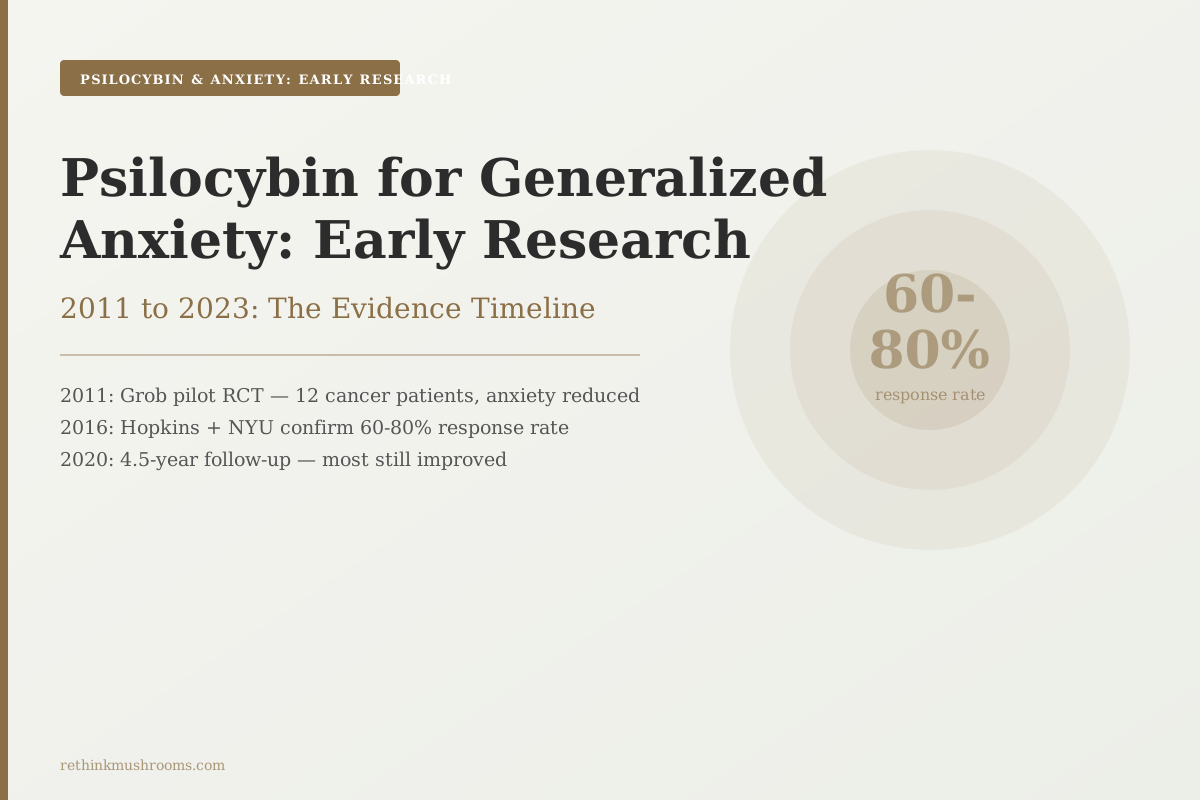
60–80% sustained response
Two independent research teams — Johns Hopkins and NYU — published RCTs in the same 2016 journal issue showing that 60–80% of cancer patients retained clinically significant anxiety reduction six months after a single high-dose psilocybin session.
Griffiths RR et al., J Psychopharmacol, 2016; Ross S et al., J Psychopharmacol, 2016
2011
first modern randomized controlled psilocybin anxiety trial, after a 40-year research gap
4.5 years
follow-up interval at which most of the 15 re-assessed NYU participants still met response criteria
1 of 9
trials in the widely cited 2023 anxiety-disorder review that actually tested psilocybin
Griffiths RR et al., J Psychopharmacol, 2016; Ross S et al., J Psychopharmacol, 2016
 View as image ↗
Modern psilocybin anxiety research did not begin with generalized anxiety disorder. It began with a much more specific and more desperate condition: the existential anxiety of dying. The first modern randomized controlled trial, published in 2011, enrolled twelve people with advanced-stage cancer. That study, and the landmark trials that followed it, produced some of the most striking response and durability data in recent psychiatric research.
It also built an evidence base almost entirely on one population. Understanding what that evidence shows — and who it actually applies to — is the starting point for any honest account of where this field stands. This piece is part of a series on psilocybin and anxiety, including the clinical evidence from cancer populations where most of the research has been conducted.
Key Takeaways
- The first modern randomized controlled trial of psilocybin for anxiety was published in 2011 by Grob and colleagues — 12 advanced-cancer patients, with significant trait-anxiety reduction at 1 and 3 months
- In 2016, two independent teams published landmark RCTs in the same journal issue: Johns Hopkins (Griffiths, N=51) and NYU (Ross, N=29). At six months, roughly 80% and 60–80% of participants respectively still met criteria for clinically significant response
- A 2020 long-term follow-up re-assessed 15 of the NYU participants an average of 4.5 years later; roughly 60–80% still met response criteria, though the study had no remaining control group
- A 2021 meta-analysis of five studies found psilocybin superior to placebo for trait anxiety at 1 day, 2 weeks, and 6 months, alongside a transient rise in blood pressure
- The critical caveat: all of this foundational evidence comes from patients facing a terminal diagnosis, not from a general GAD population — and the psychological mechanisms plausibly differ
- The frequently cited 2023 Feulner review covered nine trials of psychedelics for anxiety disorders, but only one of those nine used psilocybin
The 40-Year Gap: How Psilocybin Anxiety Research Was Shut Down and Restarted
From the mid-1960s through the early 1970s, clinical research with psychedelics was active and producing results. Researchers were studying LSD and psilocybin for anxiety, addiction, and end-of-life distress. Then the 1970 Controlled Substances Act placed psilocybin in Schedule I, the most restrictive federal classification. Research effectively stopped for four decades.
What was lost was not only data. The practical knowledge — how to conduct a psychedelic session, how to prepare a participant, how to integrate the experience afterward — largely left the peer-reviewed literature and had to be reconstructed when research resumed.
When Charles Grob and colleagues at Harbor-UCLA received approval to run the first modern psilocybin anxiety RCT, they were rebuilding protocols with limited recent published precedent. The population they chose was people with advanced-stage cancer: patients facing life-threatening diagnoses and anxiety that standard treatment had not adequately addressed. That choice was pragmatic and ethically defensible. It was also consequential for how everything that followed would be interpreted.
The Evidence Arc, 2011–2023
What Each Study Actually Established
Read left to right and one thing stands out: the response rates are real and repeated, but almost every row says “cancer.” The bar height reflects how much evidentiary weight each entry carries on its own.
2011Grob — Harbor-UCLA
Pilot RCT, double-blind, own-control crossover
Established: That psilocybin (0.2 mg/kg) could be given safely to medically ill patients. Trait anxiety fell significantly at 1 and 3 months.
Cannot: Effect size or durability — a 12-person pilot powered for safety, not efficacy.
2016Griffiths — Johns Hopkins
Double-blind crossover, high vs. placebo-like dose
Established: At 6 months, ~80% still showed clinically significant improvement (83% anxiety response, 78% depression response).
Cannot: Whether the effect holds outside a terminal-diagnosis population.
2016Ross — NYU
Double-blind crossover, psilocybin vs. niacin, both with psychotherapy
Established: Rapid improvement before crossover; at 6.5 months roughly 60–80% retained clinically significant response.
Cannot: Which part of the effect came from psilocybin vs. the paired psychotherapy.
2020Agin-Liebes — NYU follow-up
Within-subjects long-term follow-up of the Ross cohort
Established: At an average of 4.5 years, roughly 60–80% still met response criteria; 71–100% attributed positive life change to the session.
Cannot: Efficacy — no control group remained after the parent trial crossed over. The authors say so explicitly.
2021Yu — meta-analysis
Systematic review and random-effects meta-analysis
Established: Trait anxiety favored psilocybin at 1 day, 2 weeks, and 6 months (Hedges’ g −0.71 to −1.08).
Cannot: Long-term certainty — the authors flag small samples and high heterogeneity.
2023Feulner — anxiety-disorder review
Review of 9 psychedelic-assisted trials
Established: Encouraging symptom reduction across psychedelics in GAD, social anxiety, and medically-related anxiety, with no severe adverse events.
Cannot: A psilocybin-for-GAD conclusion — 8 of the 9 trials tested other drugs.
Sources: Grob 2011 (Arch Gen Psychiatry); Griffiths 2016 and Ross 2016 (J Psychopharmacol); Agin-Liebes 2020 (J Psychopharmacol); Yu 2021 (Psychiatry Investig); Feulner 2023 (Ochsner J).
2011: The First Modern RCT Used 12 Cancer Patients — and Still Held Up
Grob and colleagues published their pilot randomized controlled trial in the Archives of General Psychiatry in 2011.[1] Twelve adults with advanced cancer and clinically significant anxiety received both a moderate dose of psilocybin (0.2 mg/kg) and an active placebo (niacin, 250 mg, which produces a flush that mimics the early physical sensations of the drug) in separate sessions several weeks apart, in a double-blind design where each participant served as their own control.
Worth noting for a piece about generalized anxiety: the participants' anxiety diagnoses were not uniform. They included adjustment disorder with anxiety, acute stress disorder, and in some cases generalized anxiety disorder — but always in the context of an advanced cancer diagnosis. The population was defined by the cancer, not by the anxiety label.
The self-control design mattered methodologically. Each person acting as their own comparison reduces the number of participants needed to detect an effect. It also introduces order effects: if the psilocybin session changed how someone experienced the placebo session, the comparison can be confounded.
On the State-Trait Anxiety Inventory, the trait anxiety subscale showed a significant reduction at one month and three months after treatment. Mood improvement on the Beck Depression Inventory reached significance at six months, while the Profile of Mood States showed improvement that approached but did not reach statistical significance. These were not dramatic results by the standards of what came next. The sample was tiny, the dose was cautious, and the design had limits.
But the study did what a pilot is supposed to do. It established that psilocybin could be given safely to medically ill patients in a controlled setting, that they could tolerate the experience without clinically significant adverse events, and that measurable anxiety reduction followed. It was the proof of concept that justified larger and more rigorous trials.
Grob CS, Danforth AL, Chopra GS, et al. (2011) · Archives of General Psychiatry
- Population
- 12 adults with advanced-stage cancer and clinically significant anxiety
- Intervention
- Psilocybin 0.2 mg/kg, single moderate dose, with psychological support
- Comparator
- Active placebo (niacin 250 mg), sessions several weeks apart, participants as own control
- Finding
- Significant reduction in STAI trait anxiety at 1 and 3 months. No clinically significant adverse events. Mood improvement on the Beck Depression Inventory reached significance at 6 months.
preliminary A 12-person pilot powered to establish feasibility and safety, not to estimate effect size. Its importance is historical and methodological rather than statistical.
Grob et al., Arch Gen Psychiatry, 2011;68(1):71–78. PMID 20819978.
2016: Two Independent Teams Published Landmark RCTs in the Same Journal Issue
In December 2016, the Journal of Psychopharmacology published two major psilocybin anxiety RCTs back to back. They came from independent research teams at institutions on opposite ends of the country, used different protocols and different comparators, and arrived at strikingly similar results.
Griffiths and colleagues at Johns Hopkins enrolled 51 cancer patients with life-threatening diagnoses and symptoms of depression and/or anxiety.[2] They used a double-blind crossover design comparing a high dose of psilocybin (22 or 30 mg per 70 kg) against a very low, placebo-like dose (1 or 3 mg per 70 kg) — low enough to lack substantive psychedelic effects, but not an inert pill, which helped preserve blinding. Sessions were counterbalanced roughly five weeks apart, and participants worked with trained session monitors before, during, and after each one.
Here the details matter, because this trial is often summarized imprecisely. Assessments were taken about five weeks after each session and again at a six-month follow-up. At that six-month follow-up, about 80% of participants were still showing clinically significant decreases in depressed mood and anxiety. Broken out by measure, the six-month clinical response rate was 83% for anxiety and 78% for depression, with symptom remission at 57% and 65% respectively.
The trial also asked participants how much the experience meant to them. At six-month follow-up, 67% rated the psilocybin session among the five most personally meaningful experiences of their lives, and 70% rated it among the five most spiritually significant. Those are remarkable numbers for a pharmacological intervention — and they are lower than the inflated figures that circulate in secondary coverage of this trial.
Ross and colleagues at NYU enrolled 29 patients with cancer-related anxiety and depression in their own double-blind crossover trial.[3] They compared a single moderate dose of psilocybin (0.3 mg/kg) against niacin as an active placebo, with both conditions delivered alongside psychotherapy. Before the crossover, psilocybin produced immediate and substantial improvements in anxiety and depression, along with reductions in demoralization and hopelessness and gains in spiritual wellbeing and quality of life. At the 6.5-month follow-up, approximately 60–80% of participants still met criteria for clinically significant anxiolytic or antidepressant response.
In both trials, the mystical-type quality of the session mediated the therapeutic effect. That is a mechanistically important finding, and it becomes central to the question of whether these results should be expected to generalize.
Two independent institutions, different protocols, converging results, published simultaneously — that is a stronger signal than either trial alone. It is also worth being precise about what it is not: both trials were crossover designs in the same broad population, so the convergence demonstrates reproducibility within cancer-related anxiety rather than breadth across anxiety disorders generally.
For a deeper look at these two trials specifically, see Psilocybin and End-of-Life Anxiety: The NYU and Johns Hopkins Landmark Trials.
4.5 Years Later, Most Re-Assessed Participants Were Still Better
Follow-up in psychedelic research rarely extends past six months. What Agin-Liebes and colleagues published in 2020 was unusual: a long-term follow-up of the original NYU cohort.[4]
All 16 participants from the parent trial who were still alive were contacted, and 15 agreed to take part. They were assessed at an average of 3.2 years and again at 4.5 years after their psilocybin session. Reductions in anxiety, depression, hopelessness, demoralization, and death anxiety were sustained at both time points, with large within-group effect sizes. At the 4.5-year assessment, roughly 60–80% still met criteria for clinically significant antidepressant or anxiolytic response, and between 71% and 100% of participants attributed positive life changes to the experience.
That durability is genuinely unusual. Benzodiazepines lose effectiveness as tolerance develops. SSRIs generally must be taken continuously, and anxiety often returns when they are stopped. A single supervised psilocybin session associated with maintained benefit years later is a fundamentally different profile.
Two honest qualifications belong next to that claim. First, the parent trial used a crossover design, which means that by the time of long-term follow-up there was no untreated control group left to compare against — the authors themselves state that limited conclusions about efficacy can be drawn for this reason. Second, this is 15 people, self-reporting, who knew what they had received. The finding is a strong signal worth pursuing, not a demonstration of long-term efficacy.
A 2021 systematic review and meta-analysis by Yu and colleagues pooled five studies of psilocybin for end-of-life anxiety.[5] Psilocybin outperformed placebo on state anxiety at 1 day and 2 weeks, and on trait anxiety at 1 day, 2 weeks, and 6 months, with effect sizes ranging from moderate to large (Hedges' g between −0.70 and −1.08). Discontinuation, serious adverse events, and heart rate did not differ significantly from placebo. Psilocybin was, however, associated with a transient rise in blood pressure — roughly 19 mmHg systolic and 9 mmHg diastolic. The authors were explicit that small sample sizes and high heterogeneity in the long-term outcomes mean larger trials are still needed.
Cardiovascular
ModerateThe transient blood pressure rise is the most consistently measured physiological risk
Concern
Pooled trial data show psilocybin produces a temporary increase of roughly 19 mmHg systolic and 9 mmHg diastolic blood pressure during the session, compared with placebo.
What the research says
In the supervised trial setting this elevation was transient and was not associated with serious adverse events, and heart rate did not differ significantly from placebo.
Particularly relevant for: Of particular relevance to anyone with uncontrolled hypertension or existing cardiovascular disease — populations that were generally screened out of these trials.
What to do
This is one reason the foundational trials were conducted with medical monitoring. It is not a risk profile established for unsupervised use.
Yu et al., Psychiatry Investigation, 2021;18(10):958–967. PMID 34619818.
The Critical Caveat: This Evidence Comes From Cancer Patients
This point deserves its own section, because it is routinely omitted from general summaries of psilocybin anxiety research.
The 2011 Grob pilot, the 2016 Griffiths and Ross RCTs, and the 2020 Agin-Liebes follow-up all enrolled people with advanced cancer. Their anxiety was largely existential: fear of death, loss of identity and purpose, unfinished relationships, dread of suffering. That form of distress has a specific psychological texture, and it differs from generalized anxiety disorder, which affects roughly 3% of adults in a given year.
People with GAD experience chronic, pervasive worry that is not anchored to a terminal diagnosis. The worry is diffuse, persistent, shifts between topics, and is often disproportionate to circumstances. There is no single concrete object — no fact of dying — to confront and reframe.
That distinction is not merely demographic, and this is the crux of the generalization problem. In both 2016 trials, the mystical-type experience statistically mediated the therapeutic effect. In a dying patient, that mechanism has an obvious target: confronting mortality with a new frame, finding acceptance or meaning, loosening the fear of non-existence. Whether the same mechanism does useful work in generalized anxiety — where there is no death to accept — is an open empirical question rather than a settled one.
Two Different Anxieties
Why Cancer-Anxiety Results Do Not Automatically Become GAD Results
The foundational trials are strong studies of a population most readers are not in. Some of what they found should carry across. Some of it plausibly should not. This is the gap the field is currently working to close.
What the worry attaches to
May not transferCancer / existential anxiety
A concrete, known object — a terminal diagnosis and the fact of dying.
Generalized anxiety disorder
Diffuse and shifting — work, health, money, relationships, often with no fixed object.
Time course
UnclearCancer / existential anxiety
Reactive and recent, arriving with the diagnosis.
Generalized anxiety disorder
Chronic and long-standing, frequently present for years before treatment.
Proposed mechanism of benefit
May not transferCancer / existential anxiety
Mystical-type experience mediated the effect in both 2016 trials — reframing death, finding acceptance and meaning.
Generalized anxiety disorder
No death to accept. Whether the same mediator does the work is untested.
Psychotherapy pairing
Likely transfersCancer / existential anxiety
Delivered with structured preparation, supervised dosing, and integration sessions.
Generalized anxiety disorder
Same model used in the GAD trials so far — so this dimension does carry over.
Safety and tolerability
Likely transfersCancer / existential anxiety
No serious adverse events across the foundational trials; transient blood pressure rise.
Generalized anxiety disorder
Early GAD trial data also reports no serious adverse events. Safety is the most transferable finding.
Durability of benefit
UnclearCancer / existential anxiety
Response retained at 6.5 months and, in a follow-up subset, at ~4.5 years.
Generalized anxiety disorder
Longest reported GAD follow-up is measured in weeks, not years.
Mechanism and durability entries reflect Griffiths 2016, Ross 2016, and Agin-Liebes 2020; safety entries reflect Yu 2021 and Feulner 2023. GAD-column entries reflect the current early-stage GAD trial literature.
Citation Check
The 'nine trials' claim about psilocybin and GAD
The claim
“A 2023 review of nine clinical trials found that psilocybin consistently reduces anxiety in generalized anxiety disorder.”
The Feulner 2023 review is real and is frequently cited this way in secondary coverage and supplement marketing.
What research shows
MisleadingFeulner and colleagues reviewed nine psychedelic-assisted trials in clinician-diagnosed anxiety disorders. Four used ketamine, two used LSD, one used ayahuasca, one used MDMA — and one used psilocybin.
The review's actual conclusion — that psychedelics as a class show encouraging efficacy and safety in anxiety disorders including GAD, with no severe adverse events reported — is a legitimate and useful finding. It simply is not nine trials of psilocybin, and it should not be cited as though it were.
Feulner et al., Ochsner Journal, 2023;23(4):315–328. PMID 38143548.
Reading the “Nine Trials” Figure Correctly
What Was Actually Tested in the Feulner 2023 Review
This review is frequently cited as evidence that psilocybin works for generalized anxiety disorder. It is a review of psychedelics broadly. Only one of its nine trials used psilocybin at all — a distinction that changes what the paper can support.
Ketamine
4 of 9 trialsThe single largest block of the review — and pharmacologically a dissociative, not a classic psychedelic.
LSD
2 of 9 trialsClassic serotonergic psychedelic, closest mechanistic cousin to psilocybin in this set.
Ayahuasca
1 of 9 trialsDMT-containing brew with an MAOI component; different pharmacokinetics entirely.
MDMA
1 of 9 trialsAn entactogen, mechanistically distinct from psilocybin.
Psilocybin
1 of 9 trialsOne trial. This is the entire psilocybin contribution to the "nine trials" figure.
The honest read: Feulner and colleagues concluded that psychedelics as a class show encouraging efficacy and safety in clinician-diagnosed anxiety disorders, including GAD. That is a real and useful finding. It is not the same as nine trials showing that psilocybin treats GAD.
Source: Feulner et al., “Efficacy and Safety of Psychedelics in Treating Anxiety Disorders,” Ochsner Journal, 2023;23(4):315–328.
The Feulner 2023 review searched for trials across the full range of clinician-diagnosed anxiety conditions — generalized anxiety disorder, social anxiety disorder, panic disorder, specific phobia, agoraphobia, separation anxiety disorder, selective mutism, and anxiety attributable to another medical condition.[6] Across the nine trials it analyzed, the reviewed studies showed encouraging reductions in anxiety symptoms and improvements in social function, with therapeutic effects lasting weeks for many patients and no severe adverse events reported. The authors concluded that psychedelics could be considered for clinician-diagnosed anxiety disorders, particularly in patients resistant to standard treatment.
That is meaningful evidence that GAD is being studied and that the broader psychedelic class shows promise there. It is not psilocybin-specific GAD evidence, and the distinction matters when weighing what is actually known.
Where the GAD-Specific Evidence Stands
The move from cancer-anxiety evidence to GAD-specific evidence is the current frontier of the field, and it is genuinely early.
The most direct test so far is the Incannex Psi-GAD trial, a Phase 2 randomized, double-blind, placebo-controlled study designed specifically for generalized anxiety disorder. Its topline results were reported by the sponsor as positive. An important caveat travels with those numbers: they were released as company topline announcements rather than through peer-reviewed publication, which means they have not yet been subject to independent review of the full dataset and analysis. They should be read as promising and provisional.
A second independent Phase 2 trial is underway. Registered as NCT06969170 and led by Queen's University with Diamond Therapeutics as a collaborator, it is recruiting 50 adults with generalized anxiety disorder to evaluate the safety, tolerability, and preliminary efficacy of a psilocybin oral solution. Independent replication is the standard that the GAD question has not yet met, and this trial is a step toward it.
For a fuller treatment of the GAD-specific trial data, see Psilocybin for Generalized Anxiety Disorder: Open-Label and RCT Evidence. For the mechanistic picture — what psilocybin appears to be doing in the anxious brain regardless of diagnosis — see Psilocybin and the Anxious Brain: Neuroscience of Relief.
- Mechanistic and receptor workcompleted
5-HT2A agonism and downstream plasticity effects are well characterized.
- Animal modelscompleted
Preclinical anxiolytic and fear-extinction signals are established.
- Case reports and open-label workcompleted
Available across multiple anxiety presentations.
- Small GAD-specific randomized trialscurrent
One sponsor-reported Phase 2 trial, plus a second independent Phase 2 trial now recruiting.
- Large independent Phase 3 RCT in GADmissing
None completed. This is the standard that would support clinical conclusions.
- Meta-analysis of GAD-specific trialsmissing
A meta-analysis exists for end-of-life anxiety, but not for GAD — there are too few trials to pool.
The cancer-anxiety literature has reached meta-analysis. The GAD-specific literature is still at the small-trial stage, with peer-reviewed replication outstanding. These are two different evidence positions that are frequently reported as one.
Yu 2021 (PMID 34619818); Feulner 2023 (PMID 38143548); ClinicalTrials.gov NCT06969170.
The Bottom Line
The early psilocybin anxiety evidence is consistent and, in places, remarkable. From the 2011 Grob pilot through the twin 2016 Hopkins and NYU RCTs to the 2020 long-term follow-up, the data show 60–80% response rates sustained at six months and, in a small re-assessed subset, at 4.5 years — durability that standard anxiolytics do not produce. A 2021 meta-analysis of five studies confirmed moderate-to-large effect sizes with a transient blood pressure rise as the main physiological signal. The essential caveat is one of population: this foundational evidence comes from patients facing a terminal diagnosis, where the mystical-type experience mediating the effect had a clear target. The frequently cited 2023 review that extends the picture to generalized anxiety disorder covered nine trials, only one of which used psilocybin. GAD-specific psilocybin evidence exists but remains at the small-trial stage, with independent peer-reviewed replication still outstanding.
Frequently Asked Questions
Sources & References
- 1RTHM-00397·Grob, Charles S et al. (2011). “Pilot study of psilocybin treatment for anxiety in patients with advanced-stage cancer..” Archives of general psychiatry.Study breakdown →PubMed →↩
- 2RTHM-00426·Griffiths, Roland R et al. (2016). “Psilocybin produces substantial and sustained decreases in depression and anxiety in patients with life-threatening cancer: A randomized double-blind trial..” Journal of psychopharmacology (Oxford.Study breakdown →PubMed →↩
- 3RTHM-00445·Ross, Stephen et al. (2016). “Rapid and sustained symptom reduction following psilocybin treatment for anxiety and depression in patients with life-threatening cancer: a randomized controlled trial..” Journal of psychopharmacology (Oxford.Study breakdown →PubMed →↩
- 4RTHM-01160·Agin-Liebes, Gabrielle I et al. (2020). “Long-term follow-up of psilocybin-assisted psychotherapy for psychiatric and existential distress in patients with life-threatening cancer..” Journal of psychopharmacology (Oxford.Study breakdown →PubMed →↩
- 5RTHM-01466·Yu, Chia-Ling et al. (2021). “Psilocybin for End-of-Life Anxiety Symptoms: A Systematic Review and Meta-Analysis..” Psychiatry investigation.Study breakdown →PubMed →↩
- 6RTHM-01693·Feulner, Leah et al. (2023). “Efficacy and Safety of Psychedelics in Treating Anxiety Disorders..” Ochsner journal.Study breakdown →PubMed →↩