Psilocybin & Anxiety
4.5 yrs maintained improvement
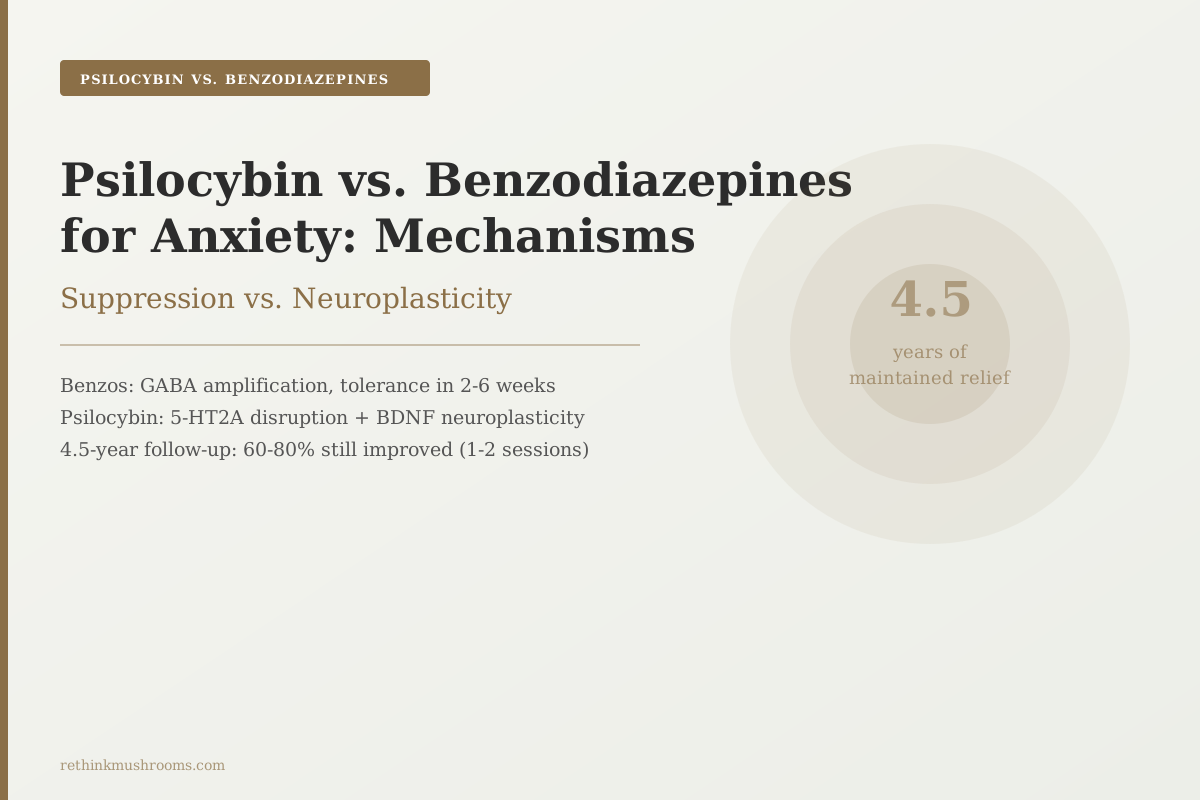
A 2020 follow-up study of psilocybin-treated cancer patients found 60-80% still maintained clinically significant anxiety reduction at 4.5 years — from one or two sessions. Benzodiazepines, taken daily, develop tolerance within weeks.
Agin-Liebes GI et al., Journal of Psychopharmacology, 2020
2-6 wks
typical timeframe for benzodiazepine tolerance to develop with regular use
6 months
maintained anxiety response in the 2016 Hopkins and NYU psilocybin RCTs
0
cases of psilocybin physical dependence or withdrawal syndrome documented in clinical trials
Agin-Liebes GI et al., Journal of Psychopharmacology, 2020
 View as image ↗
Benzodiazepines and psilocybin both reduce anxiety. They do so through mechanisms so different that comparing them clarifies something important about how anxiety treatment can work. One amplifies the brain's calming signal, provides immediate relief, and loses effectiveness as the brain adapts to it. The other disrupts the brain's rigid fear circuits, triggers structural changes in how neurons connect, and appears to produce benefit that outlasts the drug by months or years.
This comparison is part of a broader series on psilocybin for anxiety. It is not an argument that psilocybin should replace benzodiazepines in every context. Benzodiazepines have clinical roles where they are the right tool. The comparison is about long-term anxiety management — and there, the mechanisms produce a meaningful practical difference.
Key Takeaways
- Benzodiazepines reduce anxiety by amplifying GABA, the brain's primary calming signal, at the GABA-A receptor — producing immediate sedation and anxiolysis but causing tolerance within 2-6 weeks and physical dependence with regular use
- Psilocybin reduces anxiety through 5-HT2A receptor activation (disrupting rigid fear networks and decreasing amygdala reactivity) and BDNF-driven neuroplasticity that restructures how anxiety-maintaining circuits are organized
- The 2016 Hopkins and NYU RCTs found 60-80% anxiety response maintained at 6 months from single psilocybin sessions; a 2020 follow-up found 60-80% of participants still improved at 4.5 years
- Psilocybin does not cause the tolerance that benzodiazepines do; 5-HT2A receptors downregulate after activation (which is why repeated sessions require longer intervals, not higher doses), but no dose-escalation pattern occurs
- Combining benzodiazepines with psilocybin blunts the therapeutic and psychedelic effects; clinical psilocybin protocols require tapering benzodiazepines before treatment begins
- Benzodiazepines remain appropriate for acute anxiety situations (panic, procedures, crisis); this comparison applies to long-term anxiety management, where their limitations are most pronounced
How Benzodiazepines Work: Immediate Relief at the Cost of Dependency
Benzodiazepines, which include alprazolam (Xanax), diazepam (Valium), clonazepam (Klonopin), and lorazepam (Ativan), reduce anxiety by amplifying the brain's main calming signal. That calming signal is a chemical called GABA. GABA works by slowing neural activity — when it binds to its receptor on a neuron, the neuron becomes less likely to fire.
The receptor GABA uses, called the GABA-A receptor, has a site where benzodiazepines can bind separately from where GABA binds. When a benzodiazepine is present at that separate site, it makes the receptor respond more strongly when GABA arrives. The GABA signal gets amplified. Neurons slow down faster, stay quiet longer, and the physical sensations of anxiety — the racing heart, tense muscles, vigilant alertness — subside. The effect is real and immediate, typically within 30 to 60 minutes.
This is why benzodiazepines are effective for acute situations: panic attacks, pre-procedure anxiety, acute agitation, alcohol withdrawal. They can rapidly calm a nervous system that is running dangerously hot.
The problem with regular use is tolerance. When the GABA-A receptor is activated more than it was designed to be, the brain compensates. The receptor becomes less sensitive to the benzodiazepine signal over time. The same dose produces less effect. This tolerance typically develops within two to six weeks of regular use. The practical consequence: patients need higher doses to achieve the same effect, or they start experiencing anxiety between doses.
Physical dependence follows from the same process. When the receptor has adapted to enhanced GABA signaling and the benzodiazepine is suddenly removed, the receptor is now undersensitive relative to baseline. GABA can no longer calm it adequately on its own. The result is rebound anxiety, which is often more intense than the original anxiety being treated, along with physical withdrawal symptoms that can include seizures in severe cases. The World Health Organization classifies benzodiazepine withdrawal as one of the most medically dangerous withdrawal syndromes, comparable to alcohol withdrawal.
Cognitive impairment is a consistent side effect with regular use: slowed memory consolidation, reduced attention, psychomotor slowing. Falls in elderly patients are a significant clinical concern. Long-term benzodiazepine use is associated with cognitive decline, though causality is debated in the literature.
The critical limitation for anxiety treatment: benzodiazepines suppress the symptoms of anxiety while the drug is active but do not address or change the underlying neural patterns that maintain anxiety. When the drug is stopped, the anxiety circuit runs as it always did.
How Psilocybin Works: Two Mechanisms, Neither of Which Causes Dependency
Psilocybin acts on anxiety through two main receptor mechanisms, each producing different effects on different timescales.
The first mechanism operates at the 5-HT2A receptor, the primary serotonin receptor responsible for psilocybin's psychedelic properties. These receptors are found densely in the prefrontal cortex, the brain region responsible for executive function, flexible thinking, and regulation of emotional responses from the amygdala. When psilocybin activates 5-HT2A receptors, the orderly firing patterns of neural circuits in the cortex become temporarily disrupted. The habitual pathways that maintain automatic fear responses and chronic worry loops cannot run on their usual tracks.
Kraehenmann and colleagues demonstrated one specific consequence of this mechanism: psilocybin decreased amygdala reactivity to negative emotional stimuli, and the degree of that quieting correlated directly with improvement in positive mood.[5] The amygdala, the brain's threat-detection center, which fires excessively and easily in anxiety disorders, is recalibrated rather than simply suppressed.
The second mechanism operates at the 5-HT1A receptor, psilocybin's secondary serotonin target. When psilocybin activates 5-HT1A receptors in the thalamus (the brain's sensory gatekeeper) and prefrontal cortex, it promotes the release of GABA at those sites. This is the counterintuitive part: psilocybin produces anxiolytic effects partly through GABA-mediated inhibition, just like benzodiazepines. But the sites and mechanisms differ. Benzodiazepines amplify GABA globally throughout the brain; psilocybin promotes GABA release at specific sites involved in threat processing. The effects are selective, not sedating.
The third mechanism operates over a longer timescale. Psilocybin upregulates BDNF, the brain's primary growth and maintenance signal. BDNF elevation, which persists for days to weeks after a session, promotes the formation of new dendritic spines and synaptic connections. New synaptic connections in circuits that have been restructured by the acute psilocybin experience can become lasting changes when reinforced by therapeutic integration. This is the mechanism for durable benefit: not a temporary suppression of symptoms, but a reorganization of the underlying circuits.
No case of psilocybin physical dependence has been documented in clinical trials. There is no withdrawal syndrome. There is a form of rapid tolerance to the psychedelic experience itself: if someone takes psilocybin on consecutive days, the second experience is noticeably diminished. This is because 5-HT2A receptors downregulate after being activated. But this receptor adaptation does not cause the dose-escalation cycle seen with benzodiazepines. Clinical psilocybin protocols use extended intervals between sessions precisely because of this receptor kinetics, and the therapeutic effect from each session continues across those intervals.
The Duration Gap: Daily Pills vs. One Session That Lasts Years
The comparison of treatment duration is where the practical difference becomes most stark.
Griffiths and colleagues at Johns Hopkins found that a single high-dose psilocybin session produced clinically significant anxiety and depression reduction in 80% of cancer patients at six weeks, maintained at six months.[1] Ross and colleagues at NYU found a 60-80% response rate within one day of a single session, maintained at 6.5 months in the same proportion of participants.[2]
A 2021 systematic review and meta-analysis by Yu and colleagues synthesized the end-of-life psilocybin anxiety evidence and confirmed large effect sizes and sustained benefits across the published trial set.[4]
Agin-Liebes and colleagues then extended the follow-up dramatically.[3] In 2020, they reassessed participants from the original NYU Ross trial at an average of 4.5 years post-treatment. Of the 15 participants who could be reached and consented to follow-up, 60-80% still maintained clinically significant reductions in anxiety and depression. Most attributed lasting improvements in their quality of life, sense of meaning, and emotional relationships to their psilocybin experience from years earlier.
One or two sessions producing 4.5 years of maintained benefit is a pharmacological profile that does not exist in the benzodiazepine literature. Benzodiazepines require daily dosing to maintain effect and lose that effect as tolerance develops. The comparison is not about which drug works better in the first hour. It is about what each produces over the course of years.
The honest limitation: the psilocybin trials were in cancer patients, not the general GAD population. The psychological context — confronting death, finding acceptance — may be a significant contributor to the durability of the effect in that group. Whether the same durability would be found in GAD patients is not yet established.
Why Psilocybin Doesn't Cause Tolerance While Benzodiazepines Do
Tolerance works differently for each mechanism.
With benzodiazepines, the GABA-A receptor undergoes desensitization. When it is stimulated more than usual, the receptor adapts by becoming less sensitive — it starts requiring more benzodiazepine to achieve the same enhancement of GABA's signal. The patient needs a higher dose to get the same anxiolytic effect they got from the original dose six weeks earlier.
With psilocybin's 5-HT2A mechanism, the opposite pattern occurs acutely: 5-HT2A receptors become less sensitive after activation, making a second consecutive session less effective. This is why clinical psilocybin protocols space sessions weeks apart. But this receptor adaptation does not produce a dose-escalation cycle. It produces a required rest period — and during that rest period, the neuroplastic effects from the previous session are consolidating. The two properties are linked: the receptor quiets down, and the structural changes have time to settle.
The result is that psilocybin tolerance limits repetition but does not require dose escalation. Benzodiazepine tolerance requires dose escalation and creates physical dependence if the dose is not continually raised or the drug is not carefully tapered.
For readers interested in the 5-HT2A mechanism in more detail, Psilocybin and 5-HT2A: The OCD Serotonin Connection covers the same receptor mechanism in a related anxiety context.
The Critical Interaction: Benzodiazepines Block Psilocybin's Therapeutic Effect
If someone is currently taking benzodiazepines and is considering psilocybin therapy, there is a specific pharmacological interaction that every clinical psilocybin protocol accounts for.
Benzodiazepines blunt psilocybin's psychedelic effects. When GABA-A is amplified by a benzodiazepine, the cortical disruption that psilocybin normally produces via 5-HT2A is attenuated. The experience is reduced in depth and altered in character. The therapeutic outcomes appear to be correspondingly diminished.
This is why clinical psilocybin protocols across current research settings require participants to taper and discontinue benzodiazepines before beginning psilocybin treatment. The taper takes time and must be done carefully given benzodiazepine withdrawal risk. Patients who have been on benzodiazepines long-term may face a significant transition period before they are eligible for psilocybin therapy.
Benzodiazepines are not forbidden during psilocybin sessions in an absolute safety sense. They are kept available as an emergency intervention if a participant experiences severe distress that cannot be managed through psychological support alone. In that context, a small dose of a benzodiazepine can provide an "emergency brake" — significantly reducing the intensity of the psilocybin experience rapidly. This is available to clinical research staff as a contingency, not as a routine part of sessions.
Where This Comparison Applies — and Where Benzodiazepines Are the Right Tool
This comparison is specifically about long-term anxiety management in people with ongoing anxiety conditions. It is not an argument that benzodiazepines should be avoided in every situation.
Benzodiazepines are appropriate and sometimes the best available tool for acute anxiety situations: panic attacks that need rapid intervention, anxiety before medical or surgical procedures, acute agitation, alcohol withdrawal syndrome. In these contexts, the immediacy of their mechanism is an advantage and the long-term tolerance problem is not relevant because the drug is not being used daily over weeks.
The population where benzodiazepines are problematic is people who are prescribed them for chronic anxiety conditions and who take them daily over months or years. In that population, tolerance typically develops, efficacy degrades, and the dose required to maintain effect increases until the patient is dependent on the drug without having reliably controlled anxiety anymore.
Psilocybin, as a potential alternative for that population, remains experimental. It is not approved for generalized anxiety disorder. It is accessible only through clinical trials in most jurisdictions. For the comparison to be clinically relevant, it requires completing the evidence development process: larger GAD-specific trials, replication of results, regulatory review. For evidence on where that process currently stands, see Psilocybin for Generalized Anxiety Disorder: Open-Label and RCT Evidence.
For the full neuroscience of what psilocybin does in the anxious brain, see Psilocybin and the Anxious Brain: Neuroscience of Relief. And for the early research that established the clinical evidence base, see Psilocybin for Generalized Anxiety Disorder: Early Research.
The Bottom Line
Benzodiazepines and psilocybin differ in mechanism, durability, and dependency profile. Benzodiazepines enhance GABA to suppress anxiety acutely — effective but subject to tolerance within weeks and physical dependence with regular use. Psilocybin disrupts rigid fear circuits through 5-HT2A and promotes BDNF-driven neuroplasticity, producing effects that outlast the drug by months to years with no tolerance or withdrawal. The 4.5-year follow-up data is the most concrete expression of this difference. A critical interaction: benzodiazepines blunt psilocybin's therapeutic effects, requiring tapering before psilocybin treatment. Both tools have their appropriate contexts; the comparison is specifically about long-term anxiety management where benzodiazepines' limitations become most clinically relevant.
Frequently Asked Questions
Sources & References
- 1. Source details for this reference are not yet available.
- 2. Source details for this reference are not yet available.
- 3. Source details for this reference are not yet available.
- 4. Source details for this reference are not yet available.
- 5. Source details for this reference are not yet available.