Psilocybin & Anxiety
12.8 vs. 3.6 pts HAM-A
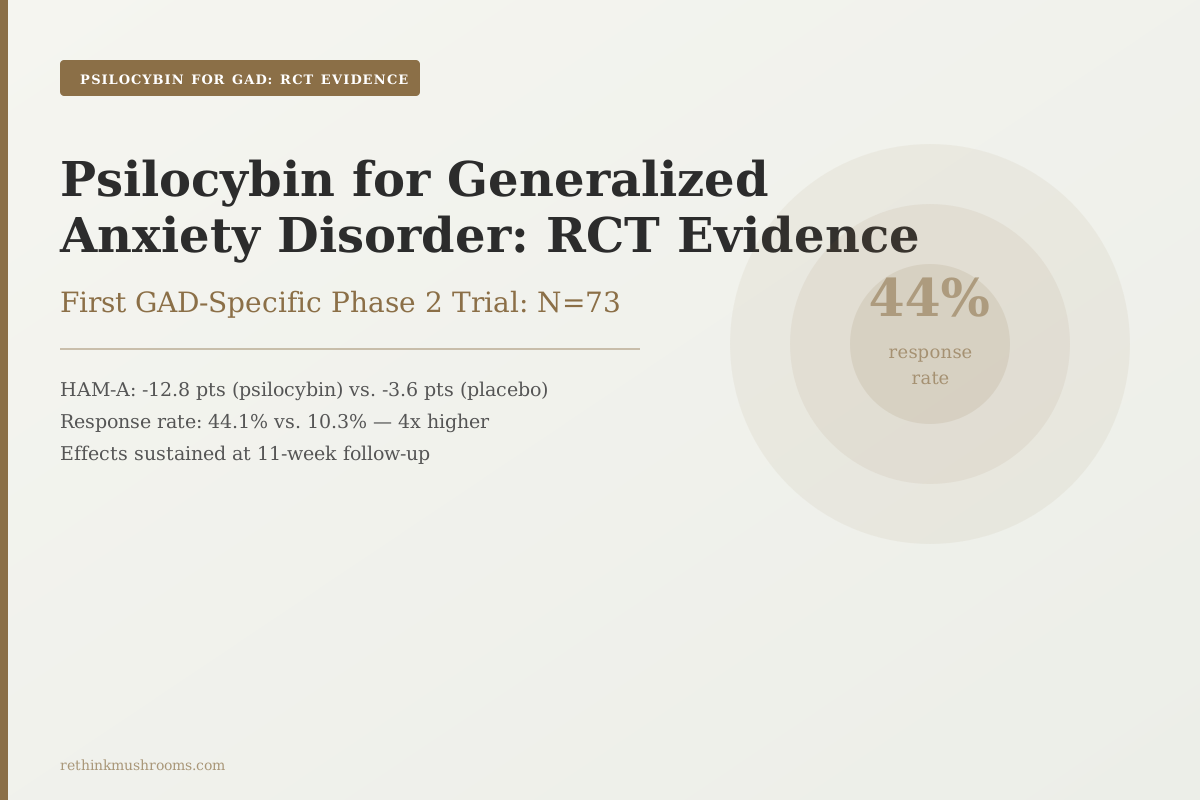
The first Phase 2 randomized controlled trial designed specifically for generalized anxiety disorder found a 12.8-point reduction in anxiety scores for psilocybin versus 3.6 points for placebo — a statistically significant result with a 44.1% response rate, sustained at 11-week follow-up.
Incannex Healthcare Psi-GAD Phase 2 Trial, topline results
44.1%
response rate in the Psi-GAD trial — more than four times the placebo response of 10.3%
N=73
participants in the first GAD-specific double-blind psilocybin RCT
4.5 yrs
follow-up in the NYU cancer trial, where most participants still showed maintained benefit
Incannex Healthcare Psi-GAD Phase 2 Trial, topline results
 View as image ↗
The most important thing to understand about the psilocybin and generalized anxiety disorder evidence base is what it mostly does not include. The foundational trials, the ones with the largest sample sizes and most rigorous designs, were conducted in cancer patients facing existential anxiety at end of life. That population and their condition differ meaningfully from generalized anxiety disorder, which affects people without terminal diagnoses and involves chronic, diffuse worry that is often disproportionate to actual circumstances. This piece is part of a series on psilocybin for anxiety, including the landmark trials from the cancer setting that established the evidence base.
For readers who need to understand what the current evidence actually covers for psilocybin generalized anxiety disorder research, this article separates the populations clearly, covers what the cancer trial data does and does not tell us about GAD, and presents the most recent GAD-specific trial data — including the first Phase 2 randomized controlled trial designed specifically for this diagnosis.
Key Takeaways
- The foundational psilocybin anxiety trials (Griffiths 2016, Ross 2016, Agin-Liebes 2020) were conducted in cancer patients with existential anxiety — a distinct condition from generalized anxiety disorder
- A 2023 review by Feulner and colleagues examined nine psychedelic clinical trials specifically across anxiety disorders including GAD, social anxiety, and anxiety secondary to medical conditions — all showed anxiety reduction
- The first Phase 2 RCT designed specifically for generalized anxiety disorder (Incannex Psi-GAD, N=73) found a 12.8-point HAM-A reduction for psilocybin versus 3.6 points for placebo, P less than 0.0001, with a 44.1% response rate
- The Psi-GAD response rate was more than four times the placebo response rate of 10.3%, and effects were sustained at the 11-week follow-up assessment
- No adverse effects reached serious or severe classification; one participant withdrew during treatment; no increased suicidality or psychosis was documented
- Psilocybin is not approved for generalized anxiety disorder anywhere; it remains experimental and is only accessible through clinical trials and, in some jurisdictions, compassionate access programs for other indications
What the GAD Evidence Base Actually Contains — and What It Mostly Does Not
Most articles about "psilocybin for anxiety" present the evidence as if it were a unified body of research. It is not. The published evidence comes from multiple different populations, anxiety types, and research contexts that are worth separating clearly.
The cancer anxiety evidence includes five trials and analyses: the 2011 Grob pilot (12 patients), the 2016 Griffiths Hopkins RCT (51 patients), the 2016 Ross NYU RCT (29 patients), the 2020 Agin-Liebes long-term follow-up (15 participants from the NYU trial), and the 2021 Yu meta-analysis of end-of-life anxiety trials. All of these involve existential anxiety in people with life-threatening medical diagnoses.
The GAD-specific evidence is newer and smaller. The Feulner 2023 review, which explicitly included GAD alongside other anxiety diagnoses, represents the published bridge between the cancer evidence and the GAD-specific question. The Incannex Psi-GAD Phase 2 trial represents the first purpose-built GAD randomized controlled trial.
This distinction matters for interpretation. When you read that "80% of cancer patients showed significant anxiety reduction after psilocybin," that is a real finding about a real population. Applying it directly to generalized anxiety disorder in the general population requires inference that the data does not fully support — at least not yet.
What the Cancer RCTs Tell Us About Psilocybin and Anxiety — and Their Limits
The Johns Hopkins RCT by Griffiths and colleagues enrolled 51 cancer patients with life-threatening diagnoses and clinically significant depression and anxiety.[3] In a double-blind crossover design comparing high-dose psilocybin against a very low pharmacologically active dose, 80% of participants showed clinically significant reductions in both depression and anxiety at six weeks. The effect was maintained at six months.
The NYU RCT by Ross and colleagues enrolled 29 cancer patients in a similar crossover design comparing psilocybin against niacin as an active placebo.[4] Significant anxiety and depression reductions appeared within one day of the psilocybin session. The 60-80% response rate was maintained through 6.5 months.
The long-term follow-up by Agin-Liebes and colleagues assessed the NYU participants at an average of 4.5 years post-treatment.[5] Of those reachable, 60-80% still maintained the clinically significant improvements. Most attributed lasting changes in attitude, mood, and relational quality to their psilocybin experience.
What these trials do not tell us: whether the same response rates would be found in people with generalized anxiety disorder. The psychological mechanism in cancer patients appears to involve confronting and reframing the specific existential threat of death. GAD patients are not facing a terminal diagnosis. The worry that drives GAD is often about ordinary circumstances: health, finances, relationships, work. Whether psilocybin's disruption of rigid fear circuits produces the same benefit in this different psychological context is what the GAD-specific trials are designed to test.
The First Phase 2 RCT Designed Specifically for GAD: 73 Patients, Statistically Significant Results
The Incannex Healthcare Psi-GAD trial is the first randomized, double-blind, placebo-controlled Phase 2 trial designed specifically for generalized anxiety disorder.
The trial enrolled 73 adults with moderate-to-severe GAD. Participants received two dosing sessions of 25mg synthetic psilocybin with psychotherapeutic support, or placebo with equivalent support. The design mirrors the structure of psilocybin depression trials: carefully prepared participants, therapeutic support during sessions, integration sessions after.
The primary outcome measure was the Hamilton Anxiety Rating Scale (HAM-A), a 14-item clinician-administered assessment covering both psychological and physical anxiety symptoms — persistent worry, tension, fear, insomnia, concentration difficulty, and somatic symptoms like muscle tension and cardiovascular reactivity. A score above 18 indicates moderate-to-severe anxiety. A reduction of 7 or more points is typically considered a clinically meaningful response.
Topline results: the psilocybin group showed a 12.8-point reduction in HAM-A scores. The placebo group showed a 3.6-point reduction. The difference was statistically significant at P less than 0.0001. The secondary outcome measure, the GAD-7 (a patient self-report tool), showed a 7.4-point reduction for psilocybin versus 3.5 points for placebo, also statistically significant (P less than 0.0004).
The response rate, defined as 50% or greater reduction in HAM-A score, was 44.1% for psilocybin versus 10.3% for placebo — more than four times higher. Effects were maintained at the 11-week follow-up assessment.
Safety: no serious adverse events were reported. One of 73 participants withdrew during the treatment period. The adverse events that did occur were characterized as transient and mild to moderate in severity. No increase in suicidality or psychosis was documented.
A critical note on sourcing: these results were released as company press release topline data and covered in medical journalism in 2024 and 2025. Whether full peer-reviewed publication of the complete dataset has occurred at the time you are reading this should be independently verified. The specific numerical results cited here come from published topline disclosures and should be interpreted in that context — encouraging, but awaiting the full peer-reviewed publication.
What a 12.8-Point HAM-A Reduction Means in Clinical Context
HAM-A scores above 18 indicate moderate-to-severe anxiety; scores of 14-17 indicate mild anxiety; below 14 is generally considered subclinical. If a participant began with a moderate-to-severe score — say, 22 — a 12.8-point reduction would bring them to approximately 9, which is in the subclinical range.
To put this in perspective: the typical antidepressant response in GAD trials is a HAM-A reduction in the range of 5-8 points over 8-12 weeks of daily medication. A 12.8-point reduction after two psilocybin sessions is larger than what most daily anxiolytics produce, though the comparison must be made carefully: the trials differ in population, design, duration, and outcome measurement protocols.
The 44.1% response rate compares favorably to pharmacological GAD treatments. SSRIs and SNRIs typically produce response rates of 40-60% in GAD, but require continuous daily use to maintain benefit. The Psi-GAD trial produced a similar or higher response rate from two sessions with maintenance at 11 weeks.
What the Psi-GAD trial does not establish: whether the results replicate in a second independent trial. Replication is the standard of evidence in clinical research, and a single Phase 2 trial, even a well-designed one, is not sufficient to conclude efficacy with confidence. The Diamond Therapeutics trial (NCT06303739, active), which tests a take-home psilocybin dosing approach in 40 GAD participants, represents a second independent investigation.
A 2023 Review of Nine Anxiety Trials — Including GAD Specifically
The Feulner 2023 review, published in the Ochsner Journal, examined nine clinical trials of psychedelics for anxiety disorders across a range of diagnoses: generalized anxiety disorder, social anxiety disorder, and anxiety secondary to medical conditions.[1]
All nine trials showed anxiety reduction. Across psilocybin, LSD, MDMA, ketamine, and ayahuasca, the review found consistent evidence of efficacy across anxiety diagnoses. Safety was established: no severe adverse events were documented across the nine trials. The authors concluded that psychedelics could be considered a viable option for clinician-diagnosed anxiety disorders.
The Feulner review is notable because it explicitly addressed GAD as one of the diagnoses being studied — not just anxiety secondary to terminal illness. It is the published evidence bridge between the foundational cancer research and the GAD-specific question.
A 2021 systematic review and meta-analysis by Yu and colleagues synthesized the end-of-life anxiety evidence specifically, confirming large effect sizes and favorable safety in that population, and identifying serotonergic mechanisms and neuroplasticity as the primary pathways for anxiety reduction.[2] That analysis represents the best published summary of the cancer anxiety evidence base that informs expectations for GAD research.
Current Status: Active Trials, No Approval
Psilocybin is not approved for generalized anxiety disorder anywhere in the world. In the United States, it remains a Schedule I controlled substance, meaning it is only accessible through FDA-approved clinical trials or Expanded Access (compassionate use) programs in specific circumstances.
Australia approved psilocybin in 2023 for treatment-resistant depression and MDMA for PTSD — not for generalized anxiety disorder. The UK, Canada, and some European countries have compassionate access programs that allow licensed providers to use psilocybin in specific research or therapeutic contexts, again generally not for GAD specifically.
The active trial landscape: Diamond Therapeutics (NCT06303739) is currently enrolling 40 GAD participants in a Phase 2 trial using a take-home psilocybin approach. This design, which differs from the supervised in-clinic sessions used in most psilocybin research, tests whether meaningful outcomes are achievable outside a controlled research setting.
For more on the mechanistic comparison between psilocybin and the current standard of care — benzodiazepines and SSRIs — see Psilocybin vs. Benzodiazepines for Anxiety: Mechanisms Compared. For the neuroscience of what psilocybin does in the anxious brain, see Psilocybin and the Anxious Brain: Neuroscience of Relief.
The Bottom Line
The psilocybin GAD evidence base is becoming more specific. The foundational cancer anxiety trials (Griffiths 2016, Ross 2016, Agin-Liebes 2020) established compelling response rates and durability but in a distinct population. The 2023 Feulner review extended the evidence picture to include GAD specifically, finding consistent anxiety reduction across nine trials. The Incannex Psi-GAD Phase 2 trial provided the first GAD-specific RCT data: a 12.8-point HAM-A reduction vs. 3.6 for placebo, a 44.1% response rate, sustained at 11 weeks. Full peer-reviewed publication should be verified. Psilocybin for GAD remains experimental; replication and regulatory review are needed before clinical conclusions can be drawn.
Frequently Asked Questions
Sources & References
- 1. Source details for this reference are not yet available.
- 2. Source details for this reference are not yet available.
- 3. Source details for this reference are not yet available.
- 4. Source details for this reference are not yet available.
- 5. Source details for this reference are not yet available.