Psilocybin & Anxiety
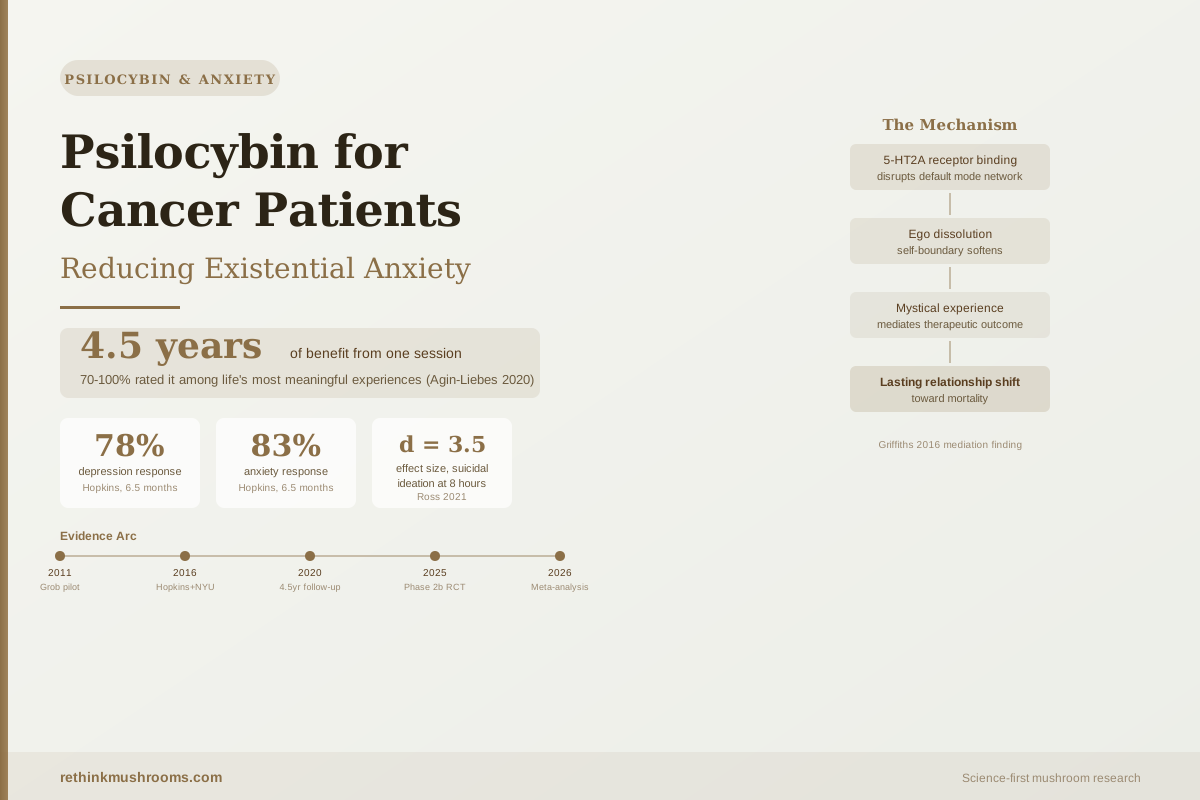
4.5 years of sustained benefit from a single psilocybin session
At 4.5-year follow-up of the landmark NYU trial, 71-100% of surviving participants rated the psilocybin experience among the most personally meaningful of their lives, with anxiety and depression reductions still measurable — in an uncontrolled, within-subject follow-up.
Agin-Liebes et al., J Psychopharmacol, 2020
~80%
of Hopkins participants still showed clinically significant drops in depressed mood and anxiety at 6-month follow-up
4 RCTs
the entire randomized evidence base in cancer patients — 127 randomized participants across 14 years
60–80%
of surviving NYU participants still met criteria for a clinically significant response 4.5 years later — with no control group remaining
Agin-Liebes et al., J Psychopharmacol, 2020
 View as image ↗
Four and a half years after a single psilocybin session, researchers tracked down the surviving participants from the 2016 NYU cancer anxiety trial and measured their mental states again. The anxiety and depression reductions from that one session were still present. Between 71 and 100 percent attributed positive life changes to the therapy and rated it among the most personally meaningful and spiritually significant experiences of their entire lives. No additional doses had been administered.[4]
That finding — apparent durable benefit from a single pharmacological event — has no clear parallel elsewhere in psychiatry. Antidepressants require daily dosing and stop working when discontinued. Benzodiazepines provide temporary relief while the drug is active. Psilocybin appears to do something different: it facilitates an experience that changes a person's relationship to their situation in a way that seems to persist long after the drug has cleared.
That last sentence needs a caveat the headlines usually drop, and this article will keep returning to it: by the time those 4.5-year measurements were taken, every participant had received psilocybin. The randomized comparison had ended years earlier. What the follow-up shows is what happened to treated people over time — not what psilocybin caused relative to an untreated group.
Existential anxiety in cancer refers to fear about death, loss of meaning, and uncertainty about the future that differs from ordinary anxiety. In clinical trials, a single guided psilocybin session produced immediate and lasting reductions in this distress. In the landmark Johns Hopkins trial, about 80% of patients still showed clinically significant decreases in depressed mood and anxiety at the 6-month follow-up. A 2026 meta-analysis found strong pooled antidepressant effects, though its authors describe the evidence as preliminary.[13]
Key Takeaways
- At 4.5-year follow-up of the NYU trial, reductions in anxiety, depression, hopelessness, demoralization, and death anxiety were all still present, with roughly 60-80% meeting criteria for a clinically significant antidepressant or anxiolytic response and 71-100% attributing positive life changes to the therapy — but this was an uncontrolled within-subject follow-up of 15 surviving participants, not a randomized comparison (Agin-Liebes 2020)
- In the Hopkins RCT, high-dose psilocybin produced large decreases in depressed mood and anxiety in 51 cancer patients, with about 80% still showing clinically significant decreases at the 6-month follow-up; mystical-type experience on session day mediated the effect of dose on outcome (Griffiths 2016)
- A 2021 meta-analysis of 5 studies found psilocybin superior to placebo for state anxiety at day 1 (Hedges' g -0.70) and 2 weeks (-1.03), and for trait anxiety at day 1 (-0.71), 2 weeks (-1.08), and 6 months (-0.84) (Yu 2021)
- Among participants with elevated suicidal ideation at baseline, a secondary analysis found within-group reductions apparent as early as 8 hours and persisting 6.5 months; reductions in loss of meaning appeared at 2 weeks and remained robust out to 4.5 years (Ross 2021)
- A 2025 network meta-analysis ranked the highest psilocybin dose (0.3 mg/kg) first, with SUCRA values of 87.81% for depression and 94.2% for trait anxiety — but only two RCTs met its inclusion criteria, and the depression effect was not sustained at 2 weeks (Swieczkowski 2025)
- A 2025 phase 2b RCT from an independent Australian team (n=35, St Vincent's Melbourne) found significantly greater reductions in depression than active placebo, the first randomized replication of the 2016 results by a separate group (Ross ML 2025)
- The entire randomized evidence base in cancer patients is four trials totaling 127 randomized participants; the repeated meta-analyses largely re-pool the same two 2016 trials rather than adding independent confirmation
What Existential Anxiety Means in Cancer — and Why Conventional Treatments Fall Short
Generalized anxiety disorder is treatable with SSRIs, cognitive-behavioral therapy, and benzodiazepines. These work because generalized anxiety is partly a disorder of threat perception — the nervous system responding disproportionately to stimuli that are not actually dangerous.
Cancer-related existential anxiety is different. The anxiety is an appropriate response to a real and potentially imminent threat: the loss of life, the loss of functional capacity, the dissolution of the future a person had imagined. SSRIs can blunt the emotional experience of that anxiety, but they don't change the patient's relationship to mortality. Benzodiazepines reduce acute distress but leave the underlying existential problem unchanged. Cognitive-behavioral therapy can reframe catastrophic thinking, but death itself is not a cognitive distortion. It's real.
What oncology psychology calls "demoralization" — a distinct state of hopelessness, loss of meaning, and existential despair that is different from but often co-occurs with clinical depression — is particularly resistant to pharmacological treatment. Conventional antidepressants were not designed for a crisis of meaning. They treat neurotransmitter dysregulation, not a person's confrontation with their own mortality.
This clinical gap is what made the psilocybin research in cancer patients so compelling when it began producing results. The therapy was addressing something that other treatments weren't reaching.
Grob's 2011 Pilot: Establishing Safety First
Before any large trials could proceed, researchers needed to establish that it was safe to administer a psychedelic compound to people who were physically ill and emotionally compromised. Grob and colleagues addressed this in a 2011 pilot trial — the first modern, controlled study of psilocybin in cancer patients.[1]
Twelve adults with advanced-stage cancer and reactive anxiety were enrolled in a double-blind, placebo-controlled trial in which subjects acted as their own control. Each received a moderate dose of psilocybin (0.2 mg/kg) in one session and niacin — an active placebo that causes flushing but no psychoactive effect — in a separate session, with the order randomized. The primary question was safety and tolerability in a medically compromised population.
Grob's group found a significant reduction on the State-Trait Anxiety Inventory trait anxiety subscale (the general, ongoing level of anxiety rather than acute situational anxiety) at both 1 month and 3 months after treatment. Mood improvement on the Beck Depression Inventory reached significance at 6 months, while the Profile of Mood States showed improvement that approached but did not reach significance. The trial established that psilocybin was physically safe and tolerable in this population — there were no clinically significant adverse events.
The authors themselves framed the result modestly: the study established feasibility and safety, and the efficacy data showed "a positive trend" rather than proof of benefit. Follow-up data were also collected unblinded, which limits how much weight the symptom numbers can carry.
Twelve participants cannot confirm efficacy. What Grob 2011 provided was the safety profile necessary to justify larger trials. The result: five years later, two landmark trials launched simultaneously.
The Two Landmark Trials of 2016
In December 2016, the Journal of Psychopharmacology published two simultaneous randomized controlled trials of psilocybin for cancer-related anxiety and depression, accompanied by 11 expert editorials. This kind of coordinated publication is reserved for findings that the field considers potentially transformative.
The Johns Hopkins trial, led by Griffiths and colleagues, enrolled 51 cancer patients with depression and anxiety.[2] Participants received two sessions in randomized crossover order: one with high-dose psilocybin (22 or 30 mg per 70 kg of body weight) and one with very low-dose psilocybin (1 or 3 mg per 70 kg) as the comparator, counterbalanced with 5 weeks between sessions. Using very low-dose psilocybin rather than a placebo is methodologically elegant: it controls for expectation and session context while using a dose too small to produce meaningful psychoactive effects.
High-dose psilocybin produced large decreases in both clinician-rated and self-rated depressed mood and anxiety, alongside increases in quality of life, life meaning, and optimism, and decreases in death anxiety. At the 6-month follow-up those changes were sustained, with about 80% of participants continuing to show clinically significant decreases in depressed mood and anxiety, and more than 80% endorsing moderately or greater increased well-being and life satisfaction. Ratings from community observers — friends and family members who knew the participants — showed corresponding changes, which matters because it means the effect was visible from outside the participant's own self-report.
The strength of the mystical-type experience during the session — measured by a standardized questionnaire (the MEQ30, Mystical Experience Questionnaire) — mediated the effect of psilocybin dose on therapeutic outcomes. Patients who had more profound experiences during the session had better clinical outcomes afterward.
The NYU trial, led by Stephen Ross and colleagues, enrolled 29 cancer patients in a similar crossover design, using niacin (rather than low-dose psilocybin) as the active comparator alongside a single 0.3 mg/kg psilocybin dose delivered in conjunction with psychotherapy.[3] The niacin design addresses a limitation of the Hopkins design: niacin produces physical side effects (flushing, warmth) that make participants more uncertain whether they received psilocybin, potentially controlling better for expectation effects.
The primary outcomes were assessed between groups at 7 weeks, before the crossover — the window in which a genuine randomized comparison still existed. Psilocybin produced immediate, substantial, and sustained improvements in anxiety and depression, and reduced cancer-related demoralization and hopelessness. The NYU trial also measured outcomes beyond depression and anxiety: spiritual well-being (using the FACIT-Sp, Functional Assessment of Chronic Illness Therapy Spiritual Well-Being scale) and quality of life, both of which improved. At the 6.5-month follow-up — after the crossover, when all participants had received psilocybin — approximately 60-80% continued to show clinically significant reductions in depression or anxiety, along with sustained benefits in existential distress and improved attitudes toward death. As in the Hopkins trial, the psilocybin-induced mystical experience mediated the therapeutic effect.
Participants described, in qualitative interviews, a shift in relationship to their cancer — "acknowledging cancer's place in my life," "emotional uncoupling from cancer," "reconciliation with death."
For a detailed side-by-side analysis of how these two trials were designed and what makes their results reliable, see The Johns Hopkins and NYU Cancer Anxiety Studies: Landmark Results.
4.5 Years Later: The Most Important Finding in This Field
The standard measure of psychiatric treatment efficacy is 8-12 weeks. Response rates are measured at the end of a medication trial, before the medication is discontinued. Sustained remission at 1 year is considered a strong outcome.
In 2020, Agin-Liebes and colleagues published a long-term follow-up of the NYU trial participants.[4] All 16 participants who were still alive were contacted, and 15 agreed to participate, at an average of 3.2 and 4.5 years following psilocybin administration. The researchers measured anxiety, depression, hopelessness, demoralization, and death anxiety at both time points.
Reductions across all five domains were sustained at both follow-ups, with large within-group effect sizes. At the 4.5-year follow-up, approximately 60-80% of participants met criteria for a clinically significant antidepressant or anxiolytic response. Between 71 and 100 percent attributed positive life changes to the psilocybin-assisted therapy and rated it among the most personally meaningful and spiritually significant experiences of their lives.
Now the caveat, which the study's own authors state plainly: limited conclusions can be drawn about efficacy because of the crossover design of the parent trial. Every participant in the NYU study eventually received psilocybin. By 3.2 and 4.5 years there was no comparison group left — no set of people with the same diagnoses who had not been treated. This is a within-subjects analysis of a self-selected subset of survivors, which is a different and weaker kind of evidence than a randomized comparison.
That distinction matters because the alternative explanations are not exotic. People adapt to a cancer diagnosis over four years with or without treatment. The 15 people who were alive and willing to be re-interviewed are not a random sample of the original 29 — they are the ones who survived and stayed reachable. And participants who have had a profound drug experience are not blind to what they received when asked years later how meaningful it was.
None of this makes the finding uninteresting. Sustained improvement years after a single session is worth taking seriously, and no antidepressant maintains benefit years after discontinuation. But the honest statement is narrower than the headline: among cancer patients who received psilocybin-assisted therapy and were still alive years later, most reported durable improvement, and there is no controlled evidence establishing that psilocybin caused all of it.
The mechanism behind that apparent durability is the subject of a dedicated cluster article. The short version: psilocybin doesn't suppress anxiety pharmacologically. It facilitates an experience that appears to change a person's relationship to their situation — a change that isn't dependent on the drug still being present.
Why Psilocybin Reduces Death Anxiety: The Mechanism That Pharmacologists Don't Have a Drug For
Psilocybin is a 5-HT2A receptor partial agonist — it binds to a type of serotonin receptor found in high concentrations in the brain's cortex. When it binds to those receptors, it disrupts the activity of the default mode network (DMN), a set of brain regions involved in self-referential thinking, mind-wandering, and the construction of the autobiographical self. The DMN is, roughly, the brain system that maintains your sense of "me" over time.
When the DMN quiets under psilocybin, the boundary between self and world becomes less defined. This state — called ego dissolution — can be disorienting or frightening at low doses without preparation. In the context of therapeutic support, it is the same state that mystics have described for millennia: a direct experience of being connected to something larger than the individual self.
The clinical significance for death anxiety is specific: the fear of death is, in part, a fear of self-annihilation — the end of the "me" that has accumulated experiences, relationships, and meaning. When that self temporarily loosens during ego dissolution, participants often report that death feels less like an endpoint and more like a transition within a larger continuity. The Ross 2016 qualitative descriptions — "acknowledging cancer's place in my life," "reconciliation with death" — are descriptions of this shift, not just mood improvement.
Griffiths' 2016 finding that mystical experience strength significantly mediated the therapeutic outcomes is the key mechanistic data point.[2] The patients who had the most profound experiences during the session had the best outcomes months later. The drug facilitates the experience; the experience produces the change; the change persists after the drug is gone.
For a complete mechanistic explanation of the DMN, ego dissolution, and the death anxiety pathway, see How a Single Dose of Psilocybin Reduces Death Anxiety.
The Depth of the Effect: What Ross 2021 Found About Meaning and Suicidal Ideation
The standard outcome measures in psychiatric research — depression scales and anxiety scales — capture symptom severity but not the full experiential depth of what the psilocybin trials documented. Ross and colleagues published a secondary analysis of the NYU trial in 2021 that measured two outcomes rarely reported in psychiatric research: suicidal ideation and loss of meaning.[5]
Among participants who had elevated suicidal ideation at baseline, psilocybin-assisted psychotherapy was associated with reductions in suicidal ideation that were apparent as early as 8 hours after dosing and persisted for 6.5 months. Speed matters here in a way it rarely does elsewhere in psychiatry: conventional antidepressants take weeks to act, which is the wrong timescale for someone whose distress is acute and whose prognosis is measured in months.
Two qualifications belong in the same breath as that finding. First, these are within-group changes — each participant compared against their own baseline — not between-group differences against a control. Second, this was a secondary, exploratory analysis of a subgroup, run after the main trial to probe a hypothesis rather than to test one prospectively. The authors describe the results as preliminary and say explicitly that they warrant further investigation in participants with elevated depression and suicidality. Large apparent effects in small subgroups are exactly where regression to the mean and selection effects do their most convincing work.
Reductions in loss of meaning appeared 2 weeks after treatment and remained significant and robust at the 6.5-month, 3.2-year, and 4.5-year follow-ups.[5] "Loss of meaning" is a construct that captures the existential demoralization specific to cancer patients facing death — not just depression symptoms, but the feeling that nothing matters and one's life has lost its purpose. The authors' hypothesis is that the antisuicidal signal works through that route: psilocybin acts on hopelessness and demoralization, and relief in suicidal ideation follows from restored meaning rather than from direct mood elevation.
What the Meta-Analysis Evidence Shows
Individual trials, even well-designed ones, can be anomalous. Meta-analyses — studies that pool results across multiple trials — provide a more reliable summary of the evidence. That logic holds when the pooled trials are independent. In this literature they largely aren't, and that turns out to be the most important thing to understand about the review evidence.
Yu and colleagues published a meta-analysis of psilocybin for end-of-life anxiety in 2021, pooling 5 studies.[6] Using Hedges' g (a measure of effect size corrected for small sample sizes), they found psilocybin superior to placebo for state anxiety at 1 day (g = -0.70; 95% CI -1.01 to -0.39) and 2 weeks (-1.03; -1.47 to -0.60), and for trait anxiety at 1 day (-0.71; -1.15 to -0.26), 2 weeks (-1.08; -1.80 to -0.36), and 6 months (-0.84; -1.37 to -0.30). Values above 0.8 are conventionally called large effects; the trait anxiety estimates at 2 weeks and 6 months crossed that threshold, though every confidence interval is wide enough to be compatible with a considerably smaller effect. The authors also recorded a transient rise in systolic (19.00 mmHg) and diastolic (8.66 mmHg) blood pressure versus placebo, and found no significant differences in all-cause discontinuation, serious adverse events, or heart rate.
Bader and colleagues synthesized 7 studies comprising 132 participants in a 2024 review.[8] They reported pooled anxiety scores on the STAI (State-Trait Anxiety Inventory, the most widely used clinical anxiety measure) of 35.15 (95% CI 32.28-38.01) at 4 to 4.5 months and 33.06 (28.73-37.40) at 6 to 6.5 months post-administration, both significantly improved relative to baseline. Quality of life and pain control also improved. Note what these figures are and are not: they are pooled score levels at two follow-up windows compared against baseline, not a between-group treatment effect, and their confidence intervals overlap each other substantially.
Swieczkowski and colleagues published a network meta-analysis in 2025 using SUCRA values — a statistical method that ranks which treatment performed best across all trials in a network, expressed as a percentage.[12] The highest psilocybin dose (0.3 mg/kg) ranked first for depression (SUCRA = 87.81% on the Beck Depression Inventory), state anxiety (91.58% on STAI state), and trait anxiety (94.2% on STAI trait). Two details keep those percentages in proportion. Only two RCTs met the inclusion criteria — a "network" of two trials. And the depression signal was not sustained: BDI scores dropped significantly at day 1 but the effect had gone by the 2-week follow-up. The STAI trait improvements did hold at both day 1 and day 14. The authors' own conclusion asks for cautious interpretation on exactly these grounds.
The most recent meta-analysis, by Moshfeghinia and colleagues in 2026, found strong pooled antidepressant effects on the BDI (SMD = -2.87) and the HADS depression subscale (SMD = -2.97), with sustained benefits at 6 months.[13] Anxiety outcomes were genuinely mixed: the HADS anxiety subscale was not statistically significant (SMD = -3.63, p = 0.11) and STAI results were inconsistent. Quality of life and spiritual well-being improvements were time-dependent, strengthening over the months following the session rather than appearing immediately — a pattern more consistent with psychological integration than with acute pharmacological relief. The authors label their own findings preliminary, citing the small number of studies, high heterogeneity, blinding and expectancy problems, and the fact that psilocybin was almost always co-administered with psychotherapy, which makes the drug's independent contribution difficult to isolate.
The reviews are not independent confirmations
Reading those five syntheses in sequence gives an impression of accumulating evidence: 2021, 2024, 2025, 2026, each apparently confirming the last. The impression is misleading. Lapid and colleagues, searching to February 2024, found 14 studies of psilocybin for cancer-related distress — of which exactly three were randomized controlled trials.[10] Those three are Grob 2011 (n=12), Griffiths 2016 (n=51), and Ross 2016 (n=29): 92 randomized participants in total. Every meta-analysis above is drawing on some subset of that same small pool, which is why their headline numbers move around so much depending on which studies they admit.
The 2025 Phase 2b Trial and the Long-Term Follow-Up
The clinical development pathway for psilocybin in cancer-related distress has continued beyond the 2016 landmark trials. Agrawal and colleagues published 2-year follow-up data in 2025 from a phase 2 trial of 30 cancer patients with major depressive disorder who received a single 25 mg psilocybin dose with psychological support in a community cancer setting.[9] Of 28 patients assessed at 2 years, 15 (53.6%) showed significant depression reduction on the Montgomery-Åsberg Depression Rating Scale, averaging 15 points below baseline, and 14 (50%) had sustained reduction. Thirteen (46.4%) showed significant anxiety reduction. This was a single-arm trial with no control group, so the 2-year figures describe the trajectory of treated patients rather than a treatment effect — but two-year durability of any kind from one dose is unusual enough to be worth following.
Then, in 2025, the first independent randomized replication arrived — and it is worth being precise about who conducted it, because the surname invites confusion. The NYU trials were led by Stephen Ross. The 2025 phase 2b trial was led by Margaret Ross at St Vincent's Hospital Melbourne, affiliated with the University of Melbourne, a separate team on a different continent.[11] That independence is the point: it is a genuine external replication rather than the original group extending its own work.
The trial randomized 35 adults (mean age 56, 54.3% female) with a life-threatening illness and clinically significant depression or anxiety to 25 mg psilocybin (n=17) or 100 mg niacin as active placebo (n=18), each with three preparatory and six integration psychotherapy sessions. At the 6-7 week primary endpoint, psilocybin produced significantly greater reductions than placebo in HADS depression (d = 1.12), BDI-II (d = 2.97), and STAI state anxiety. All participants then received open-label psilocybin, allowing a one-dose versus two-dose comparison, with follow-up to 26 weeks.
Phase 2b is a formal step in the clinical development pipeline, testing efficacy and safety at larger scale in preparation for a possible phase 3. It is worth noting that at n=35 this remains a single-site trial smaller than Griffiths 2016 — a meaningful independent replication, not yet the large multi-site trial the field still needs.
A 2025 systematic review by Lapid and colleagues, focused on cancer-related distress, found that psilocybin therapy consistently produced significant reductions in depression, anxiety, and existential distress sustained over several months, with adverse effects that were generally mild and transient.[10] The authors call for further large-scale, well-designed RCTs to confirm the findings and close existing gaps.
Safety Profile in Medically Compromised Patients
The question that clinicians and oncologists most commonly raise is whether psilocybin is safe in people who are physically ill, potentially on multiple medications, and emotionally vulnerable. The trial literature provides a consistent answer.
The trial literature gives a reasonably consistent answer, with one wording correction worth making because it is frequently misreported. The Yu 2021 meta-analysis did not find that no serious adverse events occurred; it found that the difference between psilocybin and placebo groups in serious adverse events, all-cause discontinuation, and heart rate was not statistically significant.[6] Those are different claims, and with samples this small the second one is much weaker than it sounds: a handful of trials totaling under 100 randomized patients cannot detect a rare serious harm.
What the reviews do establish is the shape of the common effects. Grob 2011 documented no clinically significant adverse events in its 12 patients.[1] Lapid 2025 found adverse effects across 14 studies to be generally mild and transient.[10] Goel and Zilate's 2022 systematic review reached compatible conclusions across the broader psilocybin literature.[7] The consistent physical finding is transient blood pressure elevation during the session — quantified by Yu 2021 at roughly 19 mmHg systolic and 8.7 mmHg diastolic above placebo — peaking within the first hours and resolving without intervention. Patients occasionally report nausea, headache, or transient anxiety during sessions.
That blood pressure figure is not trivial in this population. Cancer patients frequently have cardiovascular comorbidity, and a transient 19 mmHg systolic rise is the specific reason these trials screen for cardiac risk rather than the reason they can be described as risk-free.
The safety profile should be understood in context: all published cancer trials used careful patient screening, professional therapeutic support throughout the session, and specific preparation and integration protocols. These are not results from unsupervised recreational use, and they do not transfer to it.
Clinical context
CriticalThe trial safety record belongs to the trial setting, not to psilocybin as a substance
Concern
Every published cancer trial screened participants for cardiac and psychiatric risk, dosed them in a prepared room with two trained clinicians present for the full 6-8 hours, and provided structured preparation and integration sessions. Psilocybin can precipitate prolonged psychological distress, is generally contraindicated with a personal or family history of psychotic or bipolar disorders, transiently raises blood pressure by roughly 19 mmHg systolic, and interacts with SSRIs, MAOIs, lithium and other psychiatric medications that cancer patients are often already taking.
What the research says
None of the reported safety data transfers to unsupervised use. With fewer than 130 randomized participants across the entire literature, these trials are also far too small to detect a rare serious harm — the absence of a statistically significant difference in serious adverse events is not evidence that none exist.
Particularly relevant for: Adults with advanced or life-threatening cancer, who frequently have cardiovascular comorbidity and complex medication regimens
What to do
This article is educational and is not medical advice. If you are living with cancer and struggling with anxiety, depression, demoralization or thoughts of death, raise it with your oncology or palliative care team — these are recognized and treatable parts of cancer care. If you are having thoughts of suicide, contact your local emergency number, or in the US call or text 988 for the Suicide and Crisis Lifeline.
Yu 2021 (RTHM-01466) · Grob 2011 (RTHM-00397) · Lapid 2025 (RTHM-02122)
Can Cancer Patients Access Psilocybin Therapy?
Currently, psilocybin remains a Schedule I controlled substance in the United States, which means it cannot be legally prescribed. Cancer patients who want access to psilocybin therapy have a few options: enrollment in a clinical trial (the most reliable path for those who qualify), legal psilocybin services in states where it has been authorized for therapeutic use (Oregon and Colorado as of 2025), or palliative care exceptions in some jurisdictions.
The legal and policy landscape is changing faster than the clinical development timeline. For the current state of access, legal barriers, and what the clinical pipeline looks like, see Why Psilocybin Is Federally Illegal Despite Proven Medical Value.
For general clinical evidence on psilocybin for anxiety beyond the cancer context, see Can Psilocybin Help Chronic Anxiety? Clinical Evidence.
Across the Cluster: Deeper Dives
This article covers the overview of psilocybin for cancer patients. The cluster articles go deeper on specific aspects:
-
The Johns Hopkins and NYU Cancer Anxiety Studies: Landmark Results — detailed analysis of both 2016 trials, their methodological differences, what makes each design valid, and the Agin-Liebes 2020 follow-up
-
How a Single Dose of Psilocybin Reduces Death Anxiety — the full mechanistic explanation: DMN disruption, ego dissolution, mystical experience mediation, and why the effect persists after the drug leaves
-
Psilocybin and Quality of Life in Terminal Cancer Patients — the full QoL picture beyond anxiety and depression: spiritual well-being (FACIT-Sp), demoralization, loss of meaning, the Shnayder 2023 NIH-HEALS data
-
Psilocybin for Cancer-Related Depression and Anxiety: Combined Effects — why cancer depression and anxiety respond together to psilocybin through a shared mechanism, with the full response rate and long-term follow-up data
The Bottom Line
The clinical evidence for psilocybin in cancer patients with existential anxiety spans a 2011 safety pilot, two landmark 2016 RCTs, a 2025 independent phase 2b replication, and a 2026 meta-analysis. The core finding is consistent across all of it: a single guided psilocybin session produces large, rapid reductions in anxiety, depression, demoralization, and death anxiety, and the benefit appears to persist far longer than any comparable pharmacological treatment — with 71-100% of surviving NYU participants attributing positive life changes to the therapy at 4.5-year follow-up (Agin-Liebes 2020). The proposed mechanism, a facilitated mystical experience mediated by default mode network disruption rather than pharmacological suppression of anxiety, is supported by mediation findings in both 2016 trials and would explain the unusual durability. The honest limits are equally clear. The entire randomized base is four trials and 127 randomized participants; the long-term follow-up data is uncontrolled because both 2016 trials used crossover designs in which everyone eventually received psilocybin; the repeated meta-analyses re-pool the same handful of studies rather than adding independent evidence; and psilocybin is almost always co-administered with psychotherapy, leaving the drug's independent contribution unresolved. Access is the other constraint: psilocybin remains Schedule I in the US, and structured therapeutic access outside clinical trials is limited to Oregon and Colorado.
Frequently Asked Questions
Sources & References
- 1RTHM-00397·Grob, Charles S et al. (2011). “Pilot study of psilocybin treatment for anxiety in patients with advanced-stage cancer..” Archives of general psychiatry.Study breakdown →PubMed →↩
- 2RTHM-00426·Griffiths, Roland R et al. (2016). “Psilocybin produces substantial and sustained decreases in depression and anxiety in patients with life-threatening cancer: A randomized double-blind trial..” Journal of psychopharmacology (Oxford.Study breakdown →PubMed →↩
- 3RTHM-00445·Ross, Stephen et al. (2016). “Rapid and sustained symptom reduction following psilocybin treatment for anxiety and depression in patients with life-threatening cancer: a randomized controlled trial..” Journal of psychopharmacology (Oxford.Study breakdown →PubMed →↩
- 4RTHM-01160·Agin-Liebes, Gabrielle I et al. (2020). “Long-term follow-up of psilocybin-assisted psychotherapy for psychiatric and existential distress in patients with life-threatening cancer..” Journal of psychopharmacology (Oxford.Study breakdown →PubMed →↩
- 5RTHM-01425·Ross, Stephen et al. (2021). “Acute and Sustained Reductions in Loss of Meaning and Suicidal Ideation Following Psilocybin-Assisted Psychotherapy for Psychiatric and Existential Distress in Life-Threatening Cancer..” ACS pharmacology & translational science.Study breakdown →PubMed →↩
- 6RTHM-01466·Yu, Chia-Ling et al. (2021). “Psilocybin for End-of-Life Anxiety Symptoms: A Systematic Review and Meta-Analysis..” Psychiatry investigation.Study breakdown →PubMed →↩
- 7RTHM-00760·Goel, Dev B et al. (2022). “Potential Therapeutic Effects of Psilocybin: A Systematic Review..” Cureus.Study breakdown →PubMed →↩
- 8RTHM-01856·Bader, Husam et al. (2024). “Investigating the therapeutic efficacy of psilocybin in advanced cancer patients: A comprehensive review and meta-analysis..” World journal of clinical oncology.Study breakdown →PubMed →↩
- 9RTHM-02045·Agrawal, Manish et al. (2025). “Long-term benefits of single-dose psilocybin in depressed patients with cancer..” Cancer.Study breakdown →PubMed →↩
- 10RTHM-02122·Lapid, Maria I et al. (2025). “Evaluating the effectiveness of psilocybin in alleviating distress among cancer patients: A systematic review..” Palliative & supportive care.Study breakdown →PubMed →↩
- 11RTHM-00949·Ross, Margaret L et al. (2025). “Psilocybin-assisted psychotherapy for depression and anxiety associated with life threatening illness: A phase 2b randomized controlled trial..” General hospital psychiatry.Study breakdown →PubMed →↩
- 12RTHM-02190·Swieczkowski, Damian et al. (2025). “Psilocybin-assisted psychotherapy as a rapid-acting treatment for cancer-related depression and anxiety: Evidence from a network meta-analysis..” International journal of psychiatry in medicine.Study breakdown →PubMed →↩
- 13RTHM-02238·Moshfeghinia, Reza et al. (2026). “The effects of psilocybin on psychological distress in cancer patients: a systematic review and meta-analysis..” BMC psychology.Study breakdown →PubMed →↩