Psilocybin & Anxiety
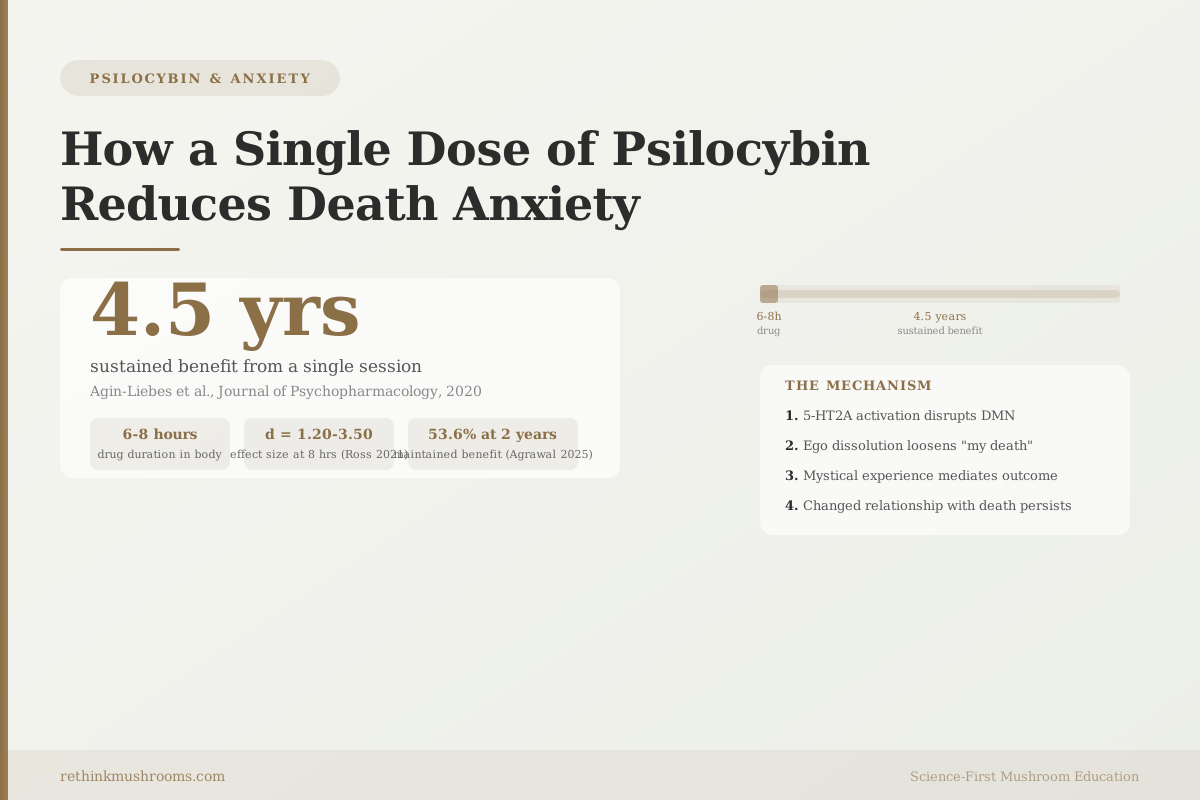
4.5 yrs sustained benefit
In a 4.5-year follow-up of the 2016 NYU psilocybin trial, surviving participants showed sustained reductions in death anxiety from a single session — years after the drug itself had cleared the body.
Agin-Liebes et al., Journal of Psychopharmacology, 2020
6-8 hrs
psilocybin's pharmacological duration in the body
d = 1.20-3.50
Cohen's d for suicidal ideation reduction at 8 hours post-session (Ross et al., 2021)
53.6%
of cancer patients maintained significant depression reduction at 2 years (Agrawal et al., 2025)
Agin-Liebes et al., Journal of Psychopharmacology, 2020
 View as image ↗
Psilocybin is active in the body for roughly 6 to 8 hours. The drug then metabolizes completely. And yet a single guided session with it has produced reductions in death anxiety that, in the best-studied cohort, were still measurable four and a half years later.
This is pharmacologically unusual. The drugs typically used for anxiety (benzodiazepines, SSRIs, buspirone) work through continuous receptor-level effects. Stop taking them and the effects fade, usually within days or weeks. Psilocybin's effects outlast its pharmacological presence by orders of magnitude. Something beyond direct chemical action has to explain it.
This article examines what that something is, what the clinical evidence shows about both the mechanism and the durability, and where the current science ends. It is one article in a cluster covering the full cancer-patient evidence base; for the complete overview, start with Psilocybin for Cancer Patients: Reducing Existential Anxiety.
Key Takeaways
- Psilocybin is pharmacologically active for 6-8 hours, but clinical improvements in death anxiety have been sustained for 4.5 years after a single session in the best available follow-up data
- In the 2016 Hopkins RCT (n=51), mystical experience strength significantly mediated therapeutic outcomes — not the dose itself, but the quality of the experience during the session
- In the 2016 NYU trial (n=29), qualitative themes included reconciliation with death and emotional uncoupling from cancer; 83% showed reduced depression versus 14% on active placebo at 7 weeks
- A 2021 secondary analysis found suicidal ideation reductions were measurable within 8 hours of the psilocybin session, with effect sizes of Cohen's d = 1.20-3.50 — among the largest acute psychiatric effect sizes reported
- In a 2023 study of 30 cancer patients, Trust and Acceptance (a spiritual well-being domain measured by NIH-HEALS) improved 22.4% from baseline, sustained at 8 weeks after the session
- A 2025 2-year follow-up found 53.6% of cancer patients maintained significant depression reduction from a single 25 mg psilocybin session combined with psychotherapy
The Pharmacological Paradox: Active for 6 Hours, Effective for Years
To understand why psilocybin's mechanism matters, start with the clinical data on duration.
In 2020, Agin-Liebes and colleagues published a 4.5-year follow-up of the 2016 NYU psilocybin trial. Of 16 surviving participants, 15 were located and assessed. The findings: sustained reductions in anxiety, depression, hopelessness, demoralization, and death anxiety at both the 3.2-year and 4.5-year follow-up points. Between 70% and 100% of participants rated the psilocybin experience among the most personally meaningful of their lives. No long-term adverse effects were reported.[4]
A 2025 study by Agrawal and colleagues, with 2-year follow-up data, found that 53.6% of cancer patients maintained significant reduction in depression from a single 25 mg psilocybin session combined with psychotherapy. This is the longest available prospective follow-up of a single psilocybin dose for cancer-related distress.[7]
No drug that acts for 6-8 hours should produce this. SSRIs, which are taken daily for months, do not produce effects this durable when discontinued. What psilocybin appears to do is catalyze a change in how a person relates to the fact of their own death. The change itself is the intervention; the drug is the facilitator.
How Psilocybin Disrupts the Brain's Self-Reference System
The relevant neurological starting point is the default mode network (DMN). The DMN is a set of interconnected brain regions that activate during self-referential thought: remembering the past, imagining the future, worrying about the self, constructing a narrative identity. When you're anxious about dying, the DMN is heavily involved. It is generating and reprocessing the narrative "I am a person who is going to die."
Psilocybin, acting primarily through partial agonism at the serotonin 2A receptor (5-HT2A), disrupts normal DMN activity. The self-referential regions become desynchronized. The narrative of "me" temporarily loosens. Researchers have described this as increased "brain entropy" or "broadened functional connectivity" — the brain's networks communicate in unusually nonhierarchical ways, with less dominance from the self-referential system.
This is covered in depth in Functional Connectivity Changes Under Psilocybin: fMRI Evidence. For this article, the pharmacology matters because it sets up the therapeutic mechanism.
Ego Dissolution and the Loosening of "My Death"
The subjective experience of DMN disruption is called ego dissolution. It's a temporary state in which the usual sense of being a bounded self, separate from the world and from other people, softens or disappears entirely. This is not the same as dissociation or confusion. Participants in clinical trials describe it as a sense of unity, of interconnectedness, of sacredness.
In this state, the thing that makes dying feel catastrophically threatening, the sense that "I" will cease to exist, is temporarily absent. There is no "me" to be threatened by death. The fear of death is, at its core, a fear about the survival of a self that the psilocybin experience temporarily dissolves.
The therapeutic value isn't that people feel good during the session and carry that feeling forward. It's that the experience changes their relationship to the concept of death itself. Patients describe it not as "I stopped being scared" but as "death stopped being the end of something that matters in the way I thought it did."
The Mediation Finding: Mystical Experience Predicts Therapeutic Outcome
The mechanism hypothesis above would be theoretical without direct clinical evidence that the nature of the experience determines the therapeutic outcome. The evidence exists.
In the 2016 Hopkins trial, Griffiths and colleagues ran a double-blind crossover study in 51 cancer patients with depression and anxiety. High-dose psilocybin (22-30 mg/70 kg) was compared to a very low dose (1-3 mg/70 kg). At the 6.5-month follow-up, 78% of participants showed clinically significant depression reduction and 83% showed anxiety reduction. Critically, the strength of the mystical experience during the session significantly mediated the therapeutic outcomes. Participants who had stronger mystical experiences showed greater improvements, independent of the dose.[1]
This mediation finding is important because it suggests the drug works through the experience it produces, not through direct pharmacological action on symptom-generating circuits. Psilocybin at a high dose consistently induces mystical experiences; psilocybin at a very low dose does not. The therapeutic benefit tracks the mystical experience, not the dose per se.
Roseman and colleagues confirmed a related finding in a 2017 study of 20 treatment-resistant depression patients. The quality of the psilocybin experience, specifically a dimension called "oceanic boundlessness" (the sense of unity, transcendence of time and space, and deeply felt sacredness), predicted antidepressant response. Patients who scored higher on oceanic boundlessness showed greater depression reductions.[3]
For readers interested in how psilocybin's pharmacology explains these experience-dependent effects, the mechanistic overview is at How Psilocybin Works: The Complete Pharmacology Guide.
The Speed of Effect: Changes Within the First 8 Hours
If psilocybin's benefits came primarily from the psychological aftermath of the experience — the weeks of "afterglow" — one would expect gradual improvement over days to weeks post-session. The data shows something faster.
A 2021 secondary analysis by Ross and colleagues examined 11 participants from the NYU trial who had elevated suicidal ideation at baseline. Suicidal ideation reductions were measurable within 8 hours of the psilocybin session, with Cohen's d values between 1.20 and 3.50. Loss of meaning was also reduced, with effect sizes of Cohen's d = 1.51 to 2.56, beginning within 2 weeks and sustained at the 4.5-year follow-up.[5]
An effect size of Cohen's d = 1.20 to 3.50 for suicidal ideation reduction at 8 hours is remarkable in context. Most psychiatric interventions for suicidal ideation operate at smaller effect sizes over weeks. Ketamine, which is considered a rapid-acting intervention, achieves its effect over hours to days. The psilocybin data here suggests something happening during the session itself, not just in the aftermath.
A 2025 network meta-analysis by Swieczkowski and colleagues confirmed the rapid-onset picture. Across doses studied, the highest psilocybin dose (approximately 0.3 mg/kg) showed effects apparent at both day 1 and day 14, with SUCRA values of 87.81% for depression (BDI), 91.58% for state anxiety (STAI), and 94.2% for trait anxiety (STAI).[8]
The speed argues against a purely neuroplastic mechanism (building new neural circuits takes weeks) and toward the experiential account: the session itself changes something about how the patient holds their fear, and that change is immediately measurable.
What Patients Describe: Reconciliation, Not Suppression
The qualitative evidence from the 2016 NYU trial provides a different lens on the mechanism than the statistical data.
Ross and colleagues found that, beyond anxiety and depression score reductions, participants in the NYU trial showed significant decreases in cancer-related demoralization and hopelessness.[2] Participants described themes of reconciliation with death, not suppression of fear. A common theme was "emotional uncoupling" from cancer, the sense that the cancer was happening in the body but that there was a dimension of experience not threatened by it. Another was acknowledgment of death as part of the natural order, rather than an unjust termination.
This language is different from the language of symptom reduction. Standard anxiety treatments aim to quiet the alarm. What participants described from psilocybin sessions was closer to understanding why the alarm was misframed.
Shnayder and colleagues' 2023 study of 30 cancer patients who received 25 mg psilocybin with psychotherapy quantified some of these dimensions using the NIH-HEALS wellness questionnaire. The Trust and Acceptance domain improved 22.4% from baseline, sustained at 8 weeks. Connection improved 12.7%. Reflection and Introspection improved 7.7%, all with p values below 0.001.[6] "Trust and Acceptance" captures something different from "STAI anxiety score." It's measuring a person's fundamental orientation toward their situation.
For deeper exploration of this phenomenological dimension, see How Psilocybin Changes the Relationship with Mortality and Psilocybin and Meaning-Making at End of Life.
Durability: What the Long-Term Data Shows
The 4.5-year Agin-Liebes follow-up is the most important durability data available, even with its small sample (15 participants). The sustained reductions across multiple domains (anxiety, depression, hopelessness, demoralization, death anxiety) at both 3.2-year and 4.5-year time points argue against a simple hedonic response or placebo effect. Responses to placebos don't typically hold for 4.5 years.[4]
The Agrawal 2025 2-year data adds independent confirmation with a different sample and a slightly different design (25 mg with structured psychotherapy). 53.6% maintaining significant depression reduction at 2 years from a single session is a durability profile that no existing antidepressant protocol for cancer patients matches.[7]
The honest limitation here is sample size. The NYU 4.5-year follow-up included 15 people. The Agrawal data does not specify the sample size in the available description. Both studies used highly selected populations: mostly white, educated, with stable social support, in academic medical center settings with extensive therapeutic support around the psilocybin session. Generalizability to different populations and lower-resource settings is not established.
What the Mechanism Does Not Fully Explain
The experiential account of psilocybin's mechanism, ego dissolution mediating a shift in relationship to death, is compelling and increasingly well-supported. But it leaves open several questions.
Not every psilocybin session produces a mystical experience. Some are difficult: anxiety, confusion, unsettling content. In the Hopkins trial, Griffiths and colleagues noted that some participants had challenging sessions that were ultimately followed by positive outcomes. The mystical experience mediation finding is a group-level statistical relationship; it doesn't predict individual outcomes.
The mechanism through which a session lasting 6-8 hours produces changes sustained for years is still being studied. Current hypotheses include enhanced synaptic plasticity during the session creating more durable neural circuit changes, and psychological integration of the experience producing ongoing shifts in coping and identity. Neither hypothesis is fully established in humans.
The therapeutic context matters substantially. The participants in these trials received extensive preparation, were accompanied by trained therapists during the session, and had structured integration support afterward. Isolating psilocybin's independent contribution from the surrounding therapeutic relationship is methodologically difficult.
What the mechanism research does establish is that psilocybin's effects on death anxiety are not simply pharmacological suppression of anxiety circuitry. The experience-dependent mediation finding means the drug's value is bound up with what it facilitates experientially, not just what it does chemically. This has significant implications for how clinical programs need to be structured.
For the comparative evidence on psilocybin and general anxiety, Can Psilocybin Help Chronic Anxiety? Clinical Evidence covers the non-cancer research.
The Bottom Line
Psilocybin reduces death anxiety in cancer patients through an experience-mediated mechanism rather than direct pharmacological suppression of anxiety circuits. Disruption of the brain's self-referential network (the default mode network) facilitates ego dissolution and mystical experience during the session; the strength of that mystical experience then predicts how much anxiety reduction follows. Effects are measurable within 8 hours, with effect sizes for suicidal ideation reduction (Cohen's d 1.20-3.50) larger than most psychiatric interventions achieve at all. Durability data from a 4.5-year follow-up study and separate 2-year data confirms the effects persist long after the drug has cleared, though the available sample sizes are small and populations were highly selected.
Frequently Asked Questions
Sources & References
- 1. Source details for this reference are not yet available.
- 2RTHM-00445·Ross, Stephen et al. (2016). “Rapid and sustained symptom reduction following psilocybin treatment for anxiety and depression in patients with life-threatening cancer: a randomized controlled trial..” Journal of psychopharmacology (Oxford.Study breakdown →PubMed →↩
- 3RTHM-00907·Roseman, Leor et al. (2017). “Quality of Acute Psychedelic Experience Predicts Therapeutic Efficacy of Psilocybin for Treatment-Resistant Depression..” Frontiers in pharmacology.Study breakdown →PubMed →↩
- 4RTHM-01160·Agin-Liebes, Gabrielle I et al. (2020). “Long-term follow-up of psilocybin-assisted psychotherapy for psychiatric and existential distress in patients with life-threatening cancer..” Journal of psychopharmacology (Oxford.Study breakdown →PubMed →↩
- 5RTHM-01425·Ross, Stephen et al. (2021). “Acute and Sustained Reductions in Loss of Meaning and Suicidal Ideation Following Psilocybin-Assisted Psychotherapy for Psychiatric and Existential Distress in Life-Threatening Cancer..” ACS pharmacology & translational science.Study breakdown →PubMed →↩
- 6RTHM-01789·Shnayder, Sarah et al. (2023). “Psilocybin-assisted therapy improves psycho-social-spiritual well-being in cancer patients..” Journal of affective disorders.Study breakdown →PubMed →↩
- 7RTHM-02045·Agrawal, Manish et al. (2025). “Long-term benefits of single-dose psilocybin in depressed patients with cancer..” Cancer.Study breakdown →PubMed →↩
- 8RTHM-02190·Swieczkowski, Damian et al. (2025). “Psilocybin-assisted psychotherapy as a rapid-acting treatment for cancer-related depression and anxiety: Evidence from a network meta-analysis..” International journal of psychiatry in medicine.Study breakdown →PubMed →↩