Psilocybin & End-of-Life
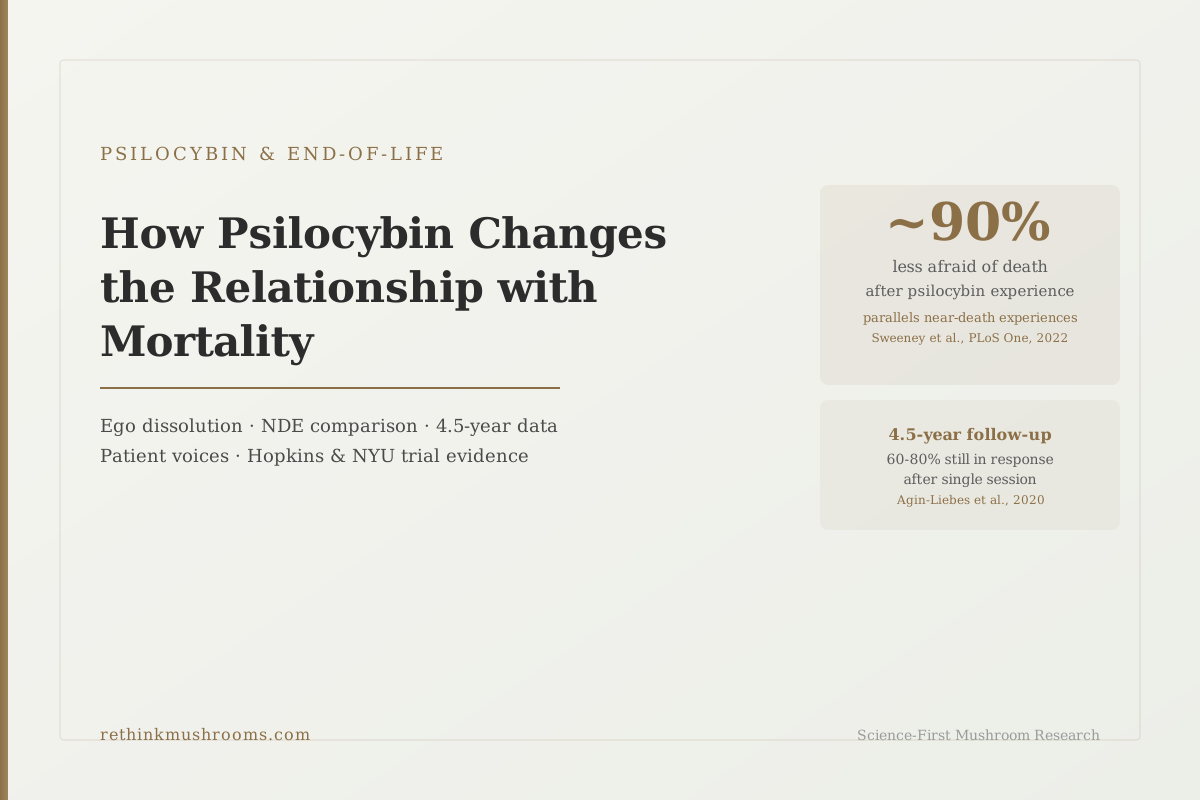
~90% less afraid of death
In a survey study comparing psychedelic experiences to near-death experiences (NDEs), approximately 90% of psychedelic users reported being less afraid of death after their experience, a shift that closely parallels what people report following an actual NDE.
Sweeney et al., PLoS One, 2022
4.5-year data
At 4.5-year follow-up of the NYU cancer trial, 60-80% of participants still met response criteria for reduced death anxiety, demoralization, and hopelessness (Agin-Liebes et al., J Psychopharmacology, 2020)
Patient language
In a 2026 qualitative study of UK women with cancer, three themes emerged: reconciliation with death, acknowledgment of cancer's place in life, and confidence in the face of recurrence (Khan et al., Qualitative Health Research, 2026)
83% anxiety reduction
The 2016 Hopkins cancer trial found 83% of patients showed clinically significant anxiety reduction at 6 months, alongside measured increases in life meaning, optimism, and spiritual well-being (Griffiths et al., J Psychopharmacology, 2016)
Sweeney et al., PLoS One, 2022
 View as image ↗
There is a class of experience that consistently produces a lasting shift in how people relate to death: the near-death experience. People who have been clinically dead and revived (or who have come very close) describe emerging with less fear of dying, a stronger sense that existence continues beyond the body, and a reorganization of what matters in life. The effect is robust enough that researchers have studied it for decades.
What Sweeney and colleagues found in 2022 is that psilocybin produces the same shift.[1]
In a survey comparing people who had psychedelic experiences to people who had near-death experiences, approximately 90% of psychedelic users reported being less afraid of death after their experience. The magnitude and quality of the change in death attitudes was comparable between the two groups. Seventy percent of respondents who reported a "God encounter" during a psychedelic experience specifically agreed that their fear of death was reduced.
People do not change their relationship with mortality through reasoning. You can know intellectually that death is inevitable and still be terrified of it. What the near-death experience comparison suggests is that psilocybin produces something more fundamental: an experiential shift in how death is felt and perceived, not merely understood.
For the clinical trial data on psilocybin in cancer patients and the reduction of anxiety and depression specifically, see psilocybin for cancer patients: reducing existential anxiety.
Key Takeaways
- In a survey study comparing psychedelic experiences to near-death experiences, approximately 90% of psychedelic users reported being less afraid of death, a shift comparable in magnitude to what people report following an actual NDE (Sweeney et al., PLoS One, 2022)
- Psilocybin's mechanism for reducing death fear appears to work through ego dissolution: a temporary disappearance of the felt sense of being a separate self, which changes the experience of death from loss of "me" to something less final
- A 2026 qualitative study of 7 UK women with cancer who received psilocybin identified three patient-generated themes: reconciliation with death, acknowledgment of cancer's place in their life, and confidence in facing potential recurrence (Khan et al., Qualitative Health Research, 2026)
- The 2016 Hopkins cancer trial (n=51) found psilocybin increased death acceptance and quality of life, optimism, and spiritual well-being at 6 months alongside 83% anxiety and 78% depression response rates (Griffiths et al., J Psychopharmacology, 2016)
- At 4.5-year follow-up of the 2016 NYU trial, 60-80% of participants still met response criteria; sustained reductions in demoralization, hopelessness, and death anxiety persisted years after a single session (Agin-Liebes et al., J Psychopharmacology, 2020)
- A 2025 qualitative study found that cancer patients with advanced disease were specifically more ready to engage with psilocybin than earlier-stage patients; existential distress created an openness that conventional medicine could not address (D'Angelo et al., Integrative Cancer Therapies, 2025)
When Psychedelics Produce the Same Shift in Death Attitudes as Nearly Dying
The Sweeney 2022 study is the clearest published evidence that psychedelic experiences and near-death experiences work through related mechanisms to change how people relate to mortality.[1]
Near-death experiences (the reports of tunnels, light, life review, and unity described by people who have been clinically dead and resuscitated) are well-documented in the clinical literature and reliably produce lasting psychological changes. People who have had NDEs typically report: reduced fear of death, a sense that consciousness continues beyond the body, increased appreciation for relationships over achievement, and a reorganization of life priorities.
Sweeney and colleagues found that psychedelic experiences produce a statistically similar profile of changes in death-related attitudes. The percentage reporting reduced death fear (~90%) was comparable between the psychedelic and NDE groups. The qualitative descriptions of the experiences had similar structures: a sense of expanded identity, contact with something perceived as larger or more fundamental than the individual self, and a shift in how the self/death boundary is experienced.
This comparison is not just poetic. It suggests that both NDEs and psychedelics are accessing a common psychological mechanism, one that involves temporarily suspending the normal sense of being a bounded, mortal self.
Why Ego Dissolution Changes the Experience of Death
In a 2006 landmark study at Johns Hopkins, Griffiths and colleagues gave high-dose psilocybin to 36 healthy adults with no terminal illness (people with no particular reason to think about death) and found that many spontaneously reported experiences involving unity, transcendence, and sacredness.[2] Most rated the experience among the most personally meaningful and spiritually significant events of their entire lives. These effects persisted at the 2-month follow-up.
What these participants were describing is ego dissolution: a temporary breakdown of the ordinary sense of being a separate, bounded self. The boundary between "I" and the rest of existence fades. The experience of being an individual (with a particular history, a body, and a future that will end) becomes less prominent, replaced by something that doesn't have a clear inside and outside.
For most of us, death is threatening because it means the end of "me," the particular self who has lived a particular life. When the sense of that bounded self dissolves temporarily, even for a few hours, death becomes conceptually and experientially different. It's not that death becomes attractive or that the idea of dying stops mattering. It's that the specific thing death was threatening (the fixed, separate self) has temporarily disappeared, and death without a fixed self to be lost is a different proposition.
This is not a sedative effect. Psilocybin does not reduce death anxiety by making people feel nothing. Cancer patients in clinical trials reported fear, grief, and difficulty during their sessions. What changes in many cases is not the absence of feeling but the quality of what the emotion points toward. Death becomes less like a wall and more like a threshold.
For a deeper look at the neurological model underlying this effect, the entropy and flexible brain model connects directly to ego dissolution. See entropy and mental health: why a more flexible brain is healthier.
What Cancer Patients Actually Report: Three Themes From the Research Frontier
The most recent qualitative evidence comes from Khan and colleagues in a 2026 paper in Qualitative Health Research, using interpretative phenomenological analysis with 7 UK women who had cancer and received psilocybin-assisted therapy.[3]
Three central themes emerged from the participants' accounts of how their psilocybin experience changed their relationship with mortality:
Reconciliation with death. Participants described not accepting death abstractly but actually reconciling with it, a felt shift rather than a cognitive one. Death was not made into something good. It was integrated into their understanding of what their life was. Several described the psilocybin session as providing something that intellectual preparation and palliative counseling had not: they experienced their mortality rather than merely thinking about it.
Acknowledging cancer's place in life. Rather than viewing cancer as something that had invaded and ruined an otherwise good life, participants began to see it as something with a specific place in the larger structure of what their life had been. This is not resignation. Participants also described grief and anger. But the cancer was no longer experienced as foreign to the self; it had become part of the story rather than the end of it.
Confidence in the face of potential recurrence. Several participants described feeling more capable of facing a cancer recurrence than they had before. Their fear of the diagnosis had not disappeared, but their belief in their ability to cope with what came next had increased. This is particularly striking because it came from women who were not cured; they still had cancer and still faced an uncertain future.
These themes came from participants describing their own experience in their own words. They are not a researcher's interpretation of what happened; they are what the women said happened. And they represent a quality of change that clinical measurement scales (anxiety score, depression score) can gesture toward but not capture.
The Hopkins and NYU Data on Death-Specific Outcomes
The largest clinical evidence base for psilocybin and cancer comes from two 2016 trials, one at Johns Hopkins and one at NYU, published in the same journal issue in December of that year.
Griffiths and colleagues at Hopkins enrolled 51 cancer patients in a crossover trial comparing high-dose psilocybin to a very low control dose.[4] At 6 months: 78% showed clinically significant depression reduction, 83% showed clinically significant anxiety reduction. Critically for this article, the trial specifically measured death acceptance, life meaning, optimism, and spiritual well-being. All improved significantly alongside the anxiety and depression numbers.
Ross and colleagues at NYU enrolled 29 cancer patients comparing psilocybin (0.3 mg/kg) to niacin placebo.[5] In addition to anxiety and depression, the NYU trial measured cancer-related demoralization, hopelessness, spiritual distress, and quality of life. Sixty to eighty percent maintained significant improvements at 6.5 months. Seventy percent of participants rated the psilocybin session among the five most personally meaningful events of their entire lives, including some who rated it the single most meaningful event.
Both trials found that the intensity of the mystical experience during the session predicted the degree of benefit. People who had deeper experiences of unity, transcendence, and sacredness during the session showed greater reductions in anxiety, depression, and death-specific distress. The mechanism was not "taking a drug"; it was the specific quality of experience the drug produced.
A 2025 Phase 2b RCT by Ross and colleagues confirmed these findings in a placebo-controlled design, showing significantly greater reductions in depression and anxiety versus placebo, alongside improvements in spiritual well-being and significant reductions in demoralization, death anxiety, and hopelessness.[8]
For a full account of both 2016 landmark trials and the cumulative evidence since, see psilocybin and end-of-life anxiety: the NYU and Johns Hopkins landmark trials.
How Long the Changed Relationship With Mortality Lasts
The most clinically significant question about psilocybin's effect on death anxiety is duration. If the reduced fear lasts only days or weeks, its practical value is limited. If it lasts months or years, it represents a potentially transformative therapeutic tool.
Agin-Liebes and colleagues followed up the Ross 2016 NYU cohort at 4.5 years.[6] Of the participants available for follow-up (n=14), 60-80% still met response criteria for anxiety and depression. Sustained reductions in demoralization, hopelessness, and death anxiety specifically persisted. Seventy-one percent still credited the psilocybin session as among the five most personally meaningful experiences of their entire lives.
This is a long-term finding from a small sample, and the study has limitations. But the direction is consistent: the change in relationship with mortality that psilocybin produced was not a transient drug effect. It lasted.
This durability matters particularly in the context of terminal illness because the reduction in death fear is needed over an extended period: through the progression of illness, through difficult treatments, and through the final period of life. A single session that produces lasting change is clinically viable in a way that a treatment requiring multiple ongoing sessions is not for patients who may not survive them.
The Cancer Diagnosis as an Opening
A 2025 qualitative study by D'Angelo and colleagues interviewed 15 cancer patients about their perspectives on psilocybin therapy for cancer-related psychological symptoms.[7]
One finding was consistent across participants: people with more advanced cancer were more ready to engage with psilocybin than earlier-stage patients. Existential distress, when it became acute enough, created an openness to unconventional approaches that earlier-stage patients did not share.
This makes clinical sense. When conventional medicine offers no further treatment for existential suffering, and when depression, anxiety, and hopelessness persist despite standard care, the threshold for trying something radical lowers. The cancer diagnosis itself, particularly in its advanced stages, creates a psychological readiness that is not present when survival feels secure.
D'Angelo's participants also named the specific barriers: cultural stigma around psychedelics, the association with recreational drug use, and discomfort with losing control. These concerns don't disappear with advanced illness, but they are weighed against a suffering that earlier-stage patients have not yet experienced.
The implication for clinical access is that the population most likely to benefit is the population that has the most to lose from current access barriers: people in hospice and palliative care whose insurance does not cover psilocybin-assisted therapy and who may not survive long enough for regulations to change. For a comprehensive look at the state of palliative care access and the 16-recommendation ethical roadmap from 57 stakeholders, see psilocybin in palliative care: research and ethics.
For comparison with how psilocybin reduces death anxiety in healthy adults without terminal illness, see how a single dose of psilocybin reduces death anxiety.
The Bottom Line
Psilocybin appears to change the relationship with mortality through ego dissolution: a temporary loss of the sense of a bounded, separate self that makes death experientially different rather than just intellectually reconsidered. Approximately 90% of psychedelic users report less fear of death after their experience, paralleling near-death experience effects. In cancer patients, the 2016 Hopkins and NYU trials showed death acceptance, life meaning, and spiritual well-being improving alongside anxiety and depression at 6 months; 60-80% maintained these gains at 4.5-year follow-up. A 2026 qualitative study of UK women with cancer identified three patient-generated themes: reconciliation with death, cancer's place in life, and confidence facing recurrence. People with advanced illness are specifically more ready to engage with psilocybin than earlier-stage patients, creating both the strongest clinical need and the sharpest access barriers.
Frequently Asked Questions
Sources & References
- 1RTHM-01623·Sweeney, Mary M et al. (2022). “Comparison of psychedelic and near-death or other non-ordinary experiences in changing attitudes about death and dying..” PloS one.Study breakdown →PubMed →↩
- 2RTHM-00096·Griffiths, R R et al. (2006). “Psilocybin can occasion mystical-type experiences having substantial and sustained personal meaning and spiritual significance..” Psychopharmacology.Study breakdown →PubMed →↩
- 3RTHM-02235·Khan, Zaynab et al. (2026). “Sense-Making Around Psilocybin in UK Women Experiencing Cancer-Related Existential Distress: An Interpretative Phenomenological Analysis..” Qualitative health research.Study breakdown →PubMed →↩
- 4RTHM-00426·Griffiths, Roland R et al. (2016). “Psilocybin produces substantial and sustained decreases in depression and anxiety in patients with life-threatening cancer: A randomized double-blind trial..” Journal of psychopharmacology (Oxford.Study breakdown →PubMed →↩
- 5RTHM-00445·Ross, Stephen et al. (2016). “Rapid and sustained symptom reduction following psilocybin treatment for anxiety and depression in patients with life-threatening cancer: a randomized controlled trial..” Journal of psychopharmacology (Oxford.Study breakdown →PubMed →↩
- 6RTHM-01160·Agin-Liebes, Gabrielle I et al. (2020). “Long-term follow-up of psilocybin-assisted psychotherapy for psychiatric and existential distress in patients with life-threatening cancer..” Journal of psychopharmacology (Oxford.Study breakdown →PubMed →↩
- 7RTHM-02072·D M Schuman, Haley et al. (2025). “"Facing Death. . . Now, That's a Serious Thing to Confront" A Qualitative Analysis of Patient Perspectives on Psychedelic-Assisted Therapy for Cancer-Related Psychosocial Symptoms..” Integrative cancer therapies.Study breakdown →PubMed →↩
- 8RTHM-00949·Ross, Margaret L et al. (2025). “Psilocybin-assisted psychotherapy for depression and anxiety associated with life threatening illness: A phase 2b randomized controlled trial..” General hospital psychiatry.Study breakdown →PubMed →↩
- 9RTHM-02196·Umbacia, Maria-Alejandra et al. (2025). “Exploring psilocybin's role in mental health and palliative medicine: a path to improved well-being..” Expert opinion on emerging drugs.Study breakdown →PubMed →↩