Psilocybin for Cancer Patients
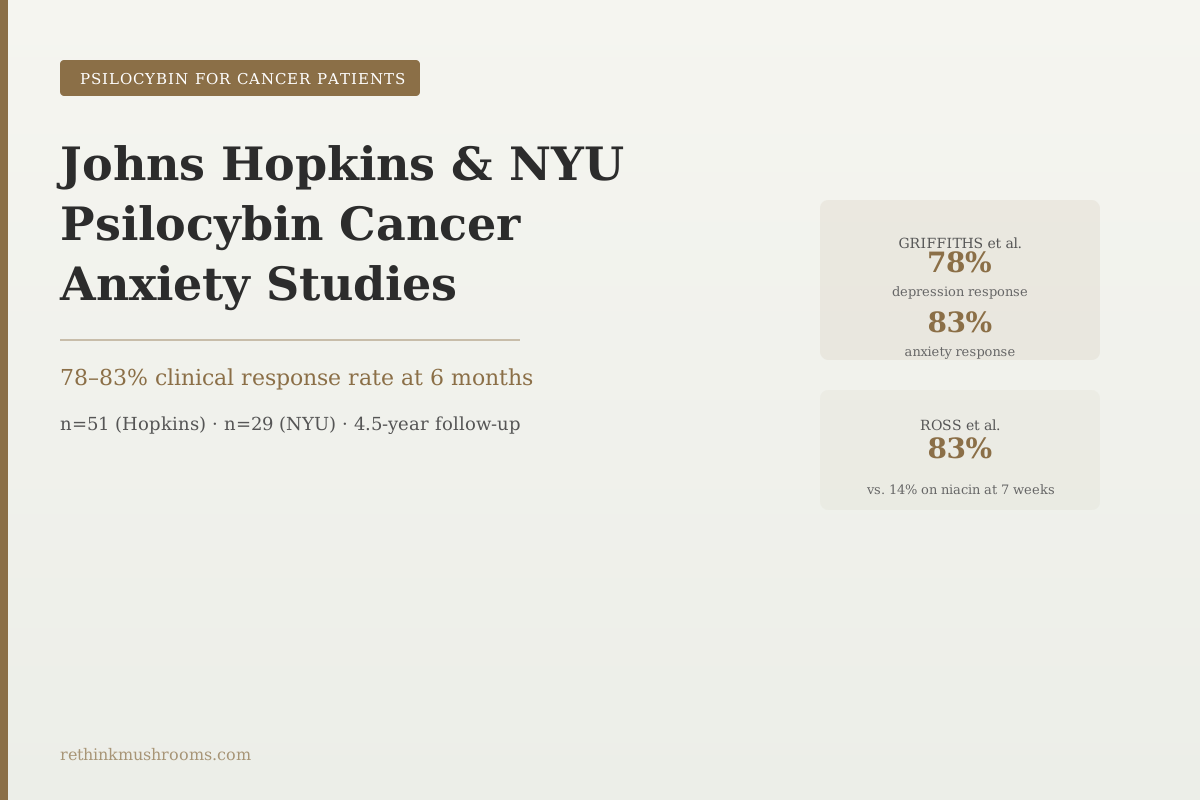
78–83% clinical response rate at 6 months
In the Johns Hopkins 2016 RCT, 78% of cancer patients showed clinically significant depression reduction and 83% showed anxiety reduction after a single psilocybin session, with effects sustained at 6.5-month follow-up. The NYU trial published simultaneously found comparable reductions plus improvements in spiritual well-being and demoralization.
Griffiths et al., Journal of Psychopharmacology, 2016
n=80
total patients across both 2016 landmark trials (Hopkins n=51, NYU n=29)
4.5 years
sustained follow-up period confirmed by Agin-Liebes et al. 2020 NYU long-term study
1 session
single psilocybin session produced the effects measured across all follow-up periods
Griffiths et al., Journal of Psychopharmacology, 2016
 View as image ↗
In December 2016, two research teams published their results in the same issue of the Journal of Psychopharmacology on the same day. Both had run randomized controlled trials of psilocybin for cancer patients experiencing anxiety and depression. Both found the same thing: large, rapid, and sustained reductions in distress after a single guided session. The journal published 11 expert editorials alongside the two papers. The coverage was described as a landmark moment in both psychiatry and psychedelic research. These Johns Hopkins and NYU psilocybin cancer anxiety study results are now the most cited body of evidence in the emerging field of psychedelic-assisted therapy for oncology patients. This article explains what each trial actually tested, what they found, how their methodologies differed, and what the 4.5-year follow-up data added. For the broader overview of how psilocybin therapy works in this population, see Psilocybin for Cancer Patients: Reducing Existential Anxiety.
Key Takeaways
- The Hopkins (Griffiths 2016, n=51) and NYU (Ross 2016, n=29) trials were published simultaneously in December 2016 alongside 11 expert editorials, and are considered the landmark clinical evidence for psilocybin in cancer-related existential distress
- In the Hopkins trial, 78% showed clinician-rated clinical response on depression and 83% on anxiety at 6.5 months; 60% were in full remission; the strength of the mystical experience during the session predicted therapeutic outcome
- In the NYU trial, 83% of the psilocybin group showed reduced depression versus 14% on the active placebo (niacin) at 7 weeks; spiritual well-being and demoralization scores also improved significantly
- The two trials used different control strategies: Hopkins used a very low psilocybin dose as the control condition; NYU used niacin (an active placebo that produces physical flushing, addressing expectation bias)
- Agin-Liebes et al. (2020) followed 15 surviving NYU participants at 4.5 years: sustained reductions in anxiety, depression, demoralization, and death anxiety persisted at both 3.2-year and 4.5-year follow-up; 70-100% rated the psilocybin experience among the most meaningful of their lives
- A 2021 meta-analysis by Yu et al. (n=132) confirmed the findings independently: psilocybin outperformed placebo for both state and trait anxiety at all follow-up periods to 6 months, with Hedges' g effect sizes from 0.60 to 1.04
Before 2016: What Grob's Pilot Study Established
Before the Hopkins and NYU results, the modern evidence base for psilocybin in cancer patients rested on a single small trial.
Charles Grob and colleagues published a double-blind crossover pilot in the Archives of General Psychiatry in 2011 using 12 patients with advanced-stage cancer.[1] The design was psilocybin versus niacin as the control. Participants received one session of each in counterbalanced order. The results showed significant reductions in trait anxiety at the 1-month and 3-month follow-up periods. Most importantly, there were no serious adverse events. The study established that psilocybin could be administered safely in a medically ill population, which was not obvious given that cancer patients often take multiple medications, may have cardiac complications from their treatments, and have elevated baseline psychological stress.
The Grob pilot was necessary but inconclusive. Twelve patients is not enough to establish efficacy. The effect sizes were small, the crossover design complicated interpretation, and the study was underpowered for most outcomes. It was, in the researchers' own framing, a proof-of-concept: important enough to justify larger trials, not sufficient to support clinical conclusions on its own.
Hopkins and NYU each built on Grob's pilot independently, running trials large enough to generate reliable effect size estimates. Both published in the same month.
December 2016: A Simultaneous Publication That Made History
The coordination between Hopkins and NYU was deliberate. Both research teams knew the other was running trials on the same question with similar designs. They agreed to publish together, and the journal arranged simultaneous peer review. The December 2016 issue of the Journal of Psychopharmacology included both full papers plus 11 invited editorials from researchers, clinicians, ethicists, and psychiatrists commenting on the findings.
This publication structure was itself an editorial statement about the significance of the work. Journal editors do not typically commission 11 editorials for a single research topic in one issue. The editorials ranged from enthusiastic endorsement to careful methodological critique, but the consensus was that these trials represented a meaningful advance in understanding how psilocybin might address a clinical need that existing treatments serve poorly.
What makes existential distress in cancer patients distinctly difficult to treat with conventional pharmacotherapy is the specific nature of the problem. Benzodiazepines reduce acute anxiety symptoms but do not address the underlying confrontation with mortality. SSRIs take 4 to 6 weeks to work and have limited evidence for anxiety specifically in the context of terminal illness. The psychological suffering these patients experience is often described as "demoralization" in the clinical literature: a distinct syndrome characterized by loss of meaning, loss of purpose, hopelessness, and changed relationship to the future, different from primary depression or generalized anxiety disorder. Psilocybin's proposed mechanism addresses something different from what these drugs target.
The Hopkins Trial: Griffiths 2016, n=51
The Hopkins trial enrolled 51 adults with a life-threatening cancer diagnosis who also had a DSM-IV diagnosis of a depressive or anxiety disorder related to their cancer experience.[2] The design was a randomized double-blind crossover: each participant received both a high-dose session and a low-dose control session, separated by at least five weeks, in randomized order.
The methodological choice that drew the most commentary was the control condition. Rather than a clearly inactive placebo, the Hopkins team used a very low dose of psilocybin (1 to 3 mg per 70 kg body weight) as the comparator against the high dose (22 to 30 mg per 70 kg). The rationale was that this produced some perceptible drug effects, maintaining blinding integrity. The criticism was that a "low dose of the same drug" is not an inert control, and that positive expectation effects might inflate the apparent benefit of the high dose.
The high dose produced perceptible psychedelic effects in all participants. The primary outcome measures were clinician-rated depression (HAM-D) and anxiety (HAM-A) at the 5-week assessment point, with follow-up extending to 6.5 months.
At 6.5 months:
- 78% of participants showed a clinician-rated clinical response on depression measures
- 83% showed a clinical response on anxiety measures
- 60% met remission criteria for depression
The mystical experience finding was important. The team used the Mystical Experience Questionnaire (MEQ30) to measure the quality of the psilocybin session. They found that the strength of the mystical experience during the session was a significant predictor of the therapeutic outcome: participants who reported a more complete mystical experience during the session showed larger and more durable reductions in distress. This suggests the mechanism is not simple serotonergic pharmacology. The drug's acute effect on subjective experience mediates the long-term psychological change.
The NYU Trial: Ross 2016, n=29
The NYU trial, led by Stephen Ross, enrolled 29 adults with DSM anxiety or depression related to cancer diagnoses.[3] The control condition was niacin, an active placebo that produces physical flushing, warmth, and prickling sensations that participants might mistake for early drug effects. This addresses a limitation of the Hopkins design: niacin creates an expectation-consistent physical experience without any psychedelic effect, making blinding more robust for participants.
The dose was 0.3 mg per kg body weight for psilocybin in the active arm.
At 7 weeks:
- 83% of participants in the psilocybin group showed reduced depression, versus 14% in the niacin group
- Anxiety, spiritual well-being, and quality of life all significantly improved in the psilocybin group
The NYU trial measured outcomes that Hopkins did not include as primary endpoints. The Functional Assessment of Chronic Illness Therapy Spiritual Well-Being scale (FACIT-Sp) captured dimensions of meaning and peace specifically. The Demoralization Scale measured the clinical syndrome of demoralization in terminal illness. Both showed significant improvements in the psilocybin group. In qualitative reporting, participants described recurring themes: a sense of reconciliation with death, an emotional uncoupling from the physical cancer diagnosis, and a feeling that their identity extended beyond the illness.
The key difference in findings between the two trials was not the magnitude of the effect but the measurement breadth. Hopkins demonstrated powerful effects on clinician-rated depression and anxiety with a larger sample. NYU added evidence that psilocybin addressed spiritual well-being and demoralization specifically, dimensions that conventional psychiatric medication does not reach.
Side-by-Side Comparison: Hopkins vs. NYU 2016
| Griffiths et al. (Hopkins) | Ross et al. (NYU) | |
|---|---|---|
| Sample size | n=51 | n=29 |
| Control condition | Very low-dose psilocybin (1-3 mg/70 kg) | Niacin active placebo |
| Active dose | 22-30 mg/70 kg | 0.3 mg/kg |
| Primary outcome measures | HAM-D, HAM-A | HADS-D, STAI |
| Depression response rate | 78% at 6.5 months | 83% vs. 14% at 7 weeks |
| Anxiety response rate | 83% at 6.5 months | Significant vs. niacin |
| Unique outcome measured | Mystical experience mediation | Spiritual well-being, demoralization |
| Key limitation | Low-dose psilocybin control may inflate effects | Smaller sample; NYU population only |
| Follow-up extended to | 6.5 months | 7 weeks (+ 4.5-year Agin-Liebes) |
The key methodological difference is in the control strategy. Hopkins' very low-dose control may have produced some active effects in participants, which could inflate the apparent high-dose benefit through mechanisms other than expectation alone. NYU's niacin control was more physically convincing as a sham treatment, potentially providing cleaner separation between pharmacological and expectation effects. Neither design is unambiguously superior; both represent genuine methodological compromises in a field where blinding psilocybin trials is inherently difficult.
4.5 Years Later: The Agin-Liebes Follow-Up
The most important evidence that emerged after the two 2016 trials was not from a new study. It was from the same NYU participants, followed for 4.5 years.
Agin-Liebes et al. (2020) traced 15 of the 16 surviving participants from the Ross 2016 trial, conducting structured clinical interviews at both 3.2-year and 4.5-year timepoints.[4] At both assessment points, the reductions in anxiety, depression, hopelessness, demoralization, and death anxiety were sustained. No long-term adverse effects were reported.
The phenomenological finding was striking: 70 to 100% of participants described the psilocybin experience as among the most personally meaningful or spiritually significant experiences of their lives, even 4 to 4.5 years later. A large fraction reported it as the single most meaningful experience. These were patients with late-stage cancer. The psilocybin session had taken place years before. Their cancers had progressed. They were, in some cases, nearer to death than they had been at enrollment. And yet the session continued to provide what they described as a psychological anchor.
The durability data from Agin-Liebes 2020 is the finding most often omitted from popular summaries of this research. Most coverage highlights the 78% and 83% response rates. The less-cited finding is that 60 to 80% of those participants were still maintaining clinically significant reductions in distress 4.5 years later, from a single session.
What Independent Meta-Analyses Found
Two meta-analyses synthesized the evidence from the 2016 trials and subsequent studies independently.
Yu et al. (2021) conducted a meta-analysis of five studies including 132 participants total.[5] Using Hedges' g as the effect size measure, they found psilocybin outperformed placebo for state anxiety at day 1 (g = -0.70) and month 1 (g = -0.73). For trait anxiety, the effects were larger: day 1 (g = -0.71), month 1 (g = -1.04), month 3 (g = -0.60), and month 6 (g = -1.03). No serious adverse events were reported across all included studies. The only consistent physiological finding was transient blood pressure elevation during the session itself. Meta-analytic synthesis confirmed that the Hopkins and NYU findings were not outliers, but rather consistent with the entire available literature at the time.
Bader et al. (2024) updated the meta-analysis with seven studies and 132 participants, finding pooled STAI anxiety scores declining from 35.15 at 4 to 4.5 months to 33.06 at 6 to 6.5 months, with approximately 60 to 80% of participants maintaining clinically significant reductions in depression or anxiety at follow-up.[6] Quality of life and pain control also showed improvement in the pooled analysis.
Where the Research Stands: Ross 2025 Phase 2b
The most recent data comes from a Phase 2b randomized controlled trial led by the NYU group and published in General Hospital Psychiatry in 2025.[7] Phase 2b represents a more rigorous and larger-scale replication of the 2016 findings, designed specifically to satisfy regulatory requirements for clinical development. The results confirmed significant reductions in depression and anxiety, extending and replicating the Ross 2016 findings in a more methodologically stringent design.
The existence of a Phase 2b trial signals that this research has moved beyond academic exploration into a clinical development pathway. Phase 3 trials, which would be required for regulatory approval, have not yet been completed.
Honest Limitations of the 2016 Evidence Base
The 2016 trials are well-designed for their era and publication context. They are not without important limitations.
Sample sizes are small. The Hopkins trial had 51 participants and the NYU trial had 29. These samples are adequate for detecting large effect sizes, but they limit the precision of estimates and the generalizability of findings. Both trials drew from relatively homogeneous populations: mostly white, college-educated, and comfortable with psychological introspection. Whether the results generalize to patients without these characteristics is not established.
Both trials involved a single psilocybin session. The treatment model in real-world deployment might look different: multiple sessions, different durations of preparatory therapy, or different support structures. The single-session design is internally consistent but may not represent optimal clinical practice.
The crossover design in both trials means some participants received psilocybin first and some received the control first. Any carryover effect from the psilocybin session (an experience described as among the most meaningful in people's lives) would contaminate subsequent control session ratings. Both teams controlled for this statistically, but it remains a structural concern.
These limitations do not undermine the findings. Large, robust, sustained effects with consistent replication across two independent teams and confirmed by meta-analysis are the strongest signal available at this evidence level. They do mean the evidence base is not yet equivalent to a multi-center Phase 3 program.
The Bottom Line
The 2016 Hopkins and NYU psilocybin trials remain the landmark evidence in this field: n=51 and n=29 respectively, different control designs, and consistent findings of 78-83% clinical response rates for depression and anxiety in cancer patients after a single guided session, with effects persisting to 6.5 months. The Agin-Liebes 2020 follow-up extended this to 4.5 years in the NYU cohort, with 60-80% maintaining clinically significant improvements. Two meta-analyses and a 2025 Phase 2b RCT have since confirmed and extended the original findings. The evidence is robust for effect size and durability; generalizability remains limited by small, demographically narrow samples.
Frequently Asked Questions
Sources & References
- 1RTHM-00397·Grob, Charles S et al. (2011). “Pilot study of psilocybin treatment for anxiety in patients with advanced-stage cancer..” Archives of general psychiatry.Study breakdown →PubMed →↩
- 2. Source details for this reference are not yet available.
- 3RTHM-00445·Ross, Stephen et al. (2016). “Rapid and sustained symptom reduction following psilocybin treatment for anxiety and depression in patients with life-threatening cancer: a randomized controlled trial..” Journal of psychopharmacology (Oxford.Study breakdown →PubMed →↩
- 4RTHM-01160·Agin-Liebes, Gabrielle I et al. (2020). “Long-term follow-up of psilocybin-assisted psychotherapy for psychiatric and existential distress in patients with life-threatening cancer..” Journal of psychopharmacology (Oxford.Study breakdown →PubMed →↩
- 5RTHM-01466·Yu, Chia-Ling et al. (2021). “Psilocybin for End-of-Life Anxiety Symptoms: A Systematic Review and Meta-Analysis..” Psychiatry investigation.Study breakdown →PubMed →↩
- 6RTHM-01856·Bader, Husam et al. (2024). “Investigating the therapeutic efficacy of psilocybin in advanced cancer patients: A comprehensive review and meta-analysis..” World journal of clinical oncology.Study breakdown →PubMed →↩
- 7RTHM-00949·Ross, Margaret L et al. (2025). “Psilocybin-assisted psychotherapy for depression and anxiety associated with life threatening illness: A phase 2b randomized controlled trial..” General hospital psychiatry.Study breakdown →PubMed →↩