Psilocybin for Cancer Patients
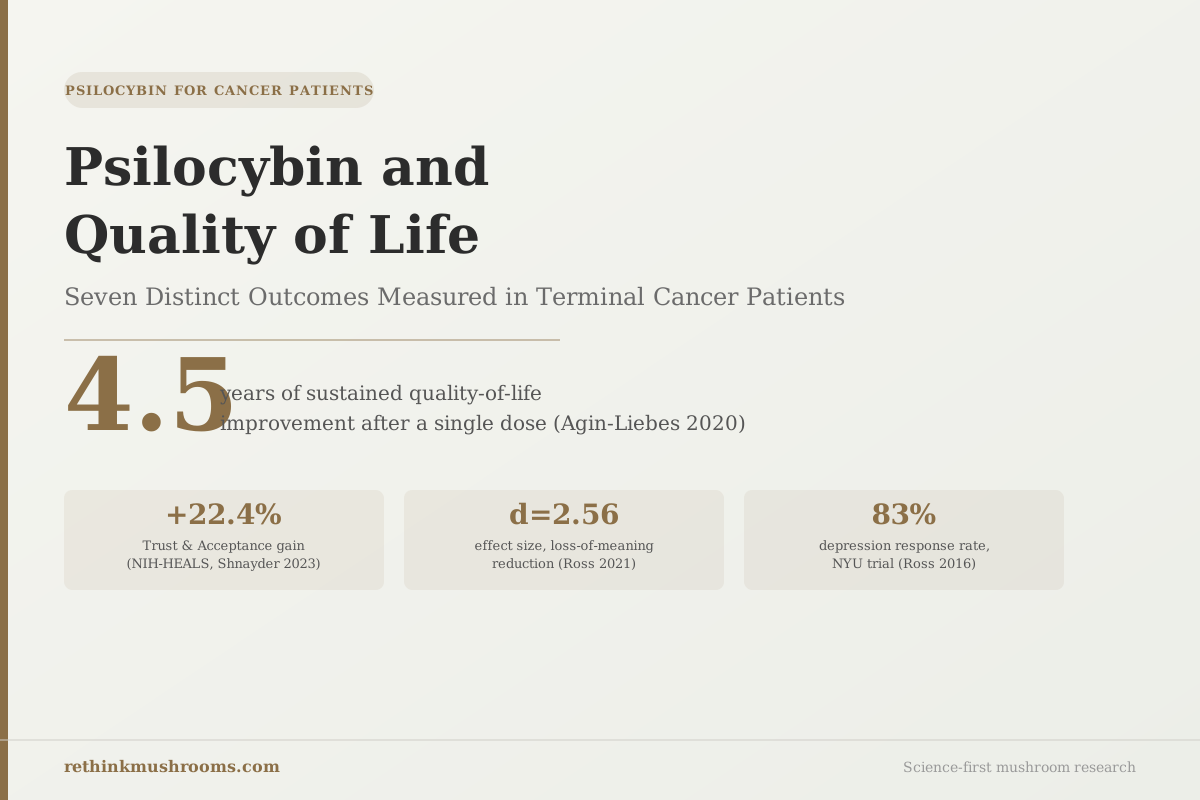
83%
of patients in the NYU psilocybin cancer trial showed reduced depression at 7 weeks, alongside concurrent improvements in spiritual well-being, demoralization, and hopelessness that persisted at 4.5-year follow-up.
Ross et al., Journal of Psychopharmacology, 2016
+22.4%
Trust & Acceptance gain (NIH-HEALS, Shnayder 2023)
4.5 years
QoL benefits sustained after a single dose
d=2.56
largest effect size for loss-of-meaning reduction
Ross et al., Journal of Psychopharmacology, 2016
 View as image ↗
When people encounter the psilocybin cancer headline numbers, they see anxiety response rates: 78%, 83%, Hedges' g effect sizes. Those numbers are real and significant. But focusing only on anxiety and depression scores misses what makes these trials distinctive: psilocybin quality of life research in cancer doesn't just move one dial. In the NYU trial, six distinct quality-of-life constructs improved simultaneously from a single session. In the 4.5-year follow-up, most of those improvements were still measurable.
This article covers what those constructs are, how they were measured, and what the data actually shows across nine studies. For a broader overview of the evidence base, see our pillar article on psilocybin for cancer patients.
Key Takeaways
- Ross 2016 (NYU trial, n=29) found improvements in spiritual well-being (FACIT-Sp), demoralization, hopelessness, and anxiety alongside depression at 7 weeks, all from a single psilocybin session
- Agin-Liebes 2020 followed 15 NYU survivors for 4.5 years: sustained reductions in anxiety, depression, death anxiety, hopelessness, and demoralization; 70-100% rated the experience among the most personally meaningful of their lives
- Ross 2021 (n=11) found loss-of-meaning reductions with Cohen's d ranging from 1.51 to 2.56, sustained at 4.5-year follow-up, larger effect sizes than most pharmacological treatments achieve at all
- Shnayder 2023 (n=30) used the NIH-HEALS wellness instrument: Trust & Acceptance improved +22.4%, Connection +12.7%, Reflection & Introspection +7.7%, all sustained at 8 weeks
- Bader 2024 meta-analysis (7 studies, 132 participants) found QoL and pain control both improved together, suggesting psychological suffering amplifies cancer pain and both respond to the same intervention
- Moshfeghinia 2026 meta-analysis adds an important caveat: spiritual well-being and quality-of-life benefits are time-dependent, not immediate, and the evidence is stronger for depression than for anxiety
Why Anxiety Scores Miss Most of What Cancer Does to a Person
Standard clinical trials for cancer-related psychological distress measure anxiety with the STAI (State-Trait Anxiety Inventory) and depression with the HAM-D (Hamilton Depression Rating Scale) or BDI (Beck Depression Inventory). These are validated, widely used instruments. They are also incomplete for what a terminal diagnosis does to a person.
Facing terminal cancer produces suffering that doesn't fit neatly into "anxiety" or "depression." A person might score within normal range on the STAI but feel that their life has lost meaning. They might not meet criteria for a depressive episode but feel completely demoralized, stripped of purpose and hope. They might have accepted their cancer intellectually while remaining unable to find peace with dying. Standard mood inventories measure none of that.
The psilocybin cancer trials, particularly from the NYU group, were designed to capture this broader landscape. They used instruments that go beyond mood scores:
| Outcome | Measurement Tool | Improvement Found | Time Point |
|---|---|---|---|
| State/trait anxiety | STAI | Hedges' g = -0.70 to -1.04 | Day 1 to Month 6 |
| Depression | HAM-D, BDI | 78-83% clinical response | 6-6.5 months |
| Spiritual well-being | FACIT-Sp | Significant improvement | 7 weeks |
| Demoralization | Demoralization Scale | Significant reduction | 7 weeks |
| Death anxiety | DADDS | Sustained reduction | 4.5 years |
| Loss of meaning | LMQ | Cohen's d 1.51-2.56 | 2 weeks to 4.5 years |
| Psychosocial integration | NIH-HEALS | +7.7% to +22.4% by domain | 8 weeks |
Each of these instruments captures a distinct dimension of what it means to be well when facing death. The fact that psilocybin moves all of them matters more than any single number.
Psilocybin's effects on cancer-specific existential distress are distinct from its effects on general anxiety disorder. For context on how the evidence differs, see our article on whether psilocybin helps chronic anxiety.
Spiritual Well-Being: The Outcome That SSRIs Don't Reliably Move in Cancer
The FACIT-Sp (Functional Assessment of Chronic Illness Therapy, Spiritual Well-Being scale) measures two components: peace and meaning (a sense that life has purpose) and faith (a sense of connection to something larger). In cancer care, low FACIT-Sp scores predict worse quality of life, faster functional decline, and poorer end-of-life experiences.
Ross and colleagues at NYU found significant improvements on the FACIT-Sp in their 2016 trial of 29 cancer patients.[2] The trial used a crossover design: patients received psilocybin in one session and niacin (an active placebo) in another, seven weeks apart. The psilocybin group showed immediate and sustained improvement on spiritual well-being scores. The niacin group showed no significant change.
This finding is unusual in oncology. Spiritual well-being is not something that standard pharmacological interventions move reliably. SSRIs don't produce consistent improvements on the FACIT-Sp in cancer patients. Chemotherapy certainly doesn't. A single psilocybin session producing measurable spiritual well-being improvements suggests the therapy is engaging dimensions of suffering that conventional treatments largely bypass.
The Griffiths 2016 Hopkins trial (n=51) reported similar broad quality-of-life findings, using different primary outcome measures, and arrived at the same pattern: wide-ranging quality-of-life improvement from a single session.[1]
Demoralization: A Different Kind of Suffering Than Depression
Demoralization is not depression. The clinical distinction matters.
Depression involves persistent low mood, anhedonia (inability to feel pleasure), and neurovegetative symptoms like sleep disruption and appetite changes. A doctor uses a specific checklist to make the diagnosis. Demoralization is different: it involves loss of meaning and purpose, a feeling of subjective incompetence, and hopelessness, but without necessarily meeting the diagnostic threshold for a depressive episode. A person can be demoralized without being depressed. In terminal cancer, demoralization is often the more accurate description of the psychological state.
Ross 2016 measured demoralization using the Demoralization Scale, a 24-item instrument developed specifically for medically ill populations.[2] The trial found significant reductions in demoralization and hopelessness in the psilocybin group at seven weeks. The niacin group showed no significant change on these dimensions.
This has practical significance. Most psychiatric trials for cancer patients focus on depressive episodes. If the primary suffering in terminal cancer is demoralization rather than clinical depression, then an intervention that reduces demoralization is addressing the actual problem. The Yu 2021 meta-analysis (five studies, n=132) confirmed consistent effects on state and trait anxiety across time points, with the effect on trait anxiety growing stronger over time: Hedges' g = -0.71 at day 1, -1.04 at month 1, and -1.03 at month 6.[5]
Loss of Meaning: The Largest Effect Sizes in Any Psilocybin Cancer Data
The Ross 2021 secondary analysis focuses specifically on loss of meaning and suicidal ideation, two constructs that are related to but distinct from general anxiety and depression.[4]
The study examined 11 NYU participants who had elevated suicidal ideation at baseline. "Suicidal ideation" in terminal cancer patients frequently reflects passive death wishes rather than active suicidal planning. It is often a measure of loss of will to live, which is itself closely tied to loss of meaning.
The findings were striking. Suicidal ideation reductions appeared within eight hours of the psilocybin session, with effect sizes of Cohen's d = 1.20 to 3.50. To put those numbers in context: an effect size of 0.8 is considered large in clinical psychology. An effect of 1.20 is very large. An effect of 3.50 approaches the upper range of what clinical psychologists measure for any intervention.
Loss-of-meaning reductions, measured with the Loss of Meaning Questionnaire (LMQ), showed effect sizes of Cohen's d = 1.51 to 2.56 at two weeks, sustained through the 4.5-year follow-up.[4]
Psilocybin is metabolically cleared from the body within six to eight hours. These effect sizes were still present 4.5 years later. That durability cannot be explained by direct pharmacological action. The intervention appears to facilitate a lasting psychological reorganization around meaning, not a temporary serotonin adjustment.
For a closer look at how meaning-making and death reconciliation interact in this context, see our article on psilocybin and meaning-making at end of life. For the pharmacological and neurological mechanisms that produce these lasting shifts, see the companion piece on how a single dose of psilocybin reduces death anxiety.
Psycho-Social-Spiritual Integration: What the NIH-HEALS Reveals
The NIH-HEALS is a wellness instrument developed to capture multi-dimensional wellbeing shifts that can follow a significant life experience. It measures three domains: Connection (to others, to nature, to something larger), Trust & Acceptance (of self, of the future, and of death), and Reflection & Introspection (a sense of insight and personal growth).
Shnayder and colleagues applied this instrument to 30 cancer patients with major depressive disorder who received a 25 mg psilocybin session with psychotherapy support in 2023.[6] The improvements across all three domains were statistically significant:
- Trust & Acceptance: +22.4% improvement, sustained at 8 weeks
- Connection: +12.7% improvement, sustained at 8 weeks
- Reflection & Introspection: +7.7% improvement, sustained at 8 weeks
The Trust & Acceptance domain is particularly relevant for terminal cancer. It includes items specifically about acceptance of death and an uncertain future. A +22.4% improvement on a scale measuring death acceptance, sustained weeks after a single session, is different data than a mood inventory score.
These three dimensions map closely to what qualitative researchers hear from psilocybin trial participants describing what changed: a sense of reconnection to family and nature, a feeling that death is acceptable or even natural, and a new perspective on their own life story.
Pain Control and Quality of Life: Why the Bader 2024 Meta-Analysis Matters
The Bader 2024 meta-analysis (seven studies, 132 participants) added a finding that receives almost no attention in popular coverage: quality of life and pain control improved together in the psilocybin cancer trials.[7]
The meta-analysis found pooled STAI anxiety scores declining from 35.15 at 4-4.5 months to 33.06 at 6-6.5 months, with approximately 60-80% of participants maintaining clinically significant reductions in depression or anxiety at follow-up. Alongside these psychological improvements, the analysis found improved pain management outcomes.
Cancer pain is not purely nociceptive, meaning it is not only a signal from damaged tissue to the brain. It has a substantial psychological amplification component. Anxiety, depression, and loss of meaning all lower the threshold at which pain becomes intolerable. When those psychological states improve, the experience of pain changes, not because the cancer has changed, but because the psychological context of the pain has shifted.
Psilocybin is not an analgesic. The Lapid 2025 palliative care systematic review explicitly frames psilocybin's role as psychological support in medically compromised populations, not a direct pain treatment.[8] But the co-occurrence of QoL and pain improvements in the meta-analysis data suggests the two are linked through the psychological changes psilocybin produces.
How Long Do Quality-of-Life Benefits Last? The 4.5-Year Answer
The Agin-Liebes 2020 study is the longest available follow-up in the cancer psilocybin literature.[3] It followed 15 of 16 surviving participants from the original NYU Ross 2016 trial to 3.2 years and then to 4.5 years post-treatment.
At both time points, sustained reductions in anxiety, depression, hopelessness, demoralization, and death anxiety were present. The percentage of participants who maintained clinically significant improvements ranged from roughly 60% to 80% depending on the specific outcome measure. And 70-100% of the 15 participants rated the psilocybin experience among the most personally meaningful or spiritually significant experiences of their lives.
That last finding deserves attention. These patients received a single psilocybin session, in most cases years before the follow-up interview. The experience remained among their most meaningful life events, alongside marriages, births of children, and deaths of loved ones. A pharmacological intervention producing a memory of that significance is itself clinically notable and not something that can be easily explained by a mechanism of "temporarily adjusted serotonin levels."
The Moshfeghinia 2026 meta-analysis calibrates the picture: quality-of-life and spiritual well-being improvements are time-dependent, not universal or immediate.[9] The 2026 analysis found strong effects on depression, mixed effects on anxiety across time points, and time-dependent improvements in spiritual well-being and quality of life. Not everyone responds, and not every dimension improves in every participant at every time point.
This is the honest evidence picture: a substantial majority maintaining meaningful gains years later, with real variability across individuals and outcome measures.
For a technical comparison of the two landmark trials that generated most of this data, see our article on the Johns Hopkins and NYU cancer anxiety studies.
The Bottom Line
Nine studies including two independent meta-analyses confirm that psilocybin improves quality of life in cancer patients across multiple dimensions beyond anxiety and depression: spiritual well-being, demoralization, loss of meaning, psychosocial integration, and pain management. The Agin-Liebes 2020 follow-up found these improvements persisting 4.5 years after a single session in the majority of participants. The Moshfeghinia 2026 meta-analysis confirms the breadth of effects while noting that some quality-of-life dimensions are time-dependent rather than immediate. The largest effect sizes in the trial data, Cohen's d up to 2.56 for loss of meaning, apply to constructs that most psychiatric pharmacotherapy does not measure at all.
Frequently Asked Questions
Sources & References
- 1. Source details for this reference are not yet available.
- 2RTHM-00445·Ross, Stephen et al. (2016). “Rapid and sustained symptom reduction following psilocybin treatment for anxiety and depression in patients with life-threatening cancer: a randomized controlled trial..” Journal of psychopharmacology (Oxford.Study breakdown →PubMed →↩
- 3RTHM-01160·Agin-Liebes, Gabrielle I et al. (2020). “Long-term follow-up of psilocybin-assisted psychotherapy for psychiatric and existential distress in patients with life-threatening cancer..” Journal of psychopharmacology (Oxford.Study breakdown →PubMed →↩
- 4RTHM-01425·Ross, Stephen et al. (2021). “Acute and Sustained Reductions in Loss of Meaning and Suicidal Ideation Following Psilocybin-Assisted Psychotherapy for Psychiatric and Existential Distress in Life-Threatening Cancer..” ACS pharmacology & translational science.Study breakdown →PubMed →↩
- 5RTHM-01466·Yu, Chia-Ling et al. (2021). “Psilocybin for End-of-Life Anxiety Symptoms: A Systematic Review and Meta-Analysis..” Psychiatry investigation.Study breakdown →PubMed →↩
- 6RTHM-01789·Shnayder, Sarah et al. (2023). “Psilocybin-assisted therapy improves psycho-social-spiritual well-being in cancer patients..” Journal of affective disorders.Study breakdown →PubMed →↩
- 7RTHM-01856·Bader, Husam et al. (2024). “Investigating the therapeutic efficacy of psilocybin in advanced cancer patients: A comprehensive review and meta-analysis..” World journal of clinical oncology.Study breakdown →PubMed →↩
- 8RTHM-02122·Lapid, Maria I et al. (2025). “Evaluating the effectiveness of psilocybin in alleviating distress among cancer patients: A systematic review..” Palliative & supportive care.Study breakdown →PubMed →↩
- 9RTHM-02238·Moshfeghinia, Reza et al. (2026). “The effects of psilocybin on psychological distress in cancer patients: a systematic review and meta-analysis..” BMC psychology.Study breakdown →PubMed →↩