Psilocybin & OCD
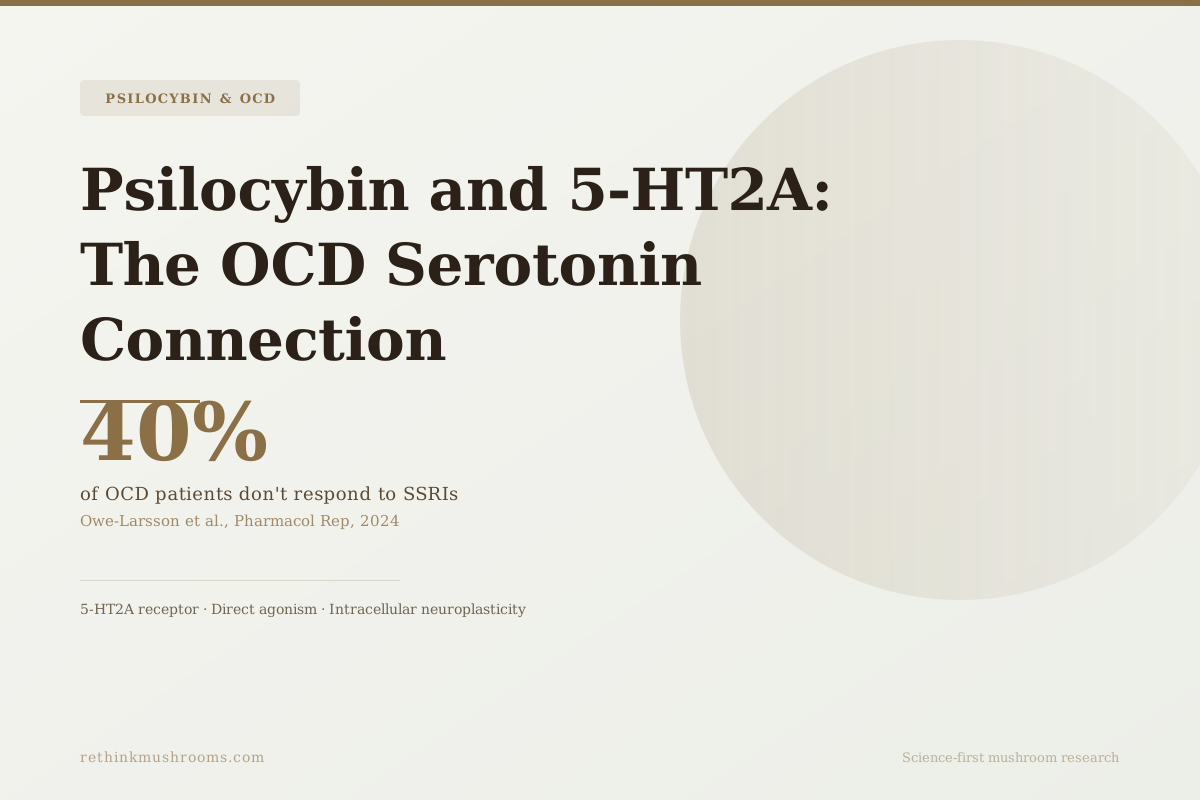
Up to 40% of OCD patients
A 2024 pharmacotherapy review reports that up to 40% of OCD patients are resistant to currently available medications, pointing attention at which serotonin receptor those medications reach only indirectly.
Owe-Larsson et al., Pharmacol Rep, 2024
5-HT2A
the serotonin receptor psilocybin activates directly in OCD neurons
Intracellular
where psilocybin reaches that serotonin cannot
Pyramidal
the specific neuron type required for lasting effects
Owe-Larsson et al., Pharmacol Rep, 2024
 View as image ↗
Serotonin is the most studied neurotransmitter in OCD research, and for good reason. The medications prescribed most often for OCD are serotonin reuptake inhibitors, known as SSRIs. They work by raising serotonin levels throughout the brain. For many patients they help. But a 2024 review of psilocybin's role in OCD pharmacotherapy puts the ceiling plainly: up to 40% of OCD patients are resistant to the medications currently available, even with serotonin significantly elevated.[1]
Psilocybin, the active compound in psilocybin mushrooms, takes a different route into the same system. Instead of raising serotonin levels, it binds directly to a serotonin receptor called 5-HT2A and activates it. The distinction matters more than it sounds. A 2023 study published in Science found that psilocybin reaches a population of 5-HT2A receptors inside neurons that serotonin itself cannot access, and that those intracellular receptors are the ones driving neuroplastic change.[2]
That is a genuinely important mechanistic result, and this article will spend most of its length on it. It is also worth saying at the outset what it is not. The receptor work was done in cells and mice. The controlled human evidence for psilocybin in OCD is two small studies totalling 28 participants, and in the better-designed of the two the benefit had faded within a month. This is a well-mapped mechanism attached to a thin clinical record — and a few of the claims that circulate alongside it, including two this article previously made, do not survive contact with the primary sources. For context on psilocybin's clinical results across anxiety conditions, see our coverage of psilocybin for anxiety. For the OCD trial results specifically, see Psilocybin OCD Clinical Trials: Current Status and Results.
Key Takeaways
- OCD involves dysfunction across serotonin, dopamine, and glutamate systems simultaneously. SSRIs only directly target serotonin reuptake, which may be part of why up to 40% of OCD patients are resistant to currently available medications (Owe-Larsson et al., Pharmacol Rep, 2024)
- Psilocybin is a direct 5-HT2A receptor agonist. The 5-HT2A receptor is densely concentrated in layer V pyramidal neurons of the prefrontal cortex, the cells that govern signaling to the OCD circuit (López-Giménez & González-Maeso, Curr Top Behav Neurosci, 2018)
- Psilocybin activates 5-HT2A via two pathways: Gq/11 protein (producing acute perceptual effects) and beta-arrestin (associated with neuroplasticity). SSRIs don't directly activate 5-HT2A at all (López-Giménez & González-Maeso, 2018)
- The claim that SSRIs downregulate 5-HT2A is repeated far more confidently than the evidence supports. A review of in vivo work describes exactly that "paradoxical" downregulation, while a small human PET study found the opposite — up-regulation (Gray & Roth, Brain Res Bull, 2001; Massou et al., Psychopharmacology, 1997)
- A 2023 Science paper found psilocybin activates 5-HT2A receptors inside the neuron that serotonin cannot reach. Those intracellular receptors specifically drive dendritic spine growth and synaptic remodeling (Vargas et al., Science, 2023)
- A 2024 mouse preprint found psilocybin's lasting effects require one specific pyramidal cell type — subcortical-projecting neurons — plus 5-HT2A expression in those cells. Silencing them abolished the effect; so did knocking out the receptor (Shao et al., bioRxiv preprint, 2024)
- In the best controlled OCD data so far, a single 10 mg dose beat 1 mg on the Y-BOCS at one week (d = 0.82), with the compulsion subscale reaching significance and the obsession subscale not (d = 0.50, p = 0.06). The effect diminished over the following three weeks (Pellegrini et al., Compr Psychiatry, 2025)
- Psilocin binds 5-HT2A, 5-HT2C and 5-HT1A at broadly similar concentrations, so 5-HT2A's central role rests on blockade experiments rather than on selectivity — leaving the other subtypes' contribution to OCD genuinely open (Erkizia-Santamaría et al., Biomed Pharmacother, 2022)
The Serotonin Theory of OCD: Where It Runs Out
OCD doesn't have a single known cause. But serotonin's role is well-established enough that SSRIs became the standard first-line medication and have remained so for more than three decades.
The reasoning: SSRIs block a protein called the serotonin transporter, which normally pulls serotonin back into the neuron after it's released. By blocking that reuptake pump, SSRIs leave more serotonin in the space between neurons, where it can continue activating receptors. For many OCD patients, this helps.
But that same 2024 review made an important point about what the serotonin account leaves out: OCD involves dysfunction across three neurotransmitter systems at once, not one. Serotonin, dopamine, and glutamate all contribute to the overactive circuit that drives obsessive-compulsive symptoms — alongside non-pharmacological contributors the review also flags, including early maladaptive schemas.[1] SSRIs address only the serotonin piece, and only indirectly. That may be part of why up to 40% of patients remain resistant.
The question that follows: what happens when you bypass the reuptake pump and instead activate specific serotonin receptors directly?
The 5-HT2A Receptor: Anatomy of a Target
The serotonin system contains at least 14 distinct receptor subtypes. They don't all do the same thing. Activating one can produce completely different effects than activating another.
5-HT2A is the subtype most closely tied to psilocybin's effects — though, as a later section shows, not because psilocybin binds it more tightly than the others. A 2018 comprehensive review of 5-HT2A receptor signaling described its location precisely: high-density expression in layer V pyramidal neurons of the prefrontal cortex.[3] These are the large output cells of the prefrontal cortex. They send long-range signals downward into the striatum and thalamus, the regions that form the feedback circuit stuck in overdrive in OCD.
These neurons function as the prefrontal cortex's main broadcast towers. They regulate what signals get amplified and sent to the rest of the brain, including the striatum's threat-detection system, which in OCD keeps registering danger even when none exists.
When psilocybin binds to 5-HT2A on these cells, it activates two distinct molecular pathways simultaneously. The first is the Gq/11 protein pathway, which is responsible for the acute perceptual and experiential effects. The second is the beta-arrestin pathway, which is associated with changes that persist after the acute effect ends, including neuroplasticity.[3]
SSRIs, by contrast, don't directly activate 5-HT2A at all. They raise the amount of serotonin floating between neurons, and that serotonin then finds 5-HT2A among many other receptors.
Why SSRIs and Psilocybin Work Differently at the Receptor Level
The distinction between these two pharmacological approaches is most visible side by side.
| Feature | SSRIs | Psilocybin |
|---|---|---|
| Mechanism | Blocks serotonin reuptake pump, raising extracellular serotonin | Directly agonizes the 5-HT2A receptor |
| Receptor target | Indirect: elevated serotonin reaches 5-HT2A among other receptors | Direct: 5-HT2A Gq/11 and beta-arrestin activation |
| Onset in OCD | 4-12 weeks | Reported within hours to one week in small trials |
| Effect on 5-HT2A density | Contested: in vivo work reports downregulation, a small human PET study the opposite | Acute activation, then neuroplastic remodeling |
| Neuroplasticity | Slow, over weeks to months | Rapid, within 24 hours in animal models |
| Treatment-resistant OCD | Up to 40% resistant to available medications | Early, small-scale evidence only |
| Administration schedule | Daily, ongoing | Periodic sessions in trials |
This table captures the core pharmacological argument. SSRIs raise the water level broadly: serotonin goes up everywhere, and 5-HT2A is one receptor that eventually responds. Psilocybin walks through a specific door.
The One Row Worth Slowing Down On
Explainers comparing psilocybin to SSRIs — including an earlier version of this article — routinely state that chronic SSRI use downregulates 5-HT2A receptors, leaving fewer available on the cell surface. It is repeated as settled. It is not.
The downregulation claim has a real basis. A 2001 review of two decades of receptor-regulation research catalogues what its authors call the "paradoxical" phenomenon: 5-HT2A downregulation following chronic treatment with antidepressants and antipsychotics across numerous in vivo studies. The authors call it paradoxical precisely because receptor theory does not predict it, and because the mechanism was unresolved.[4]
But when the question was put to human brains directly, the result went the other way. A PET study of depressed patients on long-term SSRIs found frontal 5-HT2A binding higher in treated than in untreated patients. Its authors concluded that chronic SSRI treatment "could induce an up-regulation" of 5-HT2A, and that downregulation "is not a common mechanism for the therapeutic effects of all serotoninergic antidepressive drugs."[5]
Contested Finding · SSRIs & 5-HT2A Density
“SSRIs Downregulate 5-HT2A” Is Not a Settled Fact
It is repeated confidently in explainers about psilocybin versus SSRIs, including an earlier version of this article. The two literatures point in opposite directions, and neither was run in OCD patients.
A review of two decades of receptor-regulation work describes what the authors call the "paradoxical" finding: chronic treatment with antidepressants and antipsychotics down-regulates 5-HT2A receptors across numerous in vivo studies.
Narrative review of in vivo studies (largely animal)
Drug classes pooled; mechanism unresolved at time of writing
Gray & Roth (2001), Brain Res Bull
A PET study of depressed patients on long-term SSRIs found frontal 5-HT2A binding higher in treated than untreated patients. The authors concluded SSRIs "could induce an up-regulation" and that down-regulation "is not a common mechanism" across serotonergic antidepressants.
Human PET, [18F]setoperone
6 treated vs 8 untreated patients — very small, depression not OCD
Massou et al. (1997), Psychopharmacology
How to read it: the honest position is that chronic SSRI treatment measurably changes 5-HT2A receptor availability, and the reported direction depends on which method and which population you look at. The contrast that actually holds regardless of direction is the one this article is about: SSRIs act on the receptor indirectly and slowly, through adaptation to raised ambient serotonin, while psilocybin binds and activates it directly. Neither of the two sources here studied OCD patients.
Sources: Gray & Roth (2001), Brain Research Bulletin 56(5):441-51, PMID 11750789 · Massou et al. (1997), Psychopharmacology 133(1):99-101, PMID 9335087. Both studied depression, not OCD; the PET comparison is 6 treated vs 8 untreated patients.
That human study is small — six treated patients against eight untreated — and studied depression, not OCD. Neither source settles the question, and no study in either direction has been run in OCD patients on SSRIs. What survives the disagreement is the contrast this article is actually about, which does not depend on the direction: SSRIs reach 5-HT2A indirectly and slowly, through the brain's adaptation to raised ambient serotonin. Psilocybin binds it.
The clinical implication: if an OCD patient's specific problem involves the part of the circuit where 5-HT2A is most critical, the layer V prefrontal neurons signaling downstream to the striatum, then targeted 5-HT2A activation may accomplish something that broad serotonin elevation cannot. That remains a hypothesis about mechanism, not a demonstrated clinical result.
The 2023 Discovery That Changed the Receptor Rulebook
For decades, the assumption in pharmacology was that receptors on the outer surface of neurons were the relevant targets. Serotonin is released from one neuron, crosses the synapse, binds to surface receptors on the next neuron, and activates a response. That's the textbook version.
A 2023 study published in Science challenged that assumption directly.[2]
The research found that psychedelics like psilocybin activate 5-HT2A receptors located inside the neuron, in an internal compartment called the endosome. Serotonin cannot reliably reach these intracellular receptors. Psilocybin can, because it passes through the cell membrane more easily than serotonin does.
The critical finding: those intracellular 5-HT2A receptors are specifically responsible for promoting neuroplasticity. Activating them caused dendritic spine growth and synaptic remodeling in the affected neurons.[2]
Dendritic spines are tiny projections on neurons where incoming signals are received. In OCD, the connections between the prefrontal cortex, striatum, and thalamus are thought to be maladaptively shaped, reinforcing compulsive loops rather than suppressing them. If psilocybin's intracellular 5-HT2A activation physically remodels those synaptic connections, that would supply a mechanism for benefits outlasting the drug's presence in the bloodstream. Whether such durable benefit actually occurs in OCD is a separate question, and the section on clinical timing below is where that claim runs into the human data.
This also clarifies why serotonin elevation alone doesn't produce the same result. SSRIs raise extracellular serotonin. That serotonin finds surface receptors. Psilocybin bypasses the surface entirely and activates an intracellular population of the same receptor protein. Same receptor name, fundamentally different access point.
It Is Not Just Which Receptor. It Is Which Neurons.
Knowing that 5-HT2A is the key receptor raises a follow-up question: which cells need to express it for the therapeutic effect to occur?
A 2024 study investigated this directly in mice, using optical imaging, chemogenetic silencing, and cell-type-specific electrophysiology in the medial frontal cortex.[6] The design lets you knock out one variable at a time and watch what survives.
A single dose of psilocybin grew dendritic spines on both of the two main pyramidal cell types — the subcortical-projecting pyramidal tract (PT) cells and the intratelencephalic (IT) cells. So spine growth alone did not distinguish them. The behavioral test did. Silencing the PT neurons eliminated psilocybin's ability to improve stress-related behavior; silencing the IT neurons had no detectable effect. In PT neurons only, psilocybin acutely boosted synaptic calcium transients and firing rates. And knocking out 5-HT2A receptors abolished both the behavioral effect and the structural plasticity.
Shao et al. (2024) · bioRxiv (preprint)
- Population
- Mice — two pyramidal cell types in medial frontal cortex (PT and IT)
- Intervention
- Single dose of psilocybin, with chemogenetic silencing and targeted 5-HT2A knockout
- Comparator
- Unsilenced cells; receptor-intact animals
- Finding
- Spine density rose in both PT and IT cells, but only PT silencing abolished the behavioral benefit — IT silencing did nothing. 5-HT2A knockout abolished both the behavioral effect and the structural plasticity.
preliminary Unusually clean causal design for this literature, and the necessity claims are well supported within it. But it is a preprint — not yet peer-reviewed — run in mice, and the behavioral readout is a stress-related phenotype, not an OCD model.
Shao et al. (2024), bioRxiv preprint 2024.11.02.621692, PMID 39554087
In other words, psilocybin is not acting broadly on every neuron that happens to carry a 5-HT2A receptor. The cell type matters as much as the receptor. A neuron with 5-HT2A but the wrong cell type doesn't produce the lasting effect. The right pyramidal cell type without 5-HT2A doesn't either.
Two caveats belong next to that finding rather than in a footnote. This is a preprint, meaning it has not yet cleared peer review. And the behavioral endpoint the silencing experiments abolished was a stress-related phenotype in mice, not compulsive behavior and not OCD.
With those in place, the connection to the López-Giménez findings is suggestive rather than direct. The layer V prefrontal pyramidal neurons that carry the highest 5-HT2A density in the human cortex are the cells projecting into the cortico-striatal-thalamo-cortical loop implicated in OCD, and the PT cells that proved necessary in mice are the subcortical-projecting population — the same broad class. If psilocybin's therapeutic action in humans turns out to require those cells and their 5-HT2A receptors, the receptor biology would map neatly onto the circuit biology. That mapping across species has not been demonstrated; it is the hypothesis the mouse work makes worth testing. For the full circuit explanation, see How Psilocybin Disrupts Obsessive-Compulsive Cycles.
OCD Is Not a One-Neurotransmitter Problem. Is 5-HT2A the Hub?
The 2024 pharmacotherapy review in Pharmacological Reports made a point that tends to get lost in discussions about SSRIs: OCD involves three neurotransmitter systems simultaneously. Serotonin dysfunction is real, but so is dopamine dysfunction in the striatum and glutamate dysregulation in thalamo-cortical pathways.[1]
SSRIs address the serotonin piece directly and the other two indirectly, through downstream circuit effects. Antipsychotics added to SSRIs address the dopamine piece. Nothing in current standard pharmacotherapy cleanly targets the glutamate system.
The proposal is that psilocybin's 5-HT2A activation cascades through the circuit in a way that reaches all three. When prefrontal layer V pyramidal neurons fire differently because of 5-HT2A activation, their downstream signals change; those changed signals would in turn affect dopamine release in the striatum and glutamate activity in thalamo-cortical projections, the two other systems involved in OCD. This is a reasonable inference from circuit anatomy rather than something measured in OCD patients given psilocybin.
This is the mechanistic case for why psilocybin's 5-HT2A action might matter for OCD in a way SSRIs do not: not just because the receptor targeting is more direct, but because direct 5-HT2A agonism in the right prefrontal cells could reshape a circuit that SSRIs are only partially adjusting.[1]
It is worth being clear that this is a case, not a consensus. A 2024 review in the International Journal of Neuropsychopharmacology evaluated the evidence for psychedelics in OCD and the claims made about their mechanisms, and it does not land where the mechanistic story above would like it to. Its assessment is that "the mechanisms underlying the effects of psychedelics for OCD are unclear," with several competing hypotheses still live: acute pharmacological effects, changes in neuroplasticity and resting-state neural networks, and the psychological effects of the experience itself. The review also devotes space to problems with the current evidence base and to the ongoing trials meant to address them.[7]
That is a meaningful check on everything in this article. Receptor-level accounts are satisfying because they are concrete and they run in a straight line. The people surveying this literature most closely are not yet willing to say which of the candidate mechanisms is doing the work — or how much of the effect is pharmacological at all, as against psychological.
With that caveat carried forward, the receptor argument still supplies a testable hypothesis for why psilocybin might help patients who failed SSRIs. If those patients' specific treatment-resistance stems from inadequate 5-HT2A activation (SSRIs raise ambient serotonin that approaches the receptor indirectly; they don't activate it), then a direct 5-HT2A agonist skips the step that wasn't working. For the clinical evidence on treatment-resistant OCD cases, see Psilocybin for OCD: Breaking the Loop.
Body dysmorphic disorder, an OCD-spectrum condition that shares the same corticostriatal circuit dysfunction, may involve the same receptor mechanisms. See Psilocybin and Body Dysmorphic Disorder: Emerging Research for what the evidence shows there.
How 5-HT2A Biology Explains Psilocybin's Clinical Timeline in OCD
One of the most striking things about the OCD psilocybin data is speed. SSRIs take four to twelve weeks to reduce OCD symptoms. The psilocybin trials, small as they are, report movement far sooner.
The evidence base here is two studies, and it is worth naming exactly what each one is. The first is a 2006 modified double-blind study in nine patients with OCD, testing up to four single doses from sub-hallucinogenic to frankly hallucinogenic (25 to 300 μg/kg) in a controlled outpatient setting, with symptom ratings taken across the eight-hour session.[8] The second is a 2025 pharmacological challenge study in nineteen adults, comparing 1 mg against 10 mg given four weeks apart with participants and raters blinded to dose order.[9]
Nine patients and nineteen patients. That is the whole controlled human record for psilocybin in OCD. Every mechanistic claim in this article is a hypothesis about what those two studies observed.
Effect Size Split · Pellegrini 2025
Compulsions Moved. Obsessions Did Not Quite.
Nineteen adults with OCD received 1 mg then 10 mg psilocybin four weeks apart. One week after the 10 mg dose, the compulsion half of the Y-BOCS separated significantly from the low dose. The obsession half did not.
What separated
Compulsions
The behavioural half of the Y-BOCS reached significance; the obsessional half did not (p = 0.06).
How long it held
About a week
The between-dose effect diminished over the following three weeks of follow-up.
What did not move
Mood (MADRS)
No effect on depression scores — the OCD signal was not simply an antidepressant effect.
How to read it: this is the clearest controlled OCD data psilocybin currently has, and it says two things at once. The compulsion-specific pattern is real enough to be worth a receptor-level explanation. But the effect faded within a month, which is a meaningfully weaker result than the “relief that outlasts the drug by weeks” story that mechanism papers on dendritic spine growth are often used to support. With nineteen participants, a fixed dose order and a low-dose rather than inert comparator, treat the subscale split as a lead to test, not a settled finding.
Source: Pellegrini et al. (2025), “Single-dose (10 mg) psilocybin reduces symptoms in adults with obsessive-compulsive disorder: A pharmacological challenge study.” Comprehensive Psychiatry 142:152619, PMID 40618640 · RTHM-02161. n = 19 entered, 18 completed; 1 mg vs 10 mg in fixed order, 4 weeks apart; 4-week follow-up.
The 2025 trial is the more informative of the two, and it complicates the story as much as it supports it. The 10 mg dose beat 1 mg on the Y-BOCS one week after dosing with a solid effect size (d = 0.82, p = 0.002). But the effect diminished over the subsequent three weeks. And no effect appeared on depression scores, which is genuinely useful — it suggests the OCD signal was not just an antidepressant effect wearing an OCD costume.
- Cell & Receptor Studiescompleted
Intracellular 5-HT2A activation and the Gq/11 versus beta-arrestin pathway split are characterized in cell systems (Vargas 2023; López-Giménez 2018)
- Animal Studiescompleted
Cell-type necessity established in mice via silencing and 5-HT2A knockout (Shao 2024, preprint); receptor-specific acute effects mapped by antagonist blockade (Erkizia-Santamaría 2022); reduced compulsive-type behavior reported in rodent OCD models
- Case Reportscompleted
Reports of obsessive-compulsive improvement after recreational psychedelic use date to the 1960s — suggestive, uncontrolled
- Small Human Trialscurrent
Two: Moreno 2006 (n=9, modified double-blind, dose-ranging) and Pellegrini 2025 (n=19, 1 mg vs 10 mg, blinded to order, 4-week follow-up)
- Large Randomized Trial (200+)missing
None. No placebo-controlled trial of any size has been completed in OCD; trials are ongoing
- Meta-Analysismissing
Two small studies with different designs cannot be pooled meaningfully
The mechanistic work is genuinely strong and unusually well-controlled for this field — but it is nearly all in cells and mice, and none of it was done in OCD patients. The human OCD evidence is 28 participants across two small studies, neither placebo-controlled in the conventional sense. That gap between mechanism depth and clinical reach is the single most important thing to hold onto here.
Moreno et al. (2006), J Clin Psychiatry; Pellegrini et al. (2025), Compr Psychiatry; Collins (2024), Int J Neuropsychopharmacol
With that scale in view, here is how the 5-HT2A biology is proposed to explain the two-phase pattern.
The acute phase, lasting hours, begins when psilocybin activates 5-HT2A on prefrontal pyramidal neurons. Those neurons immediately fire differently. The CSTC circuit, which in OCD is amplifying obsessive signals instead of suppressing them, receives a different input at the top of the loop. The proposal is that this real-time disruption is what the 2006 study's participants registered as symptom reduction during and immediately after their sessions.[8] Nine people reported it; that is the size of the observation this explanation is built on.
The proposed lasting phase operates through the intracellular mechanism described by Vargas et al. in Science.[2] Dendritic spine growth and synaptic remodeling take hours to days, and the idea is that the acute activation creates a window while neuroplastic remodeling consolidates the change into a circuit that has been physically altered rather than temporarily disrupted.
This is where the human OCD data pushes back on its own mechanism story. The neuroplasticity account predicts a benefit that outlasts the drug by weeks. The one trial designed to look over that horizon found the opposite trajectory: the effect was clear at one week and had diminished over the following three.[9] That does not refute the spine-growth mechanism — a single 10 mg dose may simply be too little, and the trial may be too small and too short to detect a durable change — but it does mean the confident version of the "relief that outlasts the drug" claim is not yet earned in OCD.
Two further caveats belong here. This mechanism is inferred from animal and in vitro studies: the Vargas 2023 and Shao 2024 findings were not conducted in OCD patients, and human neuroimaging specifically confirming intracellular 5-HT2A neuroplasticity in OCD does not exist. And the 2024 review of this literature explicitly declines to endorse neuroplasticity over the competing explanations, including the psychological effect of the experience itself.[7] The biological story is internally consistent and compatible with what the two small trials observed, but consistent is not the same as confirmed. For the clinical narrative and what the trial data actually shows, see Psilocybin for OCD: Rapid Symptom Relief in the Moreno Trial and Beyond.
The Open Question: Two Serotonin Receptors, Different Roles
5-HT2A receives most of the attention in psilocybin research. But a second serotonin receptor, 5-HT1A, also has a documented role in OCD-related behavior, and the two receptors work differently.
Here a widely repeated claim needs correcting, and this article previously carried it: that psilocybin binds 5-HT2A far more strongly than 5-HT1A, so the other subtypes can be safely set aside. Measured affinities say otherwise. In brain tissue from both humans and mice, psilocin — the active metabolite psilocybin converts into — showed similar affinities across three receptors: 5-HT2A at Ki 120–173 nM, 5-HT2C at 79–311 nM, and 5-HT1A at 146–152 nM.[10] At any psychedelic dose, all three are being engaged.
Affinity vs Effect · Erkizia-Santamaría 2022
Similar Binding, Different Jobs
Psilocin does not bind 5-HT2A dramatically more tightly than its neighbours — the measured affinities overlap. What separates the three receptors is which effect disappears when you block each one.
Controls: The psychedelic-like response itself
The head-twitch response was completely suppressed by the 5-HT2A antagonist MDL11939 — nothing left over for other receptors to explain.
Controls: A brake on that response at higher doses
Blocking 5-HT2C with SB242084 increased the head-twitch response at 3 mg/kg — this receptor was damping the effect, not producing it.
Controls: Body temperature, not the psychedelic effect
Blocking 5-HT1A with WAY100635 reversed psilocybin-induced hypothermia into hyperthermia — a clear, separable 5-HT1A-mediated effect.
How to read it: the common shorthand that psilocybin is “mainly a 5-HT2A drug because it binds 5-HT2A most strongly” does not survive the binding data. Psilocin reaches all three receptors at similar concentrations, so at any psychedelic dose it is engaging 5-HT2C and 5-HT1A too. 5-HT2A earns its central role through the blockade experiments — it is the receptor whose antagonist abolishes the psychedelic-like response — not through selectivity. For OCD, that leaves the contribution of the other two subtypes genuinely open rather than negligible.
Source: Erkizia-Santamaría et al. (2022), “Serotonin 5-HT2A, 5-HT2c and 5-HT1A receptor involvement in the acute effects of psilocybin in mice.” Biomedicine & Pharmacotherapy 154:113612, PMID 36049313 · RTHM-01511. Binding in human and mouse brain tissue; behavioural and thermal effects in mice. Acute effects only — no OCD model, no therapeutic endpoint.
What actually establishes 5-HT2A's central role is blockade, not selectivity. In the same work, the head-twitch response — the standard rodent proxy for a psychedelic-like effect — was completely suppressed by a 5-HT2A antagonist, leaving nothing for the other receptors to account for. Meanwhile blocking 5-HT2C increased the response, meaning that receptor was damping the effect rather than producing it, and blocking 5-HT1A reversed psilocybin's drop in body temperature into a rise. Three receptors, similar binding, plainly different jobs.[10]
Common Claim
Myth vs. evidence
The claim
“Psilocybin is essentially a 5-HT2A drug because it binds 5-HT2A much more strongly than other serotonin receptors.”
A reasonable inference from the fact that 5-HT2A antagonists abolish psychedelic effects — but it swaps a functional result for a binding one.
What research shows
Partly TruePsilocin's measured affinities for 5-HT2A (Ki 120–173 nM), 5-HT2C (79–311 nM) and 5-HT1A (146–152 nM) overlap. There is no meaningful selectivity for 5-HT2A.
5-HT2A is still the receptor that matters most for the psychedelic effect — the evidence is that its antagonist completely suppresses the head-twitch response. But that is a statement about which receptor mediates which effect, not about which one psilocin prefers. For OCD specifically, it means 5-HT2C and 5-HT1A contributions remain open questions rather than negligible ones.
Erkizia-Santamaría et al. (2022), Biomedicine & Pharmacotherapy 154:113612, PMID 36049313
The 5-HT1A link to compulsive behavior is real but comes from a narrower place than "animals bred for compulsivity." The workhorse model is marble burying in ordinary mice, where burying behavior is read as a compulsive-type repetitive act. In that model, 5-HT1A agonists reduce burying — and, notably, the effect of SSRIs in the same model is itself mediated through 5-HT1A activation rather than through the transporter block directly.[11] Marble burying is a coarse proxy: it captures a repetitive behavior, not an obsessional thought, which is precisely why it speaks to compulsions rather than obsessions.
That matters because of what the 2025 trial found. The compulsion subscale of the Y-BOCS separated significantly (d = 0.74, p = 0.003) while the obsession subscale did not (d = 0.50, p = 0.06).[9] A compulsion-specific human signal sitting alongside a compulsion-specific preclinical 5-HT1A literature is a suggestive pairing.
It is only suggestive. A p = 0.06 obsession result in nineteen people is not evidence that obsessions were unaffected — it is an underpowered study failing to resolve a smaller effect, and the difference between the two subscale results was not itself tested. Whether psilocybin's effect on compulsions involves 5-HT1A activity, or is entirely downstream of 5-HT2A-mediated circuit changes, is unresolved. Separating those contributions would need receptor-selective compounds and sample sizes that OCD psychedelic research does not yet have.
OCD also has high comorbidity with chronic anxiety, and the serotonin receptor mechanisms overlap considerably across conditions. See Can Psilocybin Help Chronic Anxiety? Clinical Evidence for the anxiety-specific evidence.
What This Does and Doesn't License
Clinical Context
CriticalReceptor mechanism is not a treatment rationale
Concern
An account this detailed — named receptors, named cell types, measured binding constants — reads like established treatment science. It is not. The entire controlled human record for psilocybin in OCD is 28 participants across two small studies, neither placebo-controlled in the conventional sense, and the 2024 review of this literature concludes the mechanisms remain unclear.
What the research says
Psilocybin is a Schedule I substance in the United States. Every finding described here comes from cell systems, animal models, or supervised research settings with medical screening, prepared dosing environments, and psychological support before, during and after — conditions that are part of the intervention, not incidental to it. Unsupervised use carries real psychiatric risk and does not reproduce the trial context. SSRIs remain the evidence-based first-line treatment for OCD.
Particularly relevant for: Anyone with OCD, an OCD-spectrum condition, or a personal or family history of psychosis or bipolar disorder
What to do
Discuss any treatment change with your prescribing clinician. If you want access to psilocybin research, look for a registered clinical trial rather than acting on mechanism. Do not stop or adjust an SSRI on your own — discontinuation carries its own risks.
Owe-Larsson et al. (2024), Pharmacol Rep; Collins (2024), Int J Neuropsychopharmacol; Pellegrini et al. (2025), Compr Psychiatry
This article is science journalism, not medical advice. It describes what the published research reports about a receptor mechanism; it does not recommend a treatment, a compound, or a dose for anyone.
The Bottom Line
Psilocybin's proposed pharmacological action in OCD centers on direct 5-HT2A receptor agonism — a qualitatively different route from SSRIs, which raise serotonin levels and reach the receptor only indirectly. The 5-HT2A receptor is densely expressed in the prefrontal layer V pyramidal neurons that feed the OCD circuit, and psilocybin's access to intracellular 5-HT2A receptors, unreachable by serotonin itself, is the leading candidate explanation for the neuroplastic changes seen in animal work. Mouse studies add cell-type precision: subcortical-projecting pyramidal neurons plus 5-HT2A expression in those cells were both necessary for a lasting effect. Three things keep this a hypothesis rather than a conclusion. The mechanistic work was done in cells and mice, never in OCD patients. The controlled human OCD record is 28 participants across two small studies, and in the better-designed of the two the benefit had diminished by four weeks. And a 2024 review of the field holds that the mechanisms remain unclear, with neuroplasticity, acute pharmacology, and the psychological effect of the experience all still competing. Two related claims commonly made in this comparison do not hold up: that SSRIs reliably downregulate 5-HT2A (contested, with human PET evidence pointing the other way), and that psilocybin binds 5-HT2A far more tightly than 5-HT1A (measured affinities are comparable). Psilocybin is a Schedule I substance in the United States; the findings described here come from research and clinical trial contexts only, and none of this is medical advice.
Frequently Asked Questions
Sources & References
- 1RTHM-01963·Owe-Larsson, Maja et al. (2024). “Psilocybin in pharmacotherapy of obsessive-compulsive disorder..” Pharmacological reports : PR.Study breakdown →PubMed →↩
- 2RTHM-01813·Vargas, Maxemiliano V et al. (2023). “Psychedelics promote neuroplasticity through the activation of intracellular 5-HT2A receptors..” Science (New York.Study breakdown →PubMed →↩
- 3RTHM-00980·López-Giménez, Juan F et al. (2018). “Hallucinogens and Serotonin 5-HT2A Receptor-Mediated Signaling Pathways..” Current topics in behavioral neurosciences.Study breakdown →PubMed →↩
- 4RTHM-02464·Gray, J A et al. (2001). “Paradoxical trafficking and regulation of 5-HT(2A) receptors by agonists and antagonists..” Brain research bulletin.Study breakdown →PubMed →↩
- 5RTHM-02465·Massou, J M et al. (1997). “Frontal 5-HT2A receptors studied in depressive patients during chronic treatment by selective serotonin reuptake inhibitors..” Psychopharmacology.Study breakdown →PubMed →↩
- 6RTHM-00906·Shao, Ling-Xiao et al. (2024). “Pyramidal cell types and 5-HT2A receptors are essential for psilocybin's lasting drug action..” bioRxiv : the preprint server for biology.Study breakdown →PubMed →↩
- 7RTHM-02463·Collins, Helen M (2024). “Psychedelics for the Treatment of Obsessive-Compulsive Disorder: Efficacy and Proposed Mechanisms..” The international journal of neuropsychopharmacology.Study breakdown →PubMed →↩
- 8RTHM-00195·Moreno, Francisco A et al. (2006). “Safety, tolerability, and efficacy of psilocybin in 9 patients with obsessive-compulsive disorder..” The Journal of clinical psychiatry.Study breakdown →PubMed →↩
- 9RTHM-02161·Pellegrini, Luca et al. (2025). “Single-dose (10 mg) psilocybin reduces symptoms in adults with obsessive-compulsive disorder: A pharmacological challenge study..” Comprehensive psychiatry.Study breakdown →PubMed →↩
- 10RTHM-00757·Erkizia-Santamaría, I et al. (2022). “Serotonin 5-HT2A, 5-HT2c and 5-HT1A receptor involvement in the acute effects of psilocybin in mice. In vitro pharmacological profile and modulation of thermoregulation and head-twich response..” Biomedicine & pharmacotherapy = Biomedecine & pharmacotherapie.Study breakdown →PubMed →↩
- 11RTHM-02466·Depoortere, Ronan et al. (2021). “Marble Burying in NMRI Male Mice Is Preferentially Sensitive to Pre- Versus Postsynaptic 5-HT1A Receptor Biased Agonists..” Pharmacology.Study breakdown →PubMed →↩