Psilocybin & Body Dysmorphic Disorder
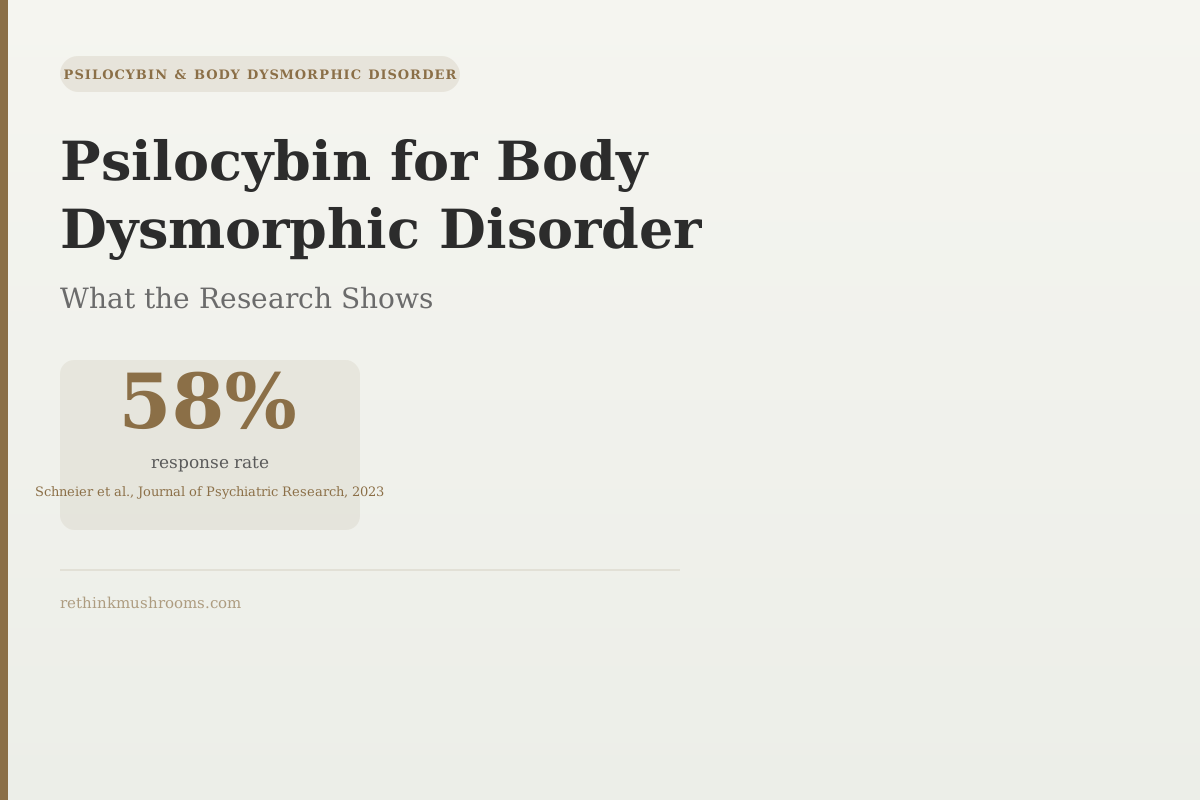
58% response rate
Seven of 12 adults with treatment-resistant body dysmorphic disorder showed clinically significant symptom reduction 12 weeks after a single 25mg psilocybin dose in a 2023 Columbia University pilot study.
Schneier et al., Journal of Psychiatric Research, 2023
12
SRI-resistant BDD patients in the pilot
25mg
single oral dose, no repeat sessions
2025
brain imaging study validated the neural mechanism
Schneier et al., Journal of Psychiatric Research, 2023
 View as image ↗
For most people, a glance in a mirror is unremarkable. For someone with body dysmorphic disorder, that same moment can collapse into hours: studying a perceived flaw, comparing, and despairing over something others often cannot see. Standard pharmaceutical treatments help many patients, but about a third fail to respond to even high-dose medication. That treatment gap is what brought researchers to psilocybin.
The first peer-reviewed psilocybin body dysmorphic disorder research, published in 2023 by a team at Columbia University, gave a single dose to 12 people who had already failed conventional treatment. Fifty-eight percent showed clinically meaningful improvement that held through the 12-week follow-up. A 2025 brain imaging study then captured, for the first time, exactly what changed in their brains when that happened.
This article covers both studies in depth, along with the earlier OCD research that made the BDD trial possible. For the broader context on how psilocybin affects anxiety-related conditions, see the research on psilocybin for cancer patients with existential anxiety.
Key Takeaways
- Schneier et al. (2023) gave a single 25mg psilocybin dose to 12 adults with SRI-resistant BDD; 7 of 12 (58%) showed a clinically significant response at 12 weeks
- BDD is classified as an OCD-related disorder in DSM-5, meaning the two conditions share the serotonergic brain circuitry that psilocybin targets
- Moreno et al. (2006) first showed psilocybin reduced symptoms in all 9 OCD patients tested; this OCD-spectrum finding provided the scientific rationale for studying psilocybin in BDD
- A 2025 pharmacological challenge study (19 adults with OCD, not randomized) found that a single 10mg psilocybin dose produced a moderate-to-large reduction in compulsive symptoms one week after dosing, though the effect faded over the following three weeks — evidence that OCD-spectrum research is advancing while still early-stage
- Zhu et al. (2025) found psilocybin increased communication between the brain's attention regulation network and its self-referential circuit in BDD patients; the degree of that connectivity change predicted how much patients improved at week 1
- All BDD psilocybin data comes from a single 12-person open-label pilot with no placebo group; randomized controlled trials have not yet been completed
What Body Dysmorphic Disorder Actually Is — and Why It Resists Treatment
Body dysmorphic disorder is a psychiatric condition defined by obsessive preoccupation with one or more perceived physical flaws. The preoccupation is not ordinary self-consciousness. People with BDD often spend three to eight hours each day performing behaviors tied to their perceived flaw: checking it in mirrors, seeking reassurance from others, researching surgical options, or avoiding situations where it might be noticed. The distress is severe. BDD is associated with high rates of major depression, social isolation, and suicidality.
One of its defining characteristics is resistance to reason. People with BDD typically know, on some level, that their concern may be disproportionate. That knowledge does not reduce the preoccupation. The flaw feels real, visible, and significant even in the face of contradictory evidence from others. This near-delusional quality is part of why cognitive-behavioral therapy, while effective for many patients, does not fully resolve symptoms in a substantial portion of cases.
The primary pharmaceutical treatment for BDD is a class of antidepressants called SRIs, or serotonin reuptake inhibitors. These include fluoxetine (Prozac), fluvoxamine (Luvox), and clomipramine. SRIs work by increasing the amount of serotonin available in the synapses between brain cells. Roughly 60 to 70 percent of BDD patients show some improvement on SRI treatment. For the remaining 30 to 40 percent, standard treatment provides inadequate relief. This SRI-resistant subgroup is who researchers have been enrolling in psilocybin studies.
For a detailed account of how SRI-resistant BDD patients came to the attention of psilocybin researchers, see Psilocybin for BDD: Why Researchers Are Interested.
Why OCD Research Came First — and Why That Matters for BDD
The psilocybin-for-BDD research program did not begin with BDD. It began, nearly two decades earlier, with obsessive-compulsive disorder.
In 2013, the fifth edition of the psychiatric diagnostic manual (DSM-5) moved body dysmorphic disorder into a category called "obsessive-compulsive and related disorders." This reclassification reflected decades of evidence that BDD and OCD share core features: intrusive unwanted thoughts, compulsive rituals performed to neutralize those thoughts, and partial response to serotonergic medications. The conditions are not identical, but they operate on overlapping brain circuits.
The brain circuit most implicated in both conditions is the self-referential system, most active when a person is thinking about themselves, ruminating, or mentally reviewing past events. Researchers call this the default mode network. In both OCD and BDD, this network runs chronically overactive. The brain gets stuck in loops: preoccupied thoughts arise, the person cannot redirect attention away from them, and the beliefs resist updating even when contradicted by direct experience. A 2023 systematic review of how psychedelics affect this self-referential network confirmed that psilocybin consistently disrupts its overactivity across multiple controlled studies.[2]
This is why SRIs help: they raise serotonin availability throughout the brain, partially calming the circuits that drive these loops. Psilocybin works differently. Rather than gradually increasing serotonin levels, it directly binds to and activates a specific serotonin receptor called 5-HT2A — and does so far more powerfully than serotonin itself. In plain terms: both SSRIs and psilocybin operate through the brain's serotonin system, but through different routes and at different speeds. That mechanistic overlap is the scientific reason BDD researchers followed the OCD literature so closely.
For more on how the 5-HT2A mechanism connects OCD-spectrum conditions to psilocybin research, see Psilocybin and 5-HT2A: The OCD Serotonin Connection.
In 2006, Moreno and colleagues ran the first clinical trial of psilocybin for an OCD-spectrum condition.[1] Nine OCD patients received varying doses of psilocybin across multiple sessions. Every participant showed some reduction in OCD symptoms under at least one dose condition, including doses that functioned as near-placebo levels. The trial was small and uncontrolled, but it established something important: psilocybin appeared to reach the compulsive thought loops that SSRIs were only partially addressing.
By 2025, OCD research had moved toward more rigorous designs. A pharmacological challenge study in 19 adults with OCD gave each participant a low 1mg dose and then a 10mg dose of psilocybin, with participants and raters blinded to the order. The 10mg dose produced a moderate-to-large reduction in compulsive symptoms one week after dosing (Cohen's d = 0.82), an effect that diminished over the following three weeks.[5] The study was small and not randomized, and it used no placebo — but it added controlled dose-comparison evidence to the OCD-spectrum literature. BDD research, meanwhile, was still in its first pilot phase.
See also: Psilocybin for OCD: Breaking the Loop
The Schneier 2023 Trial: 12 Patients, One Dose, Twelve Weeks of Follow-Up
The trial that produced the first BDD-specific psilocybin data was led by Franklin Schneier and colleagues at Columbia University and published in the Journal of Psychiatric Research in 2023.[3]
The study enrolled 12 adults with moderate-to-severe BDD who had already failed treatment with at least one SRI. It was a single-arm open-label design: all participants received the active treatment, and there was no placebo group. Each participant received one 25mg oral dose of psilocybin in a supervised clinical setting with trained psychological support. No additional doses were administered. The trial was registered at ClinicalTrials.gov under identifier NCT04656301.
The primary outcome measure was the BDD-Yale-Brown Obsessive Compulsive Scale, commonly abbreviated BDD-YBOCS. This is a validated clinical instrument that scores how much time per day a person spends on BDD-related thoughts and behaviors, how much those thoughts interfere with daily functioning, and how much distress they produce. Scores run from 0 to 48; higher scores indicate more severe symptoms. A response was defined as a 30 percent or greater reduction in total score.
Results at week 1: significant symptom reduction appeared across the group. Results at week 12: seven of the 12 participants (58%) still met the response criterion. No serious adverse events occurred during the study.
To put that 58% figure in context: in SRI clinical trials enrolling treatment-resistant BDD populations specifically, response rates tend to be substantially lower. If this effect size holds in a controlled trial, it would be clinically meaningful.
Two limitations must be stated directly. First, this was open-label with no placebo. Every participant knew they were receiving psilocybin. That knowledge, combined with intensive clinical attention and the expectation of improvement, can itself produce real and measurable symptom reductions. The trial cannot distinguish how much of the benefit came from psilocybin's pharmacology versus these contextual factors. Second, only one dose level was tested. Whether lower doses have any effect, or whether a different dose would produce better results, remains unknown.
What the 2025 Brain Scans Revealed: Who Improved and Why
Zhu and colleagues (2025) extended the Schneier trial by asking a different question: rather than measuring whether patients improved, they measured what changed in the brain when some patients improved more than others.[4]
The team used functional MRI — a brain scanning technique that tracks blood flow as a proxy for neural activity — to measure how different brain regions were communicating with each other before and after the psilocybin session in eight of the trial's participants. Three brain networks were the focus.
The Executive Control Network is the brain's attention regulation system. It handles the ability to direct focus toward relevant information and suppress irrelevant or distressing stimuli. In BDD, this system appears unable to reliably override the pull toward body-checking behavior.
The Default Mode Network is the self-referential circuit described earlier: the system most active when a person is thinking about themselves or ruminating. This is the network that runs chronically overactive in BDD and OCD.
The Salience Network acts as the brain's alarm signal, flagging which stimuli deserve attention and which do not. In anxiety and OCD-spectrum conditions, this system appears miscalibrated: it treats body-focused thoughts as urgent even when they are not.
After a single psilocybin dose, connectivity increased within the executive control network and between all three networks. The finding that predicted symptom improvement was specific: the degree to which communication between the attention regulation network and the self-referential circuit increased after psilocybin correlated with how much each patient's symptoms decreased at week 1. Patients whose attention regulation system became most tightly connected to their self-referential circuit showed the greatest symptom reduction.
This provides a mechanistic explanation that fits the clinical hypothesis directly. If BDD involves a self-referential circuit that generates intrusive body-focused thoughts, and an attention regulation system that cannot suppress them, then a treatment that improves coordination between those two systems should reduce symptoms. The Zhu 2025 data suggests that is exactly what occurred at the neural level.
The finding also points toward a potential biomarker: a measure of brain connectivity that, if validated in larger samples, could predict which patients will benefit from psilocybin before they undergo a full session.
For a deeper account of how psilocybin changes functional connectivity across conditions, see Functional Connectivity Changes Under Psilocybin: fMRI Evidence.
For the mechanistic question of how these changes may alter body image perception specifically, see How Psychedelics May Alter Body Image Perception.
The OCD-Spectrum Evidence Base, Study by Study
From OCD to BDD: Four Studies Behind the Psilocybin–BDD Hypothesis
Moreno et al. — J. Clinical Psychiatry (OCD)
Positive9 adults with OCD (open-label) · Escalating doses across sessions
All 9 participants showed acute OCD symptom reduction under at least one dose condition
First psilocybin trial in an OCD-spectrum condition; small and uncontrolled
Schneier et al. — J. Psychiatric Research (BDD)
Positive12 adults, SRI-resistant BDD (open-label pilot) · Single 25mg oral dose
7 of 12 (58%) responded at week 12; large effect (partial η² = 0.54); no serious adverse events
First BDD-specific psilocybin trial; no placebo control
Zhu et al. — Psychedelics (fMRI sub-study)
Positive8 of the pilot participants (imaging sub-study) · Single 25mg oral dose
Increased executive-control–to–default-mode connectivity after dosing predicted week-1 symptom improvement
Mechanism sub-study; n = 8, uncontrolled
Pellegrini et al. — Comprehensive Psychiatry (OCD)
Mixed19 adults with OCD (non-randomized challenge study) · 1mg then 10mg, order-blinded
10mg produced a moderate-to-large drop in compulsive symptoms at week 1 (d = 0.82); effect faded over 3 weeks
Not randomized, no placebo; transient effect — but adds dose-comparison data
Sources: Moreno et al. (2006); Schneier et al. (2023); Zhu et al. (2025); Pellegrini et al. (2025). All BDD data derives from a single 12-person open-label pilot.
What This Evidence Is — and What It Still Cannot Show
The BDD psilocybin research base as of 2025 consists of one 12-person open-label pilot and a brain imaging sub-study of eight of those participants. That is the entirety of the BDD-specific data.
A 12-person open-label trial is a feasibility and safety study. Its purpose is to establish whether the treatment can be safely administered, whether participants can tolerate the experience, and whether the effect is large enough to justify a larger controlled trial. The Schneier 2023 trial answered all three questions affirmatively. It was not designed to prove that psilocybin works for BDD. That question requires a randomized controlled trial with a placebo arm, a larger sample, and longer follow-up.
Several specific unknowns remain.
The dose question is unresolved. Twenty-five milligrams was chosen based on doses used in depression trials. Whether this is optimal for BDD, whether lower doses have any measurable effect, and whether the response differs by patient severity has not been established.
The duration of benefit beyond 12 weeks is unknown. The Schneier trial stopped measuring at 12 weeks. Whether improvements persist at 6 months or one year, and whether repeat sessions are needed to sustain them, has not been studied in BDD.
The question of who responds is only partially answered. The Zhu 2025 imaging data identified ECN-DMN connectivity change as a predictor of early response, but this is a preliminary finding from just eight imaged participants that requires replication in an independent sample. No reliable clinical profile of the BDD patient likely to respond has been established.
The relationship between psilocybin's pharmacology and the surrounding therapeutic context is also unresolved. Psilocybin trials involve intensive preparation and integration sessions. Whether the drug effect is separable from the effect of intensive clinical support is an active methodological question across the field.
A 2024 systematic review of psychedelic efficacy and safety across psychiatric conditions found that the evidence base is growing in volume and methodological rigor, while noting that most existing studies remain small and lack placebo controls.[6] The BDD literature sits at the earliest point on that maturation curve.
Clinical availability for BDD, if Phase 2 data ultimately supports it, is realistically years away. Psilocybin remains a Schedule I controlled substance in the United States. No regulatory pathway for BDD psilocybin treatment is currently established.
For the parallel story in anorexia nervosa research — which uses the same dose and reports similar improvements in cognitive flexibility and body image distress — see Psilocybin and Eating Disorders: The BDD-Anorexia Connection. For a comprehensive cross-condition summary of all three psilocybin body image studies, see Psilocybin and Body Image: Preliminary Research on Dysmorphic Disorders.
The Bottom Line
The psilocybin BDD research base consists of one 12-person open-label pilot showing a 58% response rate at 12 weeks, and a 2025 brain imaging sub-study identifying the neural connectivity changes that predicted that response in eight of those patients. Both draw on the same small pilot cohort. The broader OCD-spectrum literature — including a 2025 dose-comparison study in OCD — supports the pharmacological rationale for studying psilocybin in BDD. Phase 2 randomized controlled trials are the necessary next step before any conclusions about efficacy can be drawn.
Frequently Asked Questions
Sources & References
- 1RTHM-00195·Moreno, Francisco A et al. (2006). “Safety, tolerability, and efficacy of psilocybin in 9 patients with obsessive-compulsive disorder..” The Journal of clinical psychiatry.Study breakdown →PubMed →↩
- 2RTHM-01697·Gattuso, James J et al. (2023). “Default Mode Network Modulation by Psychedelics: A Systematic Review..” The international journal of neuropsychopharmacology.Study breakdown →PubMed →↩
- 3RTHM-01783·Schneier, Franklin R et al. (2023). “Pilot study of single-dose psilocybin for serotonin reuptake inhibitor-resistant body dysmorphic disorder..” Journal of psychiatric research.Study breakdown →PubMed →↩
- 4RTHM-02220·Zhu, Xi et al. (2025). “Single-dose psilocybin alters resting state functional networks in patients with body dysmorphic disorder..” Psychedelics.Study breakdown →PubMed →↩
- 5RTHM-02161·Pellegrini, Luca et al. (2025). “Single-dose (10 mg) psilocybin reduces symptoms in adults with obsessive-compulsive disorder: A pharmacological challenge study..” Comprehensive psychiatry.Study breakdown →PubMed →↩
- 6RTHM-02028·Yao, Yuan et al. (2024). “Efficacy and safety of psychedelics for the treatment of mental disorders: A systematic review and meta-analysis..” Psychiatry research.Study breakdown →PubMed →↩